What is RFID technology in retail? RFID technology in retail uses radio-frequency tags and readers to identify individual products without requiring direct line of sight. It enables retailers to automate inventory counting, checkout, replenishment, item tracking, and selected loss-prevention workflows.
What RFID Means on a Retail Floor
The useful part of RFID is not the tag itself. It is the fact that a retailer can give an individual product a digital identity and then capture that identity automatically.
GS1 describes retail RFID applications in which item-level EPC/RFID data can be captured during goods receiving, used for store inventory, connected with replenishment, and incorporated into point-of-sale and electronic article surveillance workflows.
For apparel, imagine a rack holding 40 garments.
With conventional barcode scanning, an employee generally needs to expose each barcode to an optical scanner. With UHF RFID, the reader can interrogate multiple tagged products within its RF field.
That difference becomes particularly noticeable during inventory counting.
A 2010 field study conducted across 62 retail stores found that RFID-enabled automatic inventory adjustment reduced inventory record inaccuracy by approximately 26%. The study was published by Auburn University’s RFID Lab and later in Production and Operations Management.
That number should not be interpreted as a universal RFID accuracy guarantee. The study measured a particular retail process under defined conditions. But it is useful evidence that RFID can change the economics of store inventory work.
How RFID Technology Works in Retail
A typical retail RFID workflow contains four practical layers:
Layer
Retail Component
Purpose
Product identity
RFID tag
Stores the electronic product identifier
RF identification
RFID reader + antenna
Detects and communicates with tags
Processing
RFID software / middleware
Filters and interprets read events
Business system
POS / ERP / WMS
Updates inventory and transactions
The reader does not independently “know” that a garment has been sold.
It receives an electronic identifier.
The retail application decides what that identifier means.
For example:
RFID tag detected → product identified → POS transaction confirmed → inventory updated → tag status changed
That distinction is important when designing a retail system. A reader can produce excellent RF data while the overall retail workflow still performs poorly if product master data, POS integration, or transaction logic is weak.
GS1’s architecture similarly separates RFID capture from application-level processing and EPCIS event information.
RFID in Apparel Retail
Apparel is one of the strongest applications because each garment can carry an individual electronic identity.
A tag can associate:
SKU
Size
Color
Product identifier
Store location
Receiving event
Sales status
Return information
This makes several operations possible.
Faster Inventory Counting
Employees can use handheld RFID readers to count merchandise across racks and stockrooms without manually scanning every visible barcode.
GS1 reports that EPC/RFID can support inventory accuracy approaching 95% in apparel and omnichannel retail applications, while its retail research has documented much higher accuracy in some individual implementations.
Better Stock Visibility
A product can be identified when it arrives, moved to the sales floor, included in an inventory count, sold, or returned.
This creates a much richer product history than a simple barcode scan at checkout.
Replenishment
If the system knows that a particular size or style is physically present in the stockroom but missing from the sales floor, staff can receive a replenishment task.
That is particularly useful in fashion retail, where the difference between “in stock” and “available to sell” can be surprisingly large.
RFID at the Retail Checkout
This is where RFID moves beyond inventory management.
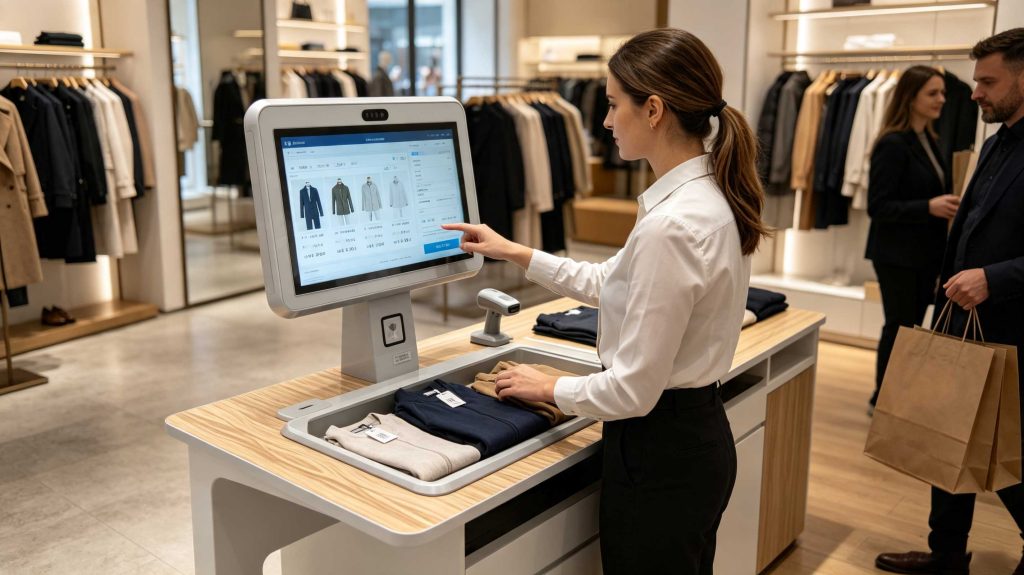
A retail checkout station can combine:
21.5-inch capacitive touchscreen
RFID identification area
Card authentication
Optional QR/barcode scanner
Optional facial-recognition module
POS software
Network communication
Instead of having a cashier manually register every garment, the RFID identification area can capture multiple tagged products placed within the designated reading zone.
The screen can then display the transaction information for confirmation and payment.
For a clothing retailer, this creates a compact workstation for:
A retail workstation should not simply be accessible to anyone standing behind the counter. Card-based identity verification or another configured access mechanism can associate the transaction with an authorized employee.
That produces a useful audit trail:
Employee → workstation → transaction → products → time
Why Retailers Combine RFID With Barcode
RFID does not make barcode technology obsolete.
A well-designed retail counter may use both.
RFID
Barcode / QR
Bulk product identification
Individual item scanning
Non-line-of-sight reading
Optical identification
Fast apparel checkout
Backup identification
Inventory counting
Product lookup
Automated item recognition
Printed customer-facing code
The hybrid approach is often more practical than forcing every workflow into RFID.
For example, a garment can carry both a conventional barcode and an RFID inlay. The barcode remains useful for customers and manual exceptions; RFID handles high-volume automated identification.
Field Evidence: Why Retail RFID Gets Attention
GS1 reported research involving ten global retailers and brands in which RFID-enabled inventory accuracy reached 93–99% among reported implementations, with inventory accuracy improving by more than 50% in the study population.
A separate Auburn RFID Lab field experiment provides another useful benchmark: approximately 26% lower inventory record inaccuracy after RFID-enabled automatic adjustment.
These figures are more useful than quoting an impressive reader specification without context.
They show where RFID can create operational value: when individual product identification is connected to the actual retail workflow.
Practical Retail Deployment Considerations
Before installing an RFID checkout or inventory system, I would validate the physical environment first.
Product factors
Garment material
Tag position
Tag orientation
Product density
Metal accessories
Liquid-containing products
Packaging
Checkout factors
Reader-to-tag distance
Reading-zone dimensions
Antenna placement
Customer movement
Cashier position
Payment terminal location
Nearby RFID readers
Software factors
POS integration
Employee authentication
Inventory synchronization
Duplicate-read filtering
Transaction logging
Exception handling
Tag-status management
A retail RFID system should be tested with real products, real staff movements and real transaction sequences.
A clean laboratory test can look excellent. Then someone places a metal shopping basket beside the reader and the behavior changes.
That is the kind of detail that determines whether an RFID retail deployment is genuinely production-ready.
Suggested Long-Tail Keywords
For the next section, the strongest supporting search terms around the topic are:
RFID retail technology
RFID inventory management
RFID retail checkout
RFID apparel tracking
These terms naturally extend the main question without turning the page into keyword repetition.
UHF RFID enables retailers to identify multiple tagged garments and improve real-time inventory visibility.
Cykeo RFID Retail Technical Advantages
In retail, RFID creates value when the reader, tag, checkout software and store workflow are designed as one system.
For apparel stores, this matters because the same RFID identity can follow a garment through receiving → stockroom → sales floor → checkout → sale → inventory update.
GS1 specifically identifies retail RFID applications for goods receiving, inventory visibility, replenishment, automated checkout and electronic article surveillance.
Multi-Item Identification
A conventional barcode checkout typically requires the operator to present each barcode to the scanner.
UHF RFID changes the interaction.
Multiple tagged garments can be placed inside the defined RFID reading area, allowing the reader to identify them without requiring the cashier to locate each printed barcode.
This is particularly useful for:
Apparel checkout
Store inventory counting
Backroom receiving
Return processing
Stock replenishment
Self-checkout
Item-level loss prevention
Auburn University’s RFID Lab reported a field experiment involving 62 retail stores in which RFID-enabled automatic inventory adjustment reduced inventory record inaccuracy by approximately 26%.
That is a useful operational benchmark—not a promise that every RFID installation will produce the same result.
The difference comes from deployment quality.
RFID Smart Retail System Architecture
A practical Cykeo retail RFID system can be divided into five layers.
The important point is that the RFID reader does not determine whether an item has been sold.
It detects the tag.
The retail application determines what that detection means.
A typical transaction can therefore look like:
RFID Tag → Reader → Tag Filtering → Product Database → POS → Payment → Inventory Update
GS1’s architecture similarly describes RFID readers providing captured EPC data to application-level software and EPCIS event data being used to document item availability and subsequent sales.
This separation becomes critical when a store has several RFID readers operating nearby.
Without proper filtering, the same garment could be detected repeatedly.
The software needs to distinguish between:
Product detected
Product presented for checkout
Product sold
Product returned
Product removed from the store
Product moved between inventory locations
RFID produces observations. Retail software creates meaning from those observations.
RFID Checkout Platform Deep Dive
The integrated retail checkout platform described for Cykeo applications is designed around a compact cashier workstation.
The core configuration can include:
21.5-inch capacitive touchscreen
Integrated RFID identification area
Card authentication area
Network communication
POS software integration
Optional QR/barcode scanner
Optional facial-recognition module
The physical integration matters.
A cashier does not need to move between several independent devices simply to identify merchandise, authenticate their account and complete a transaction.
Typical Apparel Checkout Workflow
1. Employee authentication
The cashier verifies identity using the configured authentication method.
2. Product placement
Several RFID-tagged garments are placed in the designated reading area.
3. RFID identification
The reader captures the electronic identities of the garments.
4. Product lookup
The software associates each RFID identifier with SKU, size, color and price information.
5. Transaction confirmation
The 21.5-inch touchscreen displays the products and transaction information.
6. Payment
The customer completes payment through the configured payment process.
7. Inventory update
The POS system records the sale and updates inventory.
This eliminates a large amount of repetitive manual registration.
It also creates a more useful audit trail:
Authorized employee → workstation → products → transaction → time
That is valuable in stores where several employees share checkout responsibilities.
Why Employee Authentication Matters
Retail checkout is not only about speed.
It is also about accountability.
A workstation that identifies the operator before allowing transactions can associate activities with a specific authorized user.
This supports:
Employee access control
Transaction traceability
Shift management
Exception investigation
Operational auditing
For larger retail chains, this information can be connected with centralized systems through network communication.
The RFID layer identifies the merchandise.
The authentication layer identifies the operator.
The POS layer records the commercial event.
Those three identities should not be treated as separate islands.
RFID vs Barcode in Retail
RFID and barcode technology can coexist very effectively.
Capability
RFID
Barcode / QR
Multiple products
Excellent
Usually individual scanning
Line of sight
Not normally required
Required
Apparel inventory
Strong
Good
Fast checkout
Strong
Moderate
Manual exception handling
Moderate
Excellent
Printing cost
Higher system cost
Low
Mobile-phone interaction
Limited
Excellent
Item-level automated events
Strong
More limited
GS1 notes that EPC/RFID can support near-real-time inventory visibility and inventory accuracy approaching 95% in apparel applications.
The better architecture is often RFID + barcode, rather than RFID replacing everything.
A garment can retain its visible barcode for customers and staff while its RFID inlay supports automated identification.
That gives the retailer two identification paths.
RFID vs NFC for Retail
RFID and NFC are sometimes discussed as though they are interchangeable. They are not.
NFC operates at 13.56 MHz and is designed for very short-range communication; the NFC Forum describes a typical range of up to around 2 cm.
UHF RFID, by contrast, is designed for applications where products may need to be identified from substantially greater distances and where multiple tags may be captured.
Retail Requirement
UHF RFID
NFC
Bulk apparel inventory
Excellent
Poor fit
RFID checkout zone
Excellent
Limited
Shelf inventory
Excellent
Poor fit
Smartphone tap interaction
Limited
Excellent
Product authentication by tap
Possible
Excellent
Long-range identification
Strong
Not intended
For mass inventory and checkout, UHF RFID is usually the more natural choice.
For a customer tapping a phone against a product to open digital information, NFC can be the better technology.
Industry Application Cases
1. Apparel Stores
This is the most direct application for the integrated Cykeo retail equipment.
RFID can connect:
Garment → Inventory → Checkout → Sale
A store can use handheld readers for stocktaking while the fixed RFID checkout platform handles transactions.
That avoids forcing one reader type to perform every task.
GS1’s apparel research reports RFID inventory accuracy of up to 95% and identifies improvements in item availability and cycle-count efficiency.
2. Chain Stores
For a multi-store retailer, centralized RFID data can provide visibility across locations.
A typical architecture is:
Store RFID Reader → Store POS → Network → Central Retail Platform
Management can then compare:
Store inventory
Sales
Returns
Stock discrepancies
Product movement
Replenishment requirements
The value increases as the number of locations increases because manual inventory reporting becomes increasingly expensive.
3. Self-Service Retail
RFID also supports unattended or semi-unattended checkout.
A customer places several tagged products into the designated reading zone.
The system identifies the products and presents the transaction on the touchscreen.
This can support:
Self-checkout
Unattended retail
Smart stores
Campus shops
Employee stores
Convenience retail
The technology is especially useful when several products need to be identified at once.
4. Inventory and Backroom Operations
The same RFID infrastructure can be used away from the checkout counter.
Retail employees can perform rapid stock checks using handheld RFID equipment while fixed readers handle controlled reading points.
This creates a useful division:
Fixed reader = automated event
Handheld reader = flexible investigation
That distinction is often overlooked during system planning.
RFID Deployment Strategy
Start With the Product
Before selecting the reader, test the actual products.
Measure:
Tag location
Garment material
Product density
Folding method
Metal accessories
Packaging
Reading orientation
A reader that performs perfectly with ten isolated tags may behave differently when 40 folded garments are stacked together.
Then Define the Reading Zone
For a checkout platform, the reading zone should be physically controlled.
The objective is not simply:
“Read as far as possible.”
The better objective is:
Read the intended products while minimizing unintended reads.
This is why antenna geometry, RF power, shielding, reader sensitivity and software filtering all matter.
Validate Real Transactions
A proper pilot should reproduce actual store behavior:
Employee login
Product placement
Multiple-tag reading
Product confirmation
Payment
Sale completion
Inventory update
Return
Exception handling
Do not validate only the RF reading rate.
Validate the complete transaction.
An integrated RFID checkout workstation can identify multiple apparel items while connecting employee authentication, payment, and POS operations.
FAQ
1. Can RFID identify several clothing items at once?
Yes. UHF RFID supports multi-tag identification, making it suitable for apparel inventory and checkout workflows where several tagged products are presented together.
2. Can RFID replace barcode scanners in clothing stores?
It can replace barcode scanning for selected workflows, particularly bulk identification. However, keeping barcode or QR scanning as a backup is often more practical.
3. Does RFID require the cashier to scan every garment?
No. A properly configured UHF RFID checkout zone can identify multiple tagged garments without the cashier manually presenting each barcode.
4. Can an RFID checkout system connect to POS software?
Yes. The RFID reader normally operates as an identification layer, while application software associates tag IDs with product information and sends transaction information to the POS or retail database.
5. Why is employee authentication useful?
It associates checkout activity with an authorized operator. Card authentication, and where appropriate other configured identification methods, can improve access control and transaction traceability.
6. Can RFID be used for loss prevention?
Yes. GS1 describes RFID-enabled electronic article surveillance workflows in which RFID readers at store exits can check whether merchandise has been marked as sold.
7. Should a retailer use RFID and barcode together?
In many deployments, yes. RFID provides automated item identification while barcode and QR codes remain convenient for manual scanning, customer interaction and exception handling.
SEO Ending
What is RFID technology in retail? It is more than a wireless replacement for barcode scanning. Properly deployed, RFID connects product identity with inventory, checkout, employee authentication and store operations.
For apparel retailers, the strongest architecture is usually the one that combines RFID identification, POS integration, controlled reading zones and practical employee workflows.
Cykeo approaches retail RFID from that system perspective: the tag, reader, touchscreen checkout platform, authentication method and software interface must work together at the counter and on the sales floor.
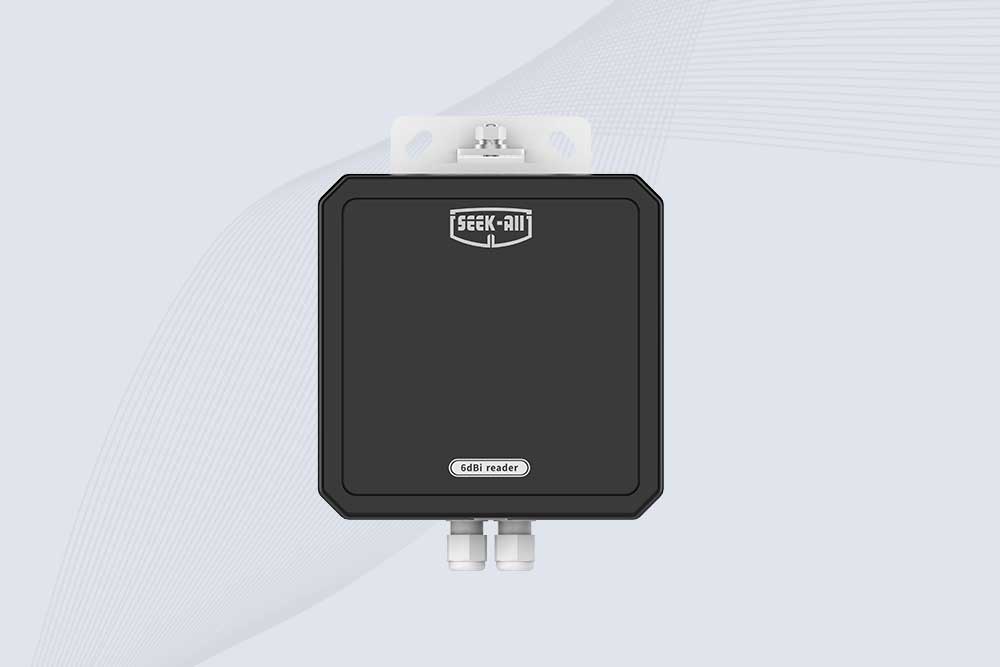
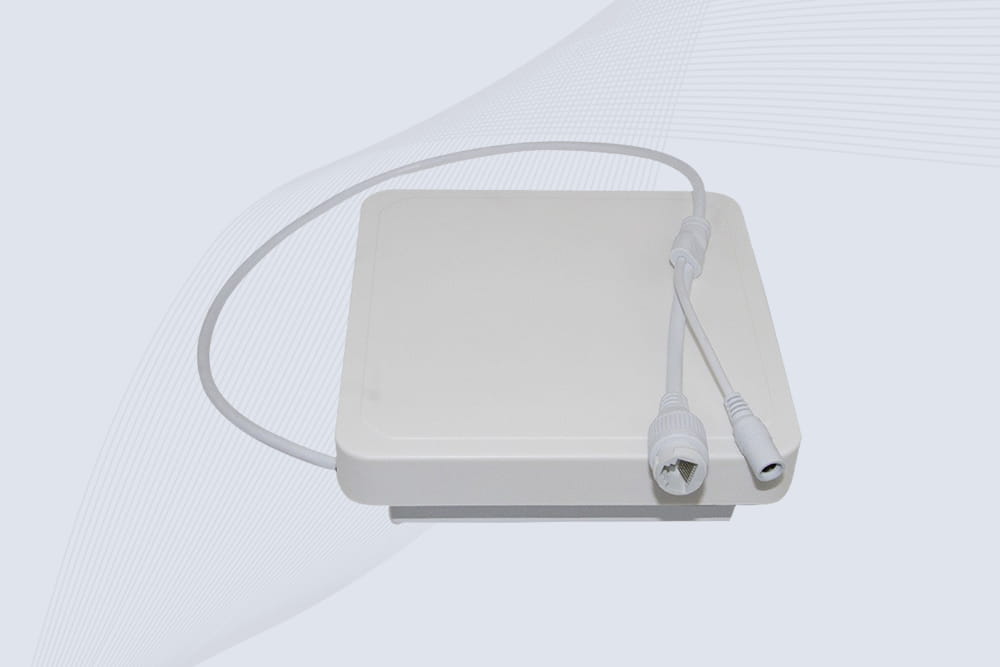
SSD-RA06L is an industrial UHF RFID reader with a built-in 6 dBi antenna, 3 m read range, 600+ tags/s, Ethernet, RS232, and optional Wi-Fi, 4G, and PoE.
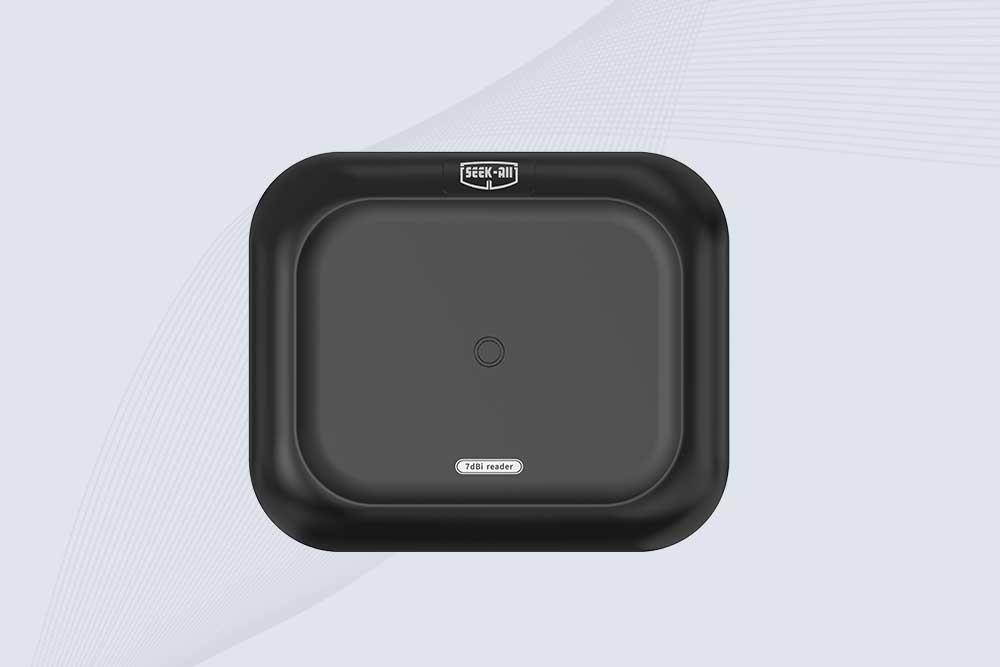
SSD-RA07L industrial UHF RFID reader with integrated 7 dBi antenna, up to 6 m reading distance, over 600 tags/s, Ethernet, RS232, and optional Wi-Fi, 4G, and PoE.
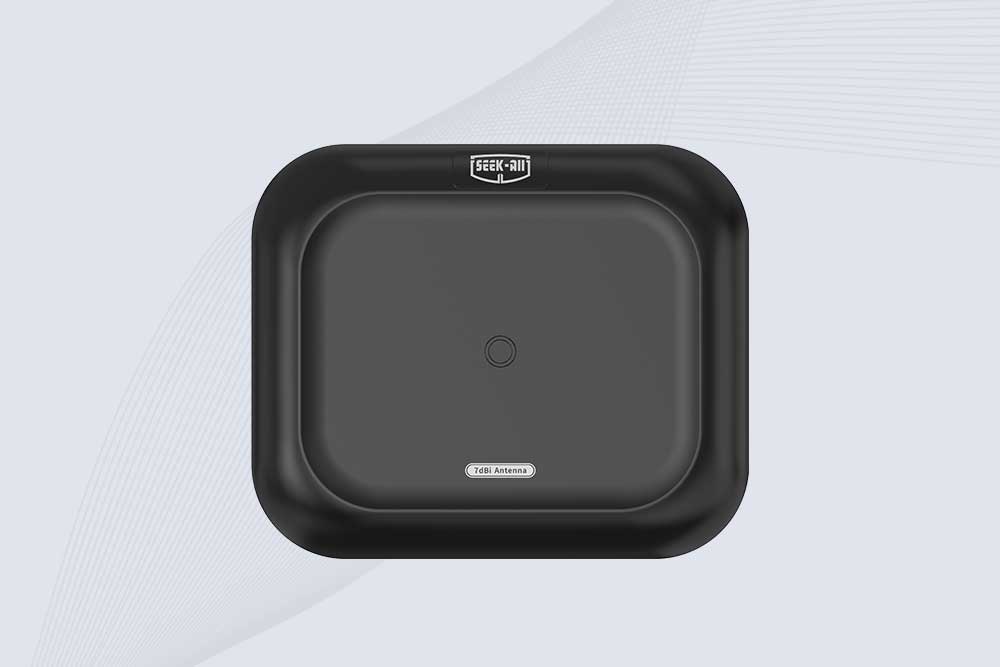
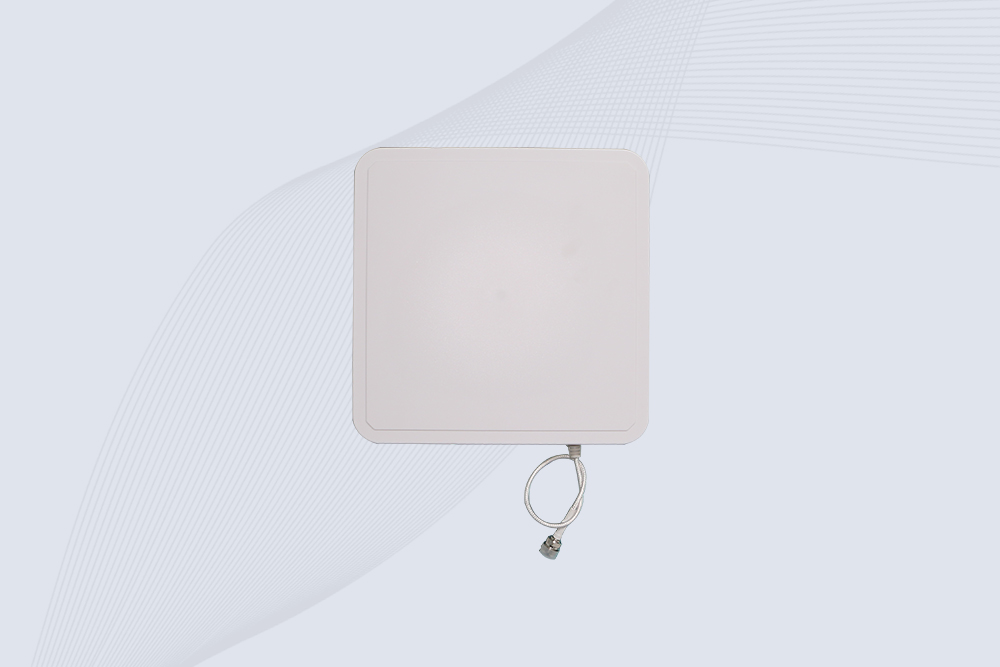
Explore the SSD-A07 UHF RFID antenna with 7 dBi gain, circular polarization, adjustable 840–960 MHz frequency, and 60°/75° beamwidth for stable RFID read/write performance.
SSD-A06 UHF RFID antenna with circular polarization, adjustable 840–960 MHz frequency, ≥4.5 dBi gain, and a compact directional design for RFID systems.
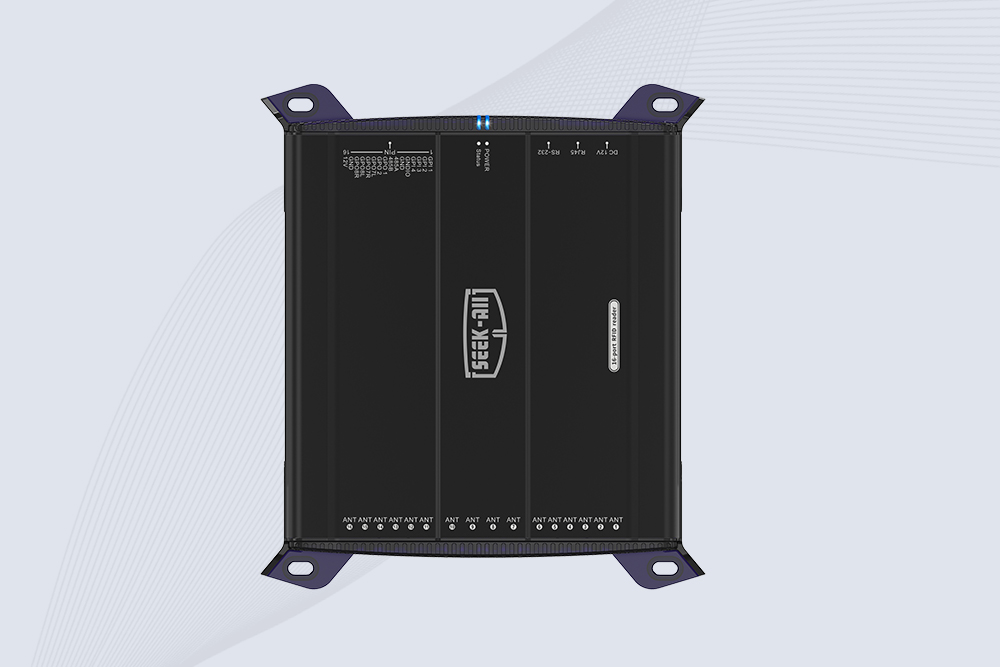
SSD-R16L Multi-Channel RFID Infrastructure for Automated Inventory Management ✔️ 16-Port High-Density RFID Reading Equipped with 16 SMA antenna ports, SSD-R16L supports multi-antenna deployment for warehouses, retail stores, logistics, production lines, and large-area RFID identification. ✔️ High-Speed & Long-Range Performance With up to 33…
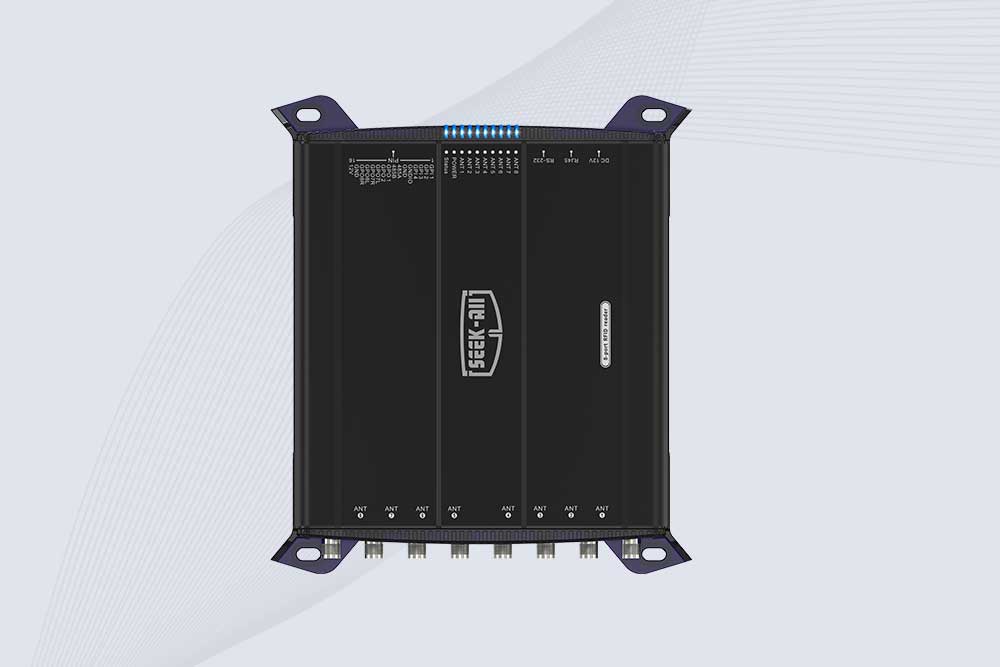
SSD-R8L 8-port UHF RFID reader with 33dBm output, up to 20m reading range and 600+ tags/s recognition. Ideal for warehouse, logistics, retail and asset tracking.
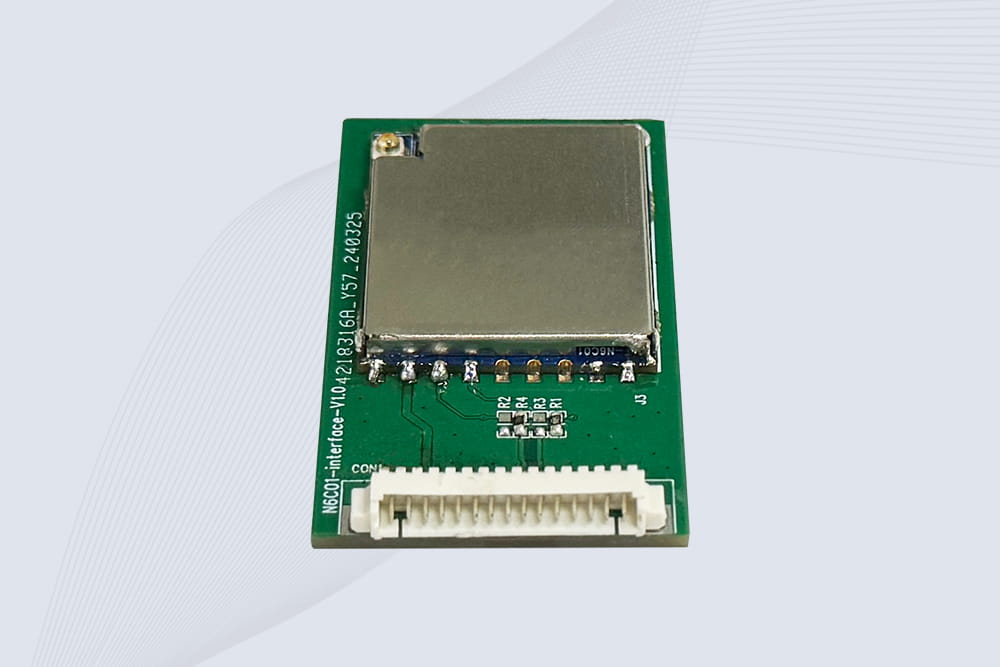
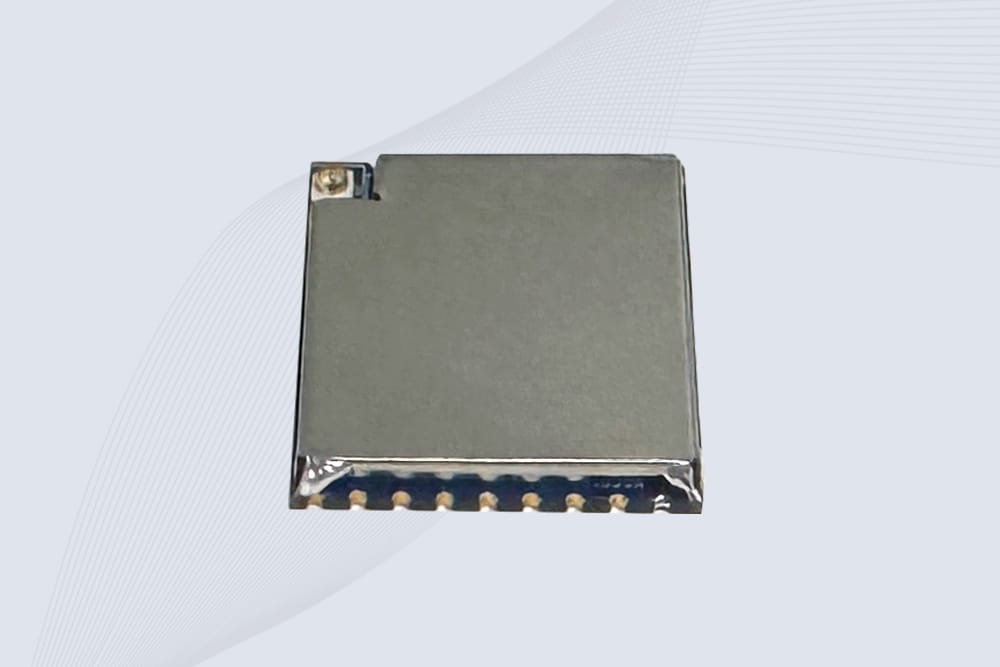
CYKEO Embedded RFID Modules are designed for compact industrial and IoT devices that require stable UHF performance. These UHF RFID Modules support global protocols, flexible power control, and reliable multi-tag reading for smart cabinets, production lines, and asset tracking systems.
CYKEO Embedded RFID Module is built for compact IoT and industrial devices that need stable UHF performance. This UHF module supports global protocols, low power operation, and reliable multi-tag reading for smart lockers, production lines, and always-on RFID systems.
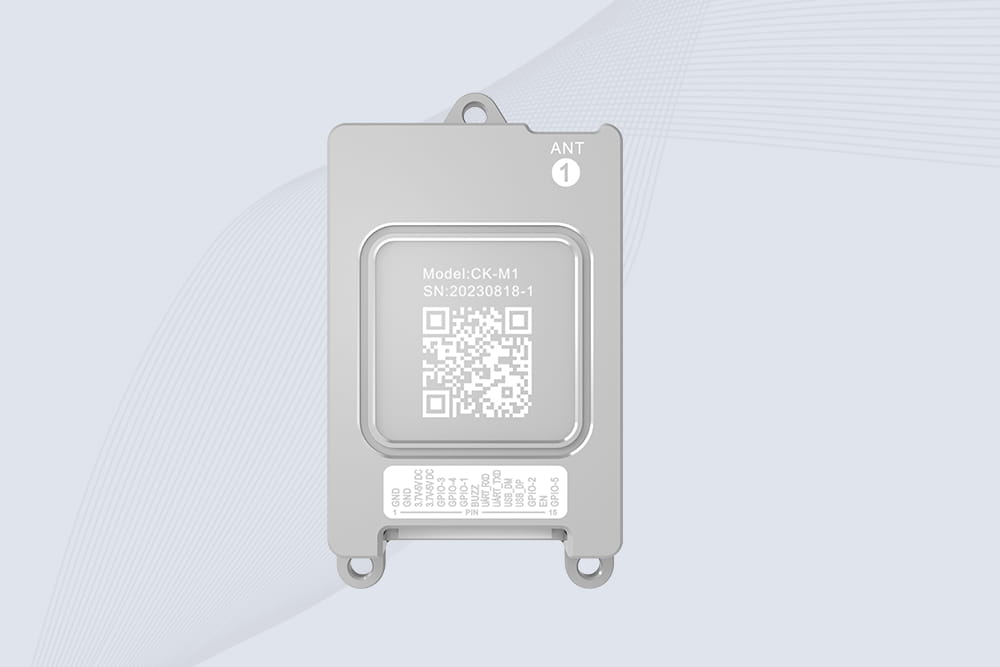
CYKEO CYKEO-M1 drone rfid module is a compact UHF RFID reader module designed for drones and UAV platforms. It supports long-range aerial scanning, fast multi-tag reading, and stable performance in wind, vibration, and outdoor environments.
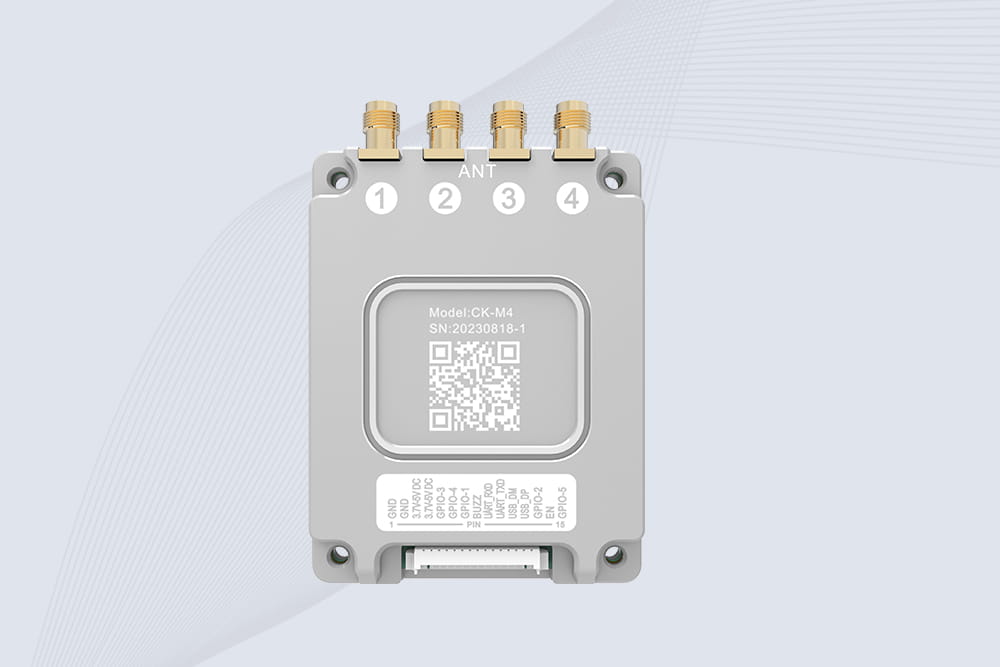
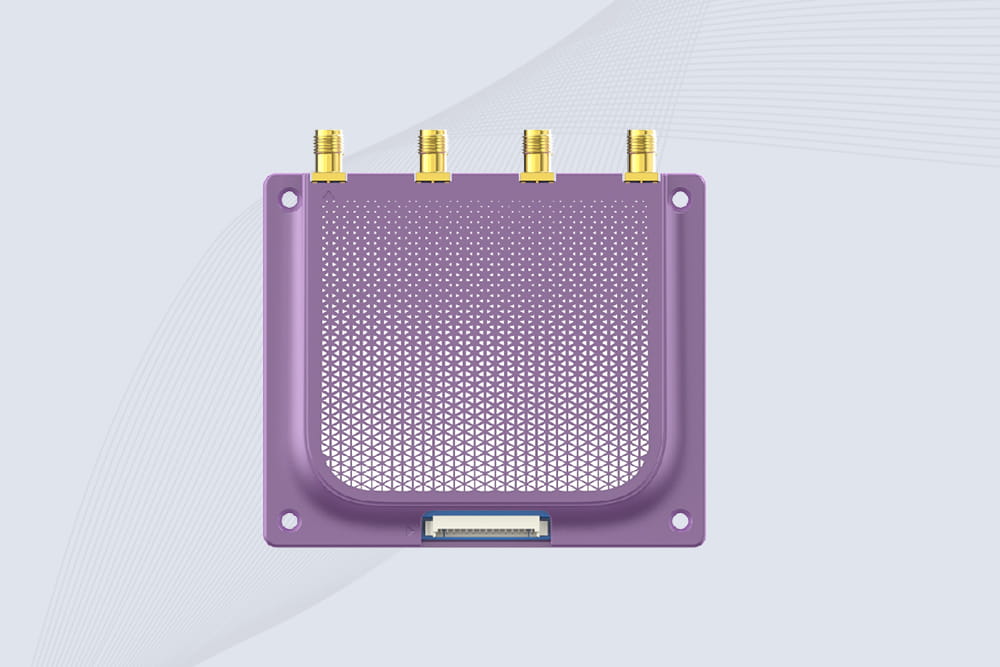
CYKEO CYKEO-M4 RC522 RFID Module is an industrial-grade UHF RFID reader with 4 ports, supporting ISO, EPC, and GB protocols. High-speed, accurate reading for IoT, automation, and warehouse applications.
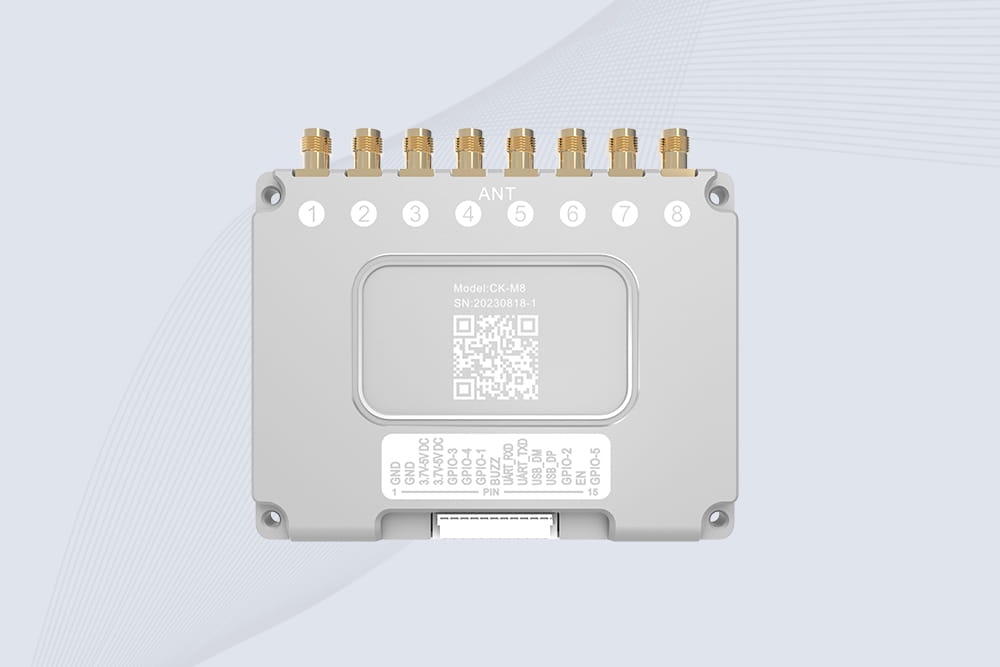
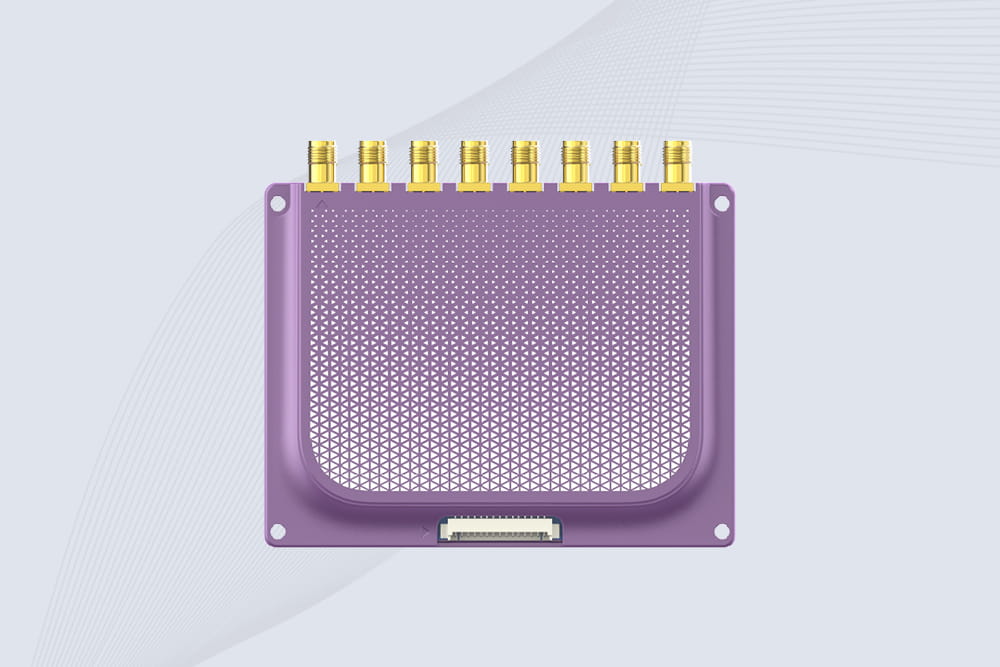
CYKEO CYKEO-M8 Module RFID is an 8-port UHF R2000 RFID Module designed for high-density, multi-tag environments. Stable 33dBm output, ISO & GB protocol support, ideal for warehouses, factories, and automated systems.
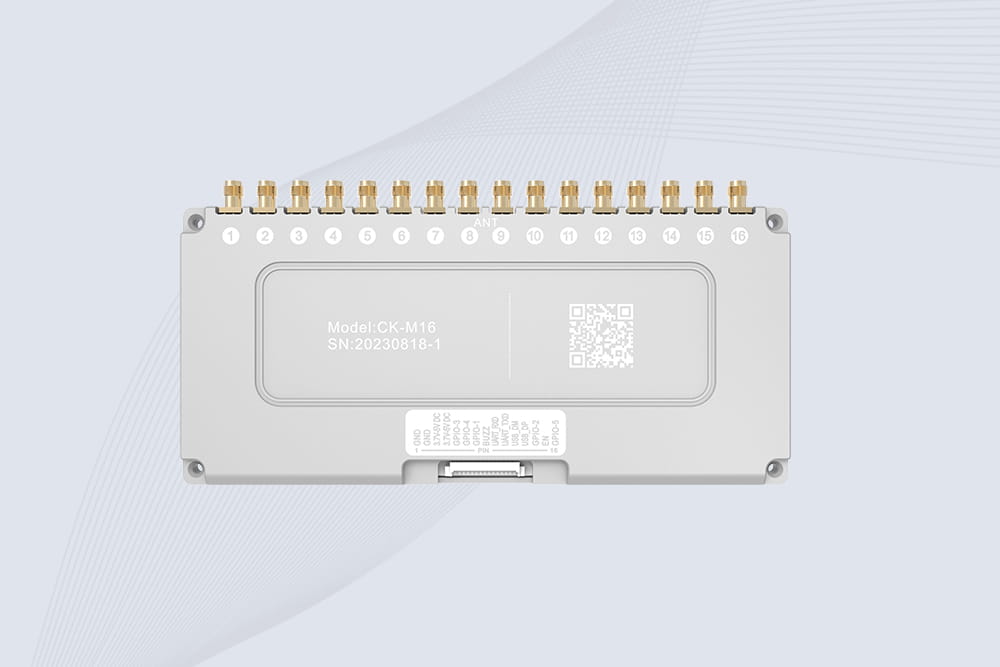
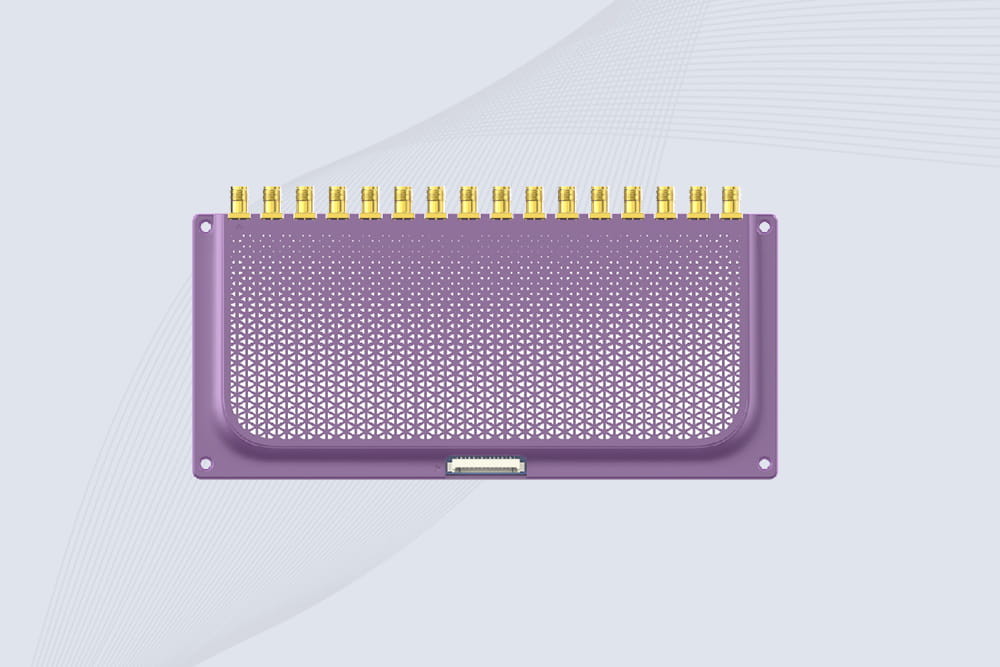
CYKEO CYKEO-M16 RFID Module is a 16-port UHF RFID reader module based on the R2000 chipset. Designed for dense tag environments, it supports ISO and GB standards and delivers stable multi-antenna control for industrial automation.
The CYKEO CYKEO-M16L RFID Reader Module is a 16-channel UHF RFID core designed for dense tag environments. With adjustable 33dBm output, multi-protocol support, and stable multi-antenna control, this RFID Tag Reader Module fits industrial automation, warehouse systems, and large-scale IoT deployments.
CYKEO CYKEO-M8L module RFID is a compact industrial UHF module built for dense tag and multi-antenna environments. With 8 RF ports, adjustable 33 dBm output, and ISO & GB protocol support, it is widely used in factories, warehouses, and automated tracking systems.
CYKEOCYKEO-M4L UHF RFID Module is a compact 4-channel RFID tag reader module designed for dense tag environments. Supporting ISO and GB protocols, it delivers stable reads up to 10 meters for industrial and IoT systems.
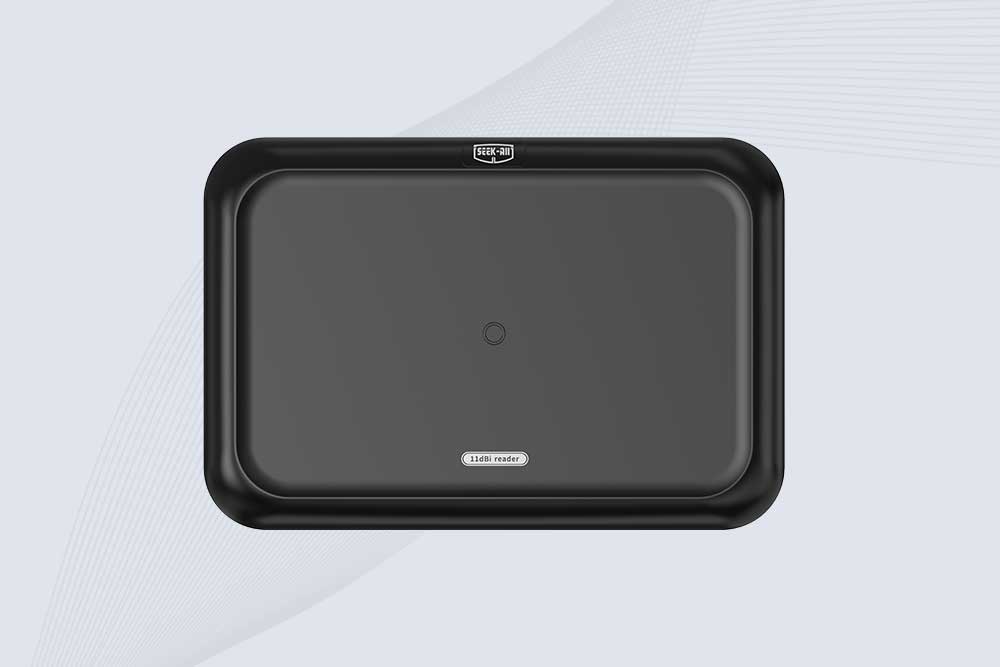
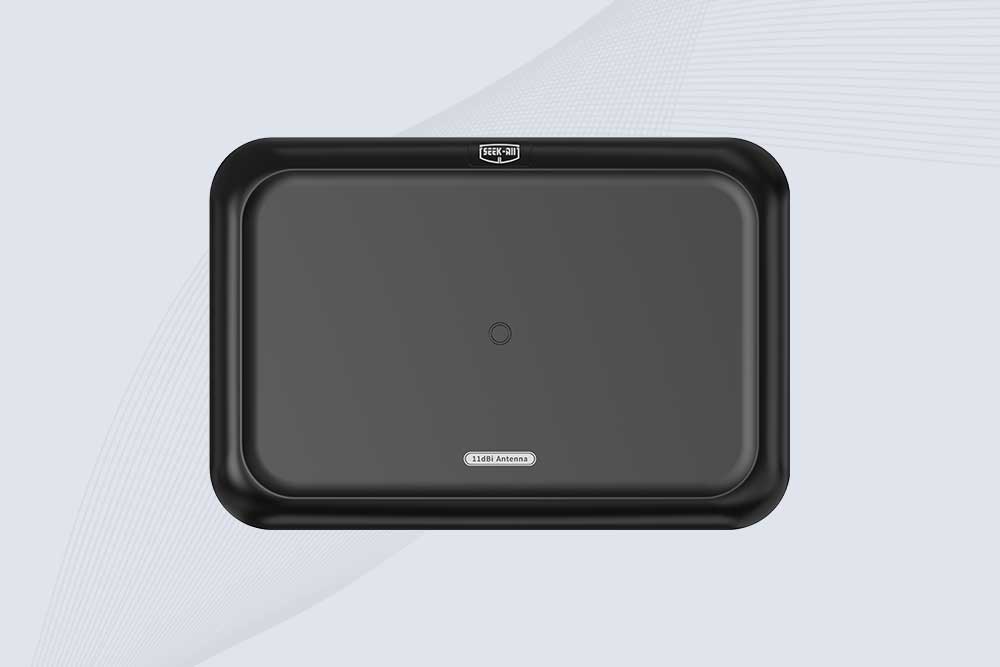
Cykeo CYKEO-A11 UHF RFID reader antenna delivers 11dBi gain, 840-960MHz frequency range, and IP65 ruggedness for retail, logistics, and industrial RFID systems. Features low VSWR and easy installation.
CYKEO Antenna RFID Reader delivers stable long-range UHF performance with a 10.5dBi directional design, built for warehouses, conveyor portals, and industrial RFID systems. This rfid reader antenna provides 20m+ read distance and rugged IP67 protection.
Cykeo CYKEO-A5B industrial Linear RFID Antenna delivers 5dBi gain, ≤1.5:1 VSWR, and IP65 rugged design for warehouse, production line, and logistics UHF systems.
Cykeo’s CYKEO-B12 Long Range RFID Antenna delivers 15m+ read range with 12dBi gain, IP65 rugged design, and global 840-960MHz UHF support. Ideal for warehouse/logistics asset tracking.
Cykeo CYKEO-B10 Long Distance RFID Antenna offers 10dBi gain, 840-960MHz frequency range, IP65 rating, and 20m+ coverage for logistics/warehousing/ETC systems. Low VSWR ensures stable signal transmission.
Cykeo CYKEO-A6 UHF RFID panel antenna features 6dBi gain, 840-960MHz broadband, IP65 metal-ready housing for logistics/smart retail. 18mm ultra-thin design with tool-free mounting.
Cykeo CK-A3 industrial antenna RFID UHF offers 5m+ tag detection, ≤1.3:1 VSWR, IP65 rugged design, and global UHF spectrum compatibility (840-960MHz) for warehouses, factories, and retail.
Cykeo CYKEO-B5 directional RFID antenna provides 5dBi gain with 60° narrow beamwidth for precise inventory tracking. IP65-rated, global UHF frequency support, and low VSWR.
Create your own high-performance DIY RFID antenna! 5dBi gain, 840-960MHz tunable, step-by-step guides. Compatible with Arduino, Raspberry Pi, and commercial UHF readers.
Cykeo CYKEO-A7 Flexible RFID Antenna features 840-960MHz wideband tuning, 7dBi gain, and IP68 rating for medical/retail/industrial curved surface deployments. 98% read accuracy with peel-and-stick installation.
Cykeo CYKEO-B5A industrial Passive RFID Antenna delivers 5dBi gain, 70° beamwidth, and -40°C~55°C operation for warehouses/smart cabinets. Compatible with Zebra/Impinj readers.
Cykeo’s CYKEO-A9B High Gain RFID Antenna delivers 15m+ read range with 9dBi amplification. Features IP54 rugged design, 840-960MHz bandwidth, and 80° beamwidth for warehouse/manufacturing RFID systems.
Cykeo’s enterprise-grade 8dbi Impinj RFID Antenna 10m+ read range with 840-960MHz tuning. Features IP65 housing, 1.4 VSWR, 35° beamwidth for retail/warehouse RFID systems.
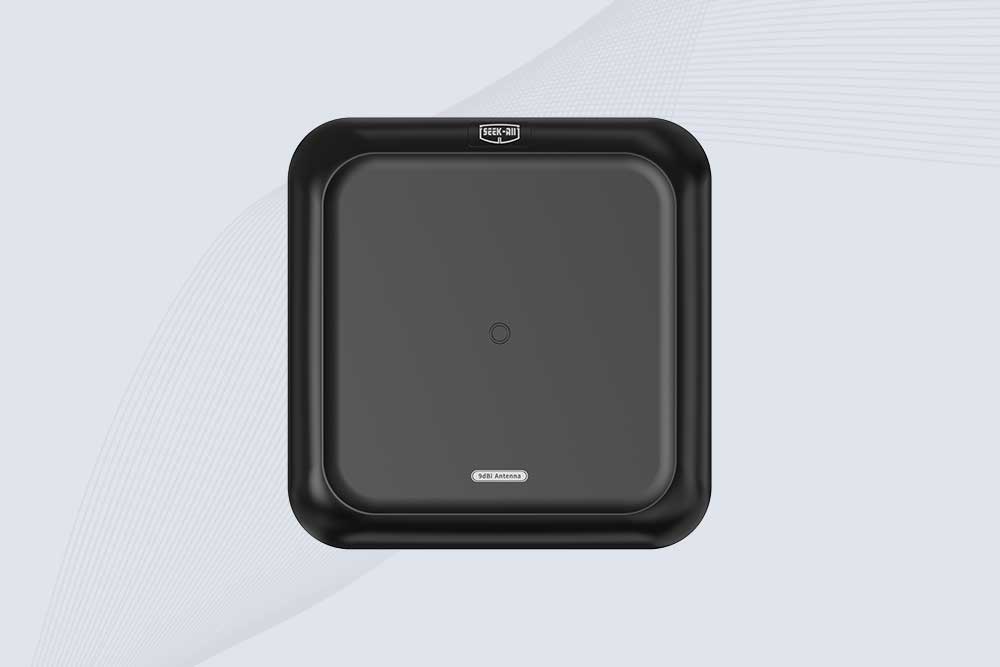
Cykeo CYKEO-A9 industrial UHF RFID antenna delivers 9dBi gain, 840-960MHz frequency range, and IP65 protection for warehouse/logistics/retail RFID systems. Features N-type connector and ≤1.3:1 VSWR.
CYKEO UHF RFID Antenna built for long-distance and industrial applications. This antenna rfid uhf delivers strong gain, outdoor durability, and reliable tag performance in warehouses, yards, and vehicle ID systems.
CYKEO Antenna RFID delivers reliable long-range UHF performance in warehouses, retail shelves, and cold-chain environments. This compact uhf rfid antenna provides stable reads with circular polarization and ultra-wide 840–960 MHz support, ideal for industrial tracking, smart shelves, and asset monitoring.
Cykeo’s CYKEO-C8 UHF RFID antennas delivers 8dBi gain, 840-960MHz full-band coverage, and IP65 ruggedness for manufacturing/warehouse RFID systems. Industrial RFID Antennas Features
Cykeo’s 8dBi UHF RFID antenna and reader kit delivers 10m+ range, 840-960MHz broadband, and IP65 ruggedness for factories, warehouses, and logistics. ISO 18000-6C & EPC Gen2 certified.
Cykeo’s CYKEO-A12C UHF Large RFID Antenna delivers 12dBi gain, 840-960MHz global frequency, IP65 ruggedness for logistics/warehousing/automotive. 40° beamwidth ensures stable 15m+ tag reads.
CYKEO Near Field RFID Antenna provides precise 5–30 cm reading for shelves, cabinets, and workstations. This compact rfid shelf antenna delivers stable short-range performance around metal and clutter, ideal for pharmacies, libraries, and electronics sorting.
Cykeo’s industrial long range RFID reader delivers 20-meter scanning, 500+ tags/sec speed, and IP67 waterproof design for automated warehouses, logistics, and harsh environment applications.
Cykeo’s CYKEO-RA6L industrial RFID long range reader features 20m read distance, 500 tags/sec speed, and IP67 protection. Ideal for warehouse automation, manufacturing WIP tracking, and smart logistics. Supports ISO 18000-6C/6B protocols.
CYKEO Long Range RFID Tag Reader built for outdoor and industrial operations. This Outdoor RFID Reader delivers 20m read distance, fast tag processing, and IP67 durability for wide-area tracking.
Cykeo CYKEO-RA12L industrial Long Range RFID Reader delivers 20m read range, 200+ tags/sec scanning, and IP67 protection for manufacturing/logistics applications. Supports ISO 18000-6C/GB protocols.
Discover industrial-grade RFID antennas that withstand dust storms, moisture, and -40°F to 185°F temps. Ensure reliable tracking in mines, farms, and factories.
Learn how to install a long range RFID scanner correctly. This guide covers antenna positioning, reader setup, interference control, and practical tips for RFID system integrators and wholesalers.
Discover how rfid tag and reader technology enables automatic identification, real-time asset visibility, and efficient inventory management with industrial-grade Cykeo RFID solutions.
 Cykeo RFID IoT Solution Products R&D Manufacturer