 Cykeo RFID IoT Solution Products R&D Manufacturer
Portable RFID Readers
Cykeo offers portable RFID readers for mobile data capture and on-site identification. The lineup includes iPhone and Android RFID readers that work with smartphones, not as standalone devices.
These readers connect via Bluetooth or USB-C and operate through a dedicated RFID app. Cykeo provides SDKs, APIs, and demo apps to support software integration, with engineering assistance available during initial setup.
Portable RFID Readers
A portable RFID reader is designed for flexible, close-range or mid-range RFID operations where fixed installation is not practical. In daily use, the reading performance depends on tag type, antenna design, output power and the way the reader is carried or positioned during operation.
Read More
Unlike built-in NFC functions found in some smartphones, a Cykeo portable RFID reader is an external RFID device. The smartphone itself does not perform RFID reading. Instead, the phone works as a control terminal, running user software that communicates with the reader through Bluetooth or USB Type-C.
Once the connection is active, the reader transmits radio signals, receives tag responses and sends the tag data back to the mobile application. This setup allows developers to reuse existing mobile platforms while adding RFID capability without redesigning hardware.
Common Application Areas:
1.Inventory Checking and Field Audits
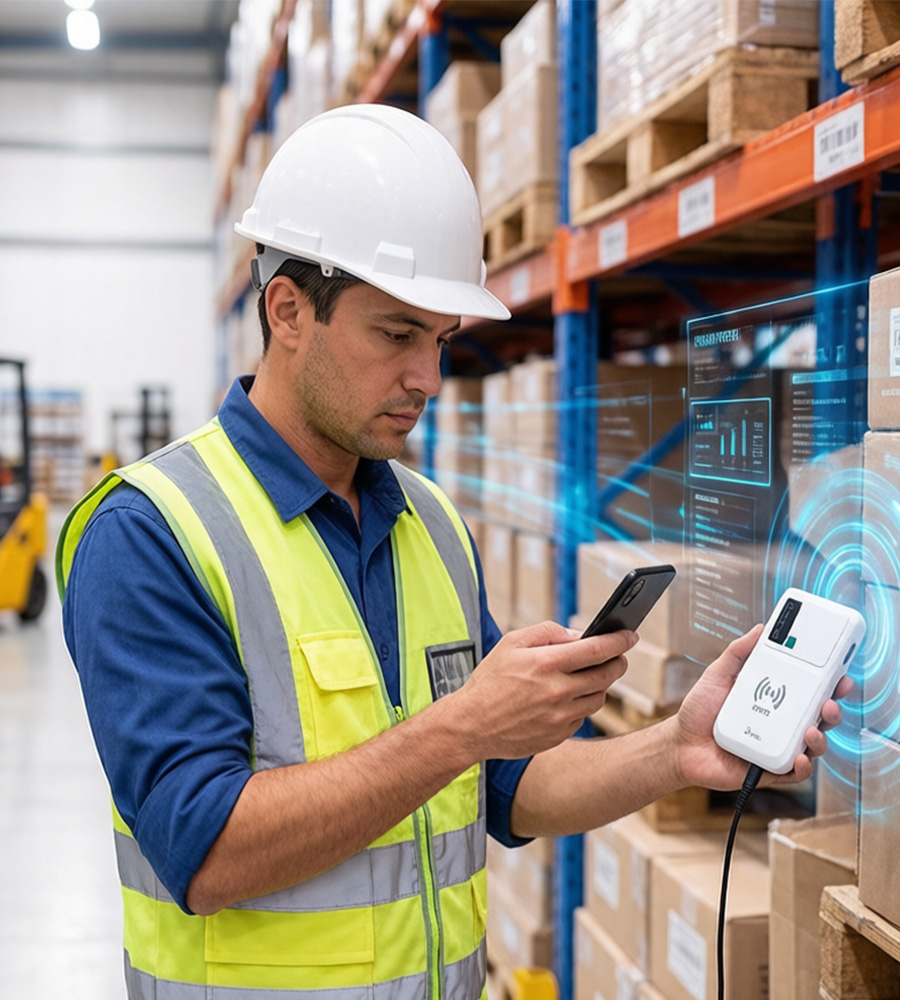
Portable RFID readers are often used for inventory checks in warehouses, retail backrooms and service locations. Staff can walk through storage areas with a phone and reader, capturing tag data without fixed gates or cables.
2.Asset Inspection and Maintenance
Factories, hospitals and utility operators use portable readers to verify tools, equipment and devices during inspections. RFID tags can be read on-site, and results are uploaded directly through mobile software.
3.System Debugging and Commissioning
During RFID cabinet, access control or smart locker projects, portable readers are frequently used by engineers to test tag performance and reader configuration before systems go live.
4.Mobile Access and Identification
In temporary access scenarios, such as exhibitions or controlled work zones, portable RFID readers allow identity verification using mobile devices without installing permanent infrastructure.
5.Project Development and Prototyping
For software developers and system integrators, portable readers are commonly used during early-stage development. They help validate tag selection, data formats and software logic before larger deployments.
About Cykeo
Cykeo is an RFID hardware manufacturer focused on Fixed RFID readers, RFID modules and RFID antennas. Products are developed for software developers, system integrators, solution providers, agents and enterprise customers who build their own RFID systems.
Many customers integrate Cykeo portable RFID readers into self-developed mobile applications, RFID cabinets, smart access systems or internal management tools. By providing open SDKs, APIs and demo software, Cykeo allows customers to control system logic on their own while relying on stable RFID hardware at the device layer.
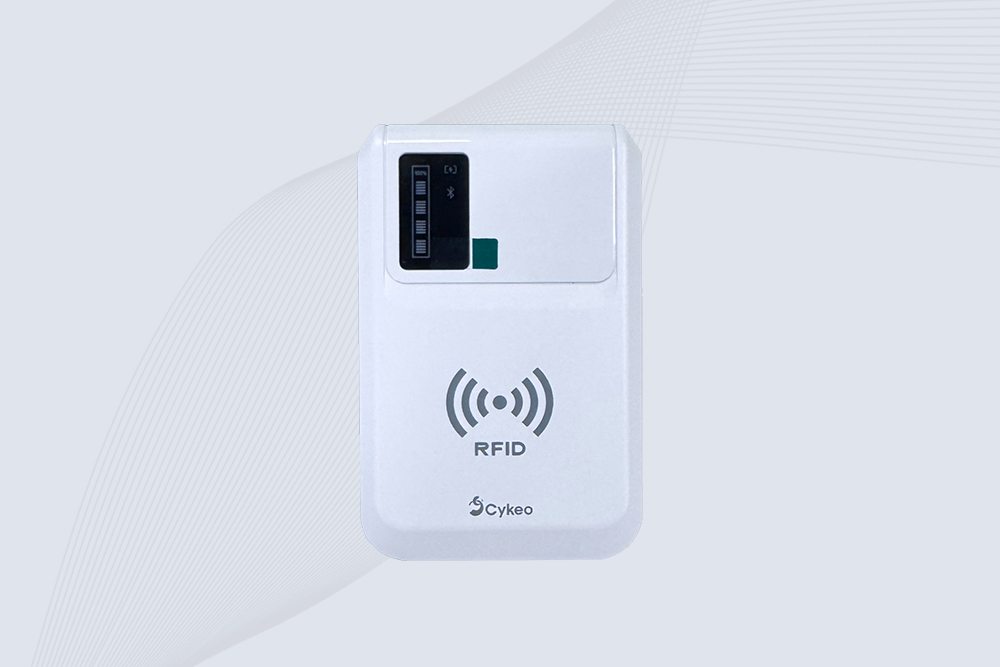
CYKEO-B5L iPhone RFID Reader
Cykeo CYKEO-B5L portable iPhone RFID reader features 8m range, 500 tags/sec scanning, and built-in 10000mAh charger. Perfect for retail/warehouse teams needing iOS integration.
More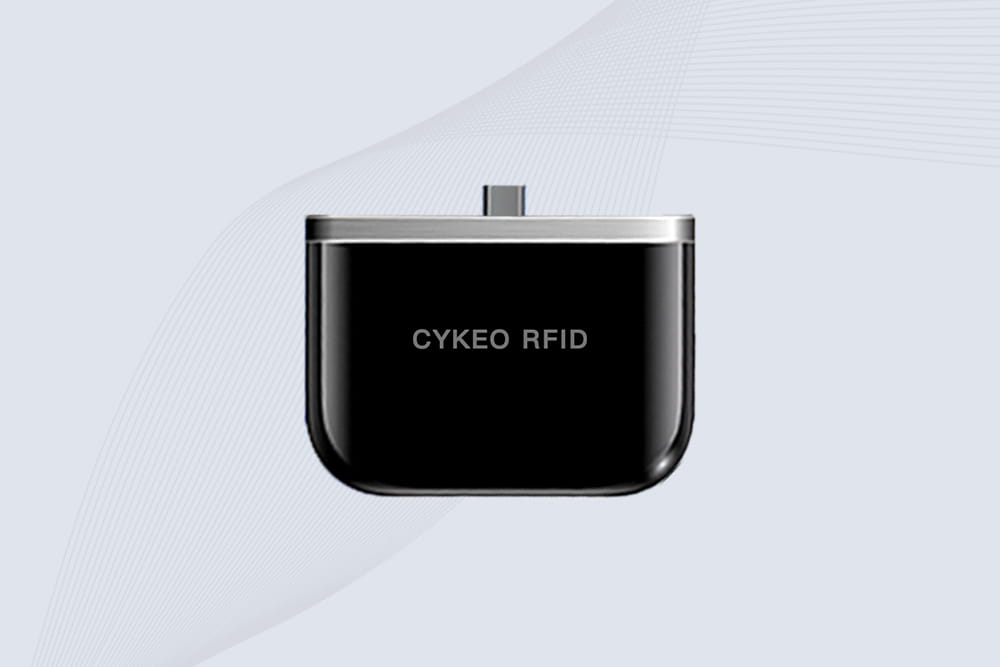
CYKEO-B4L Mobile Android RFID Reader
Cykeo CYKEO-B4L Android RFID reader features 37g magnetic phone attachment, 30cm UHF scanning, and Java/C# SDK for mobile asset tracking. Ideal for anti-counterfeit and warehouse verification.
MoreMore About Portable RFID Reader
Cykeo's portable RFID readers consistently deliver high performance. Compatible with iPhones and Android phones, our portable RFID readers offer all the features needed for a successful RFID system. A portable RFID reader is a radio frequency transmitter and receiver used to connect to iPhones and Android phones to read and write information from RFID tags. Compact and lightweight, portable RFID readers are ideal for mobile applications.
Cykeo offer a very strong after-sales team and rapid technical support services, including support for SDKs, APIs, software integration, system development, mobile or desktop applications, as well as any related configuration or troubleshooting assistance, making your project very convenient from planning to implementation.
More About iPhone RFID Reader
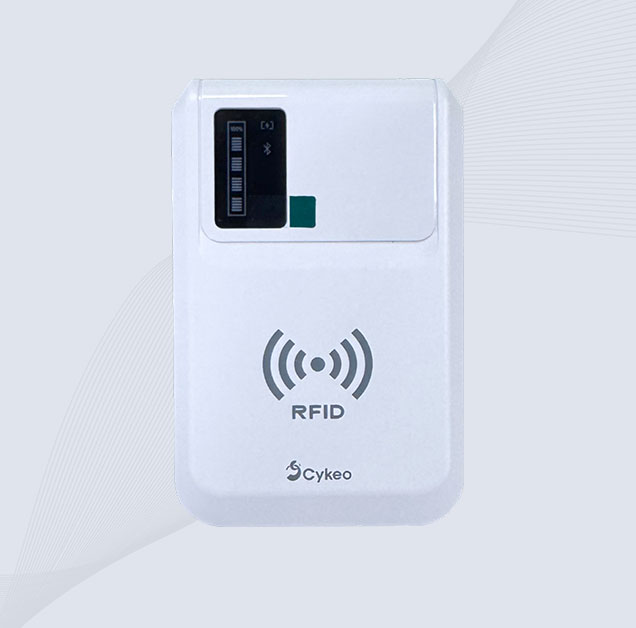
The Cykeo iPhone RFID Reader is built for people who actually work with RFID every day, not just test it on a desk. It connects directly to an iPhone via Bluetooth or USB-C and works together with a dedicated RFID app, turning a phone into a practical UHF scanning tool. There is no learning curve. If you can use a smartphone, you can use this reader.
What makes it stand out is reliability in real environments. Warehouses, hospitals, factories, loading docks — these are not clean labs. The reader maintains stable performance even when tags are dense, shelves are metallic, or scanning sessions run long. The built-in 10,000 mAh battery is a real advantage here. It powers the reader for a full shift and can also charge the phone when needed, which matters more than people think once you’re on site.
The ergonomic design fits naturally in the hand, reducing fatigue during repetitive scanning. Cykeo also provides SDKs and APIs, so integration into existing iOS systems is straightforward, whether for inventory, asset tracking, or personnel identification.
This iPhone RFID Reader doesn’t try to look fancy. It focuses on accuracy, uptime, and usability — the things that actually decide whether an RFID project succeeds in the field.
More About Android RFID Reader
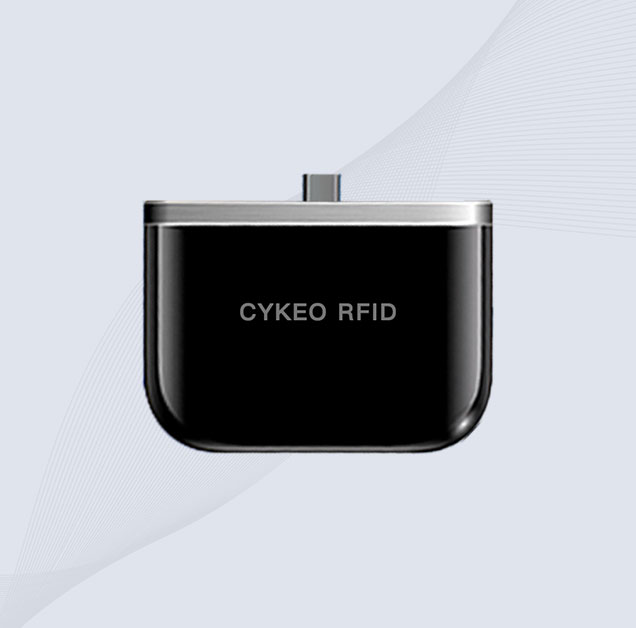
The Cykeo Android RFID Reader is built for close-range RFID work where control and accuracy are more important than long read distance. It connects directly to an Android smartphone through the USB Type-C port, using the phone for both power and data. Once the app is opened, the reader is ready to work—no pairing, no external battery, and no complicated setup.
A near-field antenna limits the reading range to around 30 cm, with an even shorter writing range. This controlled distance helps avoid accidental reads, which is critical for tasks like anti-counterfeiting checks, picking operations, workstation counting, and inspection points. Reads and writes are fast, stable, and easy to repeat.
Weighing only 37 grams, the device is comfortable for all-day use. Its magnetic back lets it attach to the phone, making one-handed operation practical during frequent scans. Despite its small size, performance remains responsive in busy environments.
Cykeo also provides C# and Java documentation, helping developers integrate the reader into existing systems. This Android RFID Reader keeps things simple, efficient, and cost-effective for real-world close-range applications.
What Are Portable RFID Readers?
Portable RFID readers are compact, mobile RFID devices designed for reading and writing RFID tags without requiring a fixed installation. Unlike traditional fixed RFID readers that remain in one location, portable RFID readers allow users to capture RFID data wherever the work happens—whether in a warehouse aisle, retail store, production line, hospital, or outdoor job site. They combine mobility, flexibility, and reliable RFID performance into a lightweight device that can easily travel with the operator.
Most modern portable RFID readers work together with smartphones or tablets instead of operating as standalone terminals. The reader connects to an iPhone or Android device through Bluetooth or USB Type-C, while the mobile application manages inventory, asset information, or business workflows. The smartphone serves as the user interface, while the RFID reader handles radio communication with RFID tags. This approach reduces hardware costs and makes it easier for businesses to integrate RFID into existing mobile applications
Portable RFID readers are widely used because they eliminate the need for operators to return to fixed workstations. Employees can scan tagged assets, products, equipment, or documents directly where they are located, improving efficiency and reducing manual work. Depending on the model, portable RFID readers can support close-range precision scanning or long-range UHF reading, making them suitable for everything from item verification to large-scale inventory counting.
Decision Framework
When Should You Choose Portable RFID Readers?
✓ Good Fit
Choose Portable RFID Readers When…
Portable RFID readers are the right choice when mobility and flexibility are more important than continuous fixed monitoring.
- You Need Mobile Inventory CountingStaff move through warehouses, retail stores, or storage areas performing cycle counts without installing fixed RFID infrastructure.
- Your Work Locations Frequently ChangeIdeal for field inspections, construction sites, maintenance teams, and temporary work areas where equipment must be carried between locations.
- You Want to Integrate RFID with Smartphones or TabletsPortable readers connect via Bluetooth or USB-C, allowing your existing mobile app to handle inventory, asset tracking, or inspections.
- You Need Fast Asset Identification AnywherePerfect for locating tools, IT equipment, medical devices, or valuable assets without bringing them back to a workstation.
- You're Testing or Deploying RFID SystemsSystem integrators and software developers often use portable readers for tag validation, antenna testing, and on-site troubleshooting.
- You Need a Cost-Effective RFID SolutionIf your operation doesn't justify installing multiple fixed readers, portable RFID readers provide an affordable way to collect RFID data on demand.
✗ Poor Fit
Don't Choose Portable RFID Readers When…
Portable RFID readers are not the best option if your application requires unattended, continuous RFID data collection.
- You Need 24/7 Automatic Tag DetectionProduction lines, warehouse gates, and conveyor systems require fixed RFID readers that operate continuously without human intervention.
- You Need Hands-Free OperationIf employees cannot stop to scan items manually, fixed RFID portals or overhead readers provide a fully automated workflow.
- You Monitor High-Volume TrafficApplications such as dock doors, vehicle access control, or pallet portals require multiple antennas and fixed readers to capture every tag automatically.
- You Need Long-Term Area MonitoringIf assets must be tracked continuously as they move through a defined zone, a permanently installed RFID infrastructure is the better choice.
- You Require Multi-Antenna CoverageLarge warehouses, tunnels, smart cabinets, or industrial production lines often need several antennas working together, which portable readers cannot provide.
- You Need Fully Automated Business ProcessesWhen RFID data must trigger automatic software actions—such as opening gates, updating inventory in real time, or sorting packages—a fixed RFID reader system offers greater reliability and automation.
Note For Partners: For manufacturers, system integrators, and software developers, always ensure the portable RFID reader offers stable SDK/API support, proven real-world reading performance, compatible communication interfaces, and strong OEM customization capability before integrating it into a customized RFID solution.
Cykeo Portable RFID Readers vsFixed RFID Reader
| Feature | Portable RFID Readers | Fixed RFID Reader |
|---|---|---|
| Deployment Type | Mobile, carried by operator | Stationary, permanently installed |
| Operation Mode | Manual scanning (user-triggered) | Fully automatic, continuous reading |
| Power Supply | Built-in rechargeable battery | Mains power / PoE |
| System Dependency | Works with mobile apps (Android / iOS / SDK) | Works with backend system / middleware |
| Reading Coverage | On-demand, point-by-point scanning | Fixed zone coverage (doorway, conveyor, gate) |
| Installation | No installation required | Requires mounting + antennas + configuration |
| Reading Range | Medium to long range depending on model | Adjustable long range with external antennas |
| Multi-tag Reading | Supported, but operator-controlled | High-volume batch reading automatically |
| Real-time Tracking | Not continuous | Fully real-time tracking |
| Use Case Focus | Inventory check, asset search, field work | Automation, logistics flow, access control |
| Mobility | High mobility, can move anywhere | No mobility (fixed position only) |
| System Complexity | Low to medium | Medium to high (requires integration) |
| Cost Structure | Lower initial cost | Higher infrastructure + installation cost |
| Best Fit Environment | Flexible, changing environments | Structured, high-throughput environments |
Our customers give this evaluation
Read feedback from system integrators, software developers, engineers, and enterprise users worldwide. Their experiences highlight CYKEO's Handheld RFID Readers product reliability, technical support, integration capabilities, and performance across logistics, manufacturing, retail, and industrial RFID applications.

Mark Thompson – RFID System Integrator (USA, Texas)
⭐⭐⭐⭐⭐
Product Used: CYKEO-B5L Portable iPhone RFID Reader
Quantity: 120 units
Review:
We deployed CYKEO-B5L in a warehouse automation project across Dallas. The 8m reading range and 500 tags/sec speed were stable even in dense pallet environments. Our team integrated it with a custom WMS system using RESTful API. CYKEO supported us during SDK debugging and firmware tuning, which helped us avoid delays during rollout. Delivery was faster than expected, and the batch consistency was solid for large-scale deployment.

Li Wei – Software Developer (China, Shenzhen)
⭐⭐⭐⭐⭐
Product Used: CYKEO-B4L Android RFID Reader
Quantity: 60 units
Review:
We used CYKEO-B4L for an asset tracking mobile app. The 37g magnetic attachment is surprisingly practical for field technicians. Java SDK was clean and easy to integrate with our ERP backend. We mainly used it for IT equipment tagging in office environments. CYKEO’s engineering team helped us adjust API latency during early testing.

Ahmed Al-Mansoori – Procurement Manager (UAE, Dubai)
⭐⭐⭐⭐⭐
Product Used: CYKEO-B5L Portable RFID Reader
Quantity: 200 units
Review:
We purchased CYKEO-B5L for a logistics warehouse project in Jebel Ali Free Zone. The battery capacity (10000mAh) was a key reason for selection. Devices arrived in one batch with consistent performance. CYKEO handled OEM labeling for our partner brand without delays. Communication with sales and engineering was smooth even across time zones.
James Carter – Warehouse Operations Supervisor (UK, Birmingham)
⭐⭐⭐⭐⭐
Product Used: CYKEO-B5L Portable RFID Reader
Quantity: 80 units
Review:
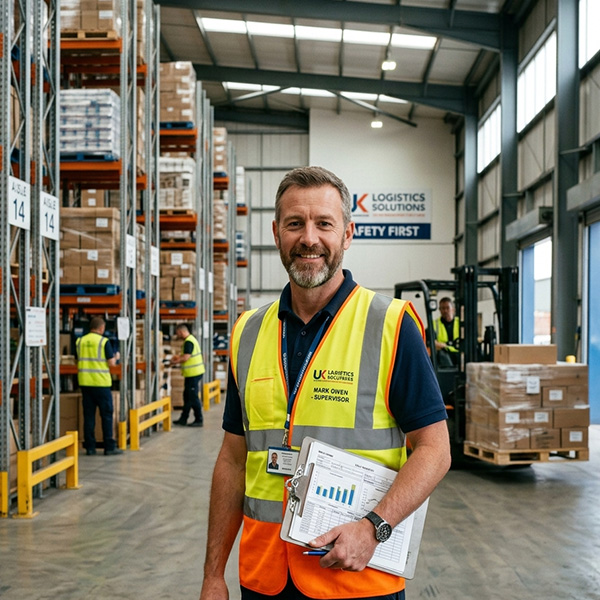
We replaced manual barcode scanning with CYKEO-B5L handheld RFID readers. The reading speed made cycle counting much faster. Even in metal rack-heavy areas, performance stayed stable. Training new staff took less than a day. CYKEO provided clear documentation and after-sales support when we integrated it into our inventory system.

Carlos Rivera – RFID Solution Architect (Mexico)
⭐⭐⭐⭐⭐
Product Used: CYKEO-B4L Android RFID Reader
Quantity: 45 units
Review:
We integrated CYKEO-B4L into a retail asset tracking solution for a national chain. The 30cm short-range precision was actually useful for shelf-level verification. Java SDK allowed smooth integration with POS backend. CYKEO supported custom firmware tweaks for scanning optimization.

David Müller – IT Engineer (Germany, Hamburg)
⭐⭐⭐⭐⭐
Product Used: CYKEO-B5L Portable RFID Reader
Quantity: 50 units
Review:
We used CYKEO devices in a hospital asset tracking system. The 500 tags/sec performance was critical for emergency equipment tracking. Integration with REST API into hospital ERP worked without major issues. Engineering support responded quickly when we needed encryption configuration adjustments.
Sarah Johnson – Field Service Technician (Australia, Sydney)
⭐⭐⭐⭐⭐
Product Used: CYKEO-B4L Android RFID Reader
Quantity: 30 units
Review:
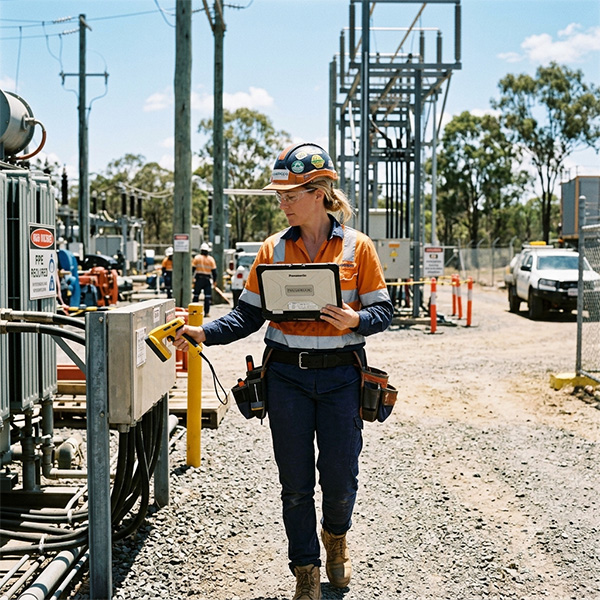
I use the B4L daily for on-site equipment checks. The magnetic phone attachment is surprisingly strong, and I can carry it easily during inspections. The SDK integration into our mobile app was smooth. Battery life on connected phone setups is stable for full-day work.

Hassan Khan – OEM Partner (Pakistan, Karachi)
⭐⭐⭐⭐⭐
Product Used: CYKEO-B5L + B4L Mixed Deployment
Quantity: 300+ units
Review:
We worked with CYKEO for OEM branding and bulk supply. Both B5L and B4L models were customized with our logo and firmware settings. Production consistency was stable across batches. They supported us with SDK documentation for our local software team. Delivery schedule was reliable even for large orders.
FAQ About Portable RFID Readers
How does a Portable RFID Reader work?
A portable RFID reader sends out radio waves through its antenna. When an RFID tag enters that field, the tag responds with its stored data. The reader captures that response, decodes it, and passes the data to a connected device, such as a smartphone or tablet. In real use, it feels simple: power on, open the app, scan, and the data appears. The complexity stays inside the reader.
How do you read data from a Portable RFID Reader?
Most portable readers work with a mobile app or PC software. Once connected, the software listens for tag IDs and data. In many projects, SDKs are used so the reader feeds data directly into your own system, not just a demo screen.
How do you connect a Portable RFID Reader to an iPhone?
Most portable RFID readers connect to an iPhone through Bluetooth rather than a direct cable. This is mainly due to iOS system limits. In practice, you power on the reader, enable Bluetooth on the iPhone, and pair the devices like any other accessory. Once paired, you open the reader’s dedicated iOS app. The app handles communication, tag reading, and data display. Some models use Apple-certified accessories or Lightning/Type-C adapters, but even then, the reader only works after the correct app is running. There’s no background scanning. Everything is app-driven.
How long is the battery life of a UHF RFID reader handheld?
Battery life depends heavily on how the reader is used. Most UHF handheld readers last a full working shift, usually around 8 to 12 hours. Constant scanning at high power drains the battery faster than occasional use.
Cykeo handheld readers are designed with power management features to extend usage time. In real operations, users typically charge devices overnight or use charging docks. For intensive environments, spare batteries or fast charging reduce downtime and keep work moving without interruption.
What’s the difference between a Portable RFID Reader and a USB RFID Reader?
A portable reader is built for mobility and often has its own battery, antenna, and wireless connection. A USB RFID reader is simpler, powered by the host device, and typically used at a desk or fixed point.
What is the typical read range of a Portable RFID Reader?
That depends on frequency, antenna design, and output power. UHF portable readers usually read from about 30 cm up to 5–8 meters. Near-field or low-power models are intentionally shorter, often under 50 cm, to avoid accidental reads in dense environments.
Can a Portable RFID Reader read multiple tags at once?
Yes, most UHF portable readers support anti-collision. That means dozens or even hundreds of tags can be read in seconds, as long as they are within range and properly oriented.
How do you connect a Portable RFID Reader to Android?
Android offers more connection options. Most portable RFID readers connect via Bluetooth or USB Type-C using OTG. With USB, you simply plug the reader into the phone and launch the RFID app. Power and data flow through the same cable, which feels fast and stable on site. Bluetooth is common when cables are inconvenient. Once paired, the reader streams tag data to the app in real time. Developers often prefer Android because SDK access is more open and hardware integration is less restricted.Either way, the logic stays simple: open connection, wait for data, process it, close or loop.
What communication interfaces do Portable RFID Readers support?
Common interfaces include Bluetooth, USB Type-C, and sometimes Wi-Fi. The choice depends on whether the focus is mobility, speed, or system integration
Do Portable RFID Readers require software or an app to work?
Yes. Most portable RFID readers need a dedicated mobile app or PC software to function properly. The reader only captures and transmits tag data, while the app or SDK handles decoding display, filtering, and system integration. Without software support, the device usually cannot show or manage RFID data.