What are rfid tags? RFID tags are small electronic identification devices that store digital information and communicate wirelessly with RFID readers. They enable automatic item recognition, tracking, and data management without direct contact, making them widely used in inventory, logistics, retail, healthcare, and industrial applications.
During years of working with RFID deployment projects, I have seen many companies misunderstand RFID tags as simple replacements for barcodes. In reality, an RFID tag is a combination of a microchip, antenna structure, and protective material designed for specific operating environments.
At Cykeo, our engineering team has tested RFID tags across warehouse inventory lines, textile management systems, tool tracking projects, and desktop encoding stations. The performance difference is rarely caused only by the tag itself. Reader power, antenna design, operating frequency, material interference, and encoding process all determine the final result.
What Are RFID Tags and How Do They Work?
An RFID tag is a wireless identification component that communicates with an RFID reader through radio frequency signals. Unlike traditional barcode labels, RFID tags do not require optical scanning alignment.
The basic working process includes:
Component
Function
RFID Chip
Stores unique identification data and memory information
When an RFID reader sends a radio signal, the tag antenna captures the energy and activates the chip. The chip then sends stored information back to the reader.
For passive RFID tags, no internal battery is required. The tag receives power from the reader signal. This design allows tags to remain lightweight, inexpensive, and maintenance-free for long-term applications.
According to GS1, RFID technology is widely adopted as part of automatic identification and data capture systems, supporting supply chain visibility and item-level management worldwide.
Different Types of RFID Tags for Industrial Applications
Not all RFID tags are designed for the same environment. During actual deployments, selecting the wrong tag type often creates unnecessary reading failures.
Common RFID tag categories include:
Passive RFID Tags
Passive tags are the most commonly used type. They rely on reader-generated electromagnetic energy and are widely used in:
Warehouse inventory
Apparel management
Library systems
Asset tracking
Retail applications
UHF RFID Tags
Ultra-high frequency RFID tags usually operate between 860–960 MHz and are preferred when companies need long reading distances and fast bulk identification.
Typical applications include:
Logistics pallets
Clothing warehouses
Manufacturing components
Large-scale inventory counting
HF RFID Tags
HF RFID tags operate at 13.56 MHz and are commonly used for:
Access cards
Smart tickets
Library cards
Payment-related applications
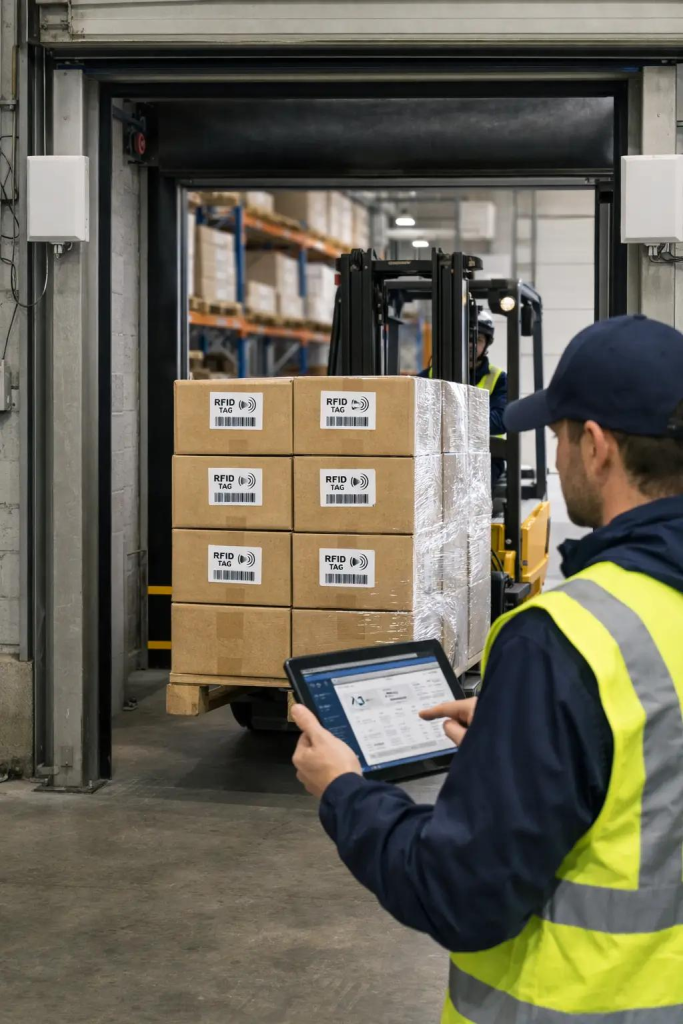
RFID tags allow warehouses to identify and manage thousands of items automatically through wireless communication.
How RFID Tags Are Programmed and Managed
In practical RFID projects, tag programming is an important step before deployment.
For example, clothing manufacturers may encode product information before shipment. Libraries may register books into databases. Tool management systems may assign each tool a unique digital identity.
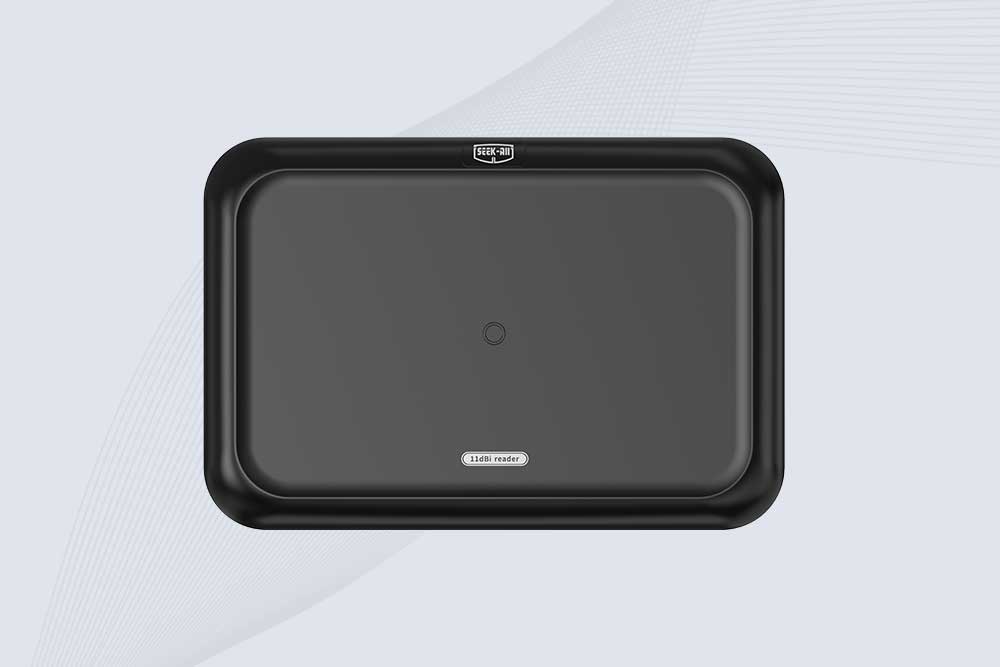
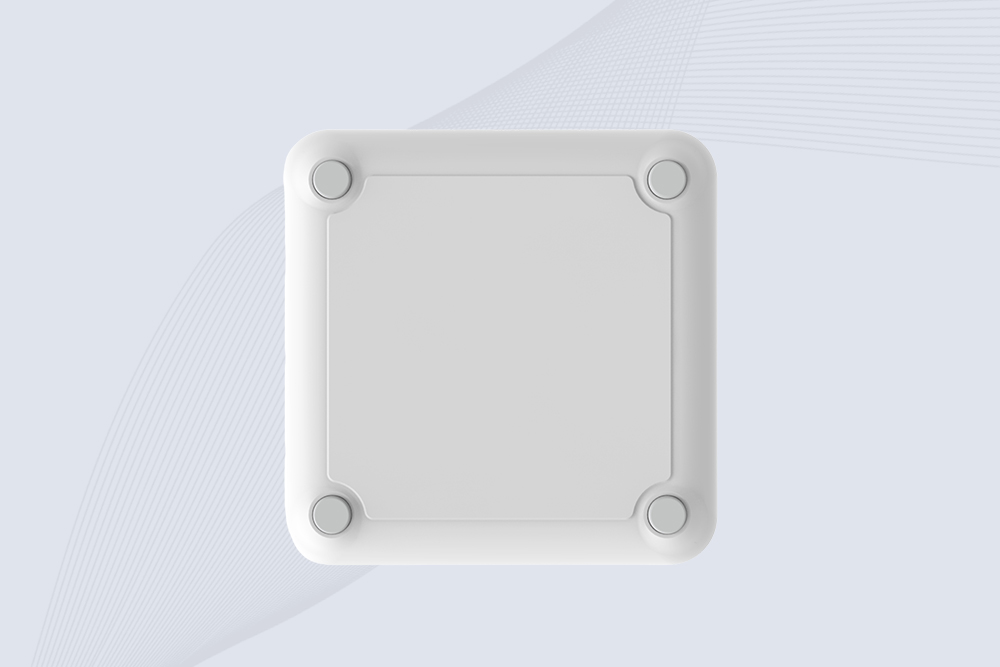
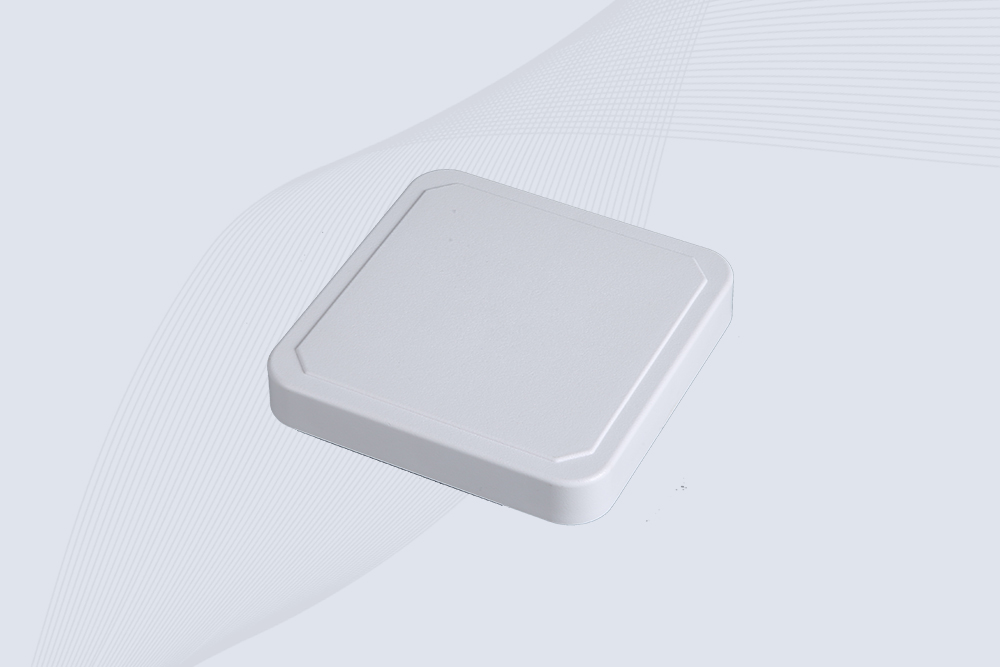
Cykeo RFID desktop card issuers are designed for these scenarios. The desktop device combines a near-field antenna structure with high-performance RFID processing to provide stable tag reading and writing.
The system features:
IMPINJ R500-based RFID performance
Maximum output power up to 33dBm
Controlled reading distance within 30cm
Controlled writing distance within 10cm
Batch tag writing capability
Tag filtering functions
Mini USB communication
C# and Java development support
The short-range design is especially valuable for controlled encoding environments. In a production office, operators can write the correct tag without accidentally activating nearby tags on the same desk.
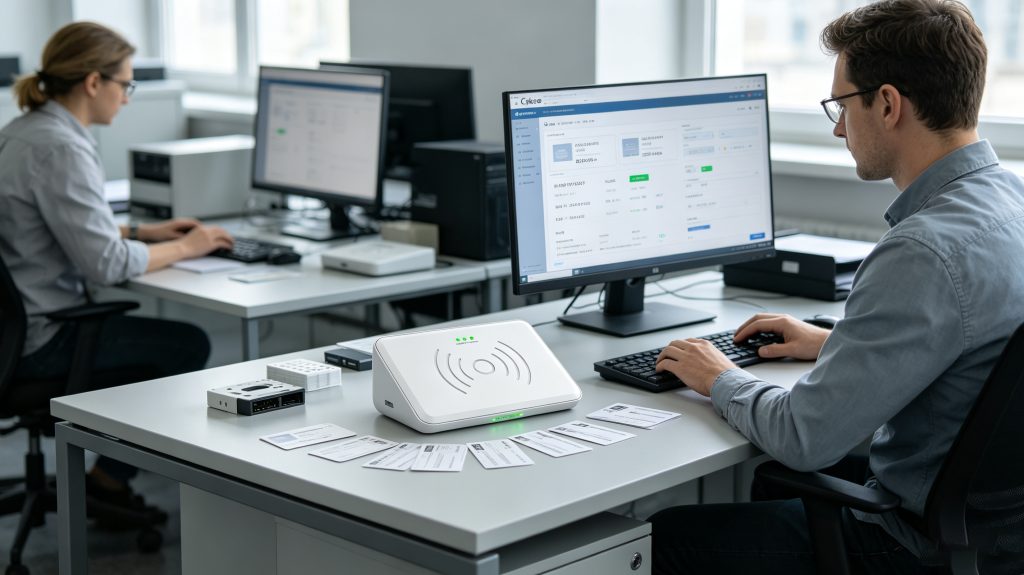
RFID desktop readers provide accurate tag programming for inventory, cards, and asset management applications.
Why RFID Tags Are Important for Modern Identification Systems
The real value of RFID tags is not only the ability to identify an object. The important change happens when physical items become connected with digital information.
During RFID implementation projects, I often see the same problem: companies collect data manually but cannot update information quickly enough. A warehouse operator may spend several minutes checking products one by one, while an RFID system can capture hundreds of tagged items within seconds when the environment is correctly designed.
This is why RFID tags are becoming increasingly important in:
Industry
RFID Tag Application
Manufacturing
Production tracking and component identification
Logistics
Pallet tracking and shipment verification
Retail
Inventory visibility and loss prevention
Healthcare
Medical equipment management
Libraries
Book registration and circulation control
According to AIM Global, RFID technology is one of the key automatic identification technologies used to improve operational visibility across multiple industries.
Research from GS1 highlights that RFID-based identification improves supply chain accuracy by creating a unique digital identity for physical products.
In practical deployments, the tag itself is only one part of the system. The relationship between tag design, reader performance, software integration, and workflow determines whether the project succeeds.
What Are RFID Tags Used For in Real Business Environments?
A common misconception is that RFID tags are mainly used for tracking expensive assets. In reality, RFID adoption has expanded into everyday operational processes.
Typical applications include:
Inventory Management
Retail stores and warehouses use RFID tags to reduce manual counting work. Products can be identified without opening boxes or scanning each barcode individually.
Asset Tracking
Companies attach RFID tags to tools, equipment, and documents to monitor location and usage history.
Smart Card and Identification Systems
RFID cards and tags are used for:
Employee access control
Membership systems
Transportation cards
Payment applications
Product Encoding Before Shipment
Manufacturers often need to write product information into RFID tags before products leave the factory.
This is where RFID desktop encoding equipment becomes valuable.
A Cykeo RFID desktop card issuer is designed for controlled tag writing environments where accuracy matters more than long-distance reading.
Unlike large-area RFID readers designed for warehouse scanning, desktop RFID writers focus on precise communication.
he near-field antenna structure limits unnecessary reading range, helping operators avoid accidental tag activation around the workspace.
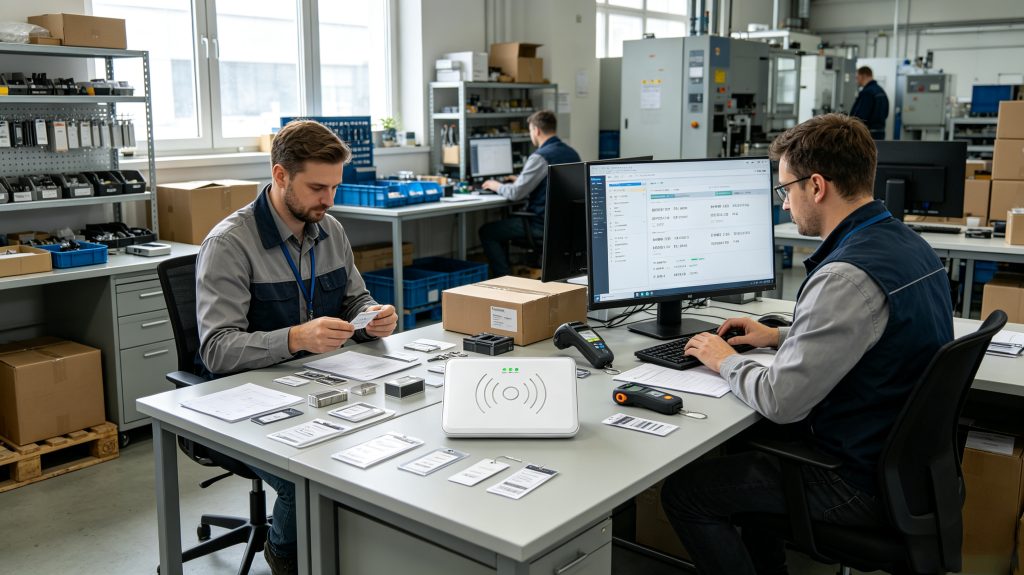
Controlled RFID tag programming improves accuracy during product registration and inventory preparation.
How RFID Desktop Readers Improve RFID Tag Management
For companies managing thousands of RFID tags, writing reliability is a critical factor.
A failed tag-writing process creates hidden costs:
Repeated manual operations
Incorrect inventory information
Production delays
Additional quality checks
Cykeo RFID desktop writers are developed for stable encoding applications.
The hardware combines:
High-performance IMPINJ R500 RFID processing technology
Stable writing performance
Maximum output power up to 33dBm
Near-field antenna control
Fast tag filtering capability
In a typical tag issuing process, operators can place RFID cards, labels, or small items near the reader and complete data writing through dedicated software.
The device supports automatic card writing and demo software, allowing customers to quickly test RFID applications before system integration.
For developers, providing C# and Java development resources reduces the difficulty of connecting RFID hardware with existing management platforms.
RFID desktop encoding devices simplify enterprise RFID deployment with stable communication and precise writing control.
FAQ About RFID Tags
Are RFID tags better than barcodes?
RFID tags provide advantages where automatic identification and bulk reading are required. Unlike barcodes, RFID does not require direct visual scanning and can read multiple tagged items simultaneously.
Can RFID tags store product information?
Yes. RFID tags contain memory areas where identification data can be stored. The amount of storage depends on the chip type and application requirements.
How far can RFID tags be read?
The reading distance depends on frequency, antenna design, reader power, and environment. UHF RFID systems can achieve long-range identification, while near-field desktop systems are designed for short-range controlled operations.
Can RFID tags be rewritten?
Many RFID tags support rewriting. This allows companies to update information during manufacturing, logistics, or asset management processes.
Expert Perspective: Choosing the Right RFID Tag System
After working with RFID equipment integration projects, my experience is that companies should not select RFID tags only based on reading distance.
A successful RFID system starts by understanding the working environment:
What materials surround the tag?
How frequently will data change?
Is the application indoor or outdoor?
Does the customer need bulk reading or controlled writing?
For example, a warehouse may require UHF tags optimized for long-distance identification, while an office registration station may need a desktop RFID writer with precise short-range control.
The hardware and workflow must match.
Cykeo focuses on RFID identification solutions including desktop RFID readers, industrial RFID readers, and customized RFID management systems. Through engineering testing and application experience, we help customers build reliable RFID workflows instead of simply supplying hardware.
Conclusion: What Are RFID Tags in Modern Digital Management?
What are rfid tags? They are intelligent identification devices that connect physical products with digital information through wireless communication. From inventory control to automated production, RFID tags provide faster, more accurate, and more efficient management methods.
With suitable RFID readers, software integration, and professional deployment experience, RFID tags become a foundation for modern smart operations.
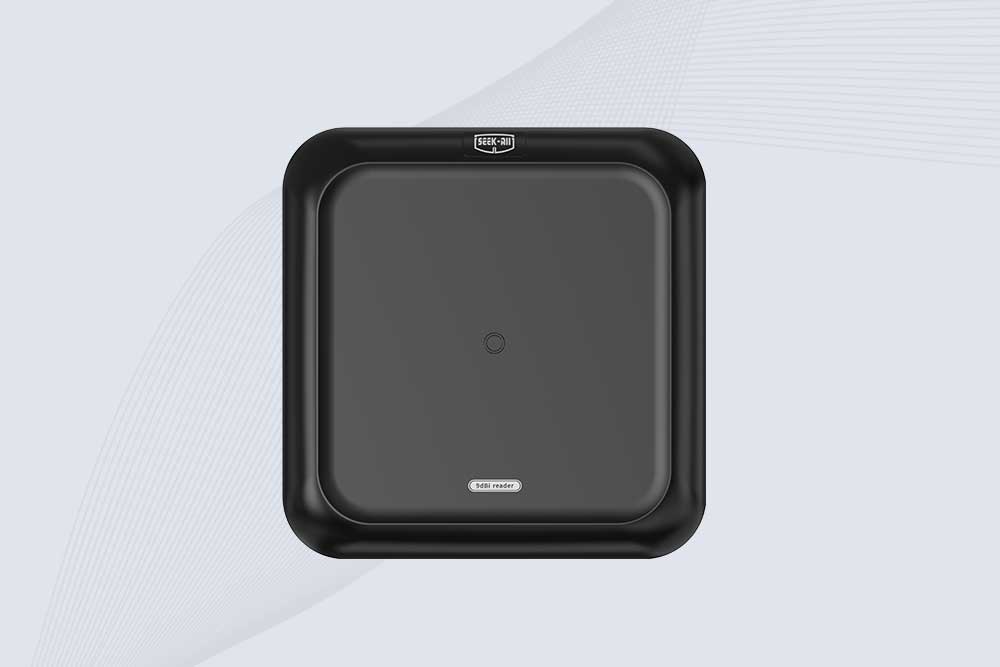
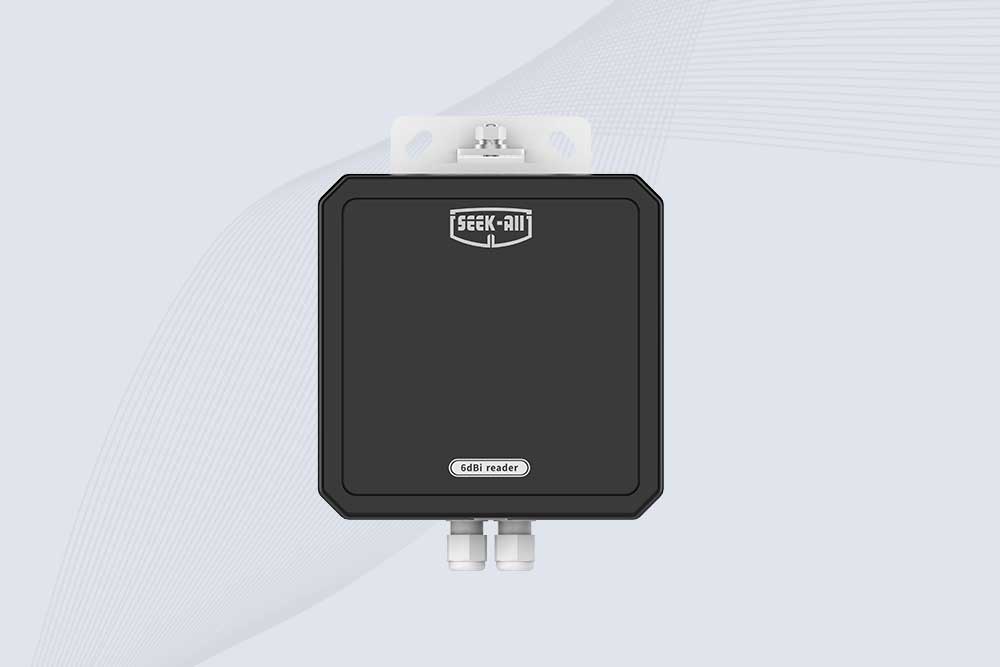
SSD-RA06L is an industrial UHF RFID reader with a built-in 6 dBi antenna, 3 m read range, 600+ tags/s, Ethernet, RS232, and optional Wi-Fi, 4G, and PoE.
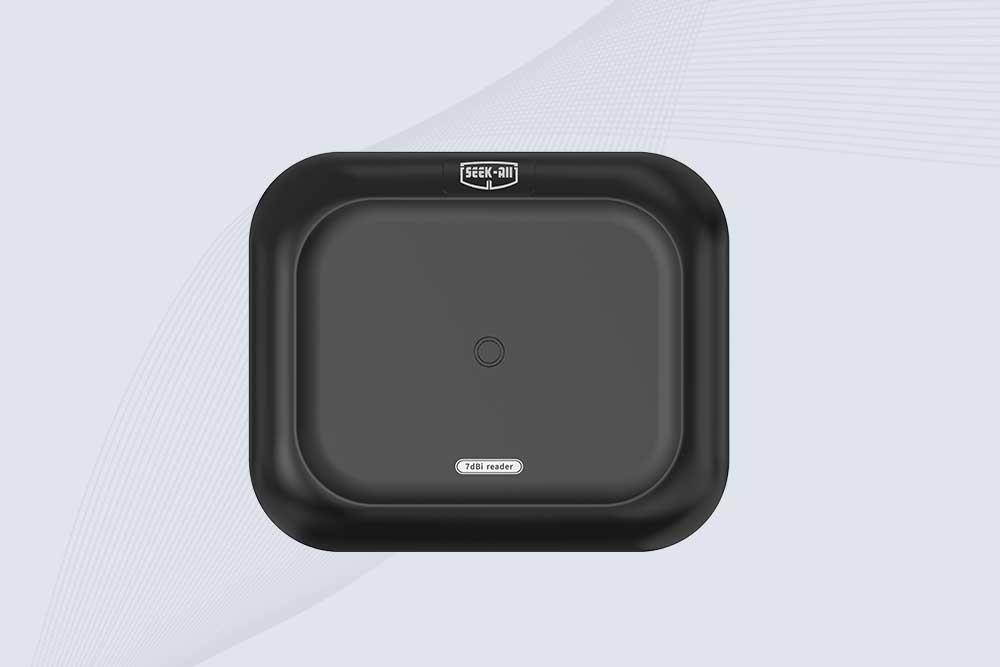
SSD-RA07L industrial UHF RFID reader with integrated 7 dBi antenna, up to 6 m reading distance, over 600 tags/s, Ethernet, RS232, and optional Wi-Fi, 4G, and PoE.
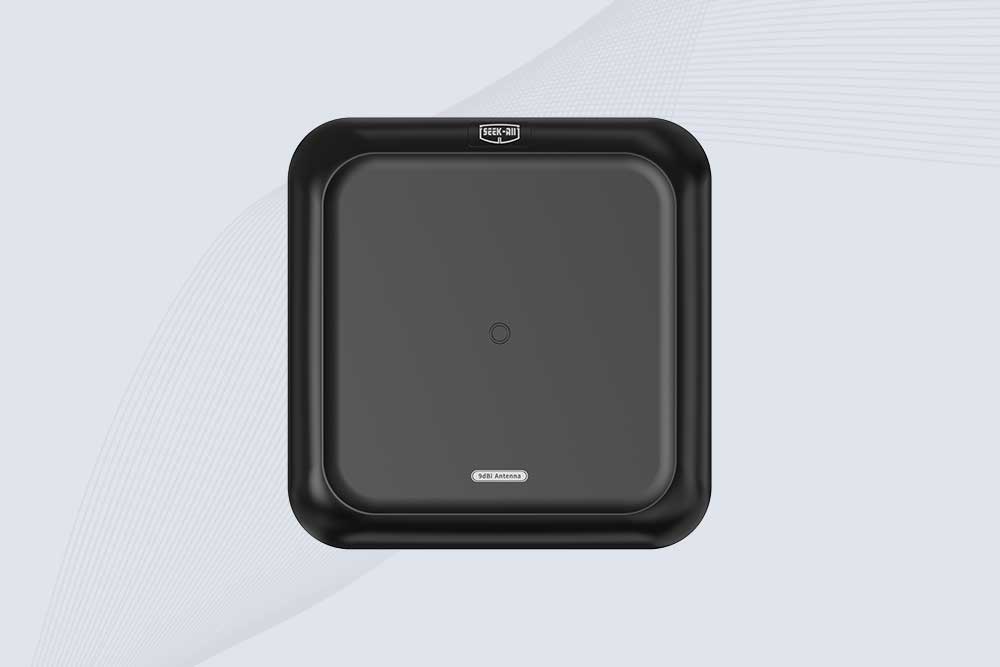
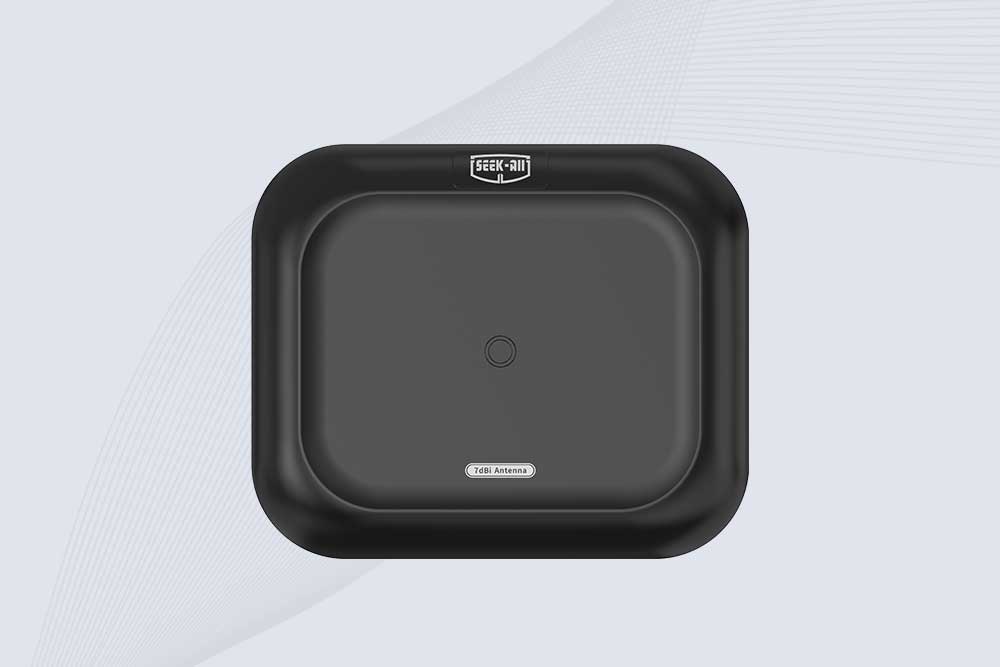
Explore the SSD-A07 UHF RFID antenna with 7 dBi gain, circular polarization, adjustable 840–960 MHz frequency, and 60°/75° beamwidth for stable RFID read/write performance.
SSD-A06 UHF RFID antenna with circular polarization, adjustable 840–960 MHz frequency, ≥4.5 dBi gain, and a compact directional design for RFID systems.
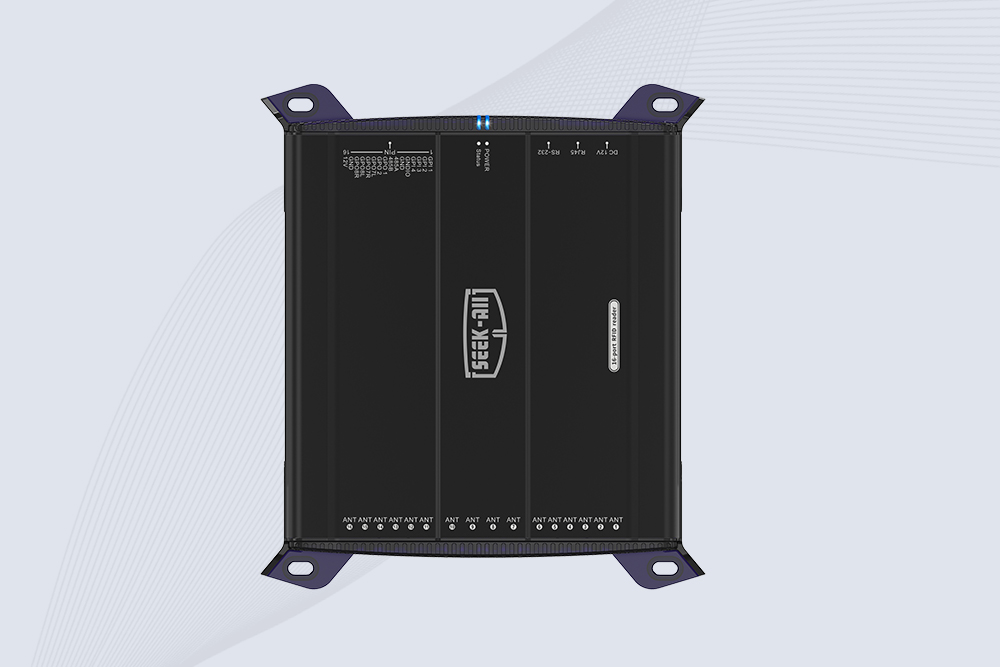
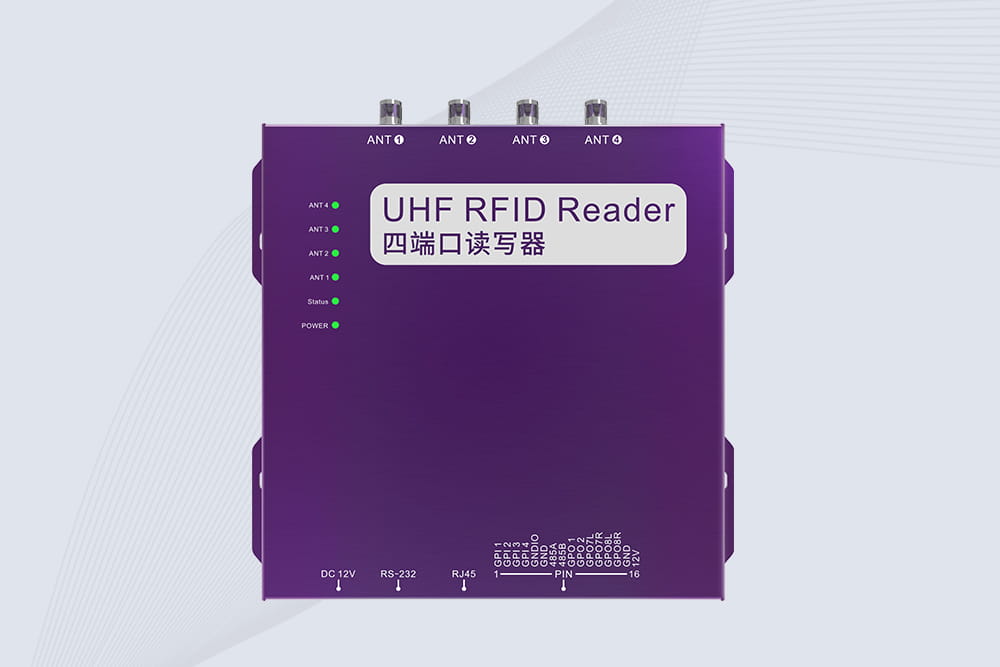
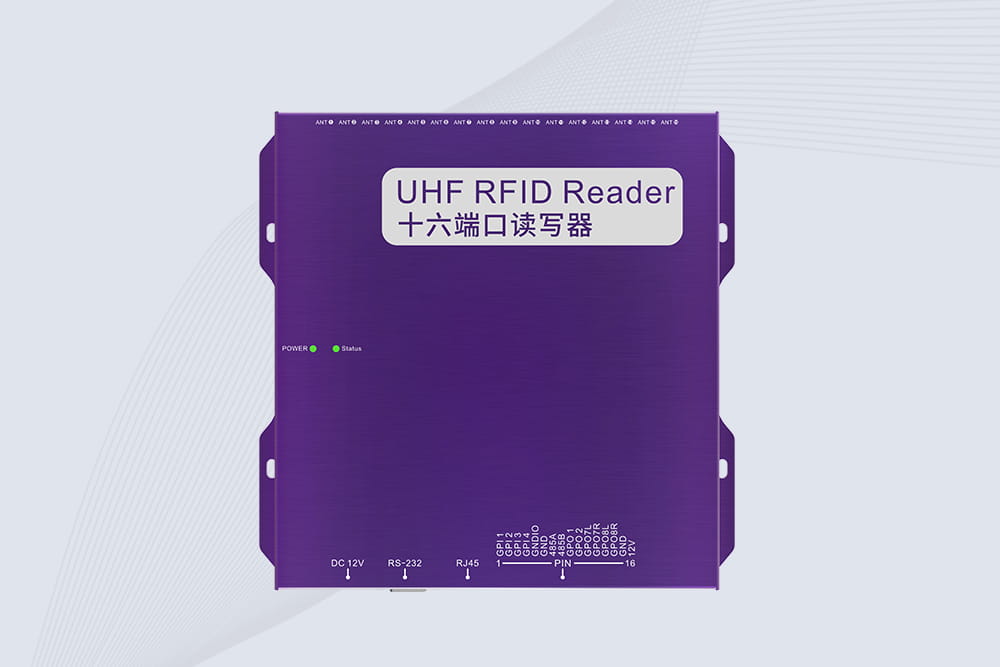
SSD-R16L Multi-Channel RFID Infrastructure for Automated Inventory Management ✔️ 16-Port High-Density RFID Reading Equipped with 16 SMA antenna ports, SSD-R16L supports multi-antenna deployment for warehouses, retail stores, logistics, production lines, and large-area RFID identification. ✔️ High-Speed & Long-Range Performance With up to 33…
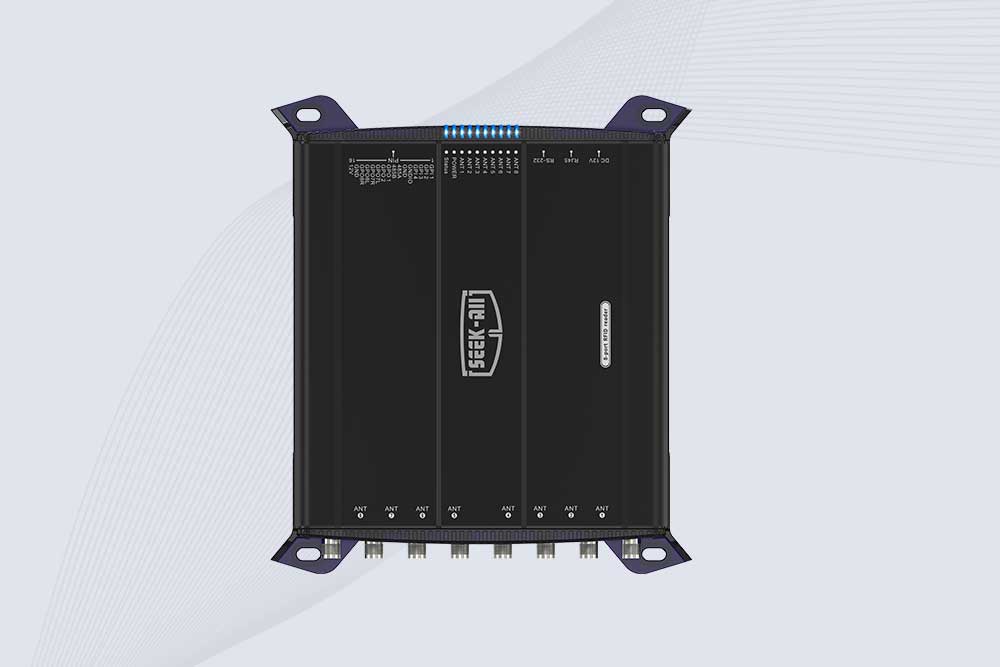
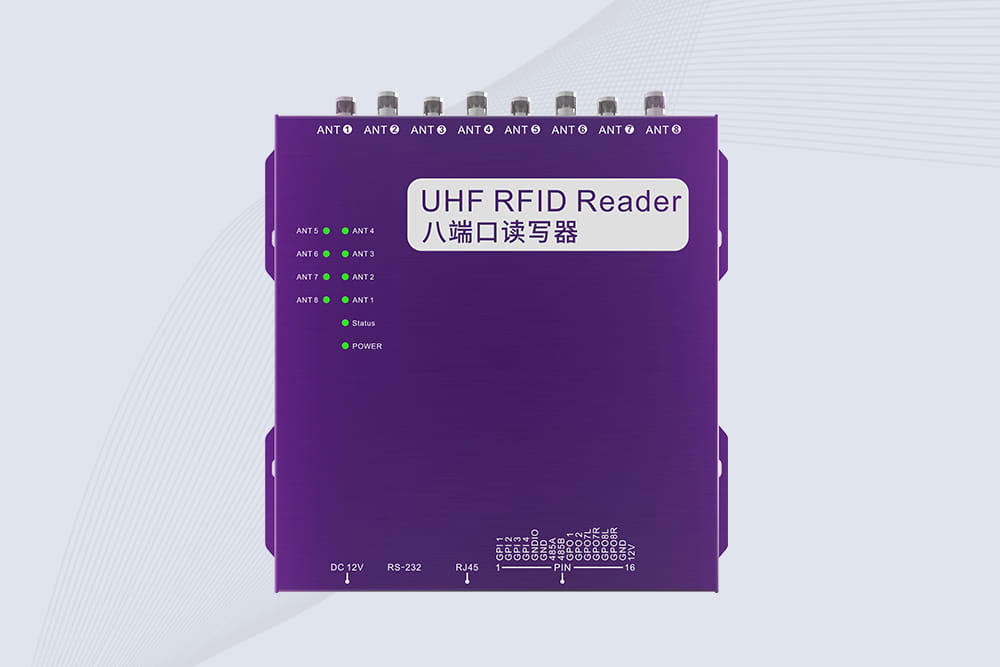
SSD-R8L 8-port UHF RFID reader with 33dBm output, up to 20m reading range and 600+ tags/s recognition. Ideal for warehouse, logistics, retail and asset tracking.
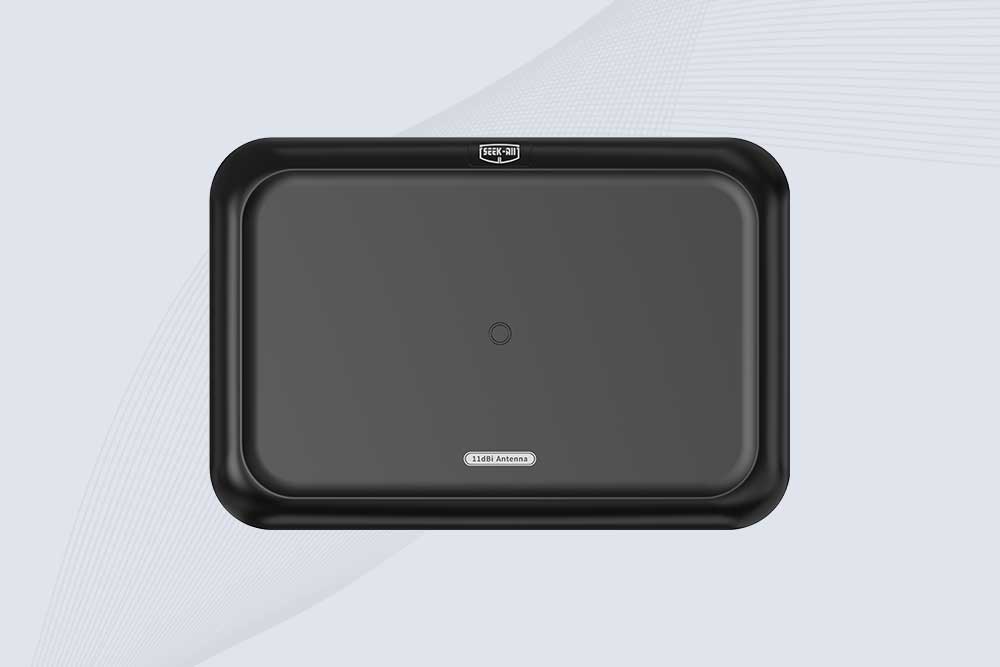
Cykeo CYKEO-A11 UHF RFID reader antenna delivers 11dBi gain, 840-960MHz frequency range, and IP65 ruggedness for retail, logistics, and industrial RFID systems. Features low VSWR and easy installation.
CYKEO Antenna RFID Reader delivers stable long-range UHF performance with a 10.5dBi directional design, built for warehouses, conveyor portals, and industrial RFID systems. This rfid reader antenna provides 20m+ read distance and rugged IP67 protection.
Cykeo CYKEO-A5B industrial Linear RFID Antenna delivers 5dBi gain, ≤1.5:1 VSWR, and IP65 rugged design for warehouse, production line, and logistics UHF systems.
Cykeo’s CYKEO-B12 Long Range RFID Antenna delivers 15m+ read range with 12dBi gain, IP65 rugged design, and global 840-960MHz UHF support. Ideal for warehouse/logistics asset tracking.
Cykeo CYKEO-B10 Long Distance RFID Antenna offers 10dBi gain, 840-960MHz frequency range, IP65 rating, and 20m+ coverage for logistics/warehousing/ETC systems. Low VSWR ensures stable signal transmission.
Cykeo CYKEO-A6 UHF RFID panel antenna features 6dBi gain, 840-960MHz broadband, IP65 metal-ready housing for logistics/smart retail. 18mm ultra-thin design with tool-free mounting.
Cykeo CK-A3 industrial antenna RFID UHF offers 5m+ tag detection, ≤1.3:1 VSWR, IP65 rugged design, and global UHF spectrum compatibility (840-960MHz) for warehouses, factories, and retail.
Cykeo CYKEO-B5 directional RFID antenna provides 5dBi gain with 60° narrow beamwidth for precise inventory tracking. IP65-rated, global UHF frequency support, and low VSWR.
Create your own high-performance DIY RFID antenna! 5dBi gain, 840-960MHz tunable, step-by-step guides. Compatible with Arduino, Raspberry Pi, and commercial UHF readers.
Cykeo CYKEO-A7 Flexible RFID Antenna features 840-960MHz wideband tuning, 7dBi gain, and IP68 rating for medical/retail/industrial curved surface deployments. 98% read accuracy with peel-and-stick installation.
Cykeo CYKEO-B5A industrial Passive RFID Antenna delivers 5dBi gain, 70° beamwidth, and -40°C~55°C operation for warehouses/smart cabinets. Compatible with Zebra/Impinj readers.
Cykeo’s CYKEO-A9B High Gain RFID Antenna delivers 15m+ read range with 9dBi amplification. Features IP54 rugged design, 840-960MHz bandwidth, and 80° beamwidth for warehouse/manufacturing RFID systems.
Cykeo’s enterprise-grade 8dbi Impinj RFID Antenna 10m+ read range with 840-960MHz tuning. Features IP65 housing, 1.4 VSWR, 35° beamwidth for retail/warehouse RFID systems.
Cykeo CYKEO-A9 industrial UHF RFID antenna delivers 9dBi gain, 840-960MHz frequency range, and IP65 protection for warehouse/logistics/retail RFID systems. Features N-type connector and ≤1.3:1 VSWR.
CYKEO UHF RFID Antenna built for long-distance and industrial applications. This antenna rfid uhf delivers strong gain, outdoor durability, and reliable tag performance in warehouses, yards, and vehicle ID systems.
CYKEO Antenna RFID delivers reliable long-range UHF performance in warehouses, retail shelves, and cold-chain environments. This compact uhf rfid antenna provides stable reads with circular polarization and ultra-wide 840–960 MHz support, ideal for industrial tracking, smart shelves, and asset monitoring.
Cykeo’s CYKEO-C8 UHF RFID antennas delivers 8dBi gain, 840-960MHz full-band coverage, and IP65 ruggedness for manufacturing/warehouse RFID systems. Industrial RFID Antennas Features
Cykeo’s 8dBi UHF RFID antenna and reader kit delivers 10m+ range, 840-960MHz broadband, and IP65 ruggedness for factories, warehouses, and logistics. ISO 18000-6C & EPC Gen2 certified.
Cykeo’s CYKEO-A12C UHF Large RFID Antenna delivers 12dBi gain, 840-960MHz global frequency, IP65 ruggedness for logistics/warehousing/automotive. 40° beamwidth ensures stable 15m+ tag reads.
CYKEO Near Field RFID Antenna provides precise 5–30 cm reading for shelves, cabinets, and workstations. This compact rfid shelf antenna delivers stable short-range performance around metal and clutter, ideal for pharmacies, libraries, and electronics sorting.
Cykeo’s industrial long range RFID reader delivers 20-meter scanning, 500+ tags/sec speed, and IP67 waterproof design for automated warehouses, logistics, and harsh environment applications.
Cykeo’s CYKEO-RA6L industrial RFID long range reader features 20m read distance, 500 tags/sec speed, and IP67 protection. Ideal for warehouse automation, manufacturing WIP tracking, and smart logistics. Supports ISO 18000-6C/6B protocols.
CYKEO Long Range RFID Tag Reader built for outdoor and industrial operations. This Outdoor RFID Reader delivers 20m read distance, fast tag processing, and IP67 durability for wide-area tracking.
Cykeo CYKEO-RA12L industrial Long Range RFID Reader delivers 20m read range, 200+ tags/sec scanning, and IP67 protection for manufacturing/logistics applications. Supports ISO 18000-6C/GB protocols.
Cykeo CYKEO-C1 industrial Forklift RFID Reader features 20m read range, 600 tags/sec scanning, Impinj R2000 chipset, and IP67 rugged design. Ideal for warehouse logistics and manufacturing. Supports ISO 18000-6C/6B protocols.
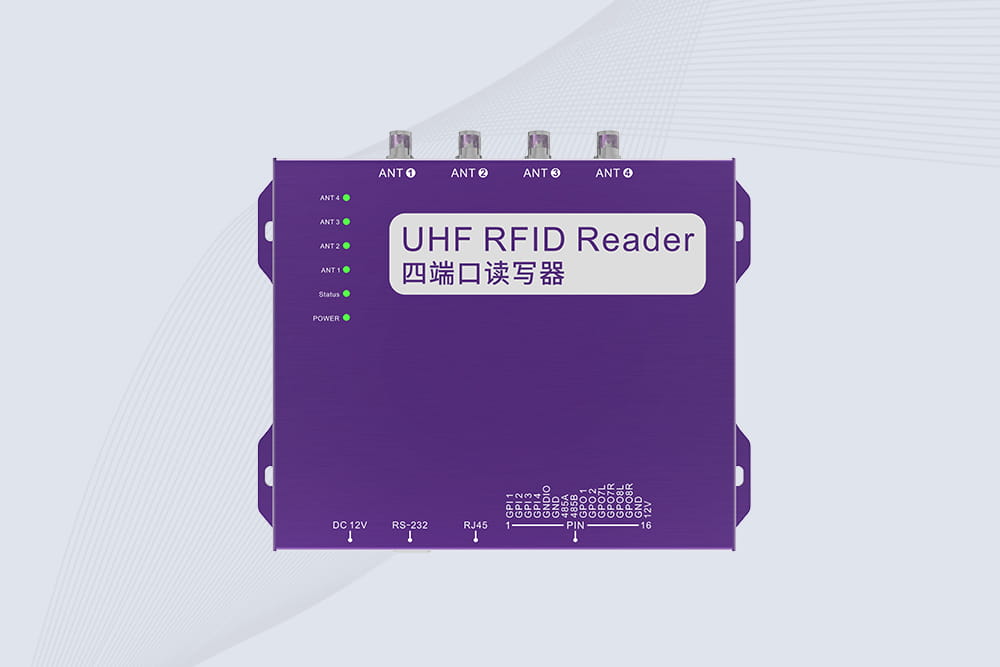
Cykeo CYKEO-R4 industrial UHF RFID Fixed Reader features 4 TNC ports, 400+ tags/sec speed, IP67 housing, and global frequency compliance for vehicle inspection, smart warehouse, and asset management systems.
CYKEO CYKEO-R8L Fixed RFID Reader with 8-port UHF design, Impinj-based RF core and up to 20m read range. An industrial Fixed RFID Reader for vehicle inspection, warehouse portals, smart manufacturing lines and secure access checkpoints.
RFID Fixed Reader from CYKEO – the CYKEO-R16L 16-port UHF fixed reader for warehouses, smart cabinets, and production lines. Long-range, multi-tag reading, stable performance for 24/7 industrial use.
Discover how IoT-enabled RFID readers are revolutionizing smart factories in 2024. Enhance efficiency, reduce downtime, and optimize workflows with Cykeo’s advanced RFID solutions.
RFID technology offers powerful theft prevention solutions for libraries. This article explores how RFID tags help libraries enhance security, reduce book theft, and promote intelligent management.
If your RFID gate access control system is slowing down vehicles, it’s usually a configuration, reader, or logic issue — not the technology itself. Learn practical tips to optimize reader placement, access rules, and detection range for smooth, re...
 Cykeo RFID IoT Solution Products R&D Manufacturer