If you’re just getting into RFID, the first thing people usually ask is simple: what is an RFID tag?
It sounds basic, but in real RFID projects, the tag is actually one of the most important parts. If the tag isn’t right, the whole system can struggle. You may have a good reader and antenna, but the tags still don’t read properly.
That’s why many RFID deployments start with testing tags first.
In this article, we’ll go through the basics in plain terms. What RFID tags are, how they work, and why there are so many different types.
What Is an RFID Tag?
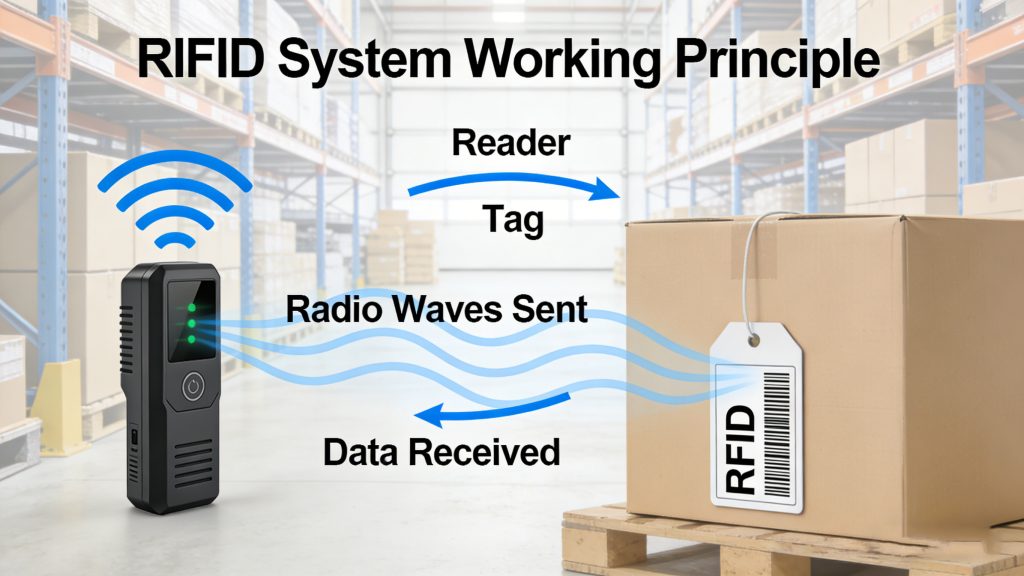
An RFID tag is a small electronic tag that stores data and talks to an RFID reader using radio signals.
Think of it like a digital ID card for an object.
You attach the tag to something — a box, a tool, a pallet, or even a piece of equipment. When that item gets close to an RFID reader, the tag sends its ID number to the reader.
The reader then passes that information to software, which tells the system exactly what item it is.
One big advantage of RFID is that you don’t need to scan items one by one. Tags can be read automatically, even when they’re inside cartons or moving through a doorway.
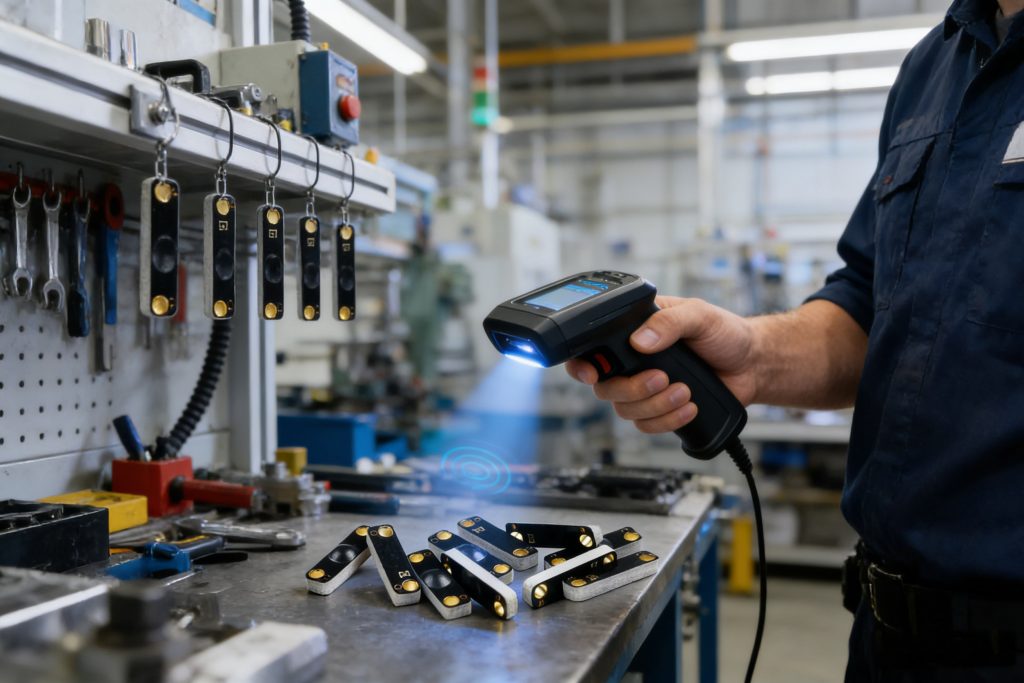
RFID tags also come in many shapes depending on the job. Some look like simple stickers. Others are hard plastic tags designed for factories or outdoor environments.
Even though RFID tags are small, they still have a few important parts inside.
The Chip
The chip stores the tag’s ID number.
Most of the time, that number links to a record in a database. For example, it might represent a specific product, tool, or asset.
Some chips can store extra data, but many systems simply use the ID number.
The Antenna
The antenna lets the tag talk to the reader.
When the reader sends out a radio signal, the antenna picks it up and sends data back.
The antenna design actually matters a lot. It affects how far the tag can be read and how stable the signal is.
The Tag Body
The chip and antenna are mounted on a base material or sealed inside a case.
For simple logistics tracking, the tag might just be a label.
For industrial use, the tag may have a thick plastic or metal housing to protect it from heat, chemicals, or rough handling.
How RFID Tags Work
The working process is pretty straightforward.
First, the RFID reader sends out radio signals.
When a tag enters that signal area, it picks up the energy from the reader.
For most passive tags, that energy powers the chip. The tag then sends its stored ID back to the reader.
The reader receives the data and sends it to the system software.
All of this happens very quickly. In many cases, dozens of tags can be read in just a second.
Of course, real environments can make things trickier. Metal surfaces, liquids, and crowded tag areas can affect performance. That’s why tag testing is common before full deployment.
Types of RFID Tags
RFID tags are usually grouped by how they get power.
Passive RFID Tags
Passive tags do not have a battery.
They get power from the reader’s signal.
These tags are small and inexpensive, which is why they’re used in most RFID systems. Warehouses and retail operations use them a lot.
Active RFID Tags
Active tags have their own battery.
Because of this, they can send signals over much longer distances.
They are often used to track vehicles, containers, or large equipment.
The downside is that they cost more and are bigger.
Battery-Assisted Tags
These tags sit somewhere in the middle.
They have a small battery to improve performance but still communicate using the reader’s signal.
Common RFID Tag Designs
RFID tags come in many different shapes. The design usually depends on where the tag will be used.
Some common types include:
RFID label tags for boxes and products
On-metal tags for machinery or metal assets
Cable tie RFID tags for tools or containers
Rugged industrial tags for factories
In many RFID projects, choosing the right tag design is more important than people expect.
A tag that works well on cardboard might perform very poorly when attached to metal.
Where RFID Tags Are Used
RFID tags are now used in many industries.
Some common examples include:
Warehouse inventory tracking
Tool management
Retail product identification
Healthcare equipment tracking
Manufacturing asset tracking
In most cases, the goal is the same: reduce manual work and collect data automatically.
Instead of scanning barcodes one by one, RFID systems can detect items as they move through a door, shelf, or workstation.
One Thing People Learn Quickly About RFID Tags
A lot of people think RFID tags are simple — and technically they are.
But once you start working on real deployments, you realize that tag selection matters a lot.
Material, placement, environment, and reading distance can all affect performance.
That’s why many RFID solution providers spend time testing different tags before installing a full system.
Once the right tag is chosen, the system usually becomes much more stable.
Final Thoughts
RFID tags are small devices, but they play a huge role in any RFID system.
They give physical objects a digital identity and allow systems to recognize them automatically.
As warehouses, factories, and supply chains become more automated, RFID tags are becoming more common everywhere.
And in most RFID projects, choosing the right tag is often the first step to getting the system working properly.
How to Identify an RFID Tag
If you’ve ever held a plastic access card, a warehouse tag, or a library label and wondered “Is this an RFID tag, and what type is it?”, you’re not alone. RFID technology hides in plain sight — inside cards, stickers, and even tools — and it comes in several different types. Knowing how to identify your RFID tag can save hours of trial and error, especially if you’re troubleshooting or planning to integrate it into a new system.For deeper technical explanation of How to Identify an RFID Tag, see this related guide:How to Identify an RFID Tag
how to check rfid card frequency
If you’ve ever tried replacing an RFID card or matching it with a new reader, you’ve probably run into the same problem most people do: you don’t actually know what frequency the card uses.
At first glance, RFID cards all look almost identical. But inside, they can work on completely different frequencies, and that matters more than most people realize. A card that works perfectly with one system may do absolutely nothing on another reader simply because the frequencies don’t match.
The good news is that checking an RFID card frequency usually isn’t difficult. In many cases, you can figure it out in just a few minutes using a phone, a reader, or even the card itself.
Avoid costly RFID reader setup errors! Learn the 7 most common installation mistakes and how Cykeo’s expertise ensures optimal RFID performance for warehouses, retail, and logistics.
A hands-on guide to RFID antenna design covering frequency selection, impedance matching, substrate choice, and tuning. Includes real-world pitfalls, on-site testing tips, and lessons from field deployment.
The best long range RFID scanner is not necessarily the one with the highest power or longest advertised range. A suitable reader should match the tag, produ...
 Cykeo RFID IoT Solution Products R&D Manufacturer