When people first get into RFID projects, they usually focus on hardware.
They compare specs, ask about reading distance, and try to pick the “most powerful” reader.
But after you’ve worked on a few real deployments, you start to realize something pretty quickly:
The system doesn’t succeed or fail because of the reader — it succeeds or fails because of the software layer.
To put it simply:
1. What an RFID Reader Actually Gives You
At its core, an RFID long range reader does one thing:
It continuously reads tag IDs and sends them out.
That’s it.
There’s no built-in logic like:
“this item entered the warehouse”
“this pallet just moved out”
“this is a valid event”
Instead, what you get looks more like this:
Tag A
Tag A
Tag A
Tag B
Tag A
Sometimes dozens or even hundreds of reads per second.
If you don’t process this properly, the data is basically useless.
2. The Real Challenge: Not Reading, But Handling Data
A lot of first-time projects get stuck here.
The assumption is:
In reality:
You still need to deal with:
Duplicate reads
Timing issues
False positives
Multiple tags at once
This is why SDK and API design matters more than most people expect.
3. What a Real Data Flow Looks Like
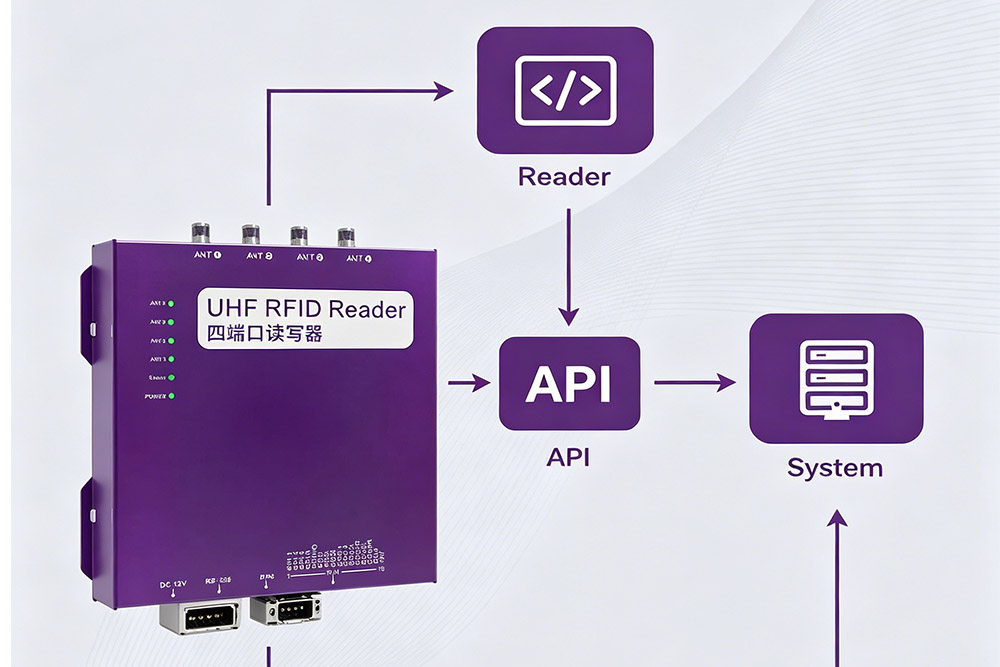
In most practical systems, the architecture looks like this:
Reader → Middleware (API / service layer) → Business system (WMS / ERP / MES)
The middle layer is where everything happens.
That’s where you:
Receive raw data
Clean it
Turn it into meaningful events
If this layer is weak, the whole system becomes unstable — no matter how good your hardware is.
4. SDK Quality Makes a Huge Difference
This is something people usually underestimate — until they hit problems.
Some readers come with SDKs that are:
Poorly documented
Missing working examples
Unstable or inconsistent
And then instead of building your system, you spend days just trying to make the device behave properly.
A good SDK usually has:
Clear and complete documentation
Real, working sample code
Support for common languages (Java, C#, Python)
Predictable behavior
In real projects, this can save a lot of time and frustration.
5. RFID Is Not Barcode — Don’t Treat It Like One
This is a big mindset shift.
Barcode scanning works like this:
→ One trigger → One result
RFID works like this:
→ Continuous scanning → Data stream
That means you cannot just take raw data and push it into your system.
You need to convert that stream into meaningful events .
6. The Most Important Step: Filtering
If you skip filtering, your system will break. It’s that simple.
Here’s a real example:
A pallet passes through a gate.
If you store all of those:
→ Your inventory increases 20 times
Clearly wrong.
Common Filtering Approaches
1. Time window filtering
2. State-based logic
3. Zone-based logic
7. Don’t Use Raw Reads as Business Data
A common mistake is writing raw RFID reads directly into a database.
This leads to:
Data overload
Confusing records
Hard-to-debug systems
A better approach is:
→ Raw data → Processing → Event → Store
That extra step makes the system usable.
8. What You’ll Run Into in Real Projects
No matter how good your setup is, real environments will introduce challenges.
For example:
Multiple tags at once
Metal interference
Network instability
None of these are unusual — but your system needs to handle them.
9. A Practical Workflow That Actually Works
If you’re building an RFID system, this order helps avoid headaches:
Define your business process first
Decide what counts as a “valid event”
Design your filtering and logic
Then integrate the reader
Most problems happen when people do this in reverse.
10. One Simple Way to Think About RFID
If you remember just one thing, make it this:
RFID is not about reading tags — it’s about processing real-time data.
The reader is just the entry point.
The real value comes from:
How you filter data
How you define events
How stable your system runs over time
Conclusion
If you’re a developer or system integrator, here’s a simple piece of advice:
Don’t start by asking,
Start by asking,
Once that’s clear, everything else becomes much easier — including hardware selection.
 Cykeo RFID IoT Solution Products R&D Manufacturer