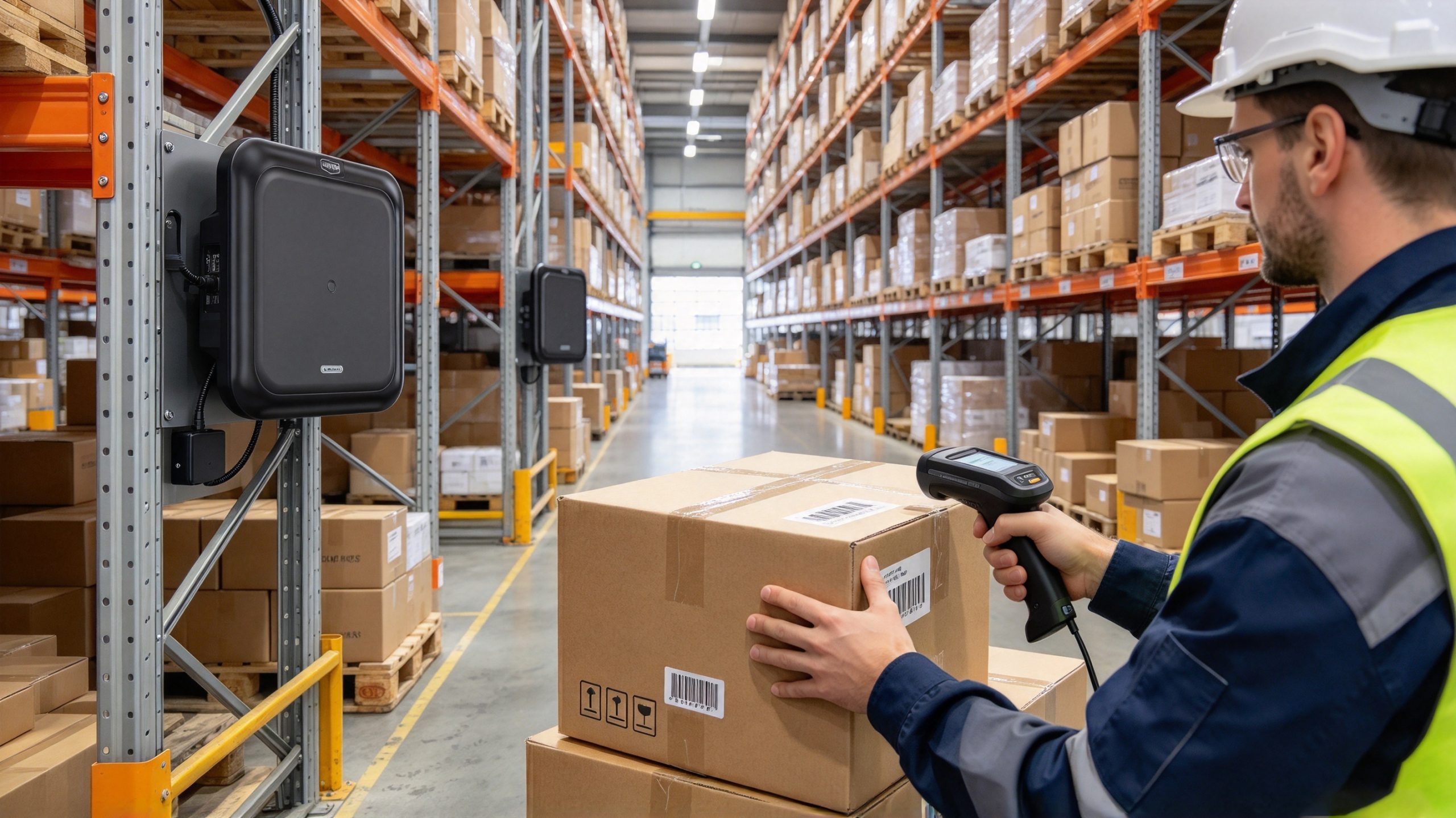
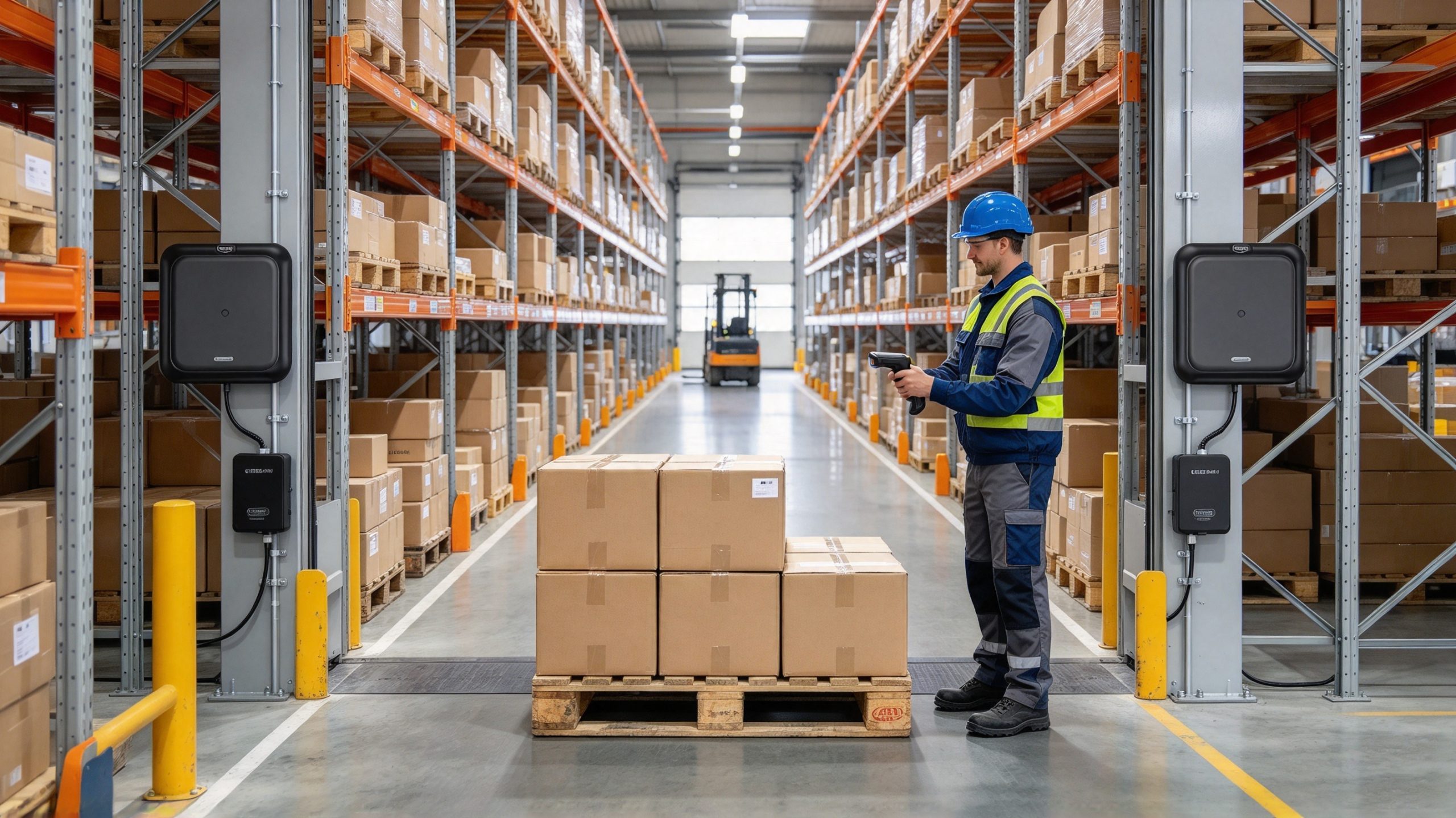
RFID differs from barcode scanning in how it captures identification data. Barcode scanners optically read a visible printed code, usually one code at a time, while RFID readers communicate with electronic tags using radio waves and can identify multiple compatible tags without direct line of sight. The better choice depends on the workflow, cost, and tracking requirements.
Both technologies help businesses identify products, manage stock, and exchange information with inventory software. Neither is automatically better in every situation. A barcode may be ideal for a checkout counter where a cashier deliberately scans each product, while RFID may be more practical for counting hundreds of tagged items in a stockroom without handling each one individually.
The difference becomes clearer when you look at what happens on a busy working day. A warehouse employee scanning a barcode needs to position the code so the scanner can capture it. An RFID reader can detect compatible tags within its configured radio-frequency reading zone, even when the tags are not visible, provided the surrounding materials and radio conditions allow a successful read.
For businesses comparing the two systems, the important question is not simply which technology is newer. It is how the identification process fits the movement of goods, the required level of traceability, and the cost of operating the system over time.
How Barcode Scanning Works
A barcode stores information in a printed pattern. A one-dimensional barcode uses lines and spaces, while a two-dimensional code, such as a QR code, uses a matrix of visual elements. An optical scanner captures the pattern and converts it into data that software can process. GS1 describes barcodes as a widely used method for identifying products, shipments, locations, and other supply-chain entities.
A typical barcode workflow looks like this:
A barcode is printed on a product, package, label, or document.
A scanner captures the visible code.
The scanner decodes the information.
The connected application looks up the matching product or record.
The system updates the relevant transaction, such as receiving, picking, checkout, or dispatch.
The process is straightforward and familiar to most employees. A retail cashier scans a product at checkout; a warehouse picker scans a bin location and then the item; a healthcare worker scans a product identifier as part of a defined verification workflow.
Barcode systems also have practical limits. The code must usually be visible to the scanner, sufficiently clear, and positioned within its effective scanning area. A label hidden behind another carton, damaged by abrasion, or printed with insufficient contrast may need to be repositioned or entered manually.
That does not make barcodes unreliable by definition. In a controlled process where each item is presented to a scanner, barcode identification can be a simple, economical, and highly effective choice.
How RFID Identification Works
RFID uses a reader, an antenna, and an electronic tag. In a common passive UHF system, the reader sends a radio-frequency signal; the tag uses energy from that field to respond, and the reader decodes the response. The resulting identifier can then be sent to inventory or asset-management software.
A typical RFID workflow is different from the barcode process:
A compatible RFID tag is attached to or incorporated into the item or package.
An RFID reader transmits a signal through its antenna.
Tags within the effective reading zone respond.
The reader captures the tag identifiers and transfers them to the host system.
Software filters repeated observations, matches identifiers to records, and processes the relevant business event.
Unlike optical barcode scanning, RFID does not generally require the tag to be directly visible to the reader. A compatible reader may also identify multiple tags during one inventory operation. However, radio-frequency performance depends on the tag, antenna configuration, item orientation, surrounding materials, and the design of the reading zone.
An RFID system is therefore not simply a barcode scanner that works from farther away. It is a different data-capture method, with different hardware, setup requirements, and opportunities for automation.
Barcode scanning requires optical capture of a visible code, while RFID readers communicate with compatible electronic tags by radio.
Key Differences Between RFID and Barcode Scanning
Feature
RFID
Barcode scanning
Data capture
Radio-frequency communication
Optical reading of a printed code
Direct line of sight
Generally not required for compatible RFID tags
The code normally must be visible to the scanner
Multiple-item identification
Can read multiple compatible tags in one inventory operation
Usually requires each code to be presented to the scanner
Physical labels
Requires compatible electronic tags
Requires printed barcodes or two-dimensional codes
Data storage
Some tags support writable memory, depending on type
The code contains encoded data; changing it generally requires generating and printing a new code
Typical hardware
RFID reader, antenna, and tags
Barcode scanner or camera-based reader and printed codes
Installation complexity
May require antenna placement, RF tuning, and integration
Often simpler where operators can scan individual labels
Point-of-sale, shipping labels, picking, receiving, and document identification
Cost considerations
Tags and reader infrastructure may cost more initially
Printing and scanning are often inexpensive and widely available
Main limitation
Radio performance and reading-zone control require attention
Visibility, label quality, and individual scanning can constrain the workflow
Which technology is faster?
RFID can reduce the time required to identify many tagged items because compatible tags may be read in the same inventory operation. Barcode scanning is often efficient when a worker already handles each product individually, such as during checkout or item verification.
The real comparison should measure the whole task—not just the time needed to capture one identifier. Include employee movement, item handling, exception correction, system integration, and reconciliation. A fast RFID read is not useful if the software incorrectly associates the tag with a transaction; a quick barcode scan is not enough if employees must repeatedly uncover or reposition labels.
Where RFID and Barcode Scanning Work Best
The difference between RFID and barcode scanning becomes clearer when you look at the actual task. A warehouse receiving team, a retail stockroom, and a manufacturing line may all need item identification, but they do not necessarily need the same capture method.
Retail Inventory and Stocktaking
Barcode scanning is effective when staff handle products individually, verify a sale, or check a specific item. It is familiar, relatively straightforward to deploy, and can use existing printed labels and scanners.
RFID is particularly useful when staff need to count many tagged items quickly. With a compatible reader and correctly configured read zone, employees can capture multiple tags without pointing a scanner at every label. This can reduce the manual work involved in inventory counts, although the result depends on tag placement, product materials, reader configuration, and the quality of the inventory process.
A peer-reviewed study by Hardgrave, Aloysius, and Goyal examined RFID-enabled inventory visibility in retail stores. In one part of the study, inventory record inaccuracy fell by approximately 26% for the studied product category. The researchers also found that results differed across categories, so this figure should not be treated as a guaranteed improvement for every retailer.
Warehouse Receiving and Shipping
At a receiving dock, barcode scanning can verify cartons or pallets when labels are accessible and the process is designed around individual scans.
RFID can be advantageous when tagged goods pass through a defined portal or reading zone. Multiple tags may be captured during one pass, allowing software to compare the detected items with an expected shipment list. However, an RFID read alone does not prove that the correct shipment has been accepted or that every item is in the intended container. The application must associate reads with the right shipment, location, and business event.
For example, a warehouse can use RFID to detect tagged cartons entering a receiving area while retaining barcode labels for exception handling, supplier identification, or manual verification.
Manufacturing and Work-in-Process Tracking
Manufacturers may use barcodes to identify a work order, component, or product at a station. This is suitable when an operator can easily present the label to a scanner.
RFID can support automated identification as tagged components or containers move through defined production points. It may help associate an item with a workstation or process stage without requiring an operator to scan each label manually.
The main engineering challenge is the environment. Metal equipment, liquid-filled products, closely packed tags, and nearby RFID zones can affect read performance. Pilot testing should use the actual tags, fixtures, containers, and production speeds rather than relying on a reader’s maximum advertised range.
RFID can automate multi-item identification at a defined receiving zone, while barcodes remain useful for individual verification and exceptions.
Cost Comparison: RFID vs. Barcode Scanning
The initial cost is often the most visible difference. Barcode labels are inexpensive to print, and many businesses already own compatible scanners. RFID requires electronic tags, compatible readers and antennas, and software capable of processing tag reads.
However, purchase price alone does not determine the better investment. A warehouse that spends substantial labor time scanning individual items may benefit from RFID, while a small operation that scans only a few products at a time may find barcodes more economical. GS1 describes RFID and barcodes as complementary technologies rather than mutually exclusive choices.
Cost factor
Barcode scanning
RFID
Identification label
Printed barcode label
Electronic RFID tag or label
Reader equipment
Optical scanner or compatible mobile device
RFID reader and, where required, antennas
Infrastructure
Often simpler to install
May require read-zone design and tuning
Staff workload
Usually involves presenting each code to a scanner
Can capture multiple compatible tags in one operation
Software
Records scans and updates business systems
Must also manage tag reads, duplicates, and read-zone events
Best cost fit
Low-volume or item-by-item scanning
High-volume operations where automated capture has measurable value
To estimate return on investment (ROI), measure the current process before buying equipment. Record the labor hours used for cycle counts, receiving and shipping checks, the frequency of stock discrepancies, and the cost of correcting them. Then compare those figures with the full cost of RFID tags, hardware, integration, maintenance, and ongoing support.
Do not assume RFID will automatically reduce labor or improve accuracy. Those benefits depend on whether the technology solves an existing operational problem.
Limitations of RFID and Barcode Scanning
Neither method is error-proof. Their failure modes are simply different.
Barcode Scanning Limitations
Line of sight: The scanner generally needs a clear view of the printed code.
Label condition: Dirt, damage, wrinkles, or poor print quality can prevent successful reading.
Individual scanning: Counting many items can take time because each code usually needs to be presented separately.
Operator dependence: Results may be affected by missed scans, incorrect handling, or failure to follow the workflow.
RFID Limitations
Radio-frequency interference: Metal surfaces, liquids, tag orientation, and surrounding materials can affect UHF RFID performance.
Unwanted reads: A reader may detect tags outside the intended group if the read zone is not controlled.
Duplicate events: A tag may be read repeatedly as it remains within range. Software must filter repeated observations and interpret them correctly.
Deployment complexity: Antenna placement, reader power, tag selection, regional frequency rules, and integration all need consideration.
RFID does not automatically identify an item’s exact physical location. A reader detects a tag within its effective reading area; the application uses that observation and other system information to determine what it means. For this reason, a well-designed barcode process can outperform a poorly configured RFID system.
Can RFID Replace Barcode Scanning?
RFID can replace barcode scanning in some workflows, but it does not need to replace it everywhere. Many businesses benefit from using both technologies for different tasks.
For example, a distribution center might use RFID portals to verify tagged cartons at receiving and dispatch, while workers use barcodes to identify individual products, check exceptions, or retrieve a record manually. A retail operation might use RFID for stocktaking and retain barcode scanning at checkout.
GS1 guidance also recognizes that the two technologies can work together. The important requirement is that both identification methods connect reliably to the same product records and business processes.
How to Choose the Right Technology for Your Business
Before selecting a system, evaluate the actual workflow rather than choosing based on read speed alone.
Choose barcode scanning when:
Staff identify products one at a time.
Labels are easy to see and reach.
Initial equipment and label costs are the main priorities.
Large numbers of tagged items must be counted quickly.
Items move through controlled receiving or dispatch points.
Manual scanning is a measurable bottleneck.
Non-line-of-sight identification can simplify the workflow.
Consider a hybrid system when:
Different tasks have different identification requirements.
RFID can automate bulk capture while barcodes support manual checks.
Existing labels and business systems need to remain in service.
A Practical Evaluation Checklist
Before implementation, answer these questions:
How many items are processed per hour or per shift?
How much staff time does the current scanning or counting process require?
Do operators need to identify one item or a group of items?
Are labels consistently visible and readable?
Will RFID tags be attached to metal objects, liquid-filled products, or tightly packed goods?
Does the system need to record individual-item identity, movement through a zone, or both?
Can the existing warehouse management system (WMS), enterprise resource planning (ERP) system, or inventory application accept the new data?
What improvement would justify the additional investment?
A limited pilot is often the most reliable way to answer these questions. Test representative products under actual operating conditions, compare results with a verified count, and measure labor time, missed identifications, unwanted reads, and total implementation costs.
Frequently Asked Questions
1. How is RFID different from barcode scanning in inventory management?
RFID uses radio waves to identify compatible electronic tags, potentially capturing multiple items at once without direct line of sight. Barcode scanning reads printed codes optically, usually one at a time. RFID may streamline bulk stocktaking, while barcodes remain cost-effective for individual-item verification.
2. Is RFID more accurate than barcode scanning?
Not in every situation. Barcode scanning can provide reliable item-by-item identification when labels are visible and the operator follows the process. RFID can improve inventory visibility by capturing many tagged items efficiently, but performance depends on tag placement, read-zone design, interference, and software processing.
3. Can RFID read multiple items at once?
Yes. Compatible RFID readers can identify multiple tags within their effective read zone during the same operation. The number of tags successfully captured depends on the reader, antenna, tags, environment, and system configuration. A successful multi-tag read should still be validated against the application’s business requirements.
4. Is RFID more expensive than barcode scanning?
RFID usually requires more specialized hardware and electronic tags, so its initial investment is often higher. Barcode labels and scanners are generally less expensive to deploy. RFID may justify its cost when automated bulk identification reduces labor or improves visibility enough to offset the additional expenses.
5. Do RFID tags need to be visible to the reader?
No. RFID does not require the direct optical line of sight that barcode scanning generally needs. However, the tag must be within a suitable radio-frequency reading area, and materials such as metal or liquid can affect performance. Tag selection and positioning remain important.
6. Should a warehouse switch completely from barcodes to RFID?
Not necessarily. A warehouse should switch only where RFID addresses a measurable limitation. A hybrid setup can use RFID for bulk identification at receiving, dispatch, or inventory counts while retaining barcodes for manual checks and existing workflows. A pilot can establish whether the benefits justify a broader rollout.
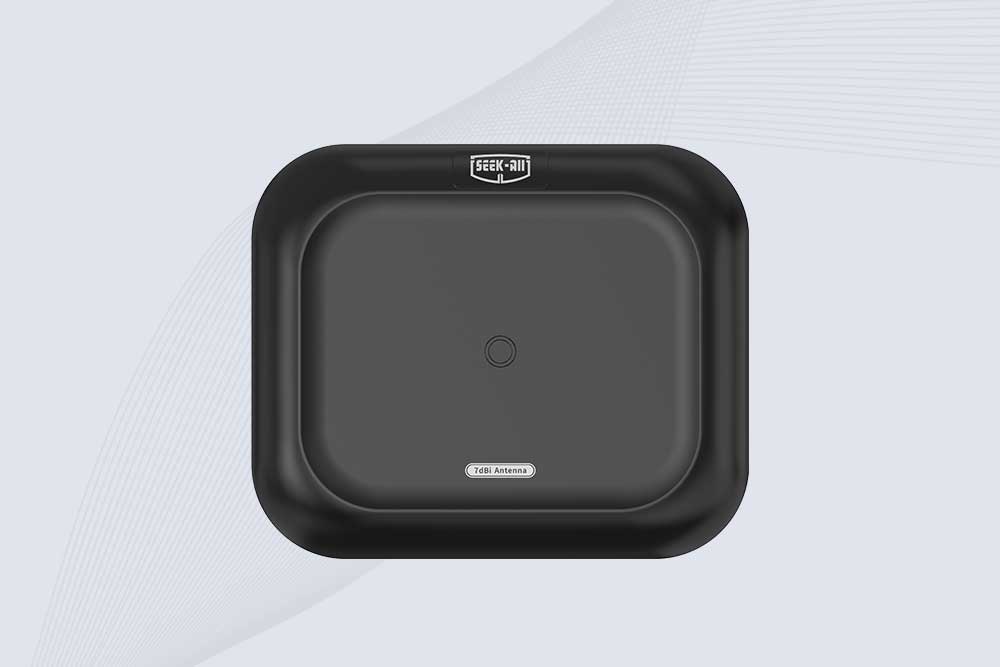
Explore the SSD-A07 UHF RFID antenna with 7 dBi gain, circular polarization, adjustable 840–960 MHz frequency, and 60°/75° beamwidth for stable RFID read/write performance.
SSD-A06 UHF RFID antenna with circular polarization, adjustable 840–960 MHz frequency, ≥4.5 dBi gain, and a compact directional design for RFID systems.
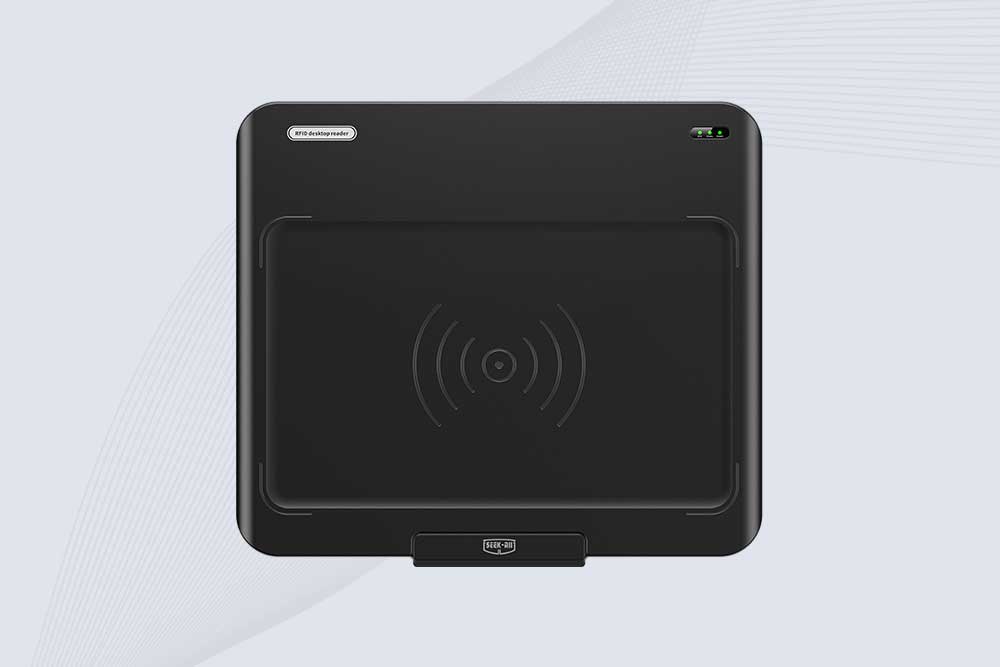
SSD-D3AL is a USB-HID UHF RFID reader with 0–30 cm reading, 0–15 cm writing, over 600 tags/s recognition, USB plug-and-play operation and OEM Logo customization.
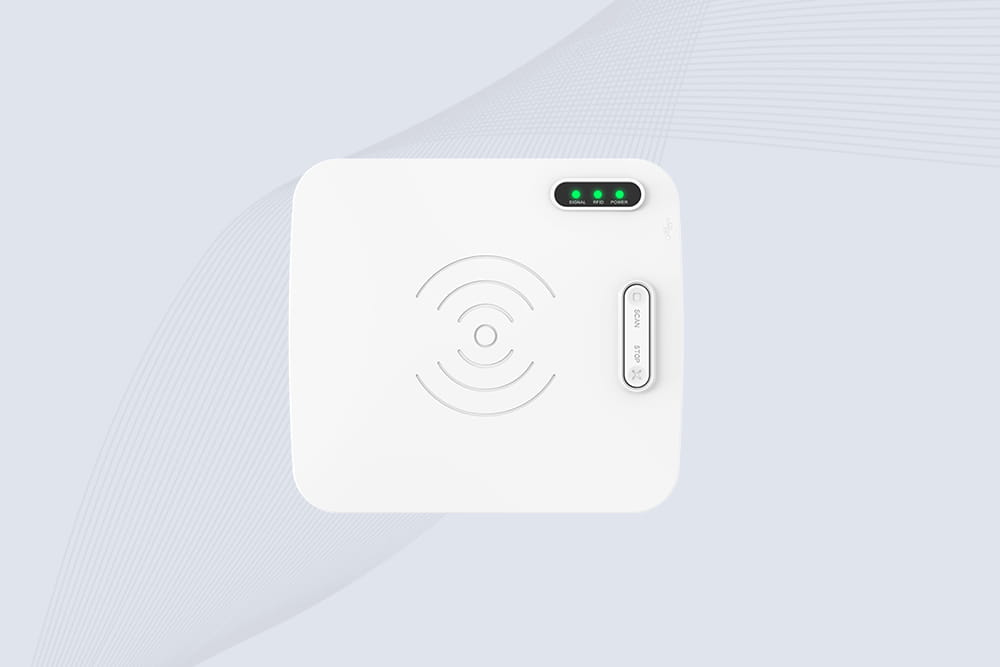
SSD-D1AL is a compact USB UHF RFID reader with Impinj E710/X3M1 chipset, USB-HID, 600+ tags/s recognition, 4/8/16 antenna support and plug-and-play USB power.
SSD-R16L Multi-Channel RFID Infrastructure for Automated Inventory Management ✔️ 16-Port High-Density RFID Reading Equipped with 16 SMA antenna ports, SSD-R16L supports multi-antenna deployment for warehouses, retail stores, logistics, production lines, and large-area RFID identification. ✔️ High-Speed & Long-Range Performance With up to 33…
SSD-R8L 8-port UHF RFID reader with 33dBm output, up to 20m reading range and 600+ tags/s recognition. Ideal for warehouse, logistics, retail and asset tracking.
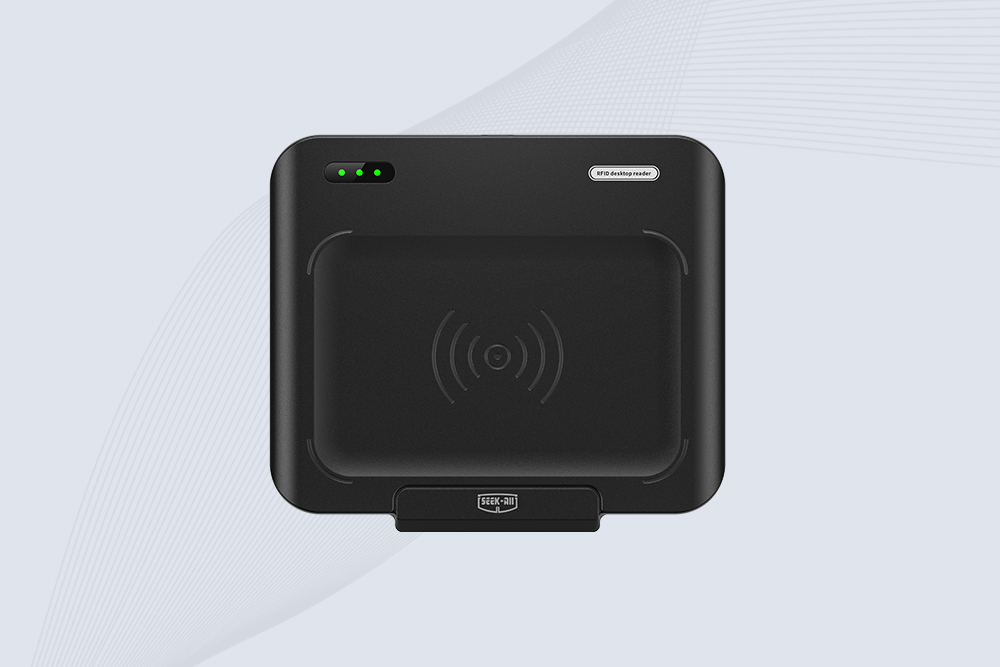
CYKEO CYKEO-D1LA USB RFID Reader is a compact desktop solution with near-field control for precise tag reading and encoding. Powered by USB, supporting ISO 18000-6C, and built for stable batch writing, this usb rfid tag reader fits retail, libraries, offices, and controlled RFID encoding tasks.
CYKEO CYKEO-D1L RFID scanner USB is a compact desktop UHF RFID scanner designed for short-range tag writing and verification. This usb rfid scanner supports batch encoding, stable 0–26 dBm output, and works across Windows, Linux, and Android systems.
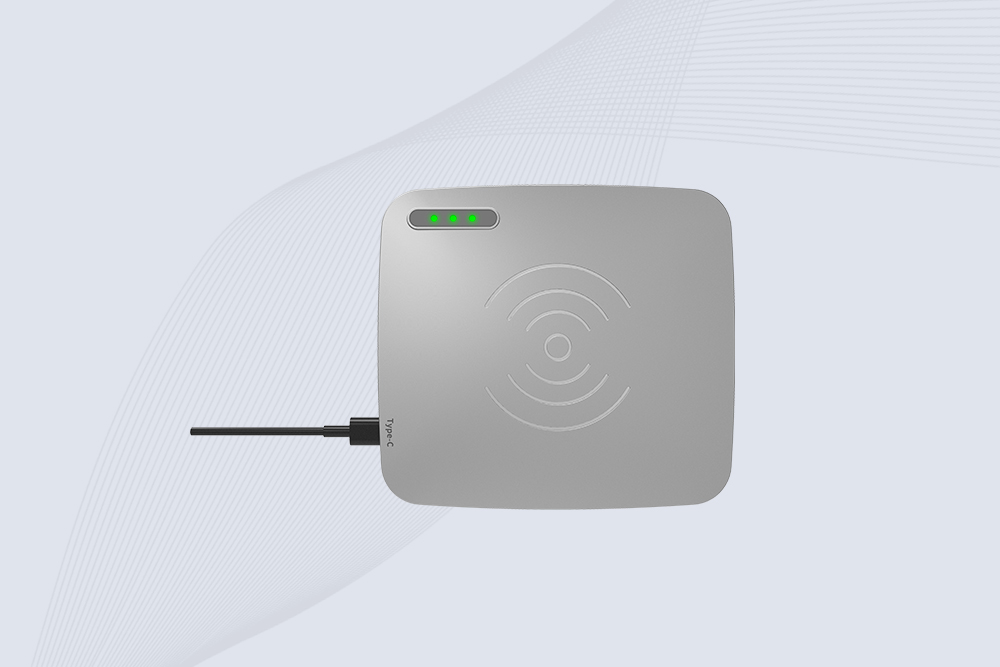
CYKEO CYKEO-D1C USB RFID Card Reader is a near-field UHF desktop writer designed for secure, short-range tag encoding. With USB-C connectivity and stable 26 dBm output, this rfid reader usb c is ideal for badge issuance, label encoding, and controlled desktop RFID workflows.
CYKEO CYKEO-D2L RFID Reader USB is a compact desktop encoder built on the Impinj R500 chip. With near-field control and stable USB power, this usb rfid card reader delivers precise tag writing for offices, retail counters, and small-scale logistics encoding tasks.
CYKEO CYKEO-D3L USB RFID Tag Reader delivers stable UHF tag reading and writing for daily desktop and light industrial tasks. Designed for controlled short-range operation, this USB RFID Tag Reader works reliably with rfid tag and reader systems in libraries, tool tracking, and inventory registration.
The CYKEO CYKEO-D4L UHF RFID Tag Reader is a stable Desktop RFID Reader designed for accurate tag registration, borrowing, and return workflows. Built with the Impinj R2000 chip, this UHF RFID Tag Reader delivers controlled short-range reads for libraries, asset tracking, and inventory management environments.
The CYKEO CYKEO-D5L Desktop RFID Card Reader is a stable UHF RFID Card Reader designed for controlled short-range reading and writing. Built for libraries, tool rooms, and asset desks, this UHF RFID Card Reader supports dense tag handling, secure data processing, and easy USB integration.
The CYKEO CYKEO-D6L RFID Reader Writer is a heavy-duty Desktop RFID Reader designed for short-range, high-accuracy tag programming. Built for libraries, labs, and asset desks, this RFID Reader Writer supports batch processing, stable 33dBm output, and seamless integration with existing management systems.
Cykeo CYKEO-D8A embedded RFID badge reader offers 30+ tags/sec scanning, 20cm anti-crosstalk precision, and DC 12V power for unmanned stores, warehouses, and smart inventory systems.
Cykeo’s CYKEO-D8C UHF RFID gate reader achieves 200-tag/batch scanning with adjustable power control, ideal for retail inventory and smart warehouse management.
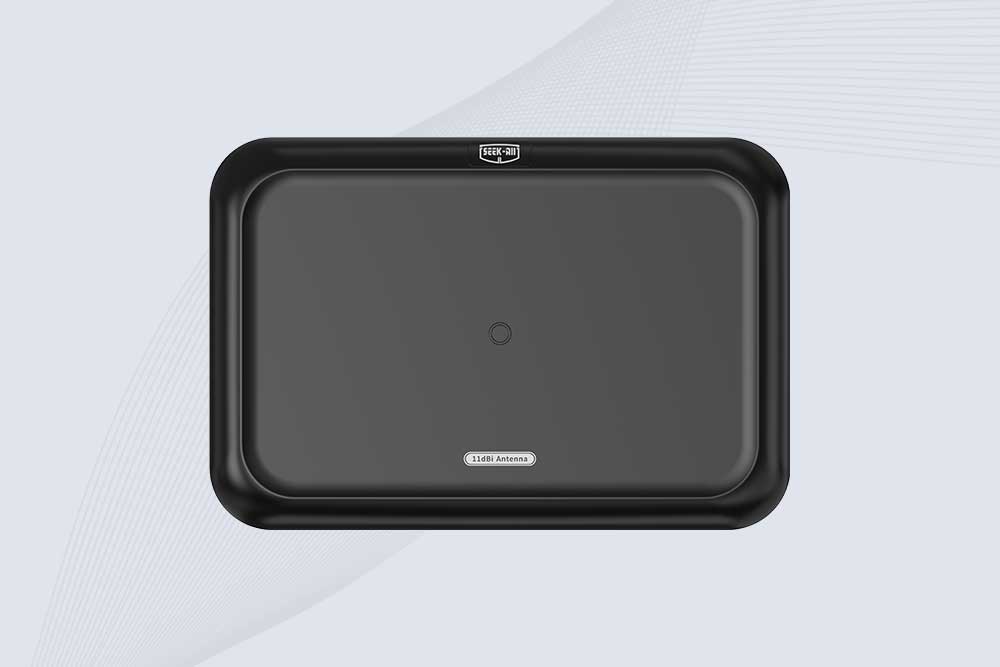
Cykeo CYKEO-A11 UHF RFID reader antenna delivers 11dBi gain, 840-960MHz frequency range, and IP65 ruggedness for retail, logistics, and industrial RFID systems. Features low VSWR and easy installation.
CYKEO Antenna RFID Reader delivers stable long-range UHF performance with a 10.5dBi directional design, built for warehouses, conveyor portals, and industrial RFID systems. This rfid reader antenna provides 20m+ read distance and rugged IP67 protection.
Cykeo CYKEO-A5B industrial Linear RFID Antenna delivers 5dBi gain, ≤1.5:1 VSWR, and IP65 rugged design for warehouse, production line, and logistics UHF systems.
Cykeo’s CYKEO-B12 Long Range RFID Antenna delivers 15m+ read range with 12dBi gain, IP65 rugged design, and global 840-960MHz UHF support. Ideal for warehouse/logistics asset tracking.
Cykeo CYKEO-B10 Long Distance RFID Antenna offers 10dBi gain, 840-960MHz frequency range, IP65 rating, and 20m+ coverage for logistics/warehousing/ETC systems. Low VSWR ensures stable signal transmission.
Cykeo CYKEO-A6 UHF RFID panel antenna features 6dBi gain, 840-960MHz broadband, IP65 metal-ready housing for logistics/smart retail. 18mm ultra-thin design with tool-free mounting.
Cykeo CK-A3 industrial antenna RFID UHF offers 5m+ tag detection, ≤1.3:1 VSWR, IP65 rugged design, and global UHF spectrum compatibility (840-960MHz) for warehouses, factories, and retail.
Cykeo CYKEO-B5 directional RFID antenna provides 5dBi gain with 60° narrow beamwidth for precise inventory tracking. IP65-rated, global UHF frequency support, and low VSWR.
Create your own high-performance DIY RFID antenna! 5dBi gain, 840-960MHz tunable, step-by-step guides. Compatible with Arduino, Raspberry Pi, and commercial UHF readers.
Cykeo CYKEO-A7 Flexible RFID Antenna features 840-960MHz wideband tuning, 7dBi gain, and IP68 rating for medical/retail/industrial curved surface deployments. 98% read accuracy with peel-and-stick installation.
Cykeo CYKEO-B5A industrial Passive RFID Antenna delivers 5dBi gain, 70° beamwidth, and -40°C~55°C operation for warehouses/smart cabinets. Compatible with Zebra/Impinj readers.
Cykeo’s CYKEO-A9B High Gain RFID Antenna delivers 15m+ read range with 9dBi amplification. Features IP54 rugged design, 840-960MHz bandwidth, and 80° beamwidth for warehouse/manufacturing RFID systems.
Cykeo’s enterprise-grade 8dbi Impinj RFID Antenna 10m+ read range with 840-960MHz tuning. Features IP65 housing, 1.4 VSWR, 35° beamwidth for retail/warehouse RFID systems.
Cykeo CYKEO-A9 industrial UHF RFID antenna delivers 9dBi gain, 840-960MHz frequency range, and IP65 protection for warehouse/logistics/retail RFID systems. Features N-type connector and ≤1.3:1 VSWR.
CYKEO UHF RFID Antenna built for long-distance and industrial applications. This antenna rfid uhf delivers strong gain, outdoor durability, and reliable tag performance in warehouses, yards, and vehicle ID systems.
CYKEO Antenna RFID delivers reliable long-range UHF performance in warehouses, retail shelves, and cold-chain environments. This compact uhf rfid antenna provides stable reads with circular polarization and ultra-wide 840–960 MHz support, ideal for industrial tracking, smart shelves, and asset monitoring.
Cykeo’s CYKEO-C8 UHF RFID antennas delivers 8dBi gain, 840-960MHz full-band coverage, and IP65 ruggedness for manufacturing/warehouse RFID systems. Industrial RFID Antennas Features
Cykeo’s 8dBi UHF RFID antenna and reader kit delivers 10m+ range, 840-960MHz broadband, and IP65 ruggedness for factories, warehouses, and logistics. ISO 18000-6C & EPC Gen2 certified.
Cykeo’s CYKEO-A12C UHF Large RFID Antenna delivers 12dBi gain, 840-960MHz global frequency, IP65 ruggedness for logistics/warehousing/automotive. 40° beamwidth ensures stable 15m+ tag reads.
CYKEO Near Field RFID Antenna provides precise 5–30 cm reading for shelves, cabinets, and workstations. This compact rfid shelf antenna delivers stable short-range performance around metal and clutter, ideal for pharmacies, libraries, and electronics sorting.
Cykeo CYKEO-C1 industrial Forklift RFID Reader features 20m read range, 600 tags/sec scanning, Impinj R2000 chipset, and IP67 rugged design. Ideal for warehouse logistics and manufacturing. Supports ISO 18000-6C/6B protocols.
Cykeo CYKEO-R4 industrial UHF RFID Fixed Reader features 4 TNC ports, 400+ tags/sec speed, IP67 housing, and global frequency compliance for vehicle inspection, smart warehouse, and asset management systems.
Understand passive RFID range capabilities across frequencies (LF, HF, UHF). Learn how to optimize read distances for inventory, assets, and access control with Cykeo solutio
RFID asset tracking in the education sector enables digital management of books, computers, multimedia equipment, and other assets through efficient identification and real-time location tracking. It improves management efficiency, prevents asset ...
Learn how commercial door entry systems improve business security, simplify access management, and reduce operating costs. Explore keyless entry, RFID, mobile credentials, installation tips, and buying advice for commercial projects.
RFID tags work by exchanging wireless signals with readers, allowing automatic identification, tracking, and data management without direct scanning. The sys...
 Cykeo RFID IoT Solution Products R&D Manufacturer