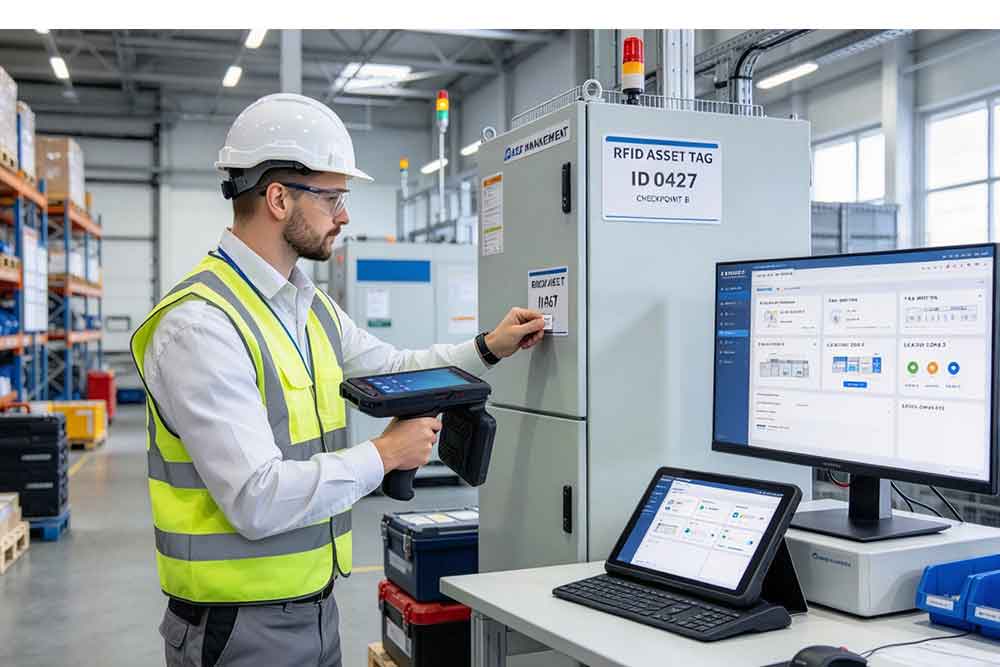
Yes. Can RFID tags be reprogrammed depends on the tag’s memory structure and security settings. Many UHF RFID tags allow EPC or User Memory data to be rewritten, while TID memory is normally factory-defined. If memory has been permanently locked, however, it cannot be reprogrammed.
That distinction matters in real RFID registration work.
A tag used for library registration, tool identification, linen tracking, or asset management may need its stored information changed after initial encoding. The physical RFID inlay does not necessarily need to be replaced. A compatible RFID reader can write new information into writable memory, provided the memory is not locked or permanently protected.
GS1 describes four logical memory areas in a typical Gen2 RFID tag: Reserved, EPC, TID, and User Memory. EPC memory generally identifies the tagged object, while User Memory can hold additional application information. TID is different: it identifies characteristics of the RFID chip and is normally programmed by the manufacturer.
What RFID Tag Data Can Actually Be Reprogrammed?
The practical answer is: EPC and User Memory are the areas most commonly considered for reprogramming.
Memory Area
Can It Usually Be Rewritten?
Typical Purpose
EPC Memory
Yes, if writable/unlocked
Item or product identifier
User Memory
Yes, if supported and unlocked
Application-specific data
TID Memory
Generally no
Chip and manufacturer identification
Reserved Memory
Security-controlled
Access and kill passwords
GS1 specifically notes that User Memory is intended for additional information about the tagged item and provides an official User Memory Encoder for preparing application data for RFID tag programming.
The important field detail is not simply whether a chip is “rewritable.” The write state must also be checked.
An EPC bank can be locked against overwriting. Gen2 also provides reversible locking and permanent locking mechanisms. Once memory has been permanently locked, subsequent writes are no longer possible.
Reprogramming RFID Tags in a Desktop Registration Workflow
This is where a desktop RFID reader becomes more useful than a generic inventory reader.
During tag registration, an operator may place one RFID tag on the near-field antenna, read its existing EPC, verify the record, write the required identifier, and then perform another read to confirm the result.
For a registration desk, controlling the reading field is valuable. Cykeo’s RFID desktop reading platform uses a near-field antenna with an effective reading range controlled within 30 cm and a writing range controlled within 10 cm. That tighter operating area helps reduce unintended reads and writes when multiple tagged objects are sitting nearby.
The platform is designed around routine administrator tasks such as:
RFID tag registration and rewriting
Item borrowing and return
Document or credential registration
Shelf-tag registration
Item lookup
Borrowing and return statistics
Registration statistics
Log queries
Tag conversion and data rewriting
The reader provides a USB interface and supports C# and Java development resources, making it practical to integrate tag-writing operations into existing registration software rather than forcing staff to operate a separate programming utility.
A controlled desktop RFID writing area allows staff to read, verify, and rewrite supported tag memory during registration.
Why Lock Status Matters More Than Reader Power
A common mistake in RFID deployment is treating unsuccessful writing as a simple power problem.
It is not always the reader.
If a tag is locked, protected by an access password, permanently locked, or simply lacks the memory area being targeted, increasing RF output will not make the write succeed. GS1’s Gen2 documentation explicitly defines lock controls for EPC, TID, and User Memory areas, including permanent lock states.
For this reason, a reliable registration workflow should distinguish between:
Tag detected
Target memory identified
Memory writable
Correct data encoded
Write command completed
Written data verified
Cykeo’s desktop platform is specified with a maximum port output of 33 dBm, together with tag-collision processing, dense tag reading, multi-tag recognition, data filtering, and RSSI support. These functions address the practical RF environment around registration—not merely the act of sending a write command.
GS1 also reports that typical RAIN RFID tags carry no more than about 8 KB of data, although actual capacity varies significantly by chip and tag design. Simple tags may provide only a 96-bit or 128-bit identifier, while higher-memory tags can support substantially more application data.
That is why “Can RFID tags be reprogrammed?” should never be answered with a blanket yes.
The correct answer is yes for supported, writable memory; no for permanently locked memory and normally no for manufacturer-controlled TID data.
RFID Tag Reprogramming: Practical Points
EPC rewriting: commonly used when assigning or changing an object identifier.
User Memory rewriting: useful when application-specific information must be stored on the tag.
TID rewriting: generally unavailable because TID identifies the chip itself.
Password protection: can restrict unauthorized writing.
Permanent lock: prevents future modification.
Near-field desktop writing: helps isolate the intended tag during registration.
Post-write verification: should be part of the software workflow rather than assuming a write command automatically means successful encoding.
GS1’s current standards work also continues to define how EPC and additional AIDC information can be represented in RFID memory, reinforcing the importance of standardized data encoding rather than treating the tag simply as an arbitrary block of hexadecimal data.
FAQ
1. Can RFID tags be reprogrammed after they are installed?
Yes, if the target memory remains writable and the reader supports the required write operation. GS1 specifically identifies writable EPC and User Memory use cases for RAIN RFID.
2. Can an RFID tag’s EPC number be changed?
Usually yes, provided EPC memory has not been locked or permanently locked. The EPC is normally used as an identifier for the tagged object.
3. Can RFID tags be reprogrammed more than once?
Yes. A writable EPC or User Memory area can generally be rewritten multiple times, subject to the tag manufacturer’s specifications, memory architecture, and lock state.
4. Can TID information be rewritten?
Generally no. TID memory describes the RFID chip and its characteristics and is normally programmed and protected during manufacturing.
5. Does a higher RFID reader power guarantee successful writing?
No. Write success also depends on tag sensitivity, antenna coupling, memory status, access protection, frequency environment, tag orientation, and the specific tag IC.
6. What is the advantage of a desktop RFID reader for tag rewriting?
A desktop platform provides a controlled short-range writing area. For Cykeo’s platform, the specified reading range is within 30 cm and writing range within 10 cm, which is suitable for registration and controlled tag conversion.
7. Can RFID tags be reprogrammed without replacing the physical tag?
Yes, when the required memory is writable. This is one reason RAIN RFID can support changing stored application data after deployment without replacing the tag itself.
Discover what is a passive rfid tag, how passive RFID technology works, and why industries use passive tags for inventory, tracking, and identification.
Discover what if rfid can achieve in real-world applications. Learn how RFID improves tracking, identification, and operational visibility with expert insights from Cykeo.
Discover how RFID security gates protect assets, streamline access, and improve efficiency in libraries, retail stores, gated communities, and industrial parks. Learn about technology trends and real-world applications.
Struggling with rfid reader distance measurement in real projects? Learn field-tested range methods, common mistakes, and CYKEO setup tips that improve reading accuracy.
Discover what RFID readers are, how they function, different types available, and where they're used. Learn key selection tips for your business needs.
Discover what does an rfid tag do and how RFID technology improves asset tracking, inventory accuracy, and automation with Cykeo professional RFID solutions.
 Cykeo RFID IoT Solution Products R&D Manufacturer