At first glance, it looks like a simple product selection question. But after discussing many RFID projects, it is usually not that simple.
A warehouse customer may want the longest reading distance possible. A factory customer may care more about avoiding missed reads. A smart cabinet manufacturer may actually need a short reading range because reading the wrong item creates problems.
This is why choosing an RFID antenna is not only about looking at specifications.
The “best” antenna depends on where it will be installed, what kind of tags are being used, and what the system is expected to achieve.
Understanding different RFID antenna types helps system integrators and buyers make better decisions before placing bulk orders.
Why RFID Antenna Type Matters More Than Many Buyers Expect
However, the antenna controls how the RF energy is distributed.
Think about two different situations.
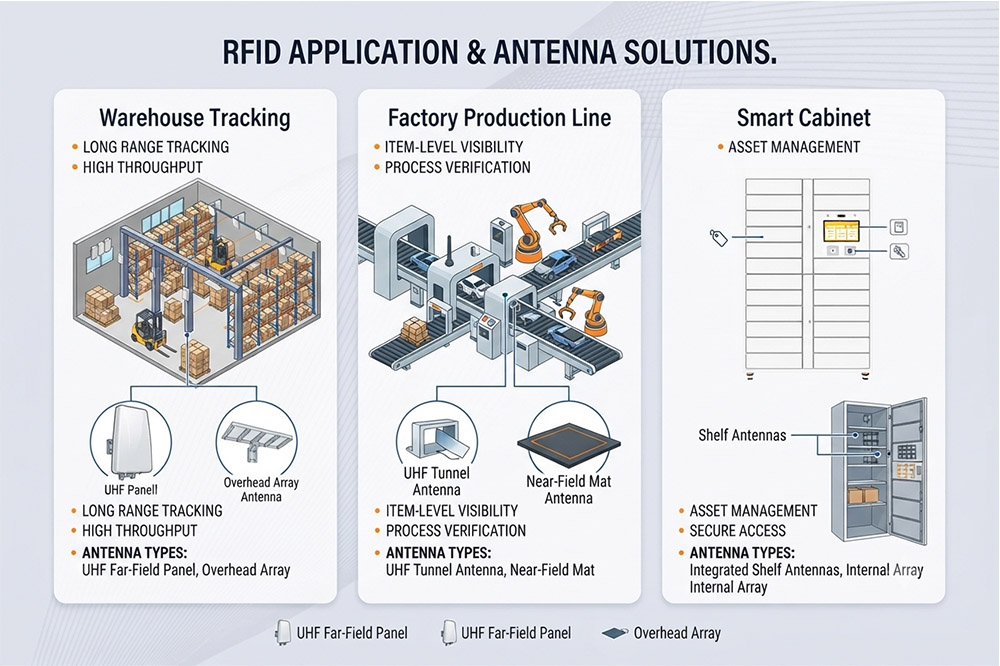
A warehouse entrance may need to identify hundreds of tagged boxes moving through a large area.
A tool management cabinet may need to identify only the tools inside one drawer.
Using the same antenna for both projects would probably create problems.
The warehouse system may have blind spots.
The cabinet system may read tags outside the target area.
The antenna type is one of the first decisions that affects the final result.
UHF RFID Antenna: The Choice for Long Range Identification
UHF RFID antennas are probably the most common type used in industrial RFID projects.
They usually operate in the 860-960 MHz frequency range and are designed for longer reading distances.
Typical applications include:
Warehouse inventory
Logistics tracking
Pallet management
Vehicle identification
Manufacturing production lines
For example, imagine a distribution center where hundreds of pallets enter and leave every day.
The company does not want workers to manually scan each pallet.
Instead, RFID antennas are installed at warehouse gates. When pallets pass through, the system automatically captures tag information.
In this case, a UHF far-field antenna is usually a better choice because the project needs distance and coverage.
But longer distance is not always better.
If the reading area is not controlled properly, the system may capture nearby tags that should not be included.
Near Field RFID Antenna: Better Control for Small Items
Near field RFID antennas work differently.
Instead of creating a large reading zone, they are designed for short-distance identification.
They are commonly used in:
Smart tool cabinets
Medical equipment tracking
Jewelry management
Laboratory asset management
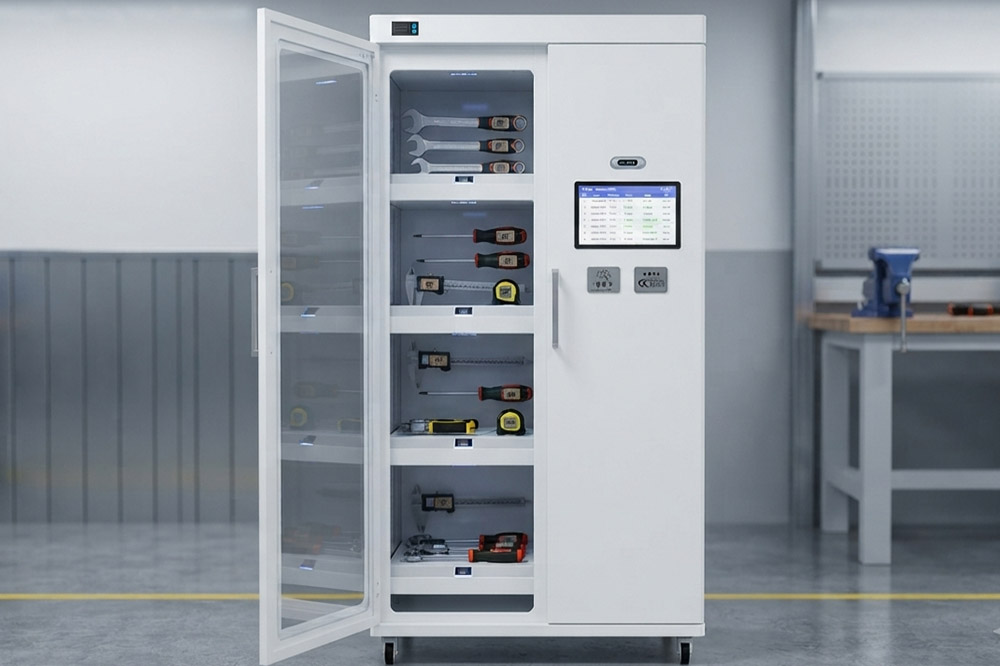
A good example is an RFID smart cabinet.
A factory may store hundreds of expensive tools inside different compartments.
The system needs to know:
Which tool was removed
Which employee took it
When it was returned
A long-range antenna would create unnecessary problems because it might read tools in nearby areas.
A near field antenna provides a more controlled reading environment.
Far Field RFID Antenna: Built for Distance and Coverage
Far field antennas are designed for applications where tags need to be detected from a distance.
They are often used with UHF RFID readers.
Common environments:
Warehouses
Loading areas
Production lines
Access control systems
The installation position becomes very important.
A small change in antenna angle can affect coverage.
For example, two antennas installed at a warehouse entrance may create a better reading zone than a single antenna because they reduce missed reads when products move through different positions.
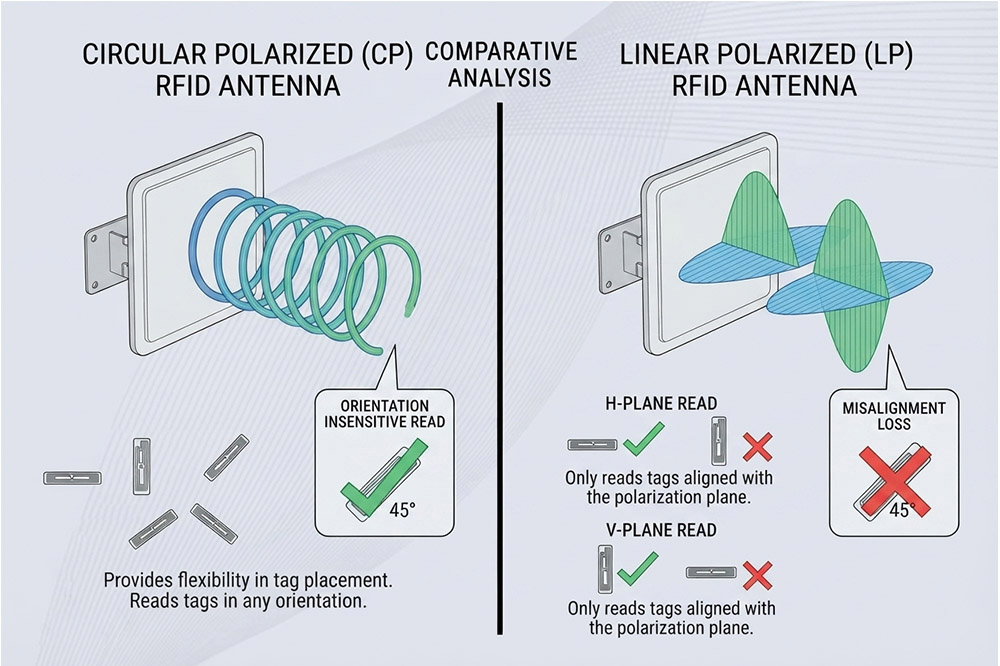
Circular Polarized RFID Antenna: When Tag Direction Is Uncertain
In real projects, tags are not always installed perfectly.
Sometimes products move randomly.
Sometimes workers attach tags at different angles.
This is where circular polarized antennas become useful.
They can receive signals from different tag orientations because the RF field rotates.
Typical applications:
Warehouse tracking
Retail inventory
Logistics systems
A customer once asked why their RFID system worked well during testing but had problems after installation.
The reason was simple:
During testing, every tag was placed in the same direction.
In the real warehouse, products were positioned randomly.
Changing to a circular polarized antenna solved much of the issue.
This kind of problem is quite common in actual deployments.
Linear Polarized RFID Antenna: Strong Directional Reading
Linear polarized antennas concentrate RF energy in one direction.
They are useful when tag orientation is controlled.
Applications include:
Conveyor systems
Fixed equipment tracking
Production automation
For example, if every product moves through a production line in the same direction, a linear polarized antenna can provide strong and stable performance.
The disadvantage is that performance can drop if tag orientation changes.
How to Choose the Right RFID Antenna Type?
Before purchasing RFID antennas in bulk, it helps to answer a few practical questions.
1. How far do you need to read?
Short distance:
Consider near field antennas.
Long distance:
Consider UHF far field antennas.
2. Are tags always facing the same direction?
Yes:
Linear polarized antennas may work well.
No:
Circular polarized antennas are usually safer.
3. Is the environment complicated?
Metal, liquid, and dense objects can affect RFID performance.
For industrial environments, antenna selection should consider:
Installation location
Interference sources
Tag material
Reading accuracy requirements
Common Mistakes When Buying RFID Antennas
Choosing Only Based on Reading Distance
Many buyers ask:
“How many meters can this antenna read?”
But distance alone does not define performance.
A 15-meter antenna is not always better than a 5-meter antenna.
The correct question is:
“Can this antenna create the reading area I actually need?”
Ignoring Installation Conditions
An antenna tested in a clean laboratory environment may perform differently in a factory.
Real environments include:
Metal structures
Moving equipment
Human interference
Multiple tags
Testing under actual conditions is often necessary before large-scale deployment.
Why Work With an RFID Antenna Supplier Instead of Buying Standard Products?
For RFID distributors and system integrators, antenna selection can directly affect project success.
A professional RFID antenna supplier should be able to support:
Antenna recommendation
Engineering testing
OEM customization
Different connector options
Special size requirements
Some projects require a standard antenna.
Others need a customized design because the installation space is limited.
For example:
A smart cabinet manufacturer may need a small antenna hidden inside the cabinet wall.
A warehouse project may require outdoor waterproof antennas.
The requirements are completely different.
FAQ About RFID Antenna Types
What is the most common RFID antenna type?
UHF RFID antennas are widely used for warehouse, logistics, and industrial tracking applications.
Which RFID antenna is best for long distance?
Usually UHF far-field antennas with suitable gain and proper installation.
Which RFID antenna is better for smart cabinets?
Near field RFID antennas are usually more suitable because they provide controlled reading areas.
Are RFID antennas customizable?
Yes. Many RFID manufacturers provide customized solutions including size, frequency, connector, and housing design.
Need Help Choosing the Right RFID Antenna?
Selecting an RFID antenna is not only about buying a component.
It is about making sure the entire RFID system works correctly after installation.
For RFID distributors, integrators, and OEM equipment manufacturers, we provide RFID antenna solutions, customization support, and bulk supply services.
Contact us to discuss your RFID project requirements.
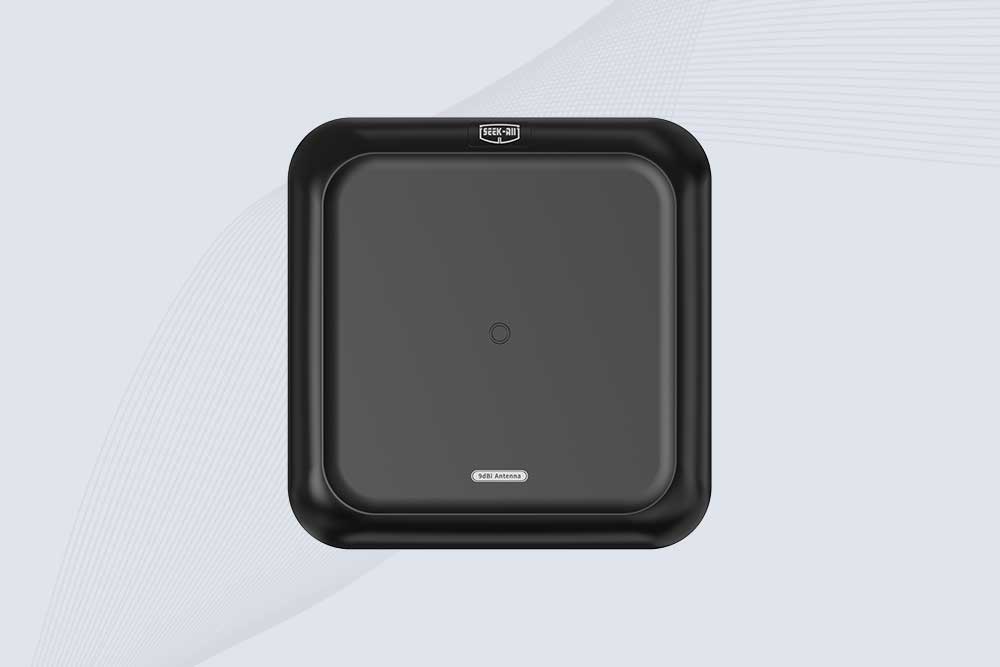
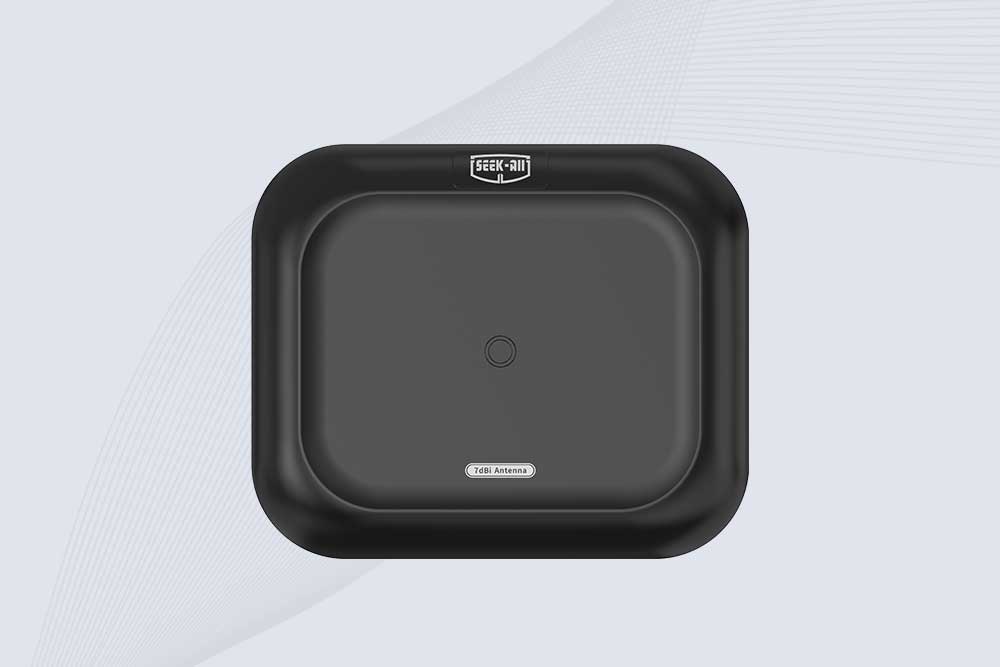
Explore the SSD-A07 UHF RFID antenna with 7 dBi gain, circular polarization, adjustable 840–960 MHz frequency, and 60°/75° beamwidth for stable RFID read/write performance.
SSD-A06 UHF RFID antenna with circular polarization, adjustable 840–960 MHz frequency, ≥4.5 dBi gain, and a compact directional design for RFID systems.
Cykeo CYKEO-A11 UHF RFID reader antenna delivers 11dBi gain, 840-960MHz frequency range, and IP65 ruggedness for retail, logistics, and industrial RFID systems. Features low VSWR and easy installation.
CYKEO Antenna RFID Reader delivers stable long-range UHF performance with a 10.5dBi directional design, built for warehouses, conveyor portals, and industrial RFID systems. This rfid reader antenna provides 20m+ read distance and rugged IP67 protection.
Cykeo CYKEO-A5B industrial Linear RFID Antenna delivers 5dBi gain, ≤1.5:1 VSWR, and IP65 rugged design for warehouse, production line, and logistics UHF systems.
Cykeo’s CYKEO-B12 Long Range RFID Antenna delivers 15m+ read range with 12dBi gain, IP65 rugged design, and global 840-960MHz UHF support. Ideal for warehouse/logistics asset tracking.
Cykeo CYKEO-B10 Long Distance RFID Antenna offers 10dBi gain, 840-960MHz frequency range, IP65 rating, and 20m+ coverage for logistics/warehousing/ETC systems. Low VSWR ensures stable signal transmission.
Cykeo CYKEO-A6 UHF RFID panel antenna features 6dBi gain, 840-960MHz broadband, IP65 metal-ready housing for logistics/smart retail. 18mm ultra-thin design with tool-free mounting.
Cykeo CK-A3 industrial antenna RFID UHF offers 5m+ tag detection, ≤1.3:1 VSWR, IP65 rugged design, and global UHF spectrum compatibility (840-960MHz) for warehouses, factories, and retail.
Cykeo CYKEO-B5 directional RFID antenna provides 5dBi gain with 60° narrow beamwidth for precise inventory tracking. IP65-rated, global UHF frequency support, and low VSWR.
Create your own high-performance DIY RFID antenna! 5dBi gain, 840-960MHz tunable, step-by-step guides. Compatible with Arduino, Raspberry Pi, and commercial UHF readers.
Cykeo CYKEO-A7 Flexible RFID Antenna features 840-960MHz wideband tuning, 7dBi gain, and IP68 rating for medical/retail/industrial curved surface deployments. 98% read accuracy with peel-and-stick installation.
Cykeo CYKEO-B5A industrial Passive RFID Antenna delivers 5dBi gain, 70° beamwidth, and -40°C~55°C operation for warehouses/smart cabinets. Compatible with Zebra/Impinj readers.
Cykeo’s CYKEO-A9B High Gain RFID Antenna delivers 15m+ read range with 9dBi amplification. Features IP54 rugged design, 840-960MHz bandwidth, and 80° beamwidth for warehouse/manufacturing RFID systems.
Cykeo’s enterprise-grade 8dbi Impinj RFID Antenna 10m+ read range with 840-960MHz tuning. Features IP65 housing, 1.4 VSWR, 35° beamwidth for retail/warehouse RFID systems.
Cykeo CYKEO-A9 industrial UHF RFID antenna delivers 9dBi gain, 840-960MHz frequency range, and IP65 protection for warehouse/logistics/retail RFID systems. Features N-type connector and ≤1.3:1 VSWR.
CYKEO UHF RFID Antenna built for long-distance and industrial applications. This antenna rfid uhf delivers strong gain, outdoor durability, and reliable tag performance in warehouses, yards, and vehicle ID systems.
CYKEO Antenna RFID delivers reliable long-range UHF performance in warehouses, retail shelves, and cold-chain environments. This compact uhf rfid antenna provides stable reads with circular polarization and ultra-wide 840–960 MHz support, ideal for industrial tracking, smart shelves, and asset monitoring.
Cykeo’s CYKEO-C8 UHF RFID antennas delivers 8dBi gain, 840-960MHz full-band coverage, and IP65 ruggedness for manufacturing/warehouse RFID systems. Industrial RFID Antennas Features
Cykeo’s 8dBi UHF RFID antenna and reader kit delivers 10m+ range, 840-960MHz broadband, and IP65 ruggedness for factories, warehouses, and logistics. ISO 18000-6C & EPC Gen2 certified.
Cykeo’s CYKEO-A12C UHF Large RFID Antenna delivers 12dBi gain, 840-960MHz global frequency, IP65 ruggedness for logistics/warehousing/automotive. 40° beamwidth ensures stable 15m+ tag reads.
CYKEO Near Field RFID Antenna provides precise 5–30 cm reading for shelves, cabinets, and workstations. This compact rfid shelf antenna delivers stable short-range performance around metal and clutter, ideal for pharmacies, libraries, and electronics sorting.
RFID Industry Writer | IoT & Asset Tracking Analyst
James writes about RFID technology, asset tracking, and the practical challenges of digital transformation across warehousing, retail, manufacturing, and logistics.
His work focuses on how RFID is applied in real-world operations—improving inventory visibility, automating workflows, and helping businesses manage assets with greater accuracy and efficiency.
He regularly covers topics including UHF RFID, smart cabinets, RFID portals, tool tracking, warehouse automation, and industrial IoT trends..
Learn multiple ways for how to connect an RFID reader to computer. Step-by-step guide for USB, Ethernet & serial ports with CYKEO readers, including driver and software setup.
Discover affordable RFID solutions for retail stores to reduce checkout errors, prevent theft, and streamline inventory. Practical tips and top picks inside.
A practical, engineer-level walkthrough of RFID antenna design, covering NFC, LF, and UHF. Real-world tuning, matching networks, metal interference, Q-factor issues, and hands-on debugging strategies. No theory-only nonsense — just actual field ex...
 Cykeo RFID IoT Solution Products R&D Manufacturer