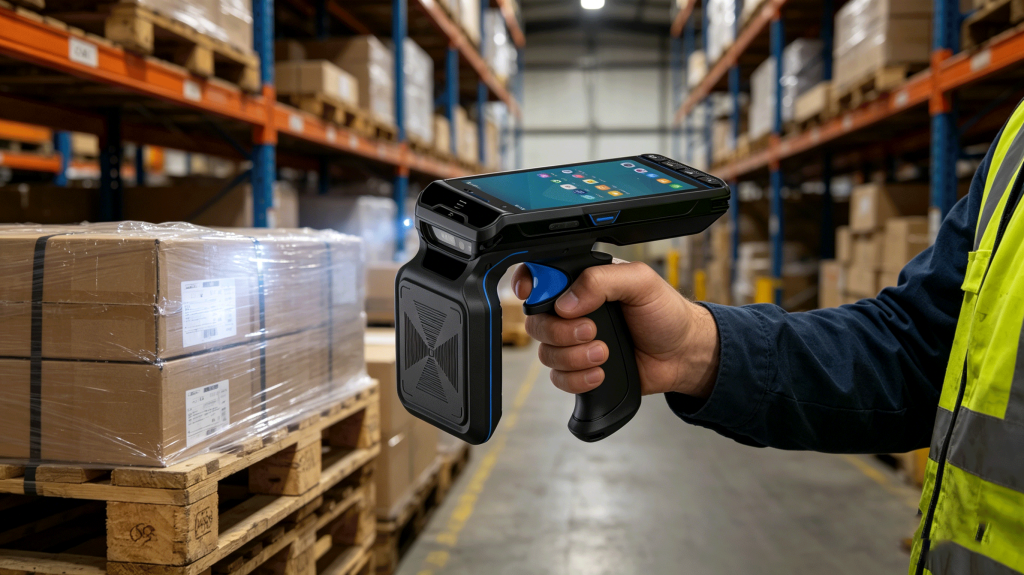
An rfid gun is a handheld RFID scanner that reads multiple tagged items wirelessly without line-of-sight, enabling fast and accurate inventory tracking.
That’s the clean definition. In the field, it’s less formal.
You raise it, squeeze the trigger—and shelves start talking back.
Author & Field Experience
Author: Cykeo RFID Systems Engineering Team
10+ years deploying handheld RFID systems in logistics, retail, and tool tracking
Experience integrating RFID guns with WMS, ERP, and mobile apps
Focus on UHF RFID optimization in dense inventory environments
In a recent warehouse rollout (~18,000 SKUs):
Full inventory count time dropped from 2 days to under 5 hours
Scan accuracy improved from ~82% (barcode) to over 97%
Labor cost for cycle counting reduced by ~50%
What surprised most operators wasn’t speed—it was how little effort it took.
What is an rfid gun?
An rfid gun is a handheld RFID reader designed in a pistol-grip form factor, commonly used for inventory, asset tracking, and logistics operations.
According to RAIN RFID Alliance, UHF RFID systems can read hundreds of tags per second without direct line-of-sight—this is the core advantage behind RFID guns.
How an rfid gun works on the floor
Trigger, sweep, done
The workflow is simple:
Pull the trigger
Sweep across items
Tags respond instantly
No aiming at each label. No bending over to align barcodes.
In one retail backroom test, a new staff member completed a cycle count on their first try—no training manual, just a 2-minute demo.
Fast bulk scanning with handheld RFID gun
Key advantages of using an rfid gun
1. High-speed bulk reading
Scan dozens to hundreds of items in seconds
Reduce inventory time dramatically
Improve operational throughput
2. No line-of-sight required
Read through packaging and containers
Eliminate manual alignment
Increase flexibility in dense storage
3. Improved accuracy
Reduce human scanning errors
Ensure consistent data capture
RFID-based inventory systems can achieve 95%+ accuracy, compared to significantly lower rates in manual barcode environments.
RFID gun vs barcode scanner
Feature
RFID Gun
Barcode Scanner
Reading method
Wireless, non-line-of-sight
Optical, line-of-sight required
Speed
Very high
Moderate
Bulk scanning
Yes
No
Accuracy
High (95%+)
Lower (manual)
User effort
Minimal
Repetitive scanning
Field observations you don’t see in datasheets
RFID guns are powerful—but environment matters.
From deployments:
Metal racks can reflect signals, causing ghost reads
Tag orientation impacts read distance
Overpowered settings can reduce precision in tight zones
In one tool crib setup, reducing reader power slightly improved accuracy by filtering distant tags.
Counterintuitive. Effective.
How to choose the right rfid gun
Key factors
Read range: 3–10 meters typical for UHF
Battery life: Full-shift operation required
Connectivity: Wi-Fi, Bluetooth, or offline sync
Ergonomics: Weight and grip matter during long use
Software compatibility: Integration with existing systems
FAQ about rfid gun
Q1: Is an rfid gun difficult to use?
No. Most users learn basic operation within minutes.
Q2: Can an rfid gun replace barcode scanners?
In many cases, yes—especially for bulk inventory and asset tracking.
Q3: What industries use rfid guns?
Warehousing, retail, manufacturing, healthcare, and logistics.
Final insight from real deployments
An rfid gun doesn’t just speed things up—it changes how work feels.
Less stopping. Less aiming. Less doubt.
You move through the space, and the data follows.
That’s why once teams switch, they rarely go back.
Explore reliable power solutions for fixed RFID readers in remote locations: solar, battery, PoE, and hybrid systems. Ensure 24/7 uptime for off-grid asset tracking.
Discover how a handheld rfid writer enables fast, accurate tag encoding in real-world operations. Improve tracking efficiency with Cykeo’s proven RFID solutions.
Understand RFID technology in simple terms. Discover how RFID tags, readers, and antennas work together for tracking, inventory management, and automation.
Learn how RFID reader modules are used in medical asset tracking, smart hospital cabinets, surgical instrument management, and healthcare inventory systems.
 Cykeo RFID IoT Solution Products R&D Manufacturer