 Cykeo RFID IoT Solution Products R&D Manufacturer

How to Choose the Best RFID Handheld Reader for Warehouse Inventory?
599Discover how to select the best RFID handheld reader for warehouse inventory management. Learn Cykeo’s expert tips on durability, range, and software integration.
MoreAll RFID Product
A key RFID tag is a fast and reliable way to track physical keys, cabinets, maintenance tools, and secured assets using ultra high frequency RFID technology. In real facility environments, UHF RFID key tracking reduces manual checking time and helps prevent key loss before it becomes an operational problem.
A few years ago, during a warehouse deployment in Southeast Asia, we noticed something unusual. The maintenance team was not losing expensive equipment — they were losing keys. Forklift keys. Electrical room keys. Backup office keys. Small items, but every missing key triggered hours of searching, paper logging, and supervisor approvals. After replacing barcode labels with Cykeo UHF RFID key tags, the search time dropped dramatically within weeks.
That experience changed how we approached low-value but high-risk assets.
Traditional key cabinets rely heavily on manual sign-out processes. They look organized on paper, but in practice, people forget to log returns, keys get mixed together, and audits become frustratingly slow.
RFID changes that.
With a properly configured key RFID tag system:
According to research published by the RAIN Alliance, billions of RAIN RFID tags are now deployed annually across logistics, healthcare, and industrial operations because of their ability to automate identification without line-of-sight scanning.
In another industry report from McKinsey & Company, companies implementing RFID-enabled asset visibility systems reported inventory accuracy improvements approaching 95% in some operational environments.
The interesting part? Small assets often create the biggest workflow disruptions.
A UHF key RFID tag contains a tiny RFID chip and antenna operating typically between 860–960 MHz. When the tag enters the read zone of an RFID reader, the system captures the tag ID instantly.
Unlike QR codes or barcodes:
In practice, a maintenance supervisor can walk past a smart cabinet and instantly verify whether all assigned keys are present.
No clipboard. No manual counting.
That difference matters during shift changes.
At a manufacturing site we worked with last year, the facility team originally planned to use low-frequency access cards for key tracking. During testing, the read speed became a bottleneck because operators returned several keys simultaneously after equipment inspections.
We switched the project to Cykeo UHF RFID key tags.
The result was immediate:
| Operation Task | Before RFID | After UHF RFID |
|---|---|---|
| Key inventory check | 25–30 minutes | Under 3 minutes |
| Missing key identification | Manual search | Automatic alert |
| Shift handover audit | Paper-based | Digital records |
| Multi-key reading | Not possible | Simultaneous reading |
The system was eventually integrated with access permissions and maintenance scheduling software.
Interestingly, the biggest improvement was not speed. It was accountability.
People return tracked items differently when the system records movement automatically.
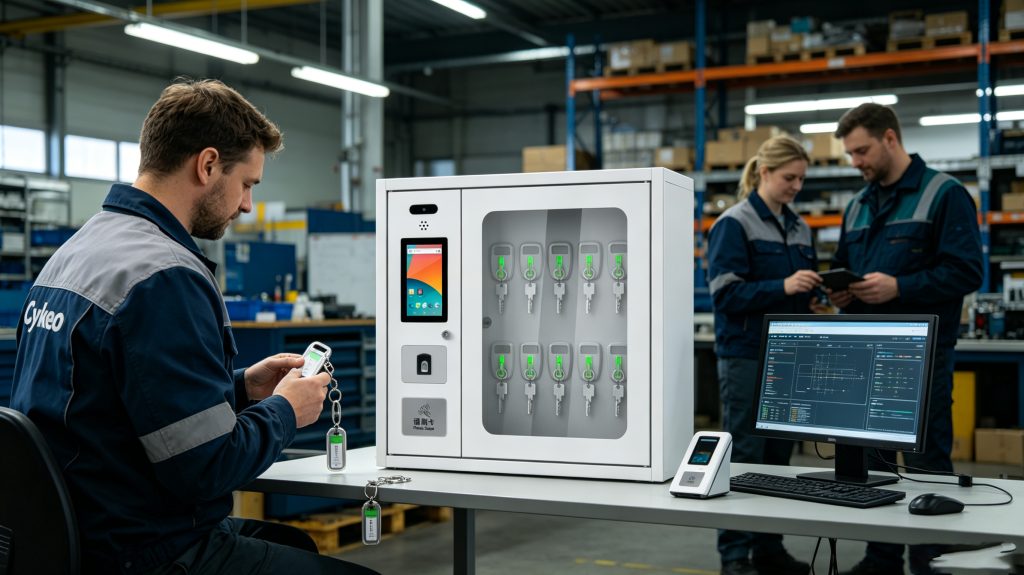
Factories often manage hundreds of keys linked to machinery, electrical panels, forklifts, and restricted zones.
RFID helps reduce operational interruptions caused by misplaced keys.
Large hotels still manage physical backup keys despite electronic locks. RFID simplifies housekeeping and engineering department tracking.
Vehicle keys disappear surprisingly often in logistics fleets. RFID cabinets allow dispatchers to know exactly who checked out a vehicle key and when.
Sensitive storage areas require reliable audit records. RFID provides traceable movement history without increasing manual workload.
Cykeo focuses heavily on stable UHF identification performance in dense-tag environments.
Several technical details matter more than marketing brochures usually admit:
In dense environments, poor signal control creates false reads very quickly.
Cykeo systems are designed to reduce that problem.
The platform also supports EPC Class1 Gen2 and ISO18000-6C standards, making integration easier for warehouse systems, smart cabinets, and industrial software platforms.
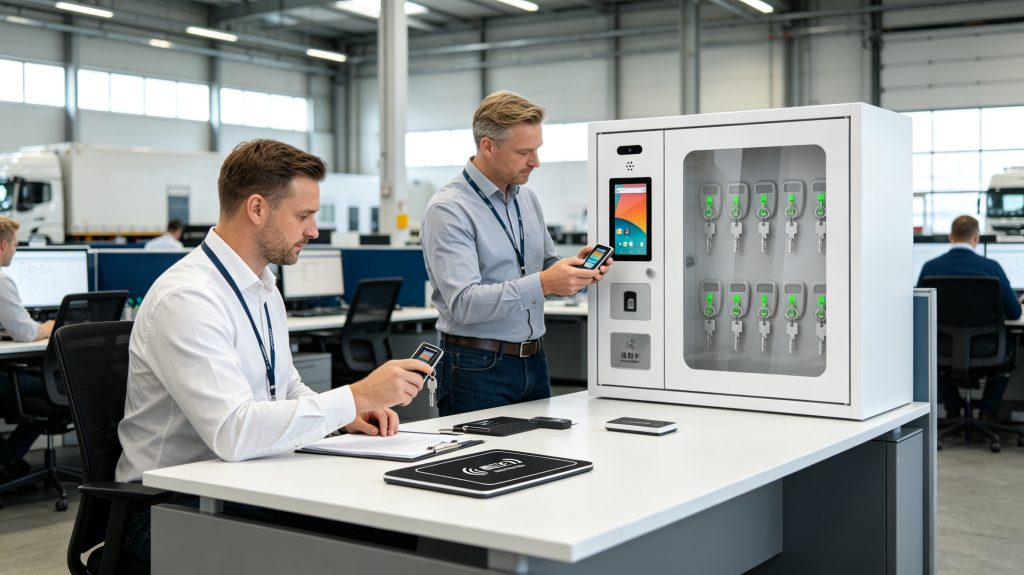
Yes. UHF RFID key tags support non-contact multi-tag reading and are significantly faster for inventory management than barcode systems.
Yes, but proper anti-metal tag selection and reader configuration are important for stable performance.
Most industrial key tracking systems use ultra high frequency RFID between 860–960 MHz because of its fast reading speed and multi-tag capability.
Yes. Most Cykeo systems support SDK and API integration for inventory platforms, facility management software, and smart cabinet systems.
A well-designed key RFID tag system does more than locate missing keys. It quietly removes operational friction from daily work.
In busy facilities, people rarely notice efficient tracking systems when they work correctly. They only notice the chaos when they fail.
That is exactly why ultra high frequency RFID has become increasingly common across industrial facilities, logistics operations, hospitality environments, and secure asset management projects.
For organizations handling dozens or thousands of keys, UHF RFID visibility is no longer optional operational technology. It is quickly becoming infrastructure.
RFID Industry Writer | IoT & Asset Tracking Analyst
James writes about RFID technology, asset tracking, and the practical challenges of digital transformation across warehousing, retail, manufacturing, and logistics.
His work focuses on how RFID is applied in real-world operations—improving inventory visibility, automating workflows, and helping businesses manage assets with greater accuracy and efficiency.
He regularly covers topics including UHF RFID, smart cabinets, RFID portals, tool tracking, warehouse automation, and industrial IoT trends..

Discover how to select the best RFID handheld reader for warehouse inventory management. Learn Cykeo’s expert tips on durability, range, and software integration.
More
Discover the 5 hidden costs of cheap RFID readers and learn how Cykeo’s high-performance RFID solutions save you money, improve efficiency, and ensure long-term ROI.
More
Discover the top long-range RFID readers optimized for vehicle access control. Learn how Cykeo’s secure, weatherproof solutions enhance security in parking lots, gated communities, and logistics hubs.
More
Discover how RFID technology improves patient safety, tracks critical medical equipment, and cuts hospital costs. Learn about real-world healthcare RFID solutions.
More