If you’re managing cables, tools, or equipment at scale, you’ve probably asked this question at some point:
Should we stick with barcodes, or move to RFID?
On paper, barcodes look cheaper.
Let’s break it down from a practical, on-site perspective—not theory.
The Real Difference
Barcodes require manual, one-by-one scanning .automatic, bulk reading without line of sight .
Everything else—cost, efficiency, accuracy—comes from that difference.
How Barcode Systems Actually Perform in the Field
Barcodes work fine in controlled environments.
But once you move into industrial scenarios, issues start showing up:
Common problems:
You must scan each item individually
Labels get dirty, scratched, or unreadable
Workers need to find and align the label
Scanning speed depends entirely on human effort
In a small warehouse, this is manageable.
In a yard with thousands of cables?
What Changes When You Switch to RFID Cable Tags
RFID cable tie tags take a completely different approach.
Instead of scanning labels visually, you’re reading data via radio frequency.
What that means in practice:
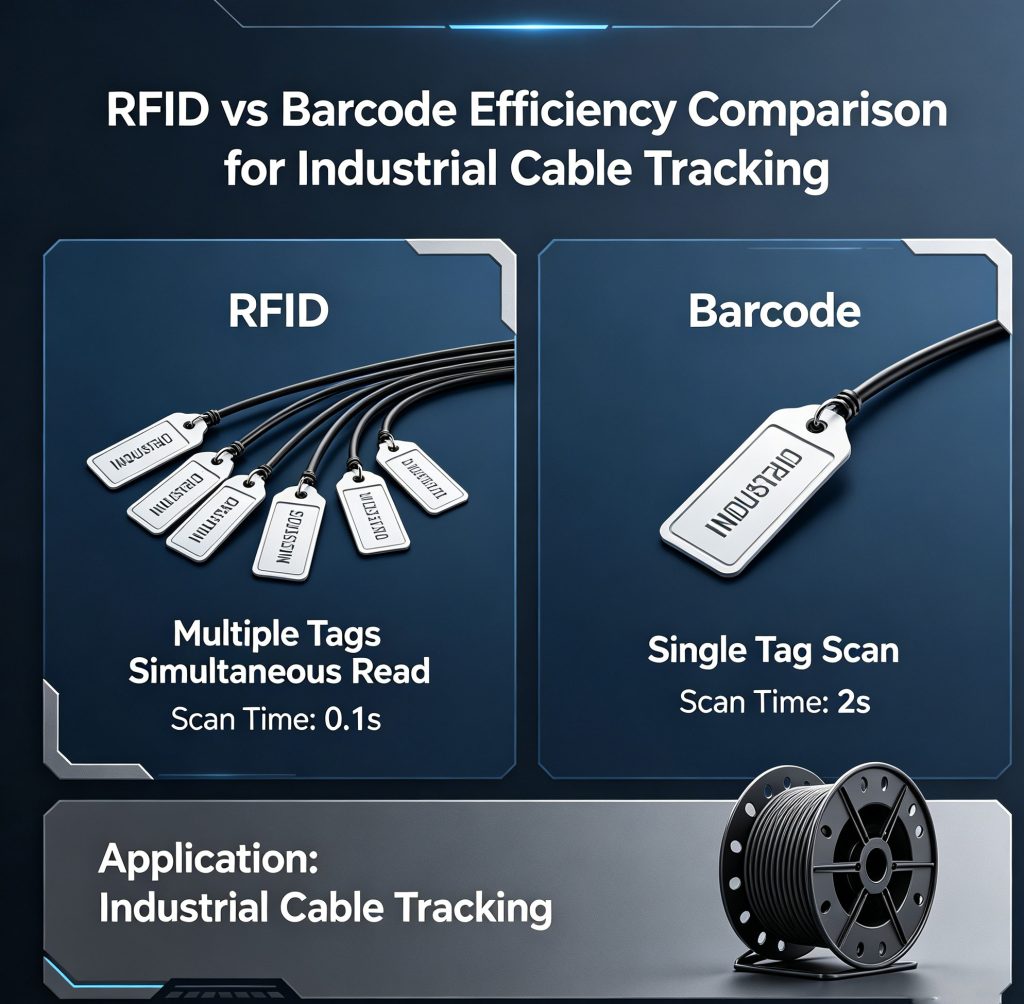
You can read dozens or hundreds of tags at once
No need to see the label directly
Tags can be read from several meters away
Data collection becomes almost automatic
For example, a technician walking past a cable rack with a handheld reader can capture all tagged assets in seconds.
No stopping. No aiming. No re-scanning.
Efficiency Comparison
Let’s look at a simple scenario:
Inventory Check (1000 assets)
Barcode:
Scan one by one
~2–3 seconds per item
Total: ~30–50 minutes
RFID:
Bulk scan
Read hundreds instantly
Total: a few minutes
Now multiply that by daily or weekly operations.
This is why companies switch—not because RFID is “cool,”labor cost becomes the real expense .
Durability: Where Barcodes Start Failing
Barcodes are vulnerable.
In industrial environments, they often:
Fade under UV exposure
Peel off over time
Get covered by dust, oil, or grease
Once a barcode is unreadable, it’s essentially useless.
Why RFID Cable Tie Tags Hold Up Better
RFID cable tags are designed differently.
Instead of sticking onto a surface, they are:
Mechanically locked onto the asset Made from industrial-grade materials (nylon / ABS)
Resistant to temperature, moisture, and handling
And most importantly:
They don’t rely on visual readability
Even if the surface is dirty, the tag still works.
Cost Comparison: The Part Most People Misjudge
Yes, RFID tags cost more per unit.
That’s obvious.
But focusing only on tag price misses the bigger picture.
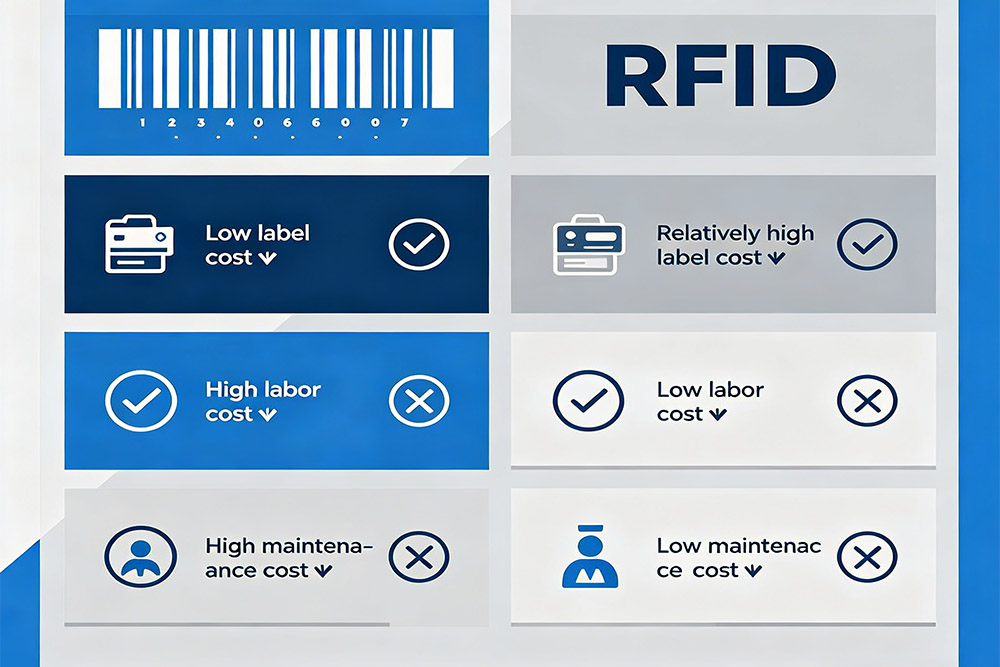
Barcode costs:
Low label cost
High labor cost
Frequent replacement
RFID costs:
Higher tag cost
Lower labor cost
Minimal maintenance
Over time, especially in large-scale operations, RFID often becomes more cost-effective .
When Barcode Still Makes Sense
To be fair, RFID is not always the right choice.
Barcodes are still suitable when:
Asset volume is low
Environment is clean and controlled
Budget is extremely limited
Real-time tracking is not required
If you only manage a few hundred items, barcode may be enough.
When RFID Cable Tags Are the Better Choice
RFID becomes the better option when:
You manage large volumes of assets or cables
You need fast inventory or audits
Labels don’t survive your environment
You want to reduce manual labor
You need long-term identification
This is especially true in:
Power & utility
Telecom infrastructure
Warehousing & logistics
Industrial manufacturing
A Practical Decision Framework
Instead of asking “which is better,” ask:
How many assets do we manage?
How often do we scan them?
How much labor is involved today?
How often do labels fail?
If labor and inefficiency are already a problem,
Final Thoughts
Barcodes are simple and cheap.
The choice depends on where your operation is today—and where it’s going.
For small setups, barcodes still work.
But for industrial asset tracking, especially involving cables and long-term use,RFID cable tie tags are quickly becoming the standard.
 Cykeo RFID IoT Solution Products R&D Manufacturer