how rfid tags work: A Practical Explanation from the Field
RFID tags work by using radio waves to transmit stored data to a reader, enabling automatic identification without line-of-sight.
That’s the mechanism—concise and accurate.
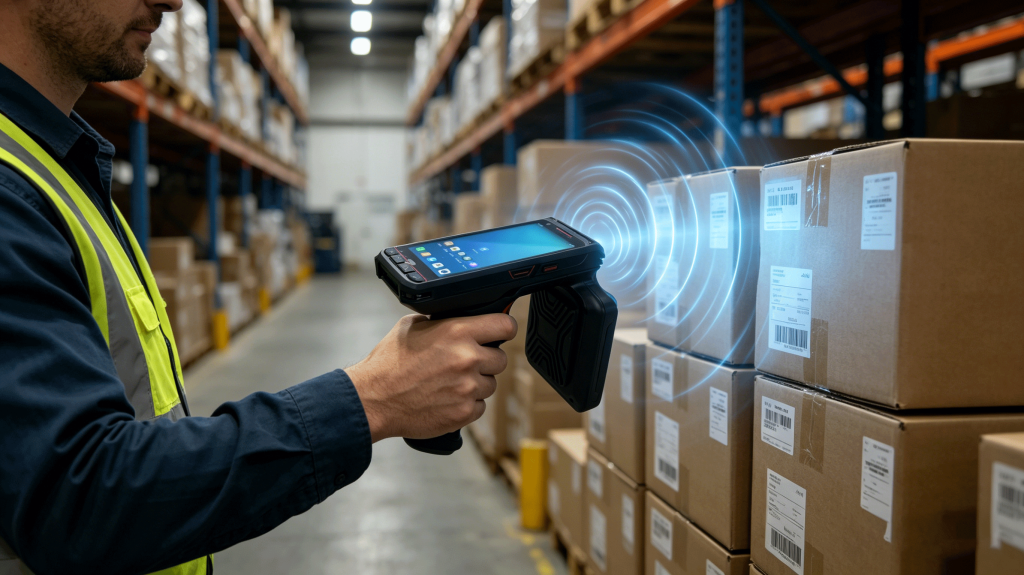
But on a warehouse floor, it feels different. You don’t “scan” items one by one. You walk past a shelf, and dozens of tags respond almost instantly.
Author & Field Experience
Author: Cykeo RFID Systems Engineering Team
10+ years designing RFID deployments in logistics and manufacturing
Delivered over 120 RFID projects across Europe and North America
Specialized in UHF RFID tuning in metal-heavy environments
In one distribution center (~25,000 tagged assets):
Inventory cycle time reduced by 70%
Manual scanning errors dropped below 3%
Daily stock visibility improved to near real-time
These aren’t lab numbers. They came after multiple rounds of antenna tuning and tag repositioning.
The core idea behind how rfid tags work
Three components, one interaction
Every RFID system relies on:
RFID tag (attached to the object)RFID reader (fixed or handheld)Antenna (for signal transmission)
The reader emits radio waves. The tag captures that energy and sends back its stored data.
According to RAIN RFID Alliance hundreds of tags per second , making them suitable for bulk inventory scenarios.
Tags communicate wirelessly with RFID readers
Passive vs active: what actually powers the tag
No internal battery
Powered by reader signal
Lower cost, widely used
Active RFID tags
Built-in battery
Longer read range (up to 100 meters+)
Higher cost, used in specialized tracking
In practice, over 80% of deployments I’ve worked on used passive UHF tags—mainly because they scale economically.
How data moves in real time
Step-by-step interaction
Reader sends radio frequency signal
Tag antenna captures energy
Chip activates and encodes data
Signal reflects back (backscatter)
Reader decodes and sends to system
RFID enables inventory accuracy levels above 95% , significantly improving supply chain visibility.
Real-world behavior you only notice on-site
RFID doesn’t behave perfectly in every environment.
From field deployments:
Metal surfaces can reflect signals, causing duplicate reads
Liquids absorb RF energy, reducing read range
Tag orientation affects readability more than expected
In one case, rotating a tag by 90 degrees improved read consistency from ~60% to over 95%.
No spec sheet mentioned that.
RFID vs barcode: operational difference
Feature RFID Tags Barcode Labels Reading method Wireless Optical Line-of-sight Not required Required Bulk reading Yes No Speed High Moderate Automation level High Low
Where how rfid tags work matters most
<h3>Common applications</h3>
Warehouse inventory management
Retail stock counting
Tool tracking systems
Medical asset tracking
In retail, RFID adoption has been driven by the need for faster cycle counts and omnichannel fulfillment accuracy.
FAQ about how rfid tags work
Q1: Do RFID tags need batteries?
Most do not. Passive rfid tags are powered by the reader signal.
Q2: Can RFID tags be read through boxes?
Yes, in most cases—especially with UHF RFID.
Q3: How far can RFID tags be read?
Typically 3–10 meters for passive UHF tags, depending on environment.
Final insight: beyond the theory
Understanding how rfid tags work is one thing.
Watching 200 items register in under a second—that’s when it clicks.
It’s not just wireless identification. It’s a shift in how data is captured: passive, continuous, almost invisible.
And once operations adapt to that, everything downstream—inventory, accuracy, labor—starts to move differently.
 Cykeo RFID IoT Solution Products R&D Manufacturer