 Cykeo RFID IoT Solution Products R&D Manufacturer
Why Does RFID Metal Interference Occur and How Can It Be Controlled in Real-World Deployments?
443RFID metal interference causes missed reads and system failures. Learn proven ways CYKEO reduces interference in real industrial environments.
MoreAll RFID Product
In industries like oil & gas, aerospace, and MRO, tool management is not just about efficiency.
It’s about safety.
A missing tool is not a small issue—it can lead to:
That’s why many companies are upgrading to RFID for tools.

Unlike standard manufacturing environments, oil & gas operations involve:
In these conditions, even a single missing tool can become a serious problem.
Traditional tracking methods simply cannot guarantee full visibility.
Most sites still rely on:
But these systems fail in real field conditions:
This creates a dangerous gap between “assumed inventory” and “real inventory”.
RFID technology removes uncertainty by automating tracking.
Each tool is:
This ensures:
You always know what is present, missing, or overdue.
For high-risk environments, handheld RFID systems are not enough.
That’s why many companies use RFID tool cabinets as a controlled access point.

In real oil & gas and MRO deployments, systems like the CK-GT1 RFID Tool Cabinet are widely used because they provide:
This turns tool storage into a controlled system rather than an open shelf.
Every tool is tracked from entry to exit
Reduces risk of foreign object damage (FOD)
No time wasted searching for tools
Automatic logs for compliance reporting
High-value tools are always accounted for
Tool tracking in confined, high-risk environments
Maintenance tool control and compliance tracking
Aircraft and heavy equipment servicing
Mobile tool kits for field engineers
After implementing RFID tool tracking systems, companies typically see:
But the most important change is this:
Accountability becomes automatic, not manual.
Oil & gas companies are not adopting RFID for convenience.
They are adopting it for risk control.
Because:
RFID provides a system that enforces discipline without relying on human memory.
In high-risk industries, tool management cannot be left to chance.
RFID for tools provides a structured, automated, and reliable way to ensure every tool is tracked and accounted for.
It’s not just about efficiency.
It’s about operational safety and compliance.
For companies operating in oil & gas, aerospace, or MRO sectors, RFID tool cabinets can be customized based on project requirements.
Available options include:
RFID Tool Cabinets
CYKEO-GT1 RFID Intelligent Tool Cabinet
CYKEO-GGT1 Intelligent Weighing Cabinet
CYKEO-GT7 RFID Inventory Tool Cabinet
CYKEO-TC RFID Multi-Drawer Tool Cart
CYKEO-GTC4 INDUSTRIAL RFID TOOL CART
CYKEO-GTC7 RFID Aviation Maintenance Cart
CYKEO-GTC7A RFID Real-Time Tool Tracking Cart
CYKEO-GTC4B RFID Mobile Tool Cart
CYKEO-GTC4C RFID Workshop Tool Control Cart
CYKEO-GTC4A Multi-drawer RFID Tool Cart
CYKEO-GTC4D RFID Tool Tracking Cart
CYKEO-GT3A COMPACT RFID TOOL CABINET
CYKEO-GT1A INDOOR RFID CABINET
CYKEO-GT4A RFID Secure Tool Cabinet
CYKEO-GT2B RFID Aviation Tool Cabinet
CYKEO-GTC5 RFID tool tracking system
CYKEO-GT3B RFID Tool Inventory System Cabinet
CYKEO-GT3 UHF RFID Tool Cabinet
CYKEO-GT4 RFID Multi-Drawer Tool Cabinet
CYKEO-GT2 INDUSTRIAL RFID TOOL CABINET
CK-GT2A INDUSTRIAL RFID CABINET
CK-GT1B INDUSTRIALRFID TOOL CABINET
CK-GT3C RFID Tool Checkout System Cabinet
RFID Reader Antennas
CYKEO-A11 UHF RFID reader antenna
CYKEO-A10 UHF RFID HIGH GAIN ANTENNA
CYKEO-PHF3 SMART HIGH-FREQUENCY POSITIONING ANTENNA
CYKEO-A5B 5dBi Industrial Linear RFID Antenna
CYKEO-B12 12dBi UHF Long Range RFID Antenna
CYKEO-B10 Long Distance RFID Antenna
CYKEO-A6 UHF RFID panel antenna
CK-A3 industrial antenna RFID UHF
CYKEO-B5 directional RFID antenna
CYKEO-A5C High-Gain UHF RFID Antenna System
CYKEO-A7 Flexible RFID Antenna
CYKEO-B5A industrial Passive RFID Antenna
CYKEO-A9B High Gain RFID Antenna
CYKEO-A8A INDUSTRIAL UHF RFID ANTENNA
CYKEO-A9 9dBi UHF RFID Antenna
CYKEO-A12 12dBi RFID Circular Polarized Antenna
CYKEO-A5 5dBi UHF RFID Circular Polarized Antenna
CYKEO-A8 8dBi HIGH-GAIN UHF RFID ANTENNA
CYKEO-A9A 9dBi UHF RFID HIGH-GAIN ANTENNA

RFID metal interference causes missed reads and system failures. Learn proven ways CYKEO reduces interference in real industrial environments.
More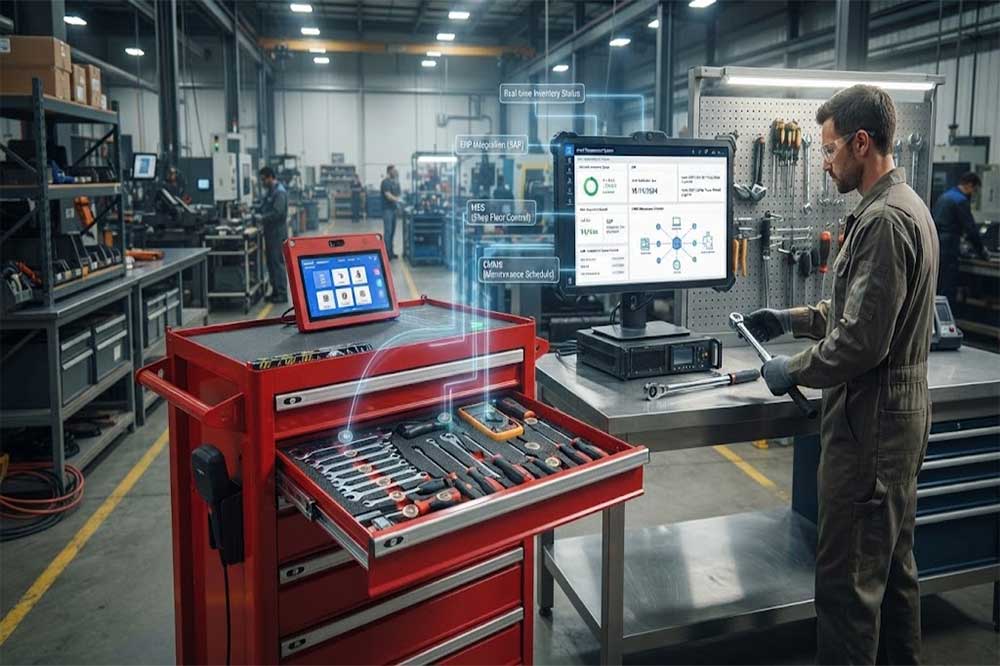
RFID tool cabinet software integration connects tool identification and cabinet transactions with ERP, MES, WMS, CMMS, or custom business systems. This artic...
More
A long range RFID scanner helps e-commerce fulfillment centers automatically identify tagged totes, cartons, picking carts, order batches, and return contain...
More
RFID access control identifies tagged items or credentials within controlled zones and triggers defined actions, combining RFID, infrared sensing, filtering,...
More