Uniform rental businesses deal with a level of inventory complexity that many industries never see.
Thousands of garments move constantly between customers, laundry facilities, warehouses, delivery vehicles, and repair departments. Some uniforms are washed several times every week, while others rotate across different worksites and employees.
Once the operation grows large enough, tracking everything manually becomes difficult very quickly.
That’s why more uniform rental companies are moving toward RFID-based garment tracking systems instead of relying entirely on barcodes or paper records.
For many operators, the change is less about technology trends and more about solving everyday operational problems that keep getting harder to manage manually.
Uniform Rental Operations Create Constant Inventory Movement
Unlike retail clothing inventory, rental uniforms never stay in one place for long.
Garments are continuously:
Delivered to customers
Returned for washing
Repaired or replaced
Sorted by company or employee
Packed for redistribution
In busy facilities, thousands of items may move through the system every day.
Without reliable tracking, problems start appearing quickly.
Uniforms get assigned to the wrong customer. Missing garments become difficult to locate. Sorting mistakes increase during busy periods. Employees spend hours manually checking inventory counts.
At smaller scales, manual systems may still work reasonably well. But once garment volume increases, those processes start slowing down operations.
RFID Makes Large-Scale Garment Tracking Easier
RFID laundry tags allow each uniform to carry its own digital identity throughout its entire lifecycle.
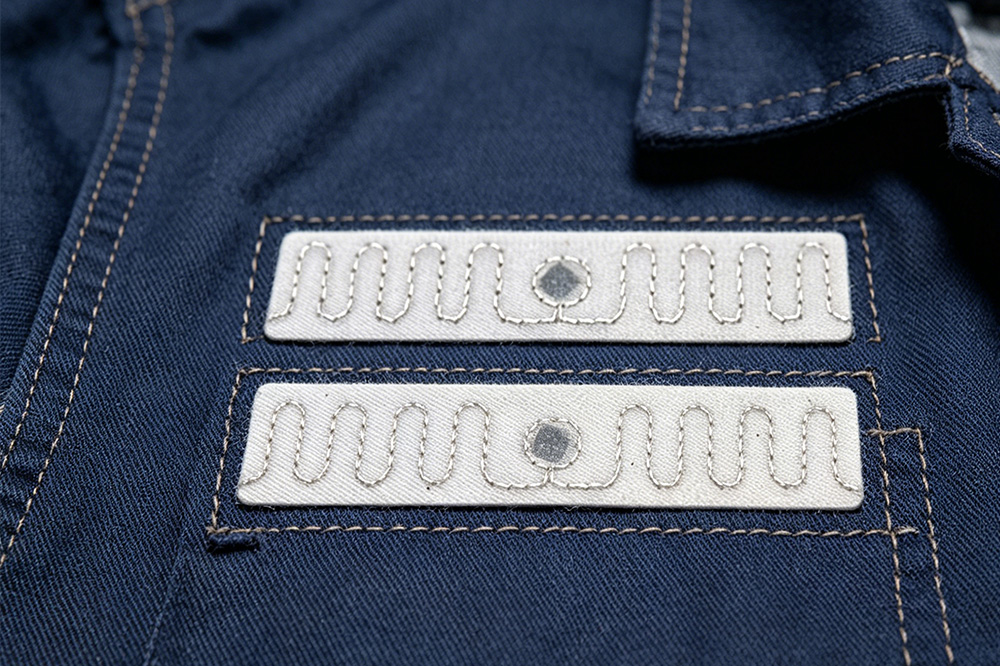
The RFID tag is sewn directly into the garment and remains attached during washing, drying, storage, and delivery.
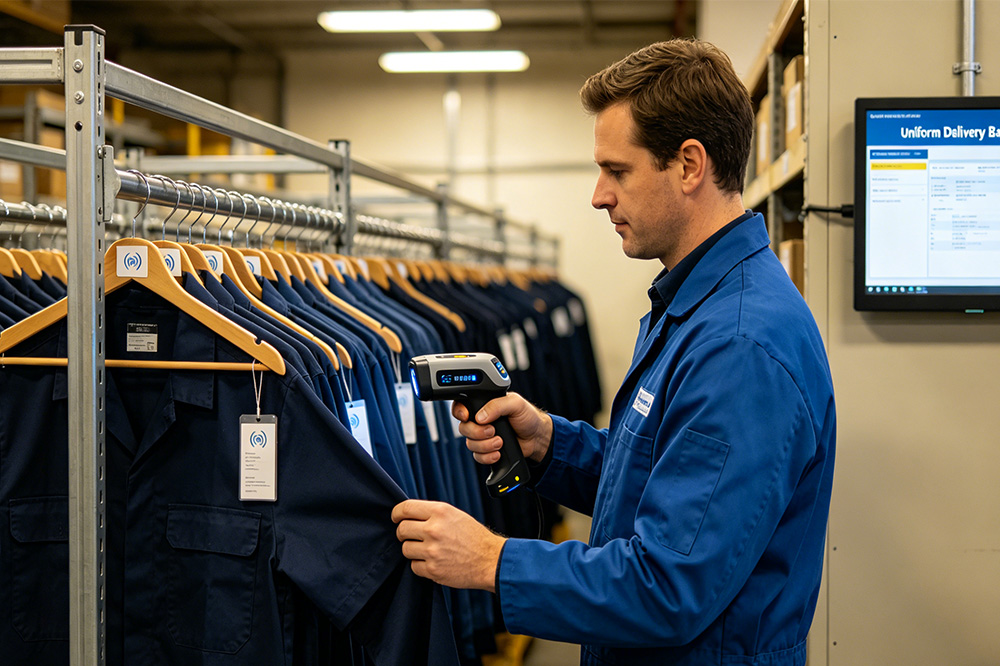
As uniforms pass through RFID reading points, the system automatically captures tracking data without requiring manual scanning.
A durable industrial RFID laundry tag is typically designed to survive repeated industrial washing cycles, heat exposure, chemical detergents, and long-term garment use.
That durability is critical because rental uniforms may stay in circulation for years.
Sorting Accuracy Improves Significantly
One of the biggest operational challenges in uniform rental businesses is sorting.
Garments from multiple customers often arrive at the laundry facility mixed together. During peak production periods, manual sorting errors become much more common.
RFID helps reduce those mistakes.
Instead of checking labels manually, RFID systems can identify garments automatically as they move through conveyor systems or sorting stations.
This allows facilities to sort uniforms based on:
Customer account
Employee assignment
Garment type
Department
Delivery route
The larger the operation becomes, the more valuable this automation is.
Many facilities notice improvements in both sorting speed and order accuracy after implementing RFID garment tracking.
Missing Uniforms Become Easier to Trace
Lost garments create ongoing costs for rental companies.
Without proper tracking, it’s often unclear whether a uniform was misplaced during washing, delivery, storage, or customer use.
RFID systems provide much better visibility into garment movement.
Operators can track when a garment:
Entered the laundry facility
Completed washing
Passed sorting checkpoints
Left for delivery
Returned from the customer
This historical tracking makes it easier to investigate inventory discrepancies instead of relying on assumptions.
For large rental operations, even a small reduction in garment loss can create noticeable cost savings over time.
Wash Cycle Tracking Helps Extend Garment Lifespan
Rental uniforms go through heavy usage.
Some garments may complete hundreds of wash cycles before replacement. Others wear out earlier depending on fabric quality, jobsite conditions, or washing frequency.
Without tracking, companies often replace uniforms based on rough estimates.
RFID systems allow operators to monitor garment lifecycle data more accurately.
That helps businesses:
Identify overused uniforms
Schedule replacements more consistently
Improve purchasing forecasts
Maintain better garment quality standards
In many cases, lifecycle tracking also helps improve customer satisfaction because garment appearance stays more consistent.
Labor Costs Are Pushing More Automation
Labor shortages and rising wages are major concerns across industrial laundry industries.
Uniform rental facilities that rely heavily on manual counting and sorting often struggle to maintain efficiency during busy production periods.
RFID reduces some of that pressure by automating repetitive inventory processes.
Instead of scanning garments individually, facilities can process large batches automatically through RFID reading systems.
That allows staff to focus more on operational flow instead of repetitive tracking tasks.
For growing rental businesses, automation becomes increasingly important as customer volume expands.
RFID Is Becoming Standard in Uniform Management
A few years ago, RFID uniform tracking was mainly used by large multinational rental companies.
Now the technology is becoming common across mid-sized operations as well.
The reason is straightforward: rental businesses need better visibility, better accuracy, and faster processing without continuously increasing labor requirements.
RFID helps address all three.
For many uniform rental companies today, RFID laundry tags are no longer viewed as advanced technology. They’re simply becoming part of modern garment management infrastructure.
A practical, engineer-level walkthrough of RFID antenna design, covering NFC, LF, and UHF. Real-world tuning, matching networks, metal interference, Q-factor issues, and hands-on debugging strategies. No theory-only nonsense — just actual field ex...
When you start looking for an rfid label supplier, you’ll quickly notice the market is full of promises like “high precision” or “covering all industries.” But when it comes down to actually solving problems with RFID labels, these slogans don’t g...
Cykeo UHF embedded RFID modules are designed for developers who need stable performance, clean APIs, and real SDK support. Easy to integrate, predictable in real systems, and ready for custom development.
Learn how to read RFID tags with Android using mobile readers. Improve efficiency with fast, accurate scanning solutions trusted in logistics and retail.
 Cykeo RFID IoT Solution Products R&D Manufacturer