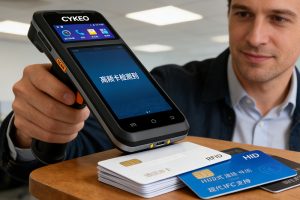
What is the meaning of RFID card? An RFID card is a card containing a radio-frequency identification (RFID) chip and antenna that communicate wirelessly with a compatible reader. Depending on its design, it can identify a person, grant access, support contactless transactions, or link an object to stored digital information without physical contact.
RFID cards are common in office access systems, employee identification, hotels, libraries, public transportation, and industrial operations. Their convenience comes from a simple interaction: a reader sends a radio signal, the card responds when appropriately powered and configured, and the connected system processes the identification data.
However, not every RFID card works in the same way. Frequency, chip design, reader compatibility, and the software behind the system all affect what a card can do.
What Does RFID Mean on a Card?
RFID stands for Radio Frequency Identification. The technology uses radio waves to transfer identification data between an RFID tag or card and a compatible reader.
An RFID card typically contains three main elements:
RFID chip: Stores an identifier and, depending on the chip and application, additional data.
Antenna: Receives radio-frequency energy or signals and enables communication with the reader.
Card substrate: The plastic or other material that protects the electronic components and gives the card its physical form.
Many everyday RFID cards are passive. They do not contain a battery; instead, the reader supplies the radio-frequency energy needed for the card to respond. Other card technologies, including certain active identification devices, use a different power arrangement.
A crucial distinction is that an RFID card does not automatically contain a person’s complete identity or account information. In many access-control systems, the card presents an identifier that software checks against an authorized database. The permissions and records are managed by the wider system, not necessarily stored directly on the card.
How Does an RFID Card Work?
An RFID card works through wireless communication between the card and a reader. When the card enters the reader’s effective field, the reader and card exchange the signals needed to identify the card or retrieve supported data. The application then determines what action, if any, should follow.
For a typical passive card, the process involves four stages:
Reader activation: The reader generates a radio-frequency field.
Card response: The card’s antenna receives energy or a communication signal, allowing its chip to respond.
Data capture: The reader receives the card’s transmitted information.
System decision: Connected software checks the identifier or card data and applies the relevant rule, such as granting door access or recording attendance.
The physical read is only one part of the process. A reader may successfully identify a card, yet the door may remain locked because the card lacks permission, its access schedule has expired, or the system cannot reach the authorization database.
This distinction matters during installation and troubleshooting. If a card is detected but a transaction fails, replacing the card immediately may not solve the problem. Reader configuration, credentials, network connectivity, and access-control rules should also be checked.
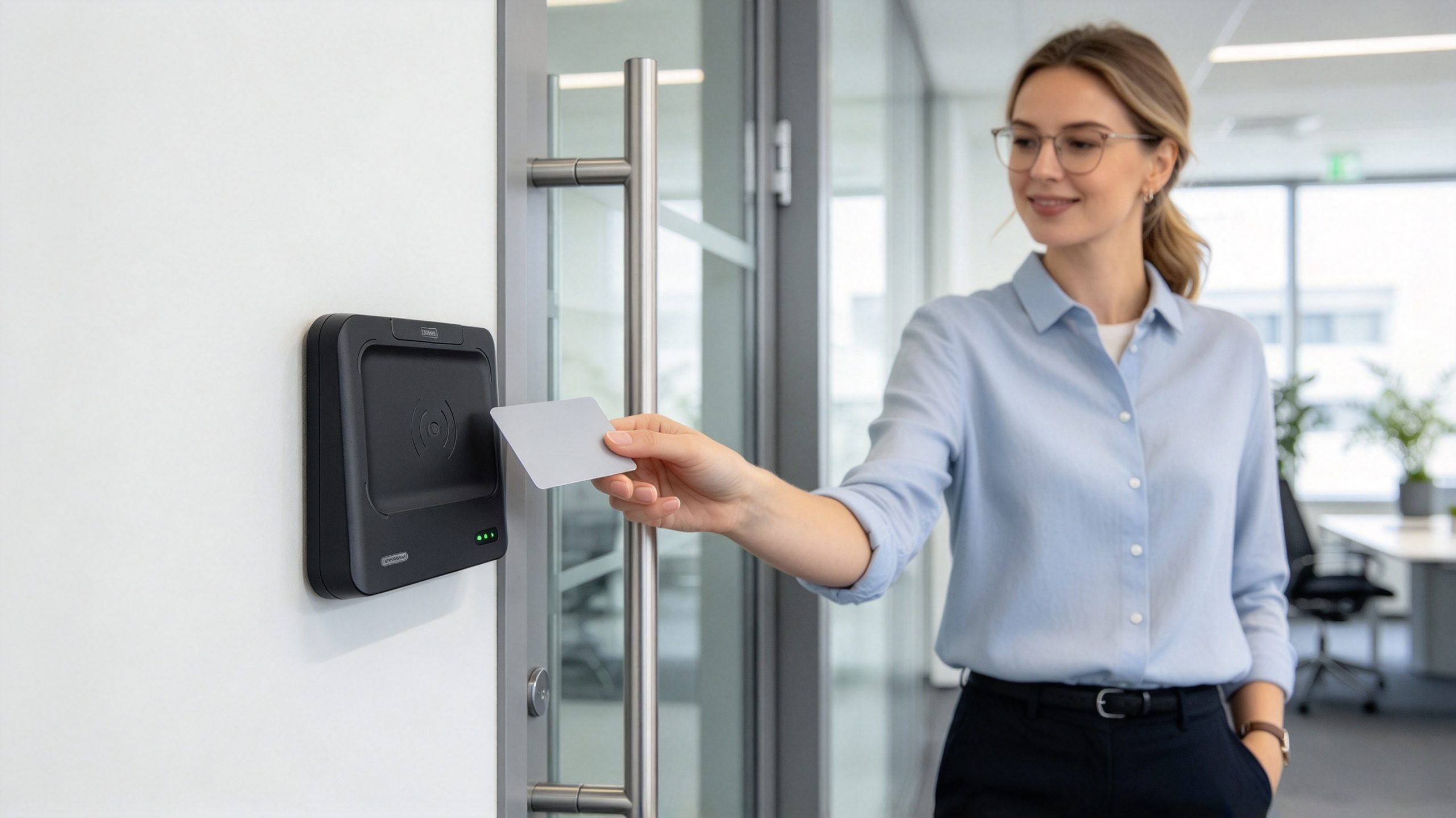
An office employee holding an RFID access card near a wall-mounted card reader at a modern European workplace.
What Is an RFID Card Used For?
An RFID card can identify a cardholder, provide controlled access, or supply data to a connected application. Its actual function depends on the card’s chip, the reader, the system configuration, and the security requirements of the deployment.
Common applications include:
Application
How the RFID card is used
Access control
Presents credentials to a door reader for authorization.
Employee identification
Connects a card identifier to an employee record or workplace system.
Hotels
Supports room access when paired with a compatible lock and credential system.
Libraries
Identifies tagged items or supports cardholder workflows in compatible RFID systems.
Public transportation
Supports identification or fare-related transactions in compatible systems.
Industrial operations
Identifies personnel or supports selected workflow and equipment-access processes.
The same physical card format can support different functions, but compatibility cannot be assumed. A card designed for one reader may not operate with another because the systems use different frequencies, protocols, chips, or credential formats.
For business buyers, the useful question is therefore not simply whether a card is RFID-enabled. It is whether the card, reader, and software are designed to work together for the intended application.
Which RFID Card Frequencies Are Used?
RFID cards operate at different frequencies, and the frequency affects communication distance, reader compatibility, and suitable applications. According to GS1’s explanation of RFID frequency bands, RFID systems commonly use low frequency (LF), high frequency (HF), and ultra-high frequency (UHF).
Frequency band
Typical frequency
Common applications
LF RFID
125–134 kHz
Selected access-control and identification systems
HF RFID
13.56 MHz
Contactless smart cards, transport ticketing, and NFC-related applications
UHF RFID
860–930 MHz, depending on the system and region
Inventory, asset identification, and longer-range identification applications
These ranges describe technology categories, not universal compatibility rules. A card and reader must support compatible radio interfaces and protocols.
HF RFID Cards and Contactless Smart Cards
HF RFID cards operating at 13.56 MHz are widely used for contactless identification and access applications. For example, NXP’s MIFARE product family supports applications including transport ticketing, corporate identification, hospitality, and access control. NXP describes a typical read/write distance of approximately 10 cm for its MIFARE products, although the actual distance depends on the product and operating conditions.
That short reading distance is useful when a user is expected to present a card deliberately. It also illustrates why RFID should not be treated as a single technology with one standard operating range.
UHF RFID, by contrast, is widely used for rapid inventory and asset identification. A UHF reader designed for warehouse operations is not automatically compatible with a conventional 13.56 MHz access card. Selecting equipment by appearance alone can lead to an installation that never works as intended.
Are RFID Cards Secure?
RFID card security depends on more than whether a card is contactless. The chip’s security capabilities, authentication method, credential management, reader configuration, and connected software all contribute to the overall protection of a system.
The U.S. National Institute of Standards and Technology (NIST) provides guidance on RFID security risks and protective measures in its Special Publication 800-98. The guidance emphasizes that security considerations vary with the RFID technology, application, and system design.
For organizations deploying RFID cards, practical precautions include:
Choose cards that support the authentication and security features required by the application.
Configure readers and access permissions according to operational needs.
Disable lost or revoked credentials promptly.
Protect the databases and communications connected to the readers.
Evaluate whether additional authentication is appropriate for sensitive areas.
A card that can be read wirelessly is not necessarily insecure, and an RFID label or card is not automatically secure simply because it uses a chip. The appropriate level of protection must match the consequences of unauthorized access.
How to Choose the Right RFID Card for Your Business
Choosing an RFID card starts with the reader and the task the card must perform. A company installing door access control has different requirements from a library identifying books or a warehouse tracking tagged inventory.
Before purchasing cards, confirm the following technical details:
Frequency and protocol: Verify that the card and reader support the same frequency band and compatible communication protocols.
Chip capabilities: Determine whether the application needs a basic identifier, memory for additional data, or cryptographic authentication.
Reading conditions: Consider the required presentation distance, reader installation, surrounding materials, and operating environment.
System integration: Check that the card can be registered and managed by the existing access-control or identification software.
Security requirements: Establish how credentials will be issued, authorized, revoked, and protected against misuse.
For example, a card that works with an office door reader may not work with a library’s UHF book-identification equipment. The difference is not necessarily the card’s appearance; it is the underlying radio technology and system compatibility.
For RFID integrators and procurement teams, testing representative cards with the intended readers before ordering in volume is a practical way to identify compatibility problems early.
What Is the Difference Between an RFID Card and an NFC Card?
RFID is the broader category of radio-frequency identification technologies. NFC, or Near Field Communication, is a short-range wireless technology operating at 13.56 MHz that is related to high-frequency RFID.
NFC supports communication between compatible devices and tags, including certain contactless cards and smartphones. However, not every RFID card supports NFC, and not every RFID reader can communicate with every contactless card.
The distinction is important when planning an access-control system or a mobile identification application. Confirm the card’s technology, supported protocols, and security features rather than relying on terms such as contactless, smart card, or RFID alone.
RFID cards connect contactless identification with compatible readers and business management systems.
Frequently Asked Questions About RFID Cards
1. What does RFID stand for on an RFID card?
RFID stands for Radio Frequency Identification. It describes a technology that uses radio waves to identify a compatible card or tag through a reader. The card typically contains a chip and antenna, while connected software uses the captured information for functions such as access control, identification, or record management.
2. Do RFID cards need batteries?
Most conventional passive RFID cards do not require batteries. They obtain the energy needed to respond from the reader’s radio-frequency field. Other identification devices may use batteries, so the answer depends on the card’s design and the technology it uses.
3. How far away can an RFID card be read?
The reading distance depends on the frequency, card antenna, reader design, power settings, and surrounding environment. Many HF access cards are designed for close-range presentation, while some other RFID technologies support longer distances. Always check the manufacturer’s specifications and test the card with the intended reader.
4. Can one RFID card work with different readers?
Yes, if the readers support the card’s frequency, protocol, and relevant credential format. Physical similarity does not guarantee compatibility. Some systems also use proprietary or application-specific credential configurations, which must be verified before deployment.
5. Are RFID cards the same as contactless bank cards?
Not necessarily. Contactless bank cards use contactless communication technology and payment-specific security mechanisms. Other RFID cards may be designed for identification, building access, transport, or asset-related applications. A card’s appearance alone does not establish its function or security capabilities.
6. Can RFID cards store personal information?
Some RFID cards can store additional data, while others primarily provide an identifier that software associates with a user record. The information available depends on the chip and how the system is configured. Organizations should minimize unnecessary personal data and apply appropriate access controls to both cards and connected databases.
7. How can I check whether an RFID card is compatible with my reader?
Check the reader’s supported frequency bands, protocols, and card technologies against the card manufacturer’s specifications. If those details match, test the card using the intended reader and software. For commercial deployments, verify credential registration, authentication, and expected operating distance before purchasing cards in bulk.
What Is the Meaning of RFID Card in Modern Identification Systems?
The meaning of an RFID card goes beyond a plastic card that can be scanned without physical contact. It is a wireless identification credential whose practical function depends on the chip, antenna, reader, software, and security configuration working together.
For businesses, the most reliable selection process begins with the application and the compatible reader—not the card’s appearance or a general claim about reading distance. Understanding these technical details helps procurement teams choose suitable cards for access control, employee identification, libraries, and other connected operations.
Cykeo supports RFID technology applications involving readers, identification equipment, and integrated systems. When evaluating a solution, confirm the required card technology and reader compatibility with the intended deployment.
Ultimately, what is the meaning of RFID card is best understood in context: it is a contactless identification medium that communicates with compatible equipment to support a defined business or operational task.
SSD-D3AL is a USB-HID UHF RFID reader with 0–30 cm reading, 0–15 cm writing, over 600 tags/s recognition, USB plug-and-play operation and OEM Logo customization.
SSD-D1AL is a compact USB UHF RFID reader with Impinj E710/X3M1 chipset, USB-HID, 600+ tags/s recognition, 4/8/16 antenna support and plug-and-play USB power.
SSD-R16L Multi-Channel RFID Infrastructure for Automated Inventory Management ✔️ 16-Port High-Density RFID Reading Equipped with 16 SMA antenna ports, SSD-R16L supports multi-antenna deployment for warehouses, retail stores, logistics, production lines, and large-area RFID identification. ✔️ High-Speed & Long-Range Performance With up to 33…
SSD-R8L 8-port UHF RFID reader with 33dBm output, up to 20m reading range and 600+ tags/s recognition. Ideal for warehouse, logistics, retail and asset tracking.
CYKEO CYKEO-D1LA USB RFID Reader is a compact desktop solution with near-field control for precise tag reading and encoding. Powered by USB, supporting ISO 18000-6C, and built for stable batch writing, this usb rfid tag reader fits retail, libraries, offices, and controlled RFID encoding tasks.
CYKEO CYKEO-D1L RFID scanner USB is a compact desktop UHF RFID scanner designed for short-range tag writing and verification. This usb rfid scanner supports batch encoding, stable 0–26 dBm output, and works across Windows, Linux, and Android systems.
CYKEO CYKEO-D1C USB RFID Card Reader is a near-field UHF desktop writer designed for secure, short-range tag encoding. With USB-C connectivity and stable 26 dBm output, this rfid reader usb c is ideal for badge issuance, label encoding, and controlled desktop RFID workflows.
CYKEO CYKEO-D2L RFID Reader USB is a compact desktop encoder built on the Impinj R500 chip. With near-field control and stable USB power, this usb rfid card reader delivers precise tag writing for offices, retail counters, and small-scale logistics encoding tasks.
CYKEO CYKEO-D3L USB RFID Tag Reader delivers stable UHF tag reading and writing for daily desktop and light industrial tasks. Designed for controlled short-range operation, this USB RFID Tag Reader works reliably with rfid tag and reader systems in libraries, tool tracking, and inventory registration.
The CYKEO CYKEO-D4L UHF RFID Tag Reader is a stable Desktop RFID Reader designed for accurate tag registration, borrowing, and return workflows. Built with the Impinj R2000 chip, this UHF RFID Tag Reader delivers controlled short-range reads for libraries, asset tracking, and inventory management environments.
The CYKEO CYKEO-D5L Desktop RFID Card Reader is a stable UHF RFID Card Reader designed for controlled short-range reading and writing. Built for libraries, tool rooms, and asset desks, this UHF RFID Card Reader supports dense tag handling, secure data processing, and easy USB integration.
The CYKEO CYKEO-D6L RFID Reader Writer is a heavy-duty Desktop RFID Reader designed for short-range, high-accuracy tag programming. Built for libraries, labs, and asset desks, this RFID Reader Writer supports batch processing, stable 33dBm output, and seamless integration with existing management systems.
Cykeo CYKEO-D8A embedded RFID badge reader offers 30+ tags/sec scanning, 20cm anti-crosstalk precision, and DC 12V power for unmanned stores, warehouses, and smart inventory systems.
Cykeo’s CYKEO-D8C UHF RFID gate reader achieves 200-tag/batch scanning with adjustable power control, ideal for retail inventory and smart warehouse management.
CYKEO Passive RFID Tags are made for wet and high-humidity environments where standard labels do not last. This rfid passive tag is often used around liquids, chemicals and temperature changes, providing stable reading distance and long data life for industrial tracking.
CYKEO CYKEO-PCB1504 Metal RFID Tags is a compact anti-metal UHF RFID solution built for direct mounting on metal surfaces. With stable 8-meter read range, Ucode-8 chip, and long data retention, this rfid metal tag fits tools, containers, automotive parts, and industrial asset tracking.
CYKEO CYKEO-PCB7020 On-Metal RFID Tags are designed for reliable tracking on steel and metal surfaces. Built with an FR4 epoxy body and industrial-grade chips, these On-Metal RFID Tags deliver stable performance, long data life, and chemical resistance, making them a dependable RFID anti-metal tag for harsh environments.
The CYKEO CYKEO-60-25 Anti-Metal RFID Tag is built for metal surfaces where standard tags fail. Designed for long-range performance, harsh environments, and stable data retention, this Anti-Metal RFID Tag is ideal for industrial assets, containers, and equipment tracking using on metal RFID tags.
The CYKEO RFID Laundry Tag is designed for long-term textile identification in harsh laundry environments. Built to withstand high heat, chemicals, and repeated washing, this RFID Laundry Tag delivers stable performance for hotels, hospitals, and industrial laundry operations using laundry rfid tags at scale.
The CYKEO CYKEO-125-7 RFID Book Tag is designed for reliable book and document tracking in libraries and archives. This RFID Book Tag delivers long read range, dense placement support, and stable performance on shelves, making it a practical rfid tag on books for library automation, file management, and archival systems.
CYKEO RFID tags in hospitals are designed for sterile environments where accuracy matters. These autoclavable RFID tags support long-term tracking of surgical tools, implants, and medications, helping hospitals improve visibility, compliance, and patient safety.
CYKEO RFID Cable Tie Tag is built for reliable identification on metal surfaces. This UHF RFID Cable Tie Tag is widely used in rfid tags for inventory systems, industrial asset management and Hospital RFID Tags, offering stable read performance, long service life and global EPC Gen2 compatibility.
CYKEO RFID Asset Tag is designed for stable identification of metal assets in industrial environments. This UHF RFID Asset Tag is commonly used for rfid tag asset tracking on equipment, tools and containers, providing reliable reads, long service life and ISO/IEC 18000-6C support.
CYKEO UHF RFID Card is designed for fast identification and long-term use in industrial and commercial systems. Supporting ISO 18000-6C, this UHF RFID Card works at 860–960 MHz and is suitable for custom RFID cards used in asset tracking, access control and inventory management.
CYKEO HF RFID Cards are designed for secure and stable access control systems. These 13.56 MHz RFID key cards support ISO 14443-A, reliable rewriting and long service life, making HF RFID Cards suitable for offices, campuses, events and membership management.
CYKEO UHF RFID Tag is designed for reliable tracking of metal jewelry and high-value items. This Jewelry RFID Tag supports long-range reading up to 8 meters, anti-counterfeit protection and stable performance on metal, making it suitable for retail, inventory control and asset management.
Cykeo CYKEO-C1 industrial Forklift RFID Reader features 20m read range, 600 tags/sec scanning, Impinj R2000 chipset, and IP67 rugged design. Ideal for warehouse logistics and manufacturing. Supports ISO 18000-6C/6B protocols.
Cykeo CYKEO-R4 industrial UHF RFID Fixed Reader features 4 TNC ports, 400+ tags/sec speed, IP67 housing, and global frequency compliance for vehicle inspection, smart warehouse, and asset management systems.
CYKEO CYKEO-R8L Fixed RFID Reader with 8-port UHF design, Impinj-based RF core and up to 20m read range. An industrial Fixed RFID Reader for vehicle inspection, warehouse portals, smart manufacturing lines and secure access checkpoints.
RFID Fixed Reader from CYKEO – the CYKEO-R16L 16-port UHF fixed reader for warehouses, smart cabinets, and production lines. Long-range, multi-tag reading, stable performance for 24/7 industrial use.
Learn how to choose the right antenna for a long range RFID scanner. Understand UHF RFID antenna types, reading distance, polarization, installation tips, and supplier selection for industrial RFID projects.
UHF textile services use RFID technology to automate linen tracking, laundry management, and textile inventory control. Discover how Cykeo improves visibility and efficiency.
Discover the best RFID-barcode hybrid scanners for small retail stores in 2024. Compare affordability, durability, and software compatibility for seamless inventory management.
 Cykeo RFID IoT Solution Products R&D Manufacturer