One of the first questions buyers ask about an RFID scanner is usually very simple:
“How far can it read?”
Then comes the frustrating part.
A supplier says 10 meters.
You test the same reader in your warehouse and get something closer to 2 meters.
Is the reader defective?
Not necessarily.
RFID reading distance is not a fixed number that comes out of the reader alone. The antenna, RFID tag, product material, reader power, tag orientation, and surrounding environment all affect the result.
I have seen this misunderstanding quite often in RFID projects. A reader can perform very well in an open test area and then behave completely differently once the customer puts the tags on real products.
So when discussing USB RFID scanner range, it is better to ask:
“10 meters under what conditions?”
The Advertised Distance Is Usually a Test Result
Suppose an RFID reader specification says:
Reading distance: up to 10 m
It is easy to read that as:
This reader will always read my tags from 10 m away.
That is not what “up to” normally means.
The stated distance may have been measured with a particular RFID tag, antenna configuration, power setting, orientation, and relatively clean RF environment.
Your application could be very different.
You may have:
Small RFID tags
Products packed closely together
Metal shelving
Liquid-filled containers
Tags facing different directions
RF interference
A different antenna position
Suddenly, that 10-meter figure does not look quite so realistic.
The specification is still useful. It just needs some context.
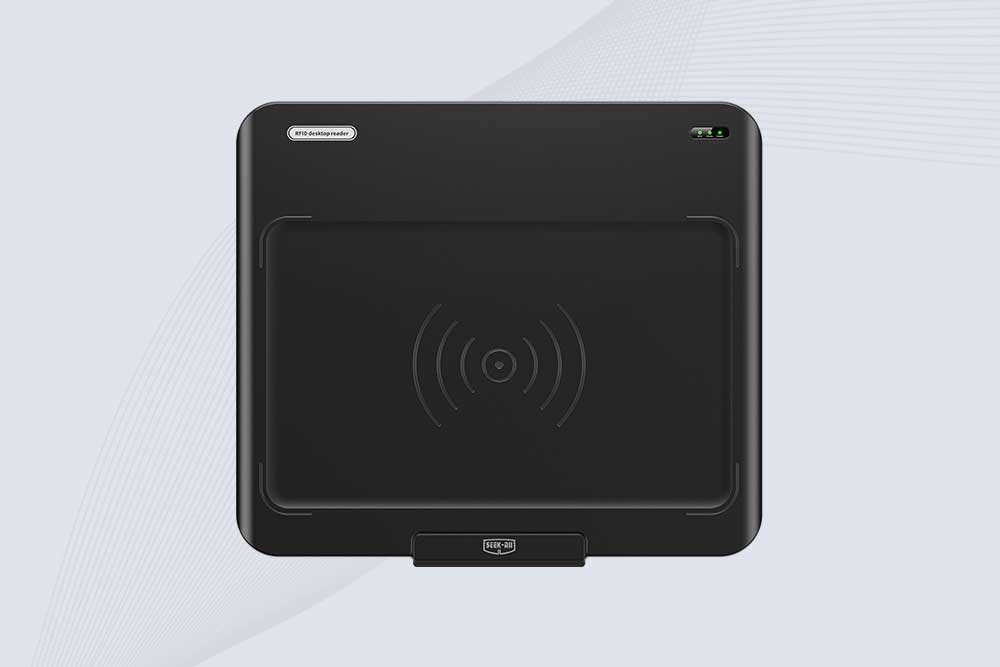
Before focusing only on RFID reading distance, it helps to understand the different types of USB RFID scanners and where they are normally used. Our USB RFID Scanner Guide covers the main reader types, applications, and selection factors.
1. Antenna Gain Makes a Big Difference
The reader and antenna work together.
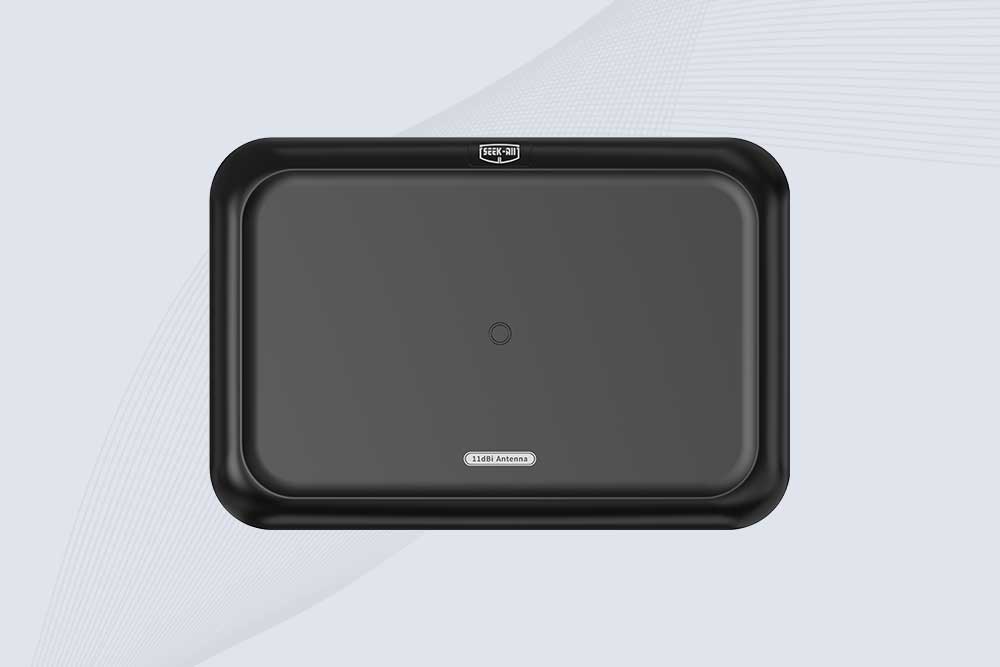
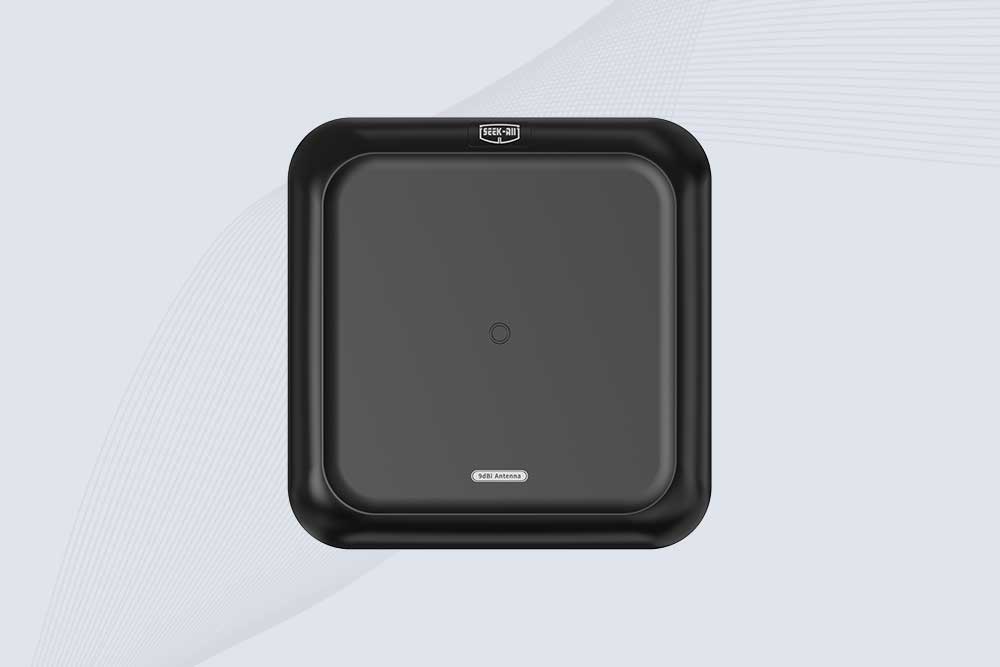
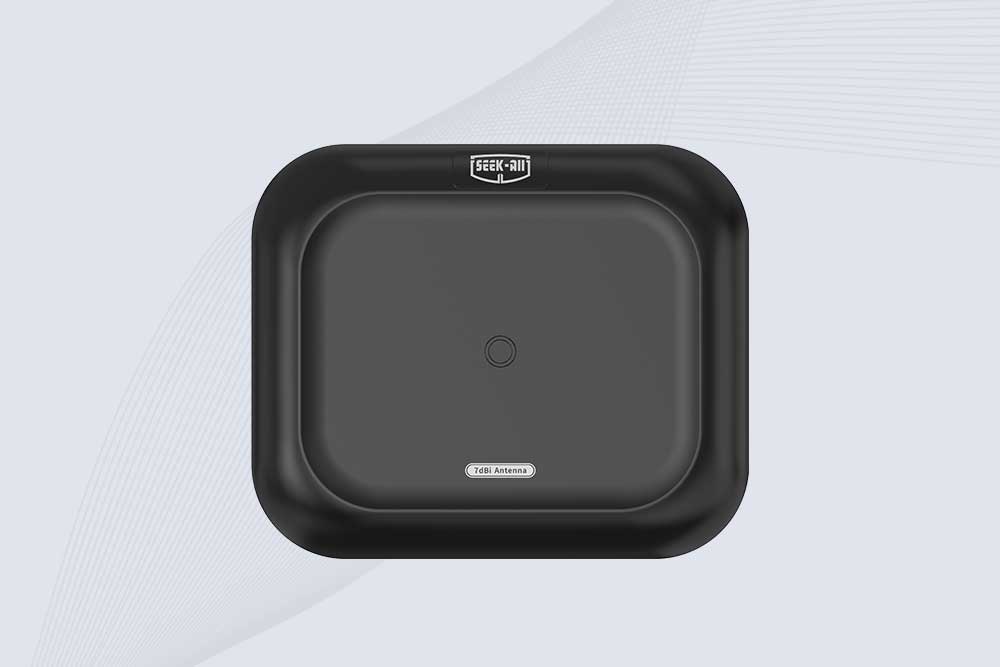
For long-range RFID applications, antenna performance is particularly important because the antenna determines how RF energy is transmitted and received.
Antenna gain is one specification worth paying attention to.
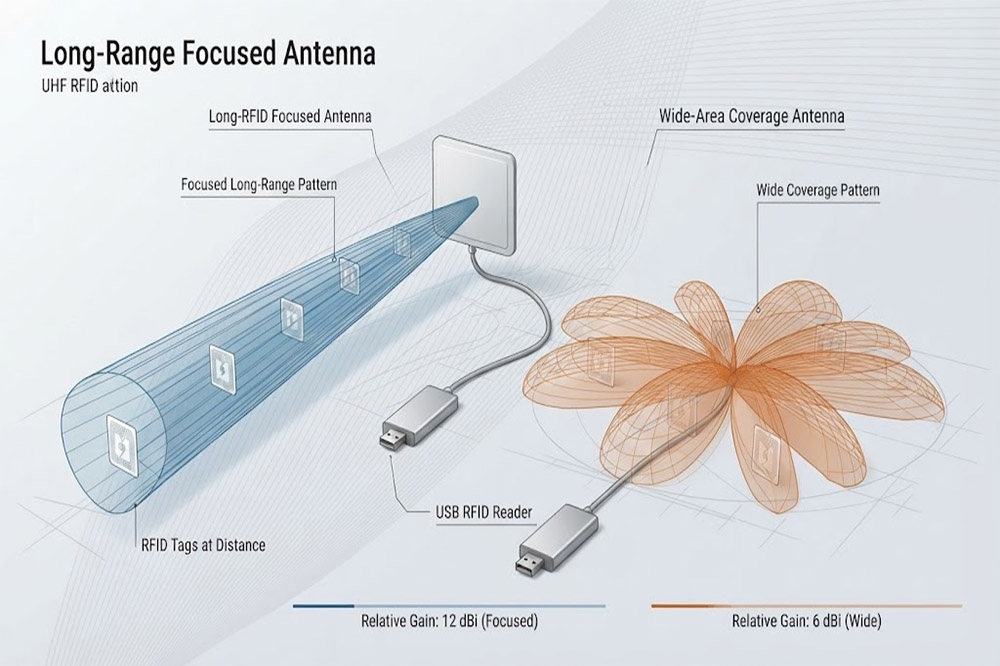
A higher-gain antenna can provide a more focused RF pattern, which may help increase reading distance in the right setup.
But higher gain is not automatically better.
A narrow reading zone may be excellent for a portal or a controlled scanning point.
It may be inconvenient if workers need to scan a wider area.
Think about a warehouse shelf.
If you want to identify products only inside one specific zone, a more focused antenna pattern could be useful.
If you want broad coverage around a workstation, a different antenna may make more sense.
So instead of asking only:
“What is the maximum gain?”
I would ask:
“What reading area do I actually need?”
2. Tag Size Can Change the Result
The RFID tag is often overlooked.
People tend to focus on the reader because it is the expensive electronic device. But the tag antenna is also part of the RF system.
A larger UHF RFID tag generally gives the RF system more antenna area to work with than a very small tag.
That does not mean every large tag will outperform every small tag.
Tag chip sensitivity, antenna design, material, mounting surface, and orientation all matter.
Still, there is a reason long-range RFID tests often use reasonably sized tags.
Now imagine a customer wants to read tiny RFID labels attached to small products from several meters away.
The reader may be perfectly capable of long-range operation, but the tag becomes the limiting factor.
This is why testing the actual tag is important.
3. Metal Is One of the Common Problems
Metal can make an RFID project much more difficult.
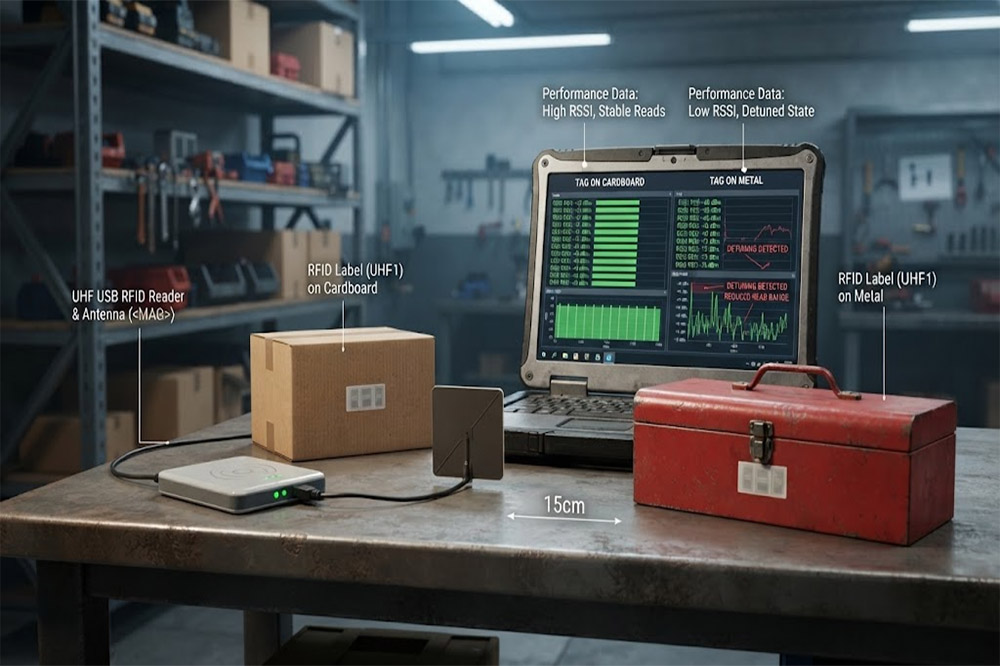
A tag that performs nicely when attached to cardboard may behave very differently when placed directly against steel.
This becomes especially obvious in:
Tool tracking
Industrial equipment
Metal containers
Warehouse racks
Machinery
Automotive parts
Metal cabinets
The problem is not necessarily the reader.
The RFID tag itself may not be designed for direct metal mounting.
There are special on-metal RFID tags designed to work better on metal surfaces.
If a customer says:
“The reader works fine with the sample tag, but once we stick it onto our metal equipment the range drops badly.”
I would look at the tag and mounting condition before immediately blaming the reader.
Sometimes changing the tag solves more than changing the reader.
4. The Environment Is Not Just Background
RFID works in the real world, and the real world is messy.
A laboratory test might have a reader, one tag, and plenty of open space.
A warehouse might have:
Steel shelves
Pallets
Forklifts
Electrical equipment
Hundreds of tagged products
Other RF devices
People moving around
Different product materials
All of these can change the reading behavior.
Liquids can also affect UHF RFID performance.
A tag on a dry cardboard box can behave differently from a tag attached to a bottle filled with liquid.
This is why a customer demonstration should ideally happen in the actual application environment.
If the reader will eventually be used beside a metal warehouse rack, testing it in an empty office is not particularly useful.
5. Tag Orientation Matters More Than People Expect
RFID tags do not always read equally well from every direction.
The orientation between the reader antenna and tag antenna can affect the result.
Imagine a worker holding a tagged box.
At one angle, the tag may be facing the reader nicely.
Turn the box 90 degrees and the reading distance may suddenly drop.
This can be frustrating during a demonstration because the customer may think:
“It worked five seconds ago.”
Nothing is necessarily broken.
The tag has simply changed position.
For applications where product orientation is unpredictable, tag selection and antenna configuration become much more important.
Why Does My 10 m Reader Only Read 2 m?
Let’s look at a realistic example.
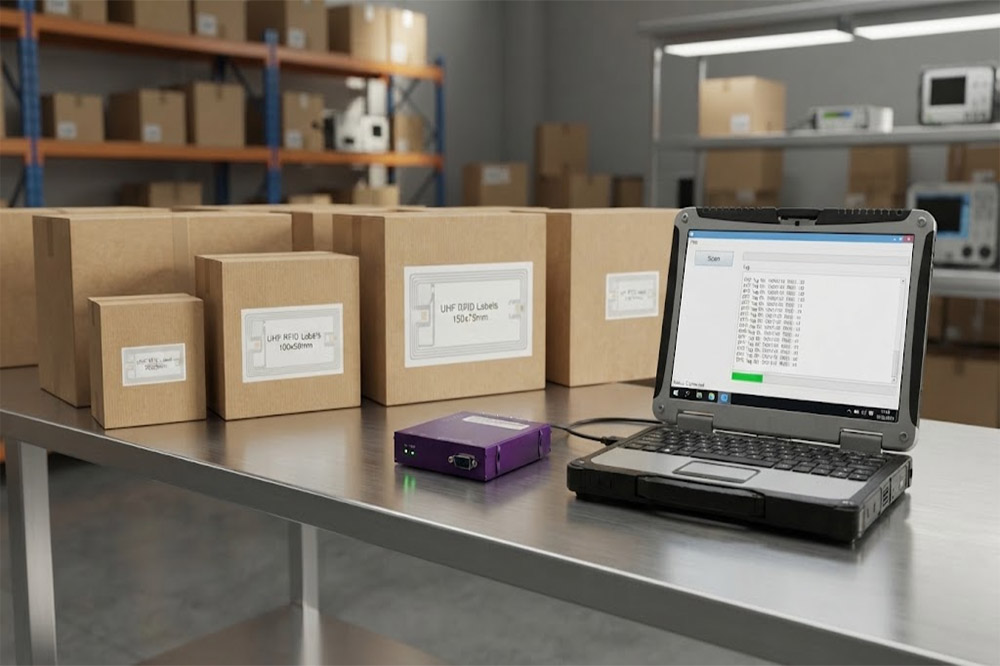
A supplier tests a UHF USB RFID reader using a medium-sized EPC Gen2 tag on a cardboard box in an open area.
The reader achieves close to 10 m.
The customer receives the sample and installs it in a warehouse.
Their actual tag is smaller.
The tag is mounted on a metal product.
The reader is placed beside a metal shelf.
The customer points the antenna at the product from an awkward angle.
Now the reading distance is 2 m.
The customer may conclude:
“The reader doesn’t meet the specification.”
But the real situation is more complicated.
The reader is being tested under completely different conditions.
This is why a proper RFID project should compare:
Supplier test → Customer tag → Customer product → Customer environment
rather than only comparing numbers on a product page.
How to Test RFID Reader Distance Properly
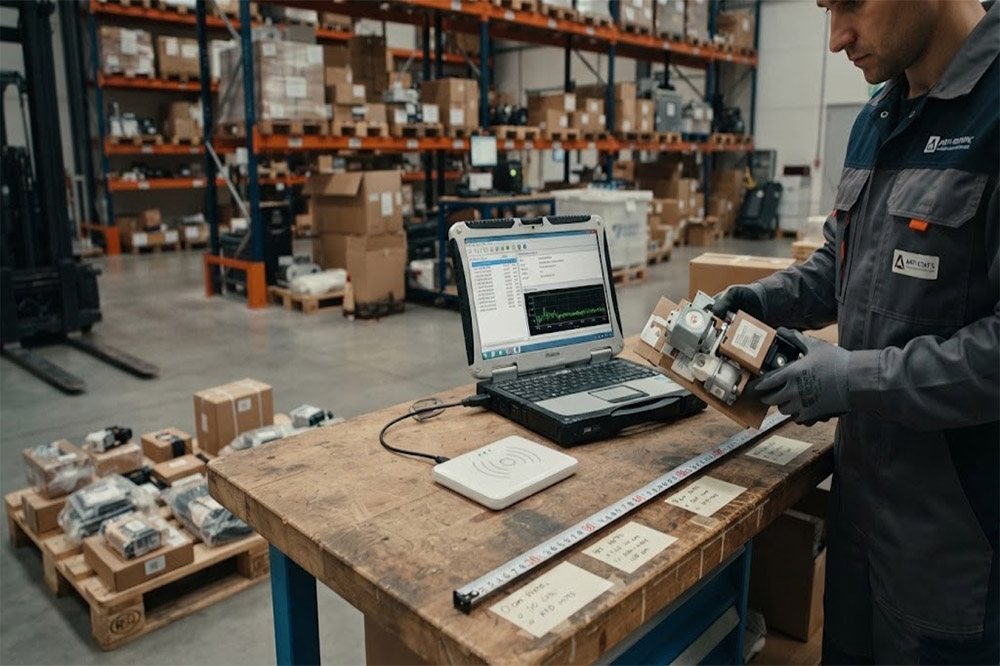
If you are buying RFID readers for a commercial project, I would suggest a simple test.
Step 1: Use the actual RFID tag
Do not use a supplier’s demonstration tag if your customer will use another model.
Step 2: Mount the tag on the actual product
Especially if the product contains metal or liquid.
Step 3: Set up the reader where it will actually be installed
Position and antenna angle matter.
Step 4: Measure stable reading distance
Don’t count one lucky read at the maximum distance.
Check whether the reader can repeatedly identify the tag.
Step 5: Test different orientations
Rotate the product and repeat the test.
Step 6: Test several tags
One unusually good tag does not represent the entire batch.
For wholesale customers, this type of testing can prevent a lot of unnecessary discussion after delivery.
Is Longer RFID Range Always Better?
Not really.
A longer range can actually create problems if the application requires a controlled reading zone.
Imagine a retail workstation where the operator wants to read only the product sitting on the table.
If the reader can detect every tagged item several meters away, nearby products may also be captured.
That creates unwanted reads.
For some applications, a controlled 2-meter zone is more useful than a 10-meter range.
This is especially important in inventory, access control, retail, and tool-management systems.
The goal is not always maximum distance.
The goal is the right reading zone.
Choosing USB RFID Scanner for Long-Range Applications
For customers looking for a long-range USB RFID scanner, I would check these points before placing a bulk order:
RFID frequency
Reader output power
Antenna gain
Antenna radiation pattern
Supported RFID tags
Tag size
Required reading distance
Product material
Metal or liquid exposure
USB communication method
Software compatibility
Actual test environment
If the customer cannot provide the RFID tag information, that should probably be the first thing to solve.
A reader specification alone cannot tell you how the final system will perform.
Cykeo provides USB RFID reader solutions for different RFID applications, including inventory, asset tracking, and system integration.
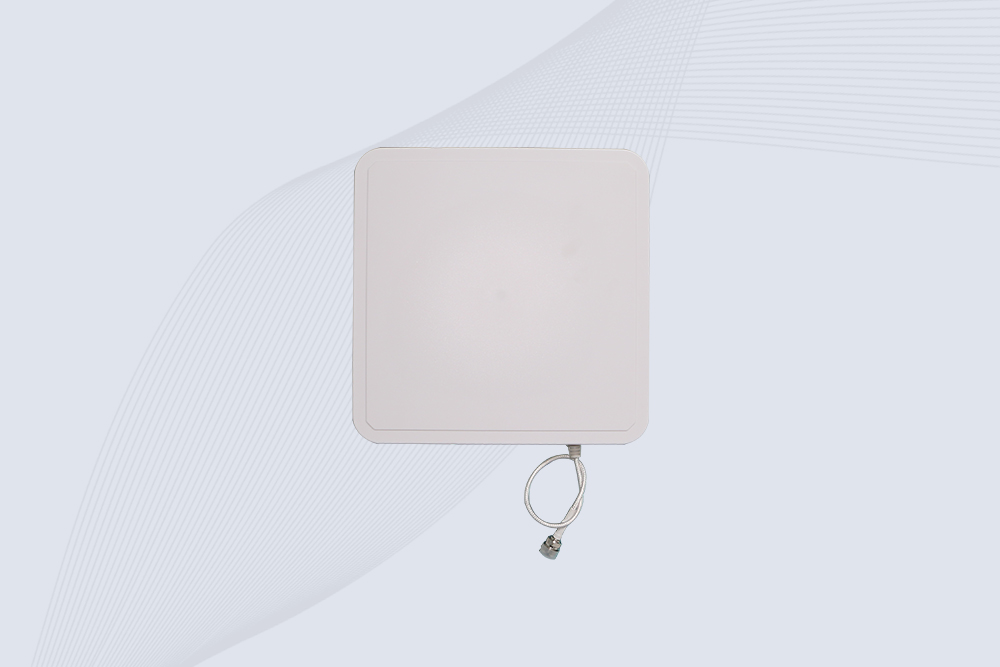
Explore the SSD-A07 UHF RFID antenna with 7 dBi gain, circular polarization, adjustable 840–960 MHz frequency, and 60°/75° beamwidth for stable RFID read/write performance.
SSD-A06 UHF RFID antenna with circular polarization, adjustable 840–960 MHz frequency, ≥4.5 dBi gain, and a compact directional design for RFID systems.
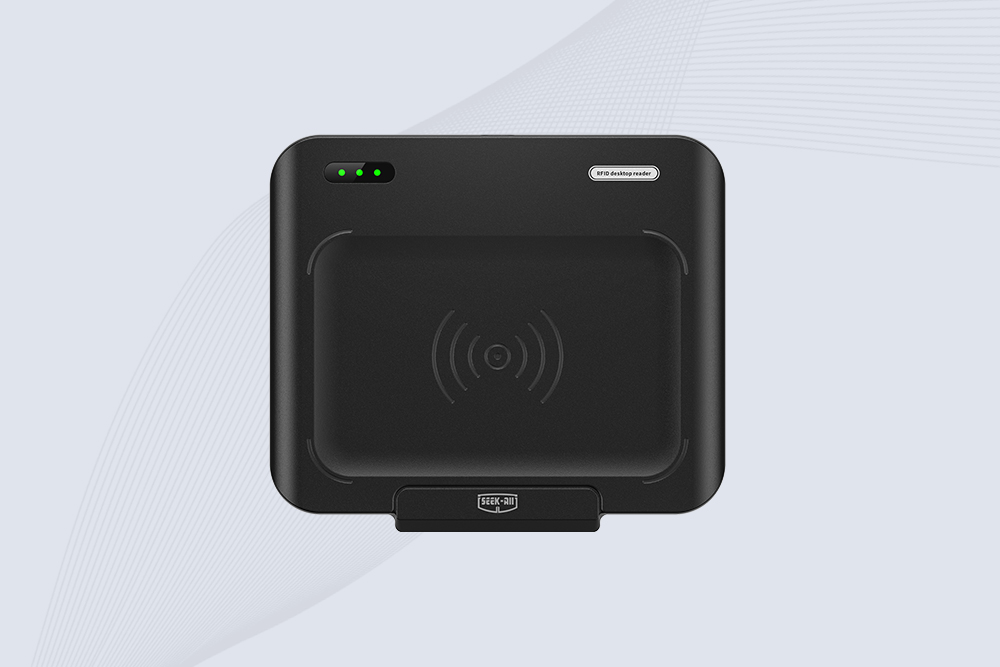
SSD-D3AL is a USB-HID UHF RFID reader with 0–30 cm reading, 0–15 cm writing, over 600 tags/s recognition, USB plug-and-play operation and OEM Logo customization.
SSD-D1AL is a compact USB UHF RFID reader with Impinj E710/X3M1 chipset, USB-HID, 600+ tags/s recognition, 4/8/16 antenna support and plug-and-play USB power.
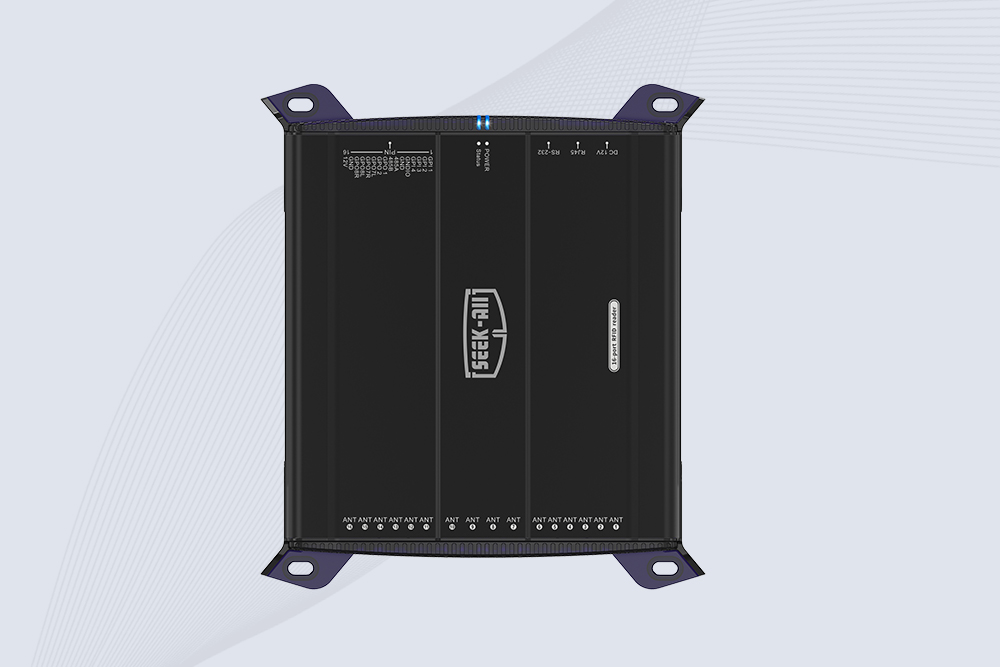
SSD-R16L Multi-Channel RFID Infrastructure for Automated Inventory Management ✔️ 16-Port High-Density RFID Reading Equipped with 16 SMA antenna ports, SSD-R16L supports multi-antenna deployment for warehouses, retail stores, logistics, production lines, and large-area RFID identification. ✔️ High-Speed & Long-Range Performance With up to 33…
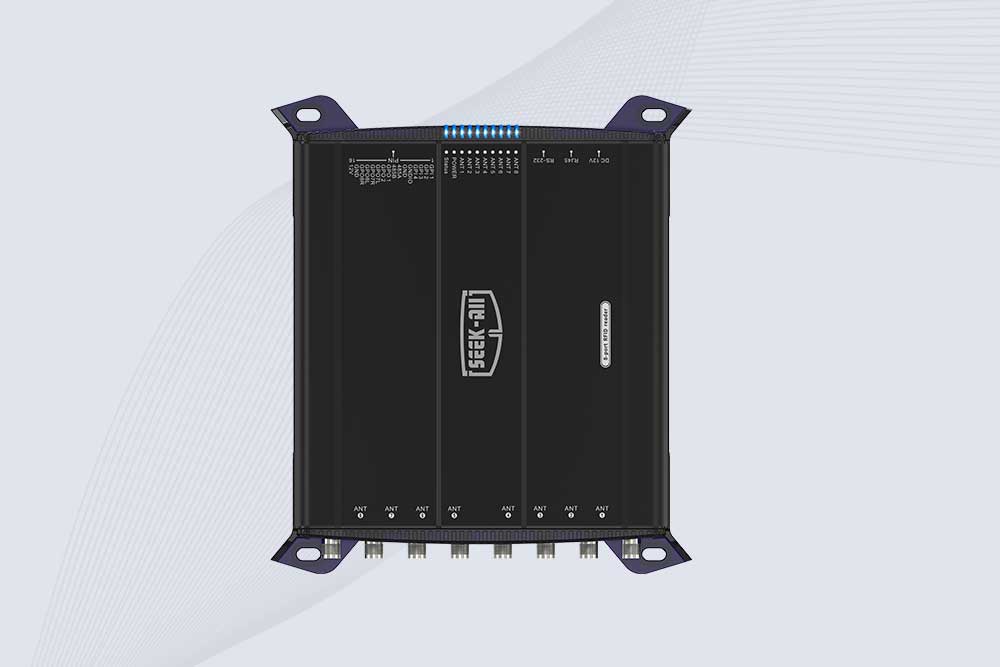
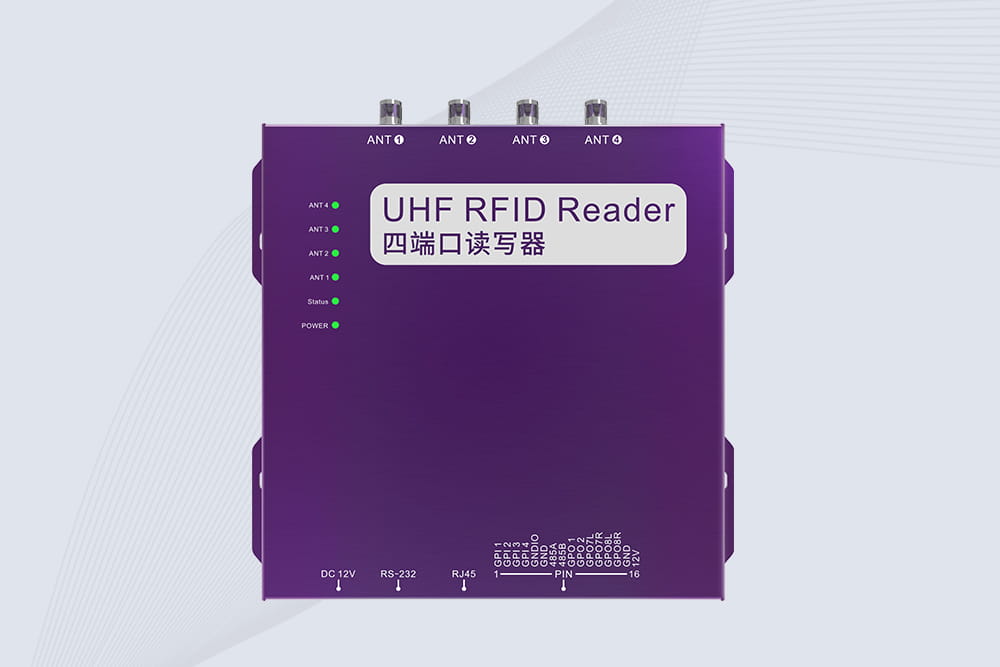
SSD-R8L 8-port UHF RFID reader with 33dBm output, up to 20m reading range and 600+ tags/s recognition. Ideal for warehouse, logistics, retail and asset tracking.
CYKEO CYKEO-D1LA USB RFID Reader is a compact desktop solution with near-field control for precise tag reading and encoding. Powered by USB, supporting ISO 18000-6C, and built for stable batch writing, this usb rfid tag reader fits retail, libraries, offices, and controlled RFID encoding tasks.
CYKEO CYKEO-D1L RFID scanner USB is a compact desktop UHF RFID scanner designed for short-range tag writing and verification. This usb rfid scanner supports batch encoding, stable 0–26 dBm output, and works across Windows, Linux, and Android systems.
CYKEO CYKEO-D1C USB RFID Card Reader is a near-field UHF desktop writer designed for secure, short-range tag encoding. With USB-C connectivity and stable 26 dBm output, this rfid reader usb c is ideal for badge issuance, label encoding, and controlled desktop RFID workflows.
CYKEO CYKEO-D2L RFID Reader USB is a compact desktop encoder built on the Impinj R500 chip. With near-field control and stable USB power, this usb rfid card reader delivers precise tag writing for offices, retail counters, and small-scale logistics encoding tasks.
CYKEO CYKEO-D3L USB RFID Tag Reader delivers stable UHF tag reading and writing for daily desktop and light industrial tasks. Designed for controlled short-range operation, this USB RFID Tag Reader works reliably with rfid tag and reader systems in libraries, tool tracking, and inventory registration.
The CYKEO CYKEO-D4L UHF RFID Tag Reader is a stable Desktop RFID Reader designed for accurate tag registration, borrowing, and return workflows. Built with the Impinj R2000 chip, this UHF RFID Tag Reader delivers controlled short-range reads for libraries, asset tracking, and inventory management environments.
The CYKEO CYKEO-D5L Desktop RFID Card Reader is a stable UHF RFID Card Reader designed for controlled short-range reading and writing. Built for libraries, tool rooms, and asset desks, this UHF RFID Card Reader supports dense tag handling, secure data processing, and easy USB integration.
The CYKEO CYKEO-D6L RFID Reader Writer is a heavy-duty Desktop RFID Reader designed for short-range, high-accuracy tag programming. Built for libraries, labs, and asset desks, this RFID Reader Writer supports batch processing, stable 33dBm output, and seamless integration with existing management systems.
Cykeo CYKEO-D8A embedded RFID badge reader offers 30+ tags/sec scanning, 20cm anti-crosstalk precision, and DC 12V power for unmanned stores, warehouses, and smart inventory systems.
Cykeo’s CYKEO-D8C UHF RFID gate reader achieves 200-tag/batch scanning with adjustable power control, ideal for retail inventory and smart warehouse management.
Cykeo CYKEO-A11 UHF RFID reader antenna delivers 11dBi gain, 840-960MHz frequency range, and IP65 ruggedness for retail, logistics, and industrial RFID systems. Features low VSWR and easy installation.
CYKEO Antenna RFID Reader delivers stable long-range UHF performance with a 10.5dBi directional design, built for warehouses, conveyor portals, and industrial RFID systems. This rfid reader antenna provides 20m+ read distance and rugged IP67 protection.
Cykeo CYKEO-A5B industrial Linear RFID Antenna delivers 5dBi gain, ≤1.5:1 VSWR, and IP65 rugged design for warehouse, production line, and logistics UHF systems.
Cykeo’s CYKEO-B12 Long Range RFID Antenna delivers 15m+ read range with 12dBi gain, IP65 rugged design, and global 840-960MHz UHF support. Ideal for warehouse/logistics asset tracking.
Cykeo CYKEO-B10 Long Distance RFID Antenna offers 10dBi gain, 840-960MHz frequency range, IP65 rating, and 20m+ coverage for logistics/warehousing/ETC systems. Low VSWR ensures stable signal transmission.
Cykeo CYKEO-A6 UHF RFID panel antenna features 6dBi gain, 840-960MHz broadband, IP65 metal-ready housing for logistics/smart retail. 18mm ultra-thin design with tool-free mounting.
Cykeo CK-A3 industrial antenna RFID UHF offers 5m+ tag detection, ≤1.3:1 VSWR, IP65 rugged design, and global UHF spectrum compatibility (840-960MHz) for warehouses, factories, and retail.
Cykeo CYKEO-B5 directional RFID antenna provides 5dBi gain with 60° narrow beamwidth for precise inventory tracking. IP65-rated, global UHF frequency support, and low VSWR.
Create your own high-performance DIY RFID antenna! 5dBi gain, 840-960MHz tunable, step-by-step guides. Compatible with Arduino, Raspberry Pi, and commercial UHF readers.
Cykeo CYKEO-A7 Flexible RFID Antenna features 840-960MHz wideband tuning, 7dBi gain, and IP68 rating for medical/retail/industrial curved surface deployments. 98% read accuracy with peel-and-stick installation.
Cykeo CYKEO-B5A industrial Passive RFID Antenna delivers 5dBi gain, 70° beamwidth, and -40°C~55°C operation for warehouses/smart cabinets. Compatible with Zebra/Impinj readers.
Cykeo’s CYKEO-A9B High Gain RFID Antenna delivers 15m+ read range with 9dBi amplification. Features IP54 rugged design, 840-960MHz bandwidth, and 80° beamwidth for warehouse/manufacturing RFID systems.
Cykeo’s enterprise-grade 8dbi Impinj RFID Antenna 10m+ read range with 840-960MHz tuning. Features IP65 housing, 1.4 VSWR, 35° beamwidth for retail/warehouse RFID systems.
Cykeo CYKEO-A9 industrial UHF RFID antenna delivers 9dBi gain, 840-960MHz frequency range, and IP65 protection for warehouse/logistics/retail RFID systems. Features N-type connector and ≤1.3:1 VSWR.
CYKEO UHF RFID Antenna built for long-distance and industrial applications. This antenna rfid uhf delivers strong gain, outdoor durability, and reliable tag performance in warehouses, yards, and vehicle ID systems.
CYKEO Antenna RFID delivers reliable long-range UHF performance in warehouses, retail shelves, and cold-chain environments. This compact uhf rfid antenna provides stable reads with circular polarization and ultra-wide 840–960 MHz support, ideal for industrial tracking, smart shelves, and asset monitoring.
Cykeo’s CYKEO-C8 UHF RFID antennas delivers 8dBi gain, 840-960MHz full-band coverage, and IP65 ruggedness for manufacturing/warehouse RFID systems. Industrial RFID Antennas Features
Cykeo’s 8dBi UHF RFID antenna and reader kit delivers 10m+ range, 840-960MHz broadband, and IP65 ruggedness for factories, warehouses, and logistics. ISO 18000-6C & EPC Gen2 certified.
Cykeo’s CYKEO-A12C UHF Large RFID Antenna delivers 12dBi gain, 840-960MHz global frequency, IP65 ruggedness for logistics/warehousing/automotive. 40° beamwidth ensures stable 15m+ tag reads.
CYKEO Near Field RFID Antenna provides precise 5–30 cm reading for shelves, cabinets, and workstations. This compact rfid shelf antenna delivers stable short-range performance around metal and clutter, ideal for pharmacies, libraries, and electronics sorting.
Cykeo CYKEO-C1 industrial Forklift RFID Reader features 20m read range, 600 tags/sec scanning, Impinj R2000 chipset, and IP67 rugged design. Ideal for warehouse logistics and manufacturing. Supports ISO 18000-6C/6B protocols.
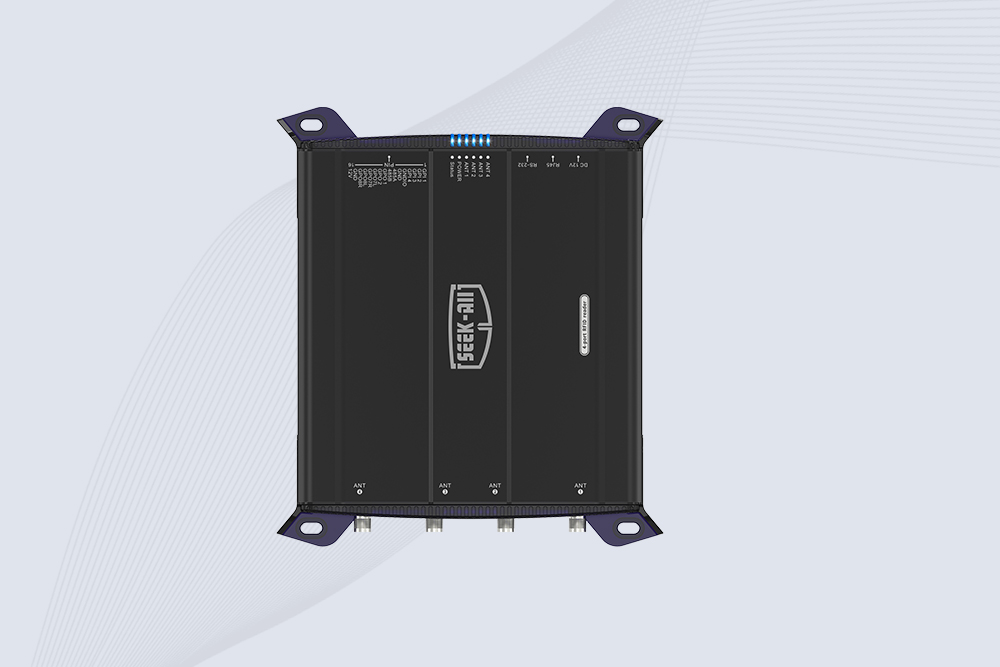
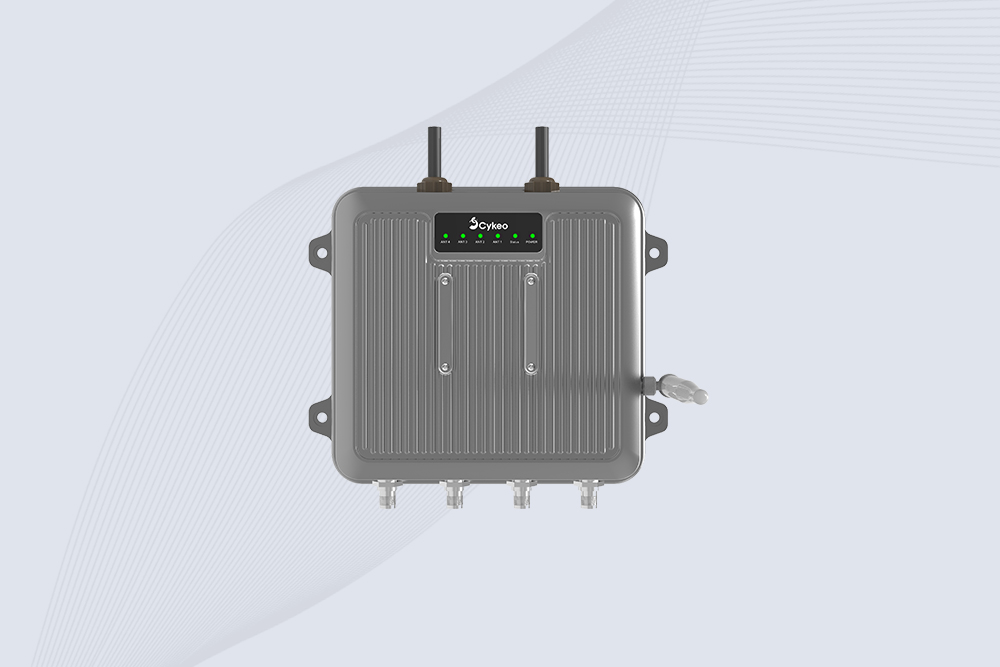
Cykeo CYKEO-R4 industrial UHF RFID Fixed Reader features 4 TNC ports, 400+ tags/sec speed, IP67 housing, and global frequency compliance for vehicle inspection, smart warehouse, and asset management systems.
CYKEO CYKEO-R8L Fixed RFID Reader with 8-port UHF design, Impinj-based RF core and up to 20m read range. An industrial Fixed RFID Reader for vehicle inspection, warehouse portals, smart manufacturing lines and secure access checkpoints.
RFID Fixed Reader from CYKEO – the CYKEO-R16L 16-port UHF fixed reader for warehouses, smart cabinets, and production lines. Long-range, multi-tag reading, stable performance for 24/7 industrial use.
RFID Industry Writer | IoT & Asset Tracking Analyst
James writes about RFID technology, asset tracking, and the practical challenges of digital transformation across warehousing, retail, manufacturing, and logistics.
His work focuses on how RFID is applied in real-world operations—improving inventory visibility, automating workflows, and helping businesses manage assets with greater accuracy and efficiency.
He regularly covers topics including UHF RFID, smart cabinets, RFID portals, tool tracking, warehouse automation, and industrial IoT trends..
Want to learn how to build a RFID reader? We walk through two practical approaches using Arduino/Raspberry Pi and explain when you should just buy one instead.
A hands-on look at the CK-T8D RFID Gate Access Control System. This article breaks down real warehouse performance, read accuracy, direction detection, anti-interference capability, and why this industrial RFID gate fits high-volume access points ...
Discover why modular RFID readers are trending in 2024. Learn how flexibility, scalability, and Cykeo’s innovations make them essential for modern industries.
Tired of RFID readers dying in storms? Learn how waterproof UHF readers handle downpours, which brands survive real farms, and how to tag cows without losing data.
 Cykeo RFID IoT Solution Products R&D Manufacturer