Hospitals handle much more textile inventory than most people realize.
Bed sheets, patient gowns, surgical textiles, staff uniforms, blankets, towels, and medical garments move constantly between hospital departments, laundry facilities, storage rooms, and external service providers.
Once the scale becomes large enough, keeping track of everything manually becomes extremely difficult.
And unlike hotels or retail businesses, hospitals face additional pressure because textile management directly affects operational efficiency, hygiene control, and patient service quality.
That’s one reason RFID laundry tracking systems are becoming more common in healthcare environments.
Hospital Textile Management Is More Complicated Than Standard Laundry Operations
In healthcare facilities, textile inventory moves continuously throughout the day.
Emergency departments, operating rooms, inpatient wards, and outpatient clinics all consume textiles at different rates. Some items require strict replacement schedules, while others circulate through industrial washing systems repeatedly.
Without accurate tracking, hospitals often deal with problems like:
Missing medical garments
Inconsistent inventory levels
Delayed linen replenishment
Excess emergency purchasing
Sorting mistakes during laundry processing
Manual counting methods rarely keep up well in large healthcare environments.
Staff members are usually focused on patient care first, which means textile tracking often becomes secondary during busy shifts.
RFID helps automate much of this process.
How RFID Laundry Tags Work in Hospitals
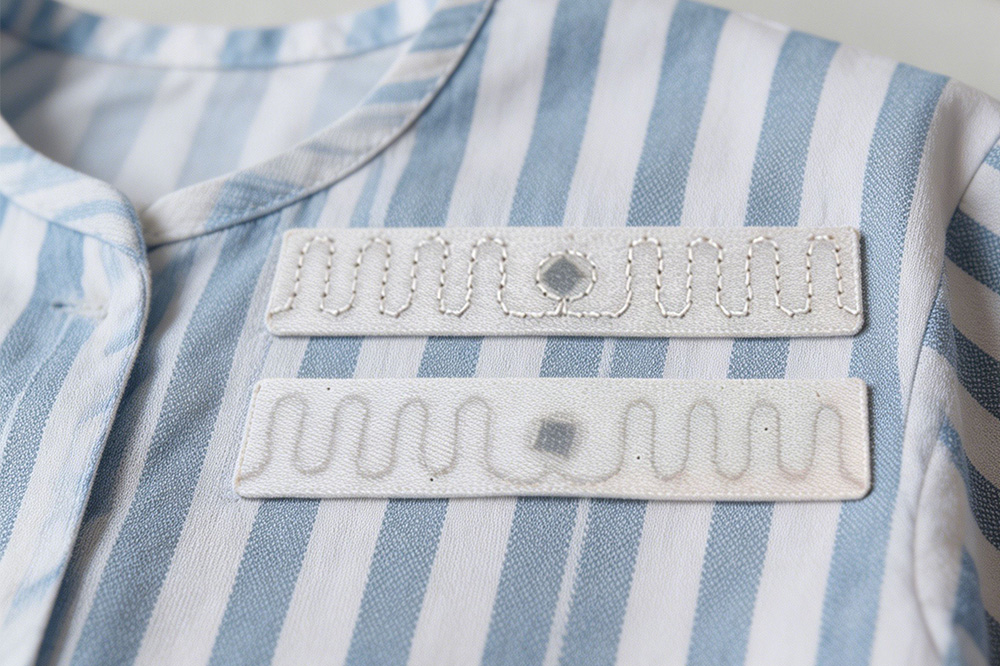
RFID laundry tags are typically sewn directly into medical textiles such as:
Patient gowns
Bed linens
Surgical fabrics
Staff uniforms
Blankets
Scrubs
Each item receives a unique digital identity that can be tracked throughout its entire lifecycle.
As textiles move through collection, washing, storage, and redistribution, RFID readers automatically record inventory activity.
A durable industrial RFID laundry tag is designed to withstand repeated hospital washing conditions, including high temperatures, chemical disinfectants, pressure extraction, and industrial drying.
That durability is especially important in healthcare environments where textiles may complete hundreds of wash cycles.
Hospitals Need Better Inventory Visibility
One common problem in hospitals is inventory imbalance.
Some departments suddenly run short on linens while other storage areas hold excess stock. Without real-time visibility, staff often spend valuable time searching for missing textiles.
RFID systems help hospitals understand:
Current inventory levels
Linen movement between departments
Wash cycle history
Textile usage frequency
Missing item patterns
Instead of relying on estimates, management teams can make decisions using actual inventory data.
This becomes increasingly important in larger healthcare networks where multiple facilities share centralized laundry operations.
Reducing Textile Loss Helps Control Costs
Hospital textiles disappear more often than many administrators expect.
Items may be discarded accidentally, misplaced during transport, mixed between departments, or lost during external laundry processing.
Over time, replacement costs add up significantly.
RFID tracking helps reduce these losses because every tagged item becomes traceable throughout the system.
If inventory discrepancies appear, operators can review movement history instead of relying entirely on manual investigation.
Some healthcare facilities also use RFID systems to identify unusually high textile consumption patterns in specific departments.
That kind of visibility is difficult to achieve with manual systems alone.
Wash Cycle Monitoring Improves Textile Quality
Medical textiles go through aggressive cleaning procedures.
Frequent exposure to disinfectants, high-temperature washing, and industrial drying gradually affects fabric quality over time.
Without tracking, hospitals often replace linens either too early or too late.
RFID systems allow operators to monitor wash cycle counts more accurately.
This helps hospitals:
Retire worn textiles at the correct time
Maintain hygiene standards more consistently
Improve textile purchasing forecasts
Reduce unnecessary inventory replacement
For healthcare environments, maintaining consistent textile quality is not only a cost issue — it also affects patient experience and operational standards.
RFID Supports Faster Laundry Processing
Healthcare laundry facilities often process large textile volumes every day.
Manual sorting and counting slow down operations significantly, especially during peak processing periods.
RFID systems allow staff to identify large batches of textiles automatically instead of scanning items individually.
This improves:
Sorting speed
Packing accuracy
Inventory counting efficiency
Delivery verification
Workflow automation
As labor shortages continue affecting industrial laundry industries, automation becomes more valuable for healthcare operations trying to maintain efficiency.
RFID Is Becoming More Common in Healthcare Textile Management
A few years ago, RFID hospital laundry systems were mainly limited to large medical centers.
Now adoption is spreading much faster across healthcare networks, uniform management providers, and commercial medical laundries.
The reason is simple: hospitals need better visibility while managing growing operational pressure.
RFID helps healthcare facilities track textile inventory more accurately without adding excessive manual workload.
For many medical textile management projects today, RFID laundry tags are no longer considered optional technology. They are increasingly becoming part of standard hospital inventory infrastructure.
If you've ever walked through a busy manufacturing plant, one thing becomes obvious very quickly—parts are constantly moving. Some move between production lines. Others wait beside machines. Finished products head toward packaging while empty pall...
Discover the best RFID/UHF long-range reader for outdoor Proof of Value (PoV) in sub-zero temperatures. Explore rugged features, cold-weather performance, and Cykeo’s solutions.
RFID cable tags vs barcode labels: compare cost, efficiency, durability, and ROI. Find out which solution is better for industrial asset tracking and cable management.
Discover whether RFID or barcode scanners are faster for logistics. Compare bulk scanning speeds, error rates, and use cases for warehouses and shipping hubs.
 Cykeo RFID IoT Solution Products R&D Manufacturer