 Cykeo RFID IoT Solution Products R&D Manufacturer
what is rfid asset tracking: Complete Guide to RFID-Based Asset Visibility
120Discover what is rfid asset tracking and how RFID technology improves asset visibility, location management, and operational efficiency with Cykeo solutions.
MoreAll RFID Product
RFID in hospitals enables real-time tracking of medical supplies, equipment, and consumables, improving inventory accuracy, reducing manual workload, and supporting safer healthcare operations. Modern RFID systems can automatically monitor asset movement, usage, and replenishment while providing visibility across hospital departments.
During more than ten years working with RFID deployments in healthcare, pharmaceutical logistics, and medical inventory automation projects, one observation appears repeatedly: hospitals rarely struggle because they lack equipment. They struggle because staff cannot immediately locate equipment, verify inventory levels, or trace item usage history.
RFID solves exactly that problem.
Healthcare environments generate thousands of inventory transactions every day.
A nurse removes surgical supplies.
A technician returns diagnostic equipment.
A department borrows infusion pumps.
Traditionally, many of these activities are recorded manually.
The result?
Delayed updates, misplaced equipment, inventory discrepancies, and unnecessary purchasing.
According to the U.S. Food and Drug Administration (FDA), Unique Device Identification (UDI) initiatives have accelerated healthcare traceability efforts, helping healthcare providers improve visibility and tracking of medical devices throughout their lifecycle.
RFID technology expands this capability by automating identification and movement tracking without requiring line-of-sight scanning.
An RFID hospital solution typically includes:
When tagged assets move in or out of storage, the system automatically records the event.
No barcode scanning.
No manual counting.
No spreadsheets.
| Asset Type | RFID Tracking Purpose |
|---|---|
| Surgical Instruments | Sterilization & usage tracking |
| PPE Inventory | Consumption monitoring |
| Infusion Pumps | Location visibility |
| Wheelchairs | Asset utilization |
| Implantable Devices | Traceability |
| Pharmaceuticals | Inventory control |
One healthcare customer operating a regional medical center struggled with emergency supply audits.
Monthly inventory checks required several employees and often consumed an entire weekend.
After deploying RFID smart shelves:
The most noticeable change was not speed.
It was confidence.
Staff no longer questioned inventory accuracy because the system continuously validated inventory levels.
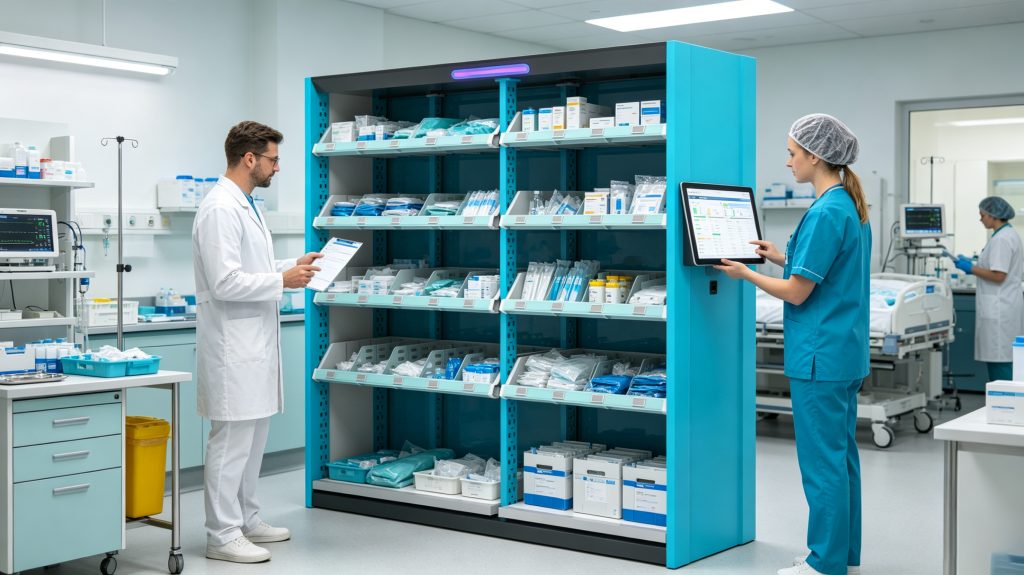
Modern RFID medical shelves combine RFID identification with weight-sensing technology.
This creates a powerful dual-verification mechanism.
Benefits include:
Hospitals can perform:
within seconds rather than hours.
Well-designed RFID healthcare shelves can achieve recognition rates above 99.95% under controlled deployment conditions.
This minimizes:
Every movement generates a digital record.
Hospitals gain visibility into:
Healthcare organizations face increasing pressure to improve traceability.
According to GS1 Healthcare, global healthcare providers continue adopting RFID and automatic identification technologies to strengthen patient safety and supply chain visibility.
RFID supports compliance by providing:
These records become particularly valuable during inspections and accreditation reviews.
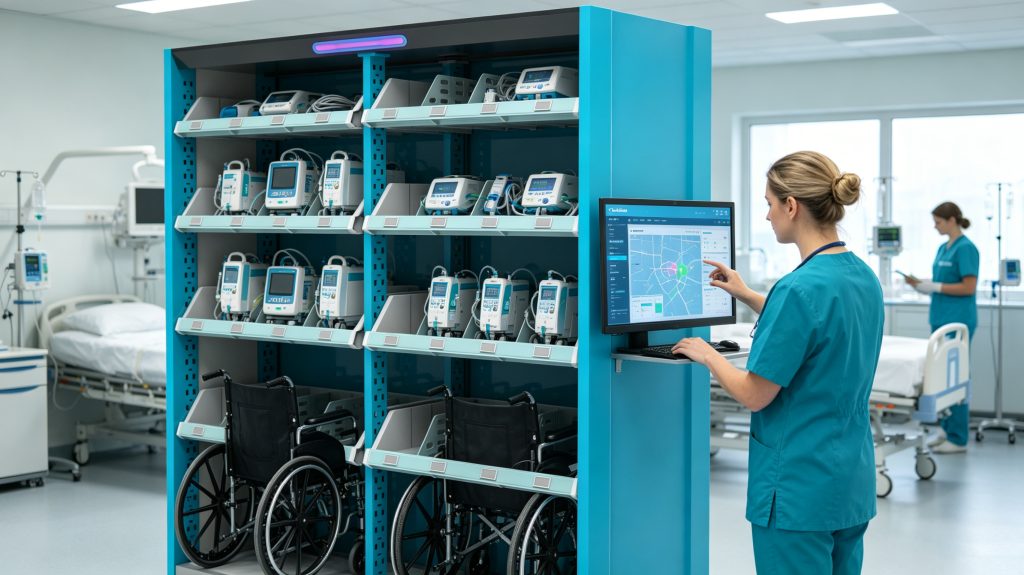
RFID in hospitals is used to track medical equipment, pharmaceuticals, surgical instruments, consumables, and healthcare inventory automatically.
Yes. RFID systems can automate inventory verification and significantly reduce manual counting requirements.
Yes. RFID is widely used for medication tracking, inventory control, and supply chain traceability.
Yes. RFID readers can automatically identify equipment movement and provide real-time location visibility.
Absolutely. RFID deployments can scale from a single department to an entire hospital network.
RFID in hospitals is no longer simply an inventory technology. It has become an operational visibility platform that helps healthcare providers manage assets, improve inventory accuracy, and support patient care more effectively.
For hospitals seeking reliable automation, real-time traceability, and scalable medical inventory management, Cykeo RFID solutions provide a practical foundation for modern healthcare operations. RFID in hospitals continues to play an increasingly important role in building smarter, safer, and more efficient healthcare environments.

Discover what is rfid asset tracking and how RFID technology improves asset visibility, location management, and operational efficiency with Cykeo solutions.
More
Discover how RFID gate access control systems enhance security and streamline vehicle or personnel entry. Learn practical setup tips, real-world cases, and integration ideas.
More
Trying to solder your way to more range? We explain why the method for how to extend RFID chip antenna is a full redesign, not a simple mod, and what really works.
More
Learn how to use rfid scanner in real work scenarios. Clear, field-tested steps for inventory, access control, and asset tracking using CYKEO RFID solutions.
More