 Cykeo RFID IoT Solution Products R&D Manufacturer
Long Range RFID Scanner for Access Control: RFID Gate and Entry Solutions
85Long range RFID scanners can automate entry identification for vehicles, personnel, equipment, and industrial assets without requiring direct barcode scannin...
MoreAll RFID Product
RFID for tracking enables automatic, real-time identification and location monitoring of assets, inventory, equipment, and goods without manual scanning, helping organizations improve visibility, accuracy, and operational efficiency across warehouses, factories, healthcare facilities, and supply chains.
Most companies don’t realize how much time disappears into searching.
Searching for pallets. Searching for tools. Searching for missing inventory.
RFID changes that dynamic.
As an RFID deployment consultant who has worked on warehouse automation, manufacturing traceability, and industrial asset visibility projects for more than a decade, I’ve repeatedly seen organizations discover that the biggest problem wasn’t inventory shortage—it was inventory uncertainty.
RFID for tracking provides certainty.
According to research published by the RFID Lab at Auburn University and GS1 US, RFID technology continues to gain adoption because it automates data capture without requiring line-of-sight scanning.
Traditional barcode workflows depend on human participation.
RFID does not.
A tagged item moving through a doorway can be identified automatically.
A pallet entering a warehouse can be recorded automatically.
A tool leaving a maintenance room can trigger an alert automatically.
That’s the operational shift.
RFID tracking is commonly used for:
One logistics customer told me something during a site audit that stuck with me:
“We weren’t losing assets. We were losing time trying to find them.”
The distinction matters.
| Challenge | Traditional Method | RFID Solution |
|---|---|---|
| Asset location | Manual search | Automatic visibility |
| Inventory count | Physical audit | Continuous monitoring |
| Equipment movement | Paper logs | Automated tracking |
| Compliance records | Manual reporting | Digital history |
The savings often come from operational speed rather than labor reduction alone.
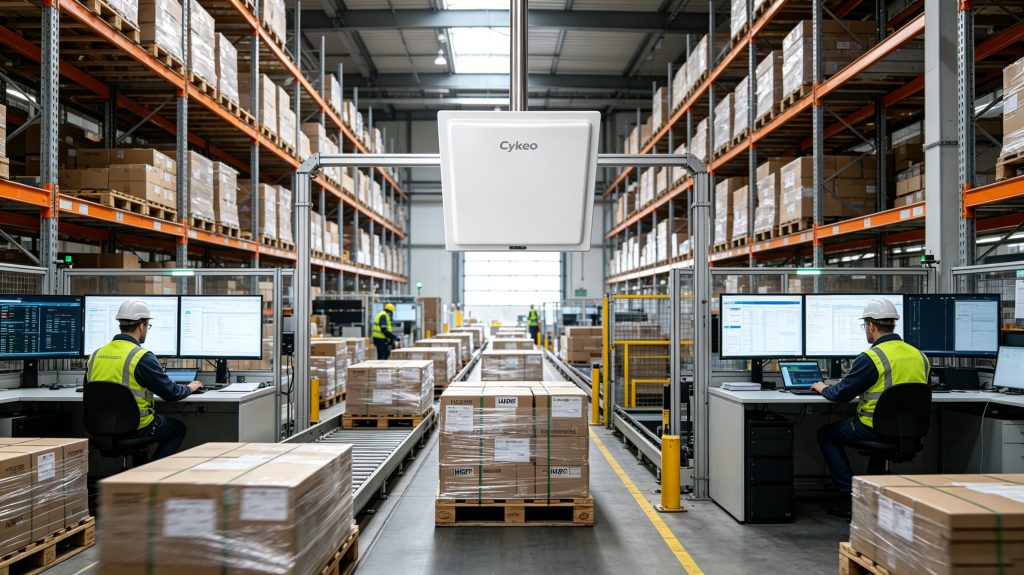
Inventory visibility is where RFID often delivers its fastest return.
According to GS1 US, organizations implementing RFID frequently report inventory accuracy improvements exceeding 95% when compared with manual inventory processes.
This improvement matters because inaccurate inventory creates secondary problems:
In one warehouse evaluation, workers spent nearly four hours locating inventory that the system reported as available.
After RFID deployment, item movements became visible automatically, reducing those search events significantly.
RFID systems enable:
The result is operational confidence rather than periodic inventory snapshots.
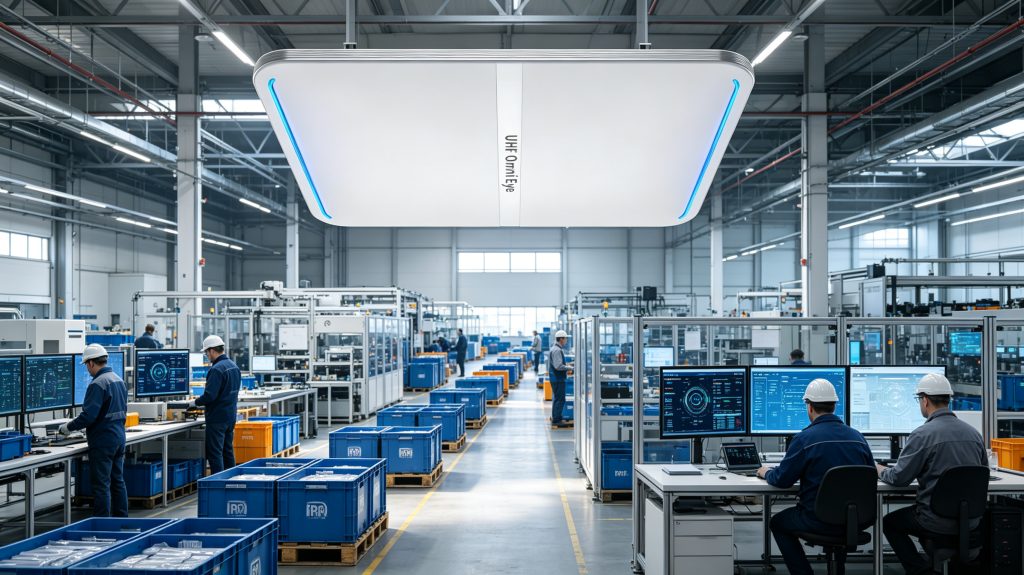
Many industrial facilities deploy ceiling-mounted UHF RFID readers to maximize coverage.
The Cykeo integrated UHF RFID reader offers several advantages:
Unlike traditional reader-and-antenna configurations, integrated systems simplify installation while reducing infrastructure complexity.
One overlooked benefit of RFID tracking is security.
When tagged assets move through monitored zones unexpectedly, audible and visual alerts can notify personnel immediately.
This transforms RFID from a visibility tool into a proactive monitoring system.
This article was reviewed by the Cykeo RFID Engineering Team, whose members have supported RFID deployments across manufacturing, warehousing, logistics, and industrial automation projects.
The observations shared here come from practical field implementations involving RFID readers, tracking systems, inventory visibility platforms, and automated identification technologies.
A recurring lesson across projects is simple:
Organizations rarely suffer from a lack of data. They suffer from delayed data.
RFID addresses that gap directly.
RFID for tracking uses radio frequency technology to automatically identify and monitor tagged assets, inventory, or equipment without requiring manual scanning.
Accuracy depends on tag selection, reader placement, and environmental conditions. Properly designed systems commonly achieve very high identification rates.
Yes. RFID readers can identify many tags simultaneously, making them suitable for bulk inventory and logistics applications.
Manufacturing, healthcare, logistics, retail, warehousing, transportation, and government organizations widely use RFID tracking systems.
No. Unlike barcodes, RFID tags can be read without direct visual alignment.
RFID for tracking has evolved from a specialized technology into a practical business tool for improving visibility, inventory accuracy, and operational control. Whether tracking assets, inventory, tools, or shipments, organizations implementing RFID for tracking gain faster access to reliable data and better decision-making across daily operations.
Long range RFID scanners can automate entry identification for vehicles, personnel, equipment, and industrial assets without requiring direct barcode scannin...
More
Explore how RFID solutions for healthcare enhance patient safety, streamline hospital operations, and optimize asset management, with practical real-world examples.
More
A developer-focused look at handheld RFID readers, exploring why they are often used as development tools, integration references, and building blocks for custom RFID systems beyond inventory counting.
More
RFID and IoT technologies offers efficiency Logistics Solution
More