RFID chip clothing uses embedded or attached RFID tags to identify, track, and manage garments throughout manufacturing, warehousing, retail, and post-sale operations. It significantly improves inventory accuracy, stock visibility, and operational efficiency while reducing manual labor.
For apparel brands facing inventory discrepancies, misplaced stock, and inefficient cycle counts, RFID technology has moved from an optional innovation to a practical business tool.
Author Expertise
This article was reviewed by the Cykeo RFID Solutions Team, engineers and RFID deployment specialists with experience supporting RFID implementations across retail apparel, warehouse logistics, textile management, and asset tracking projects.
During recent apparel RFID deployments, our team observed that manual inventory counting often required multiple employees several hours to complete. After RFID implementation, the same inventory could be verified in minutes using handheld readers and fixed RFID infrastructure.
What Is RFID Chip Clothing?
RFID chip clothing refers to garments equipped with RFID-enabled labels or tags containing a microchip and antenna.
Unlike traditional barcodes that require line-of-sight scanning, RFID tags can be identified wirelessly and simultaneously.
In apparel retail, most deployments use UHF RFID technology because it supports longer reading distances and bulk scanning.
Why Apparel Retailers Are Investing in RFID
The business case is increasingly supported by industry data.
According to the RFID Lab at Auburn University, retailers implementing item-level RFID commonly achieve inventory accuracy rates exceeding 95%.
Meanwhile, GS1 reports that RFID-enabled inventory visibility improves stock availability and reduces out-of-stock situations that directly impact sales.
Common Retail Challenges Solved by RFID
Missing inventory
Incorrect stock counts
Slow cycle counting
Inefficient replenishment
Product misplacement
High labor costs
From field observations, inventory inaccuracies are rarely caused by technology limitations. More often, they originate from manual processes, rushed stock movements, and inconsistent scanning practices.
RFID removes much of that friction.
RFID Chip Clothing Applications
Retail Inventory Management
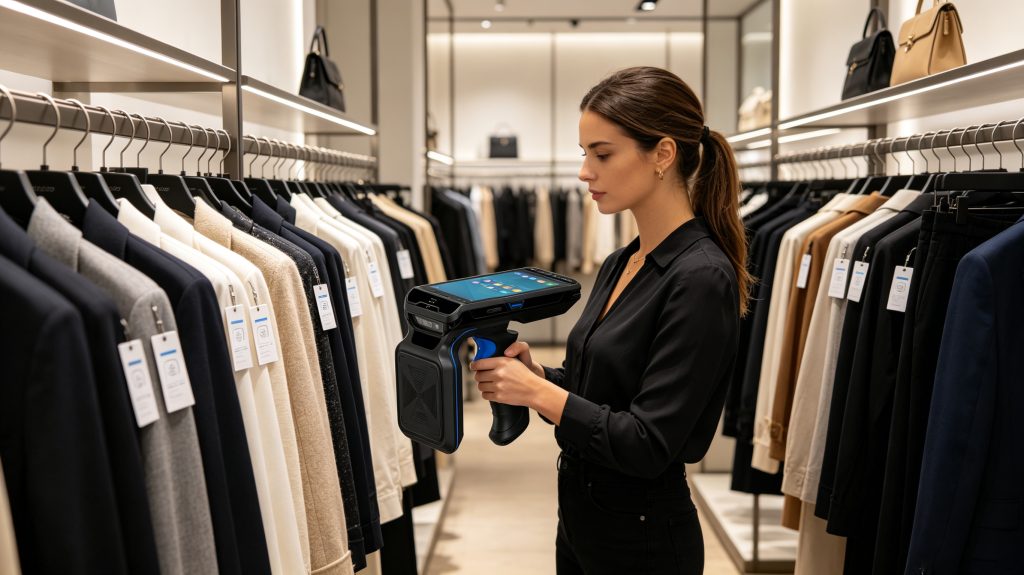
Store associates can walk sales floors with RFID readers and instantly locate missing items.
Instead of scanning hundreds of individual barcodes, thousands of garments can be identified automatically.
Warehouse Operations
RFID accelerates:
Receiving
Picking
Shipping
Inventory audits
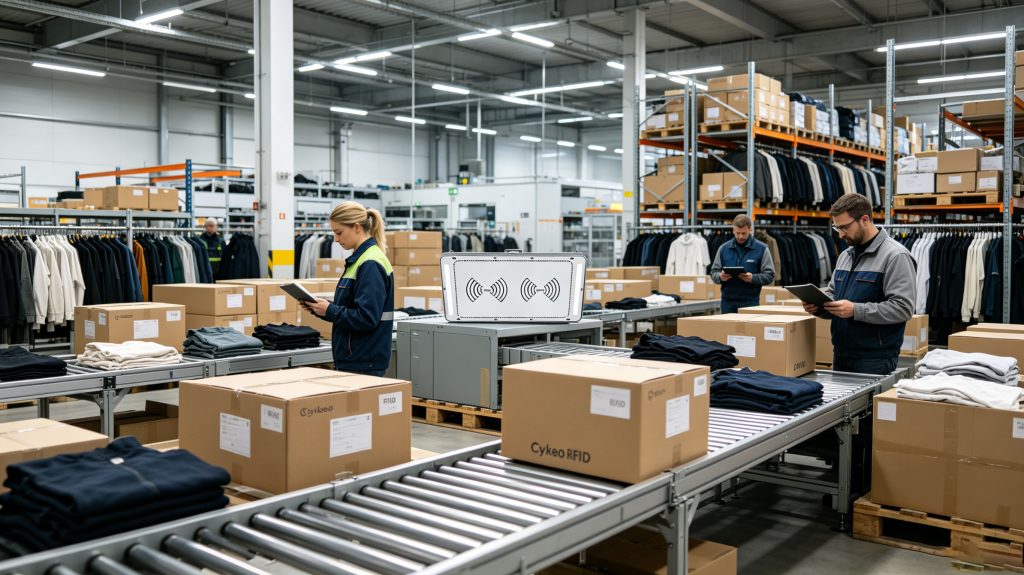
A distribution center processing thousands of apparel units daily can significantly reduce manual verification steps.
Omnichannel Fulfillment
Accurate inventory visibility supports:
Buy Online Pick Up In Store (BOPIS)
Ship From Store
Real-time stock availability
Store-to-store transfers
RFID chip clothing enables rapid apparel inventory counting without line-of-sight scanning.
RFID Chip Clothing vs Traditional Barcode Labels
Feature
RFID
Barcode
Line of Sight Required
No
Yes
Bulk Reading
Yes
No
Reading Speed
High
Moderate
Automation Level
High
Limited
Inventory Visibility
Real-Time
Manual
In practical retail environments, the biggest difference is speed.
One employee can complete an RFID inventory count in a fraction of the time previously required with barcode scanners.
Long-Term Benefits of RFID Apparel Tracking
mproved Inventory Accuracy
Accurate stock data creates better replenishment decisions and fewer lost sales opportunities.
Reduced Labor Costs
Staff spend less time counting inventory and more time assisting customers.
Better Loss Prevention
RFID supports item-level tracking and can integrate with retail security systems.
Enhanced Customer Experience
When inventory systems reflect actual stock levels, customers are more likely to find desired products available.
RFID chip clothing supports fast receiving, sorting, and warehouse inventory management.
Frequently Asked Questions About RFID Chip Clothing
Are RFID chips sewn into clothing?
Not always. Most apparel brands use RFID hang tags or care-label RFID tags attached during manufacturing.
Can RFID tags be reused?
Certain RFID hard tags can be reused. Disposable apparel RFID labels are typically designed for single-product use.
Do RFID clothing tags store personal information?
No. Standard apparel RFID tags usually store a product identifier rather than customer data.
What reading distance is typical?
Depending on tag design and reader configuration, UHF RFID apparel tags may be read from several feet to several meters away.
Is RFID used by major apparel brands?
Yes. Many global retailers have adopted RFID to improve inventory accuracy, replenishment efficiency, and omnichannel operations.
Final Answer
RFID chip clothing enables retailers, manufacturers, and warehouses to identify, track, and manage garments with significantly greater speed and accuracy than traditional barcode systems. As inventory visibility becomes increasingly important in modern retail, RFID chip clothing remains one of the most effective technologies for scalable apparel management.
Learn how to set up an RC522 RFID module with Raspberry Pi for DIY projects like access control, inventory tracking, and smart locks. Step-by-step instructions included.
Discover professional rfid event solutions for real-time UHF asset tracking, tool management, attendee control, and automated event inventory with Cykeo.
Standard RFID tags struggle with sensors. Learn how a dual-feed antenna for passive UHF RFID tag-based sensor applications ensures reliable power and data in cold chain and industrial monitoring.
Looking for a simple, reliable RFID antenna? The CK-A11 UHF RFID Reader Antenna offers wide coverage, minimal interference, and easy integration for efficient asset tracking in logistics, retail, healthcare, and more. Durable, easy-to-use, and bui...
 Cykeo RFID IoT Solution Products R&D Manufacturer