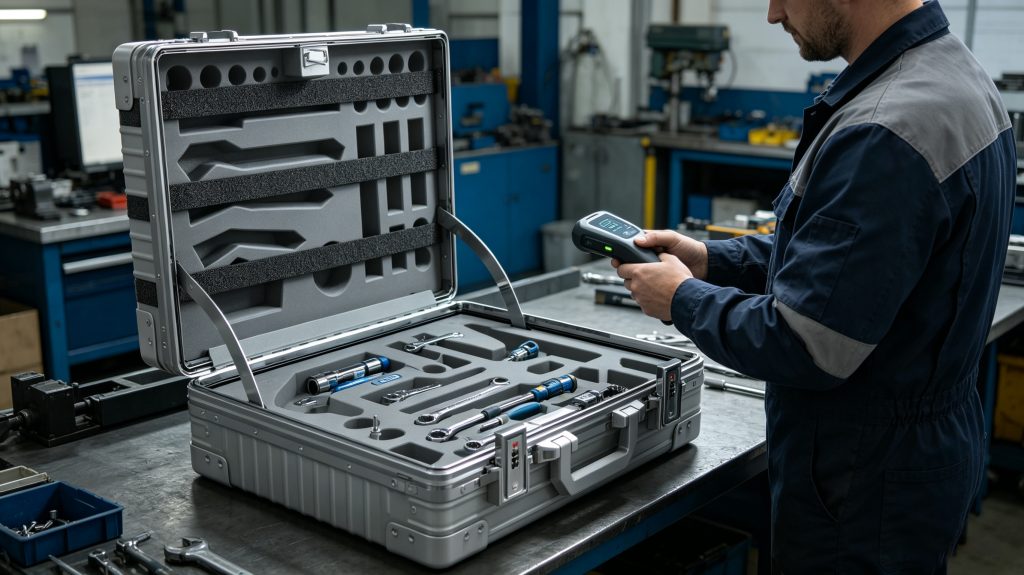
A passive rfid scanner is a device that reads RFID tags without internal power sources in the tags, using RF energy emitted by the scanner itself. It is widely used for industrial asset tracking, tool management, and logistics automation where fast, contactless identification is required.
In Cykeo industrial systems, passive RFID scanning is often integrated into tool control workflows such as maintenance kits and warehouse inventory systems to reduce manual counting and improve operational safety.
How passive RFID scanning works in real environments
Unlike barcode systems, a passive RFID scanner does not require line-of-sight. It energizes nearby tags using electromagnetic waves, then captures reflected signals containing tag IDs.
According to GS1 EPCglobal standards , UHF RFID systems typically operate in the 860–960 MHz range, optimized for supply chain and industrial identification.
In field conditions such as workshops or rail maintenance sites, this means:
Tools inside cases can still be detected
Multiple items can be scanned simultaneously
No manual alignment is required
This makes the technology practical in environments where speed and safety matter more than precision positioning.
Real-time tool identification using passive RFID scanning system
Why passive rfid scanner is critical in industrial workflows
In real maintenance and logistics environments, manual inventory is often the weakest point in operational control. A passive rfid scanner solves this by automating identification.
Typical issues it replaces:
Manual tool counting errors
Missing equipment after field operations
Slow inventory audits
Safety risks caused by incomplete tool sets
This is particularly important in industries such as:
Railway maintenance
Aviation repair operations
Power station inspections
Large-scale warehouse logistics
<h2>Cykeo integration: CYKEO-B2 smart tool system
In Cykeo deployments, passive RFID scanning is not used alone. It is integrated into systems like the CYKEO-B2 RFID smart tool kit, designed for field operations.
Key functions include:
One-click tool locking inside RFID toolbox
Automatic exit inventory check
Real-time missing tool alarms
Bluetooth-based configuration via mobile device
This system ensures that every tool is accounted for before leaving a controlled environment.
Technical foundation of passive RFID scanner systems
Energy transfer principle
A passive RFID scanner emits RF energy that powers the tag temporarily. The tag then responds with stored identification data.
Standards compliance
Most industrial systems follow:
ISO/IEC 18000-6C (EPC Gen2 protocol)
GS1 EPCglobal supply chain standards
These standards ensure global interoperability across logistics and industrial ecosystems.
Field behavior: what engineers observe on-site
In real-world deployment, performance depends on environment more than specifications.
Common observations include:
Metal surfaces can reflect RF signals unpredictably
Dense tool arrangements may require optimized scanning angles
Tag orientation affects read consistency
Experienced engineers often adjust scanner position and scan timing during commissioning rather than relying on default settings.
Automated tool verification using passive RFID technology
Performance advantages of passive rfid scanner systems
When deployed in industrial environments, a passive rfid scanner provides:
Simultaneous multi-tag reading capability
No battery requirement for tags
Faster inspection cycles
Reduced human error in asset tracking
Scalable deployment across large facilities
Compared with barcode-based systems, RFID significantly reduces dependency on line-of-sight scanning and manual labor.
Application scenarios across industries
Common use cases:
Industrial tool management systems
Warehouse inventory scanning
Railway maintenance kits
Aerospace repair tracking
Energy station inspection workflows
Each environment benefits from real-time visibility and reduced operational uncertainty.
FAQ – passive rfid scanner
What is the main advantage of passive RFID scanning?
It allows contactless, simultaneous identification of multiple tagged items without requiring internal power in the tag.
Can passive RFID scanners read through metal cases?
Yes, but performance depends on tag type and placement, especially when using on-metal RFID tags.
Is it suitable for field maintenance work?
Yes, it is widely used in railway, aviation, and industrial maintenance environments.
Compare RFID windshield tags, headlight tags, license plate tags, hang tags, and active RFID tags for parking systems. Learn the differences in installation, reading distance, lifespan, cost, and tamper resistance before selecting the right RFID p...
Discover how long do led tennis court lights last and how RFID tracking software delivers real-time visibility, automation, and accurate asset management.
RFID IT asset tracking gives IT teams real-time visibility of devices, reduces loss, and simplifies audits. Learn how RFID works in daily IT operations.
 Cykeo RFID IoT Solution Products R&D Manufacturer