 Cykeo RFID IoT Solution Products R&D Manufacturer
How to Read Data from an RFID Card: What’s Really Stored on That Thing?
455Want to know how to read data from an RFID card? Cut through the hype. We cover card types, real tools, and what that hex dump actually means.
MoreAll RFID Product
RFID in medical industry applications improve inventory accuracy, automate consumable tracking, and reduce manual hospital workload through real-time UHF RFID identification technology.
Hospitals are full of invisible movement.
A surgical consumable leaves storage at 7:12 a.m.
An intervention catheter moves between departments before noon.
A low-value sterile package disappears from records entirely because nobody had time to scan it during a busy shift.
Most inventory problems inside hospitals are not dramatic. They accumulate quietly.
At Cykeo, we have spent years observing how medical inventory behaves in real clinical environments — operating rooms, sterile storage areas, intervention departments, and consumable centers where staff priorities naturally focus on patient care first.
That is exactly why UHF RFID technology has become increasingly important in the medical industry.
Traditional barcode systems depend heavily on human participation. Staff must scan every item manually, one by one, at the correct moment.
Real hospitals rarely operate that cleanly.
Nurses are interrupted constantly. Emergency procedures change workflows. Manual registration gets delayed until the end of shifts — sometimes forgotten completely.
RFID reduces that friction.
According to research published by GS1 Healthcare, RFID improves healthcare supply chain visibility and supports more accurate inventory traceability in clinical environments.
What hospitals discover during deployment is surprisingly practical:
The biggest improvement is often not speed.
It is inventory confidence.
Cykeo’s intelligent RFID medical consumable cabinets are designed for environments including:
The system uses UHF RFID identification technology compliant with ISO18000-6C standards to identify tagged medical supplies automatically.
Unlike conventional manual workflows, inventory updates happen immediately after consumables enter or leave the cabinet.
No delayed spreadsheet reconciliation.
No paper registration logs.
No repeated recounting late at night.
| Feature | Operational Benefit |
|---|---|
| UHF RFID multi-tag reading | Rapid bulk inventory identification |
| Real-time stock synchronization | Accurate consumable visibility |
| One-item-one-code management | Full lifecycle traceability |
| Permission-based access control | Improved accountability |
| Automatic inventory after door closure | Reduced nursing workload |
| 5-second inventory cycle | Faster replenishment decisions |
Cykeo RFID cabinets can typically manage hundreds of tagged consumables with inventory accuracy reaching approximately 99.9% in controlled deployment environments.
That matters inside surgery departments where missing inventory directly delays preparation work.
In many hospitals, consumables are not “lost” because someone steals them.
They disappear because workflows are fragmented.
One department borrows inventory temporarily.
Emergency procedures bypass normal registration.
Expired consumables remain buried inside cabinets until monthly audits uncover them.
RFID changes visibility fundamentally.
Every tagged item becomes digitally traceable.
A supply manager can see:
That level of transparency changes operational behavior surprisingly fast.
In one deployment environment we observed previously, evening inventory reconciliation inside an intervention department dropped from nearly 45 minutes to under 10 minutes after RFID automation was introduced.
Nobody celebrated dramatically.
People simply stopped staying late.
High-frequency RFID works well for access authentication and close-range verification, but UHF RFID offers major advantages for hospital inventory management because it supports:
That becomes especially valuable when hospitals manage:
A McKinsey healthcare supply chain analysis also noted that digital inventory systems help reduce operational waste and improve supply efficiency.
The technology itself matters less than the outcome.
Medical staff spend less time managing inventory manually.
And more time treating patients.

Hospital administrators often focus first on procurement savings.
Clinical staff notice something else first:
Less interruption.
RFID systems quietly automate repetitive registration work that previously depended entirely on manual recording.
The process feels smoother because inventory becomes part of the background instead of a separate task nurses must remember constantly.
That operational calm is difficult to measure in spreadsheets.
But departments feel it immediately.

RFID in medical industry applications are used for tracking medical consumables, surgical supplies, laboratory inventory, and hospital assets automatically in real time.
UHF RFID supports rapid multi-tag reading and larger coverage areas, making it ideal for medical inventory management and consumable tracking.
Yes. RFID automation reduces manual registration mistakes and improves inventory accuracy significantly.
Yes. RFID is widely used for tracking surgical consumables, implants, sterile kits, and intervention supplies in operating departments.
Modern UHF RFID medical cabinets can complete inventory cycles for hundreds of tagged consumables within several seconds.
RFID in medical industry deployments are no longer experimental technology projects.
They are operational infrastructure.
Hospitals need accurate inventory visibility, reliable traceability, and automated consumable management without increasing staff workload.
Cykeo continues focusing on practical UHF RFID healthcare solutions because the best systems are rarely the most complicated ones.
They are the systems staff barely notice — because they simply work quietly in the background every day.
And inside hospitals, quiet reliability matters more than flashy software demonstrations.
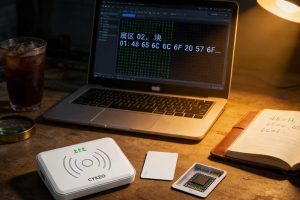
Want to know how to read data from an RFID card? Cut through the hype. We cover card types, real tools, and what that hex dump actually means.
More
RFID in warehouses uses UHF radio communication to identify multiple tagged goods without line-of-sight scanning and connect physical inventory events with w...
More
Discover the maximum read range of industrial long-range RFID readers, factors affecting performance, and best practices for optimizing UHF RFID systems.
More
Discover how a UHF RFID scanner improves inventory accuracy, asset visibility, and workflow efficiency. Learn expert insights, real deployment data, and industrial RFID best practices from Cykeo.
More