 Cykeo RFID IoT Solution Products R&D Manufacturer
RFID Tool Cabinet Access Control: User Authentication and Tool Permissions
39RFID access control is more than adding a lock to a smart cabinet. A well-designed system connects the user, tool, location, permission, and transaction into...
MoreAll RFID Product
on metal rfid tags are specially engineered RFID labels designed to work on steel, aluminum, and other conductive surfaces where standard RFID tags fail. They maintain stable signal reflection by isolating the antenna from metal interference, enabling reliable identification of tools, equipment, and industrial assets in real environments.
In Cykeo deployment scenarios such as maintenance workshops and railway inspection sites, these tags are often paired with smart RFID systems like the CYKEO-B2 tool management kit to ensure nothing is lost or left behind during operations.
In real industrial conditions, metal is one of the most disruptive materials for RF signals.
Standard RFID tags suffer from:
Industry guidance from GS1 EPCglobal confirms that RFID performance is highly dependent on material interaction and antenna isolation design.
In practice, engineers often notice that unprotected tags simply disappear in scan zones once attached to metallic tools.
on metal rfid tags use a built-in insulating layer between antenna and metal surface. This prevents electromagnetic detuning and stabilizes signal reflection.
They are tuned for EPC Class 1 Gen2 (ISO/IEC 18000-6C) environments, ensuring compatibility with industrial readers and gateways.
Unlike paper or soft labels, on-metal tags are designed for:
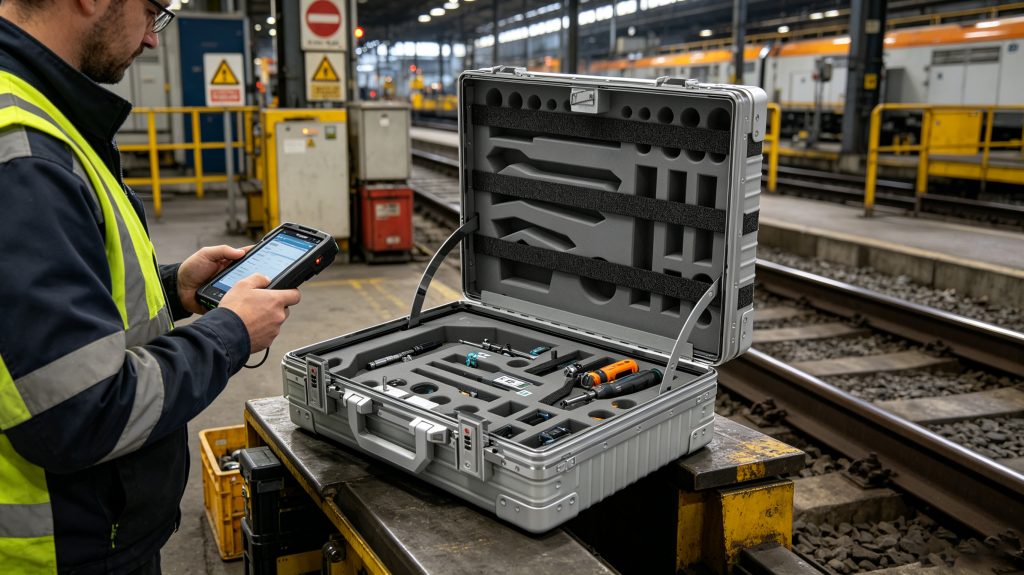
The CYKEO-B2 RFID smart toolkit is a practical extension of on metal rfid tags in real-world operations.
It enables:
This is especially important in high-risk environments such as:
Even a single missing wrench in these environments can lead to operational delays or safety risks.
In a typical maintenance shift:
The on metal rfid tags attached to each tool ensure stable detection even when tools are stacked, oily, or metallic.
Typical structure includes:
This layered design prevents direct interference from conductive surfaces.
Most industrial tags operate in:
This ensures global interoperability across supply chain systems.
Unlike barcode systems, RFID does not require line-of-sight scanning, which is critical when tools are inside cases, shelves, or stacked environments.
In real deployments, engineers often report that:
Experienced installers often test multiple mounting positions before final deployment rather than relying on theoretical read range.

When integrated into industrial workflows, on metal rfid tags provide:
In systems like CYKEO-B2, they become part of a closed-loop safety mechanism rather than just identification labels.
Metal reflects RF signals and detunes the antenna, making standard tags unreadable.
Some industrial versions are reusable depending on adhesive and housing design.
Yes, they are compatible with ISO/IEC 18000-6C RFID readers.

RFID access control is more than adding a lock to a smart cabinet. A well-designed system connects the user, tool, location, permission, and transaction into...
More
Discover how RFID chips operate: energy harvesting, signal transmission, and real-world applications. Learn about passive, active, and semi-passive chip designs.
More
RFID self-checkout kiosk designed for unmanned stores, apparel shops, and mall checkout points. Fast multi-item reading, RESTful API, and SDK for integration.
More
Discover the truth about battery-free RFID tags. Are they a sustainable, cost-saving solution for your business? Cykeo breaks down the facts, benefits, and real-world applications.
More