RFID product tracking uses radio frequency identification technology to automatically identify, locate, and monitor products throughout manufacturing, warehousing, and distribution processes. It delivers real-time visibility, faster inventory audits, and significantly higher accuracy than manual barcode-based tracking systems.
In practical deployments, RFID product tracking is not simply about knowing where an item is. It creates a live digital record of product movement, helping companies reduce shrinkage, eliminate manual scanning bottlenecks, and improve fulfillment performance.
Author Expertise
By Daniel Chen, Senior RFID Solutions Consultant at Cykeo
For more than 12 years, I have worked on RFID deployment projects across manufacturing plants, logistics centers, apparel distribution hubs, and industrial asset management facilities. My experience includes designing UHF RFID tunnel systems, warehouse portal readers, automated inventory stations, and enterprise-level tracking platforms serving thousands of tagged products daily.
One lesson appears repeatedly: visibility drives efficiency. The moment companies stop relying on manual counting, operational blind spots begin to disappear.
How Does RFID Product Tracking Work?
RFID product tracking combines four key components:
Unlike barcodes, RFID tags do not require direct line-of-sight scanning.
A pallet moving through a warehouse gate can have hundreds of tagged products identified simultaneously.
The result is continuous product visibility without slowing operations.
RFID Product Tracking in Modern Warehouses
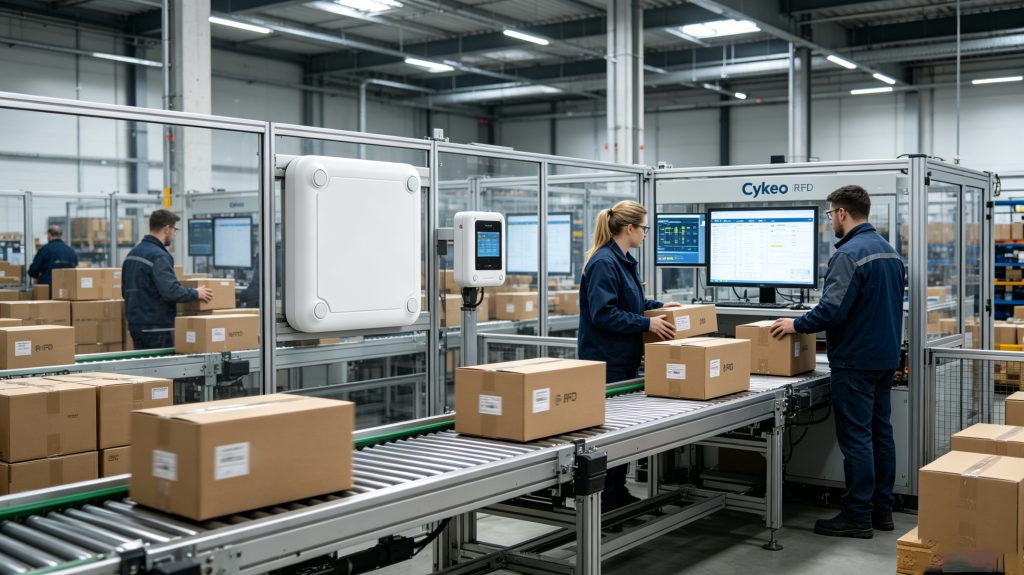
Several years ago, during a deployment in a European distribution center, warehouse personnel spent nearly four hours every day verifying outbound shipments.
After installing RFID verification tunnels, the process changed dramatically.
Cases moved through the inspection station automatically. Products were identified instantly. Operators no longer needed to scan individual items one by one.
The improvement wasn’t merely speed.
The reduction in shipping discrepancies became the most valuable outcome.
According to the RFID Lab at Auburn University, RFID implementations in retail environments have consistently demonstrated inventory accuracy levels exceeding 95%, compared with substantially lower rates from traditional manual processes.
Automated RFID verification improves shipment accuracy and inventory visibility.
Benefits of RFID Product Tracking
Faster Inventory Counts
Traditional inventory counting often requires significant labor.
RFID readers can identify hundreds of products within seconds.
In many facilities, inventory audits that previously required hours can be completed in minutes.
Improved Inventory Accuracy
A study published by Auburn University’s RFID Lab found inventory accuracy frequently exceeds 95% after RFID adoption.
Accurate inventory directly affects:
Order fulfillment
Customer satisfaction
Replenishment planning
Stock availability
Reduced Human Error
Manual scanning introduces mistakes.
RFID automates identification, reducing missed scans and duplicate entries.
Better Supply Chain Visibility
Managers gain access to real-time product movement data across:
Production lines
Distribution centers
Transportation checkpoints
Retail locations
Why Manufacturers Are Adopting RFID Product Tracking
Manufacturers face growing pressure to deliver products faster while maintaining traceability.
RFID enables:
Production Tracking
Work-in-progress items can be tracked automatically between production stages.
Quality Control
Defective batches can be identified quickly.
Recall Management
Affected products can be isolated without disrupting entire inventories.
Asset Utilization
Reusable containers, tools, and returnable transport items become easier to monitor.
According to GS1, improved traceability has become a major focus for manufacturers seeking greater supply chain transparency.
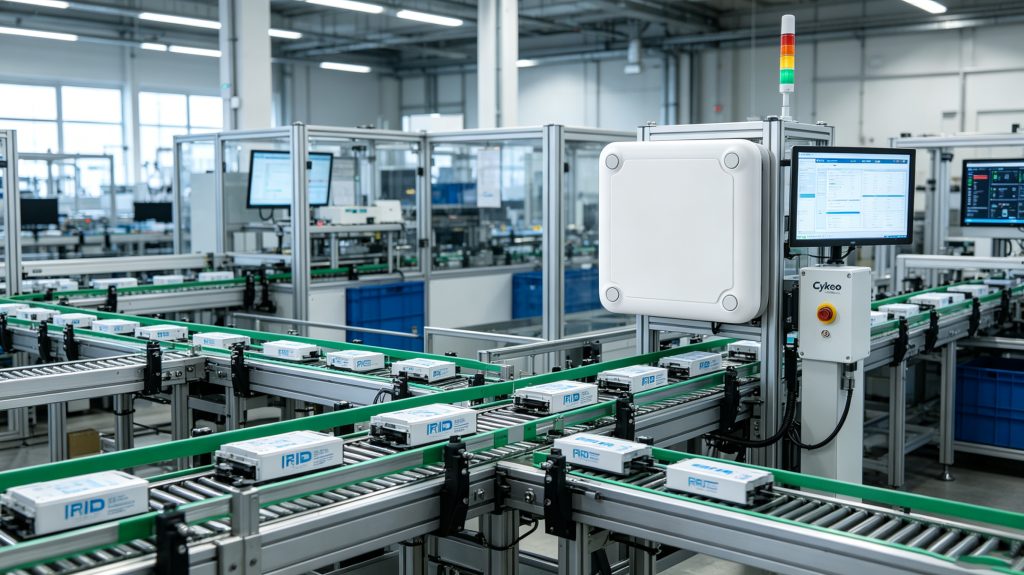
RFID captures product movement automatically throughout production stages.
Cykeo RFID Product Tracking Solutions
Cykeo develops RFID systems designed for industrial-scale product identification and inventory automation.
Typical deployments include:
RFID tunnel readers
Fixed RFID readers
Conveyor tracking systems
Warehouse portal readers
Inventory management platforms
Our RFID tunnel verification equipment can identify hundreds of tagged items within seconds while automatically validating shipment contents and generating real-time inventory records.
For high-volume distribution operations, this capability significantly reduces verification workload while improving shipment accuracy.
FAQ About RFID Product Tracking
Is RFID better than barcode tracking?
Yes. RFID enables simultaneous reading of multiple items without line-of-sight requirements, while barcodes require individual scanning.
What industries use RFID product tracking?
Common industries include:
Manufacturing
Logistics
Retail
Healthcare
Automotive
Electronics
Can RFID track products in real time?
Yes. Fixed readers installed at checkpoints continuously update product locations as items move through facilities.
What RFID frequency is best for product tracking?
UHF RFID is most commonly used because it offers longer read ranges and faster bulk-reading capabilities.
Conclusion
RFID product tracking delivers real-time visibility, higher inventory accuracy, and faster operational workflows. From manufacturing plants to distribution centers, organizations adopting RFID gain better control over product movement while reducing labor costs and human error. As supply chains become increasingly data-driven, RFID product tracking remains one of the most effective technologies for achieving scalable operational transparency.
RFID in hospitals improves medical asset visibility, inventory accuracy, and supply management. Discover how Cykeo RFID solutions enable real-time healthcare tracking and automation.
Wondering what are barcodes and RFID tags? We explain how each works, their pros and cons, and when to use them. A clear comparison for inventory and asset tracking from CYKEO engineers.
Curious about the components of RFID tag? Learn how chips, antennas, and substrates come together to create RFID functionality, plus some real-world notes from the field.
Learn how to set up an RC522 RFID module with Raspberry Pi for DIY projects like access control, inventory tracking, and smart locks. Step-by-step instructions included.
 Cykeo RFID IoT Solution Products R&D Manufacturer