RFID ear tags are widely used in livestock management to identify, trace, and monitor animals with high accuracy and minimal manual labor. In large farms, they reduce counting time, improve disease traceability, and support automated feeding and breeding management.
On a dairy project I visited in Inner Mongolia in late 2024, workers previously spent nearly two hours manually checking cattle movement records during feeding rotation. After switching to RFID ear tags and fixed readers, the same process took less than fifteen minutes. What changed wasn’t just speed. The farm manager finally trusted the inventory data.
That detail matters more than most brochures admit.
What Are RFID Ear Tags Used For?
RFID ear tags are electronic identification tags attached to livestock ears. Each tag contains a unique chip ID that can be read wirelessly using RFID readers. They are commonly used for:
Cattle identification
Sheep and goat management
Breeding tracking
Vaccination records
Animal movement monitoring
Disease traceability
Automated feeding systems
Unlike printed visual tags, RFID ear tags do not rely on line-of-sight scanning. Dirt, mud, rain, and low-light environments affect them far less than barcode systems.
According to the United States Department of Agriculture (USDA), electronic identification significantly improves livestock disease traceability speed during outbreaks.
Why Farms Are Moving Toward RFID Ear Tags
The pressure on livestock operations has changed. Ten years ago, farms mainly tracked herd size. Today they track:
Management Requirement
Traditional Method
RFID Ear Tags
Animal counting
Manual counting
Automatic scanning
Vaccination records
Paper logs
Digital database
Feeding management
Visual estimation
RFID-triggered feeding
Traceability
Slow retrieval
Instant ID lookup
Loss prevention
Difficult
Real-time movement tracking
A 2023 report from MarketsandMarkets estimated the global livestock monitoring market will continue growing due to automation demand and disease-control requirements.
The interesting part is not the technology itself. It’s labor reduction.
One poultry equipment supplier told me their customers rarely ask first about chip frequency or memory size. The first question is usually simpler:
“How many workers can we reduce during inventory checks?”
Livestock RFID Tracking in Real Farm Conditions
Dust, Moisture, and Physical Stress
Laboratory conditions look clean. Farms do not.
RFID ear tags in actual use are exposed to:
Mud
Water
UV radiation
Fence impact
Temperature swings
Continuous animal movement
Cheap tags fail early around the locking structure long before the chip stops working. I’ve seen tags remain electrically functional but physically detached after several months because of weak polymer housing.
Cykeo typically recommends reinforced TPU or high-durability plastic materials for long-cycle animal applications, especially in cattle environments where impact stress is constant.
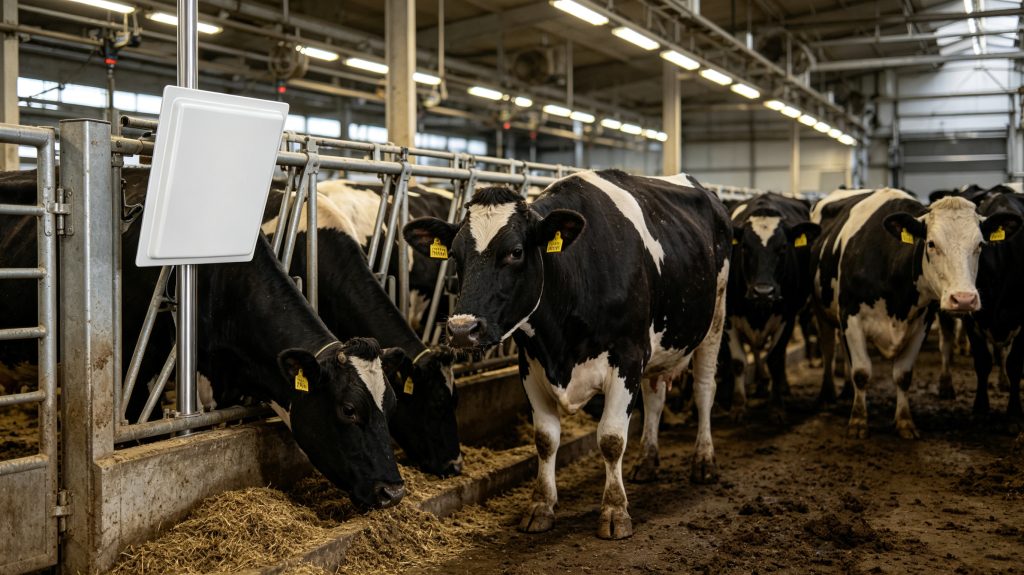
RFID ear tags improve cattle identification and feeding management efficiency in large dairy operations.
Reading Distance Matters Less Than Stability
Many buyers focus on maximum reading range. In livestock systems, stable multi-tag recognition is usually more important.
A poorly tuned long-range system may create duplicate reads near feeding lanes or gates. In contrast, stable short-to-mid range reading often produces cleaner operational data.
That becomes obvious during vaccination events. Operators move quickly. There is little patience for rescanning.
UHF RFID Ear Tags vs LF RFID Ear Tags
Comparison Table
Feature
LF RFID Ear Tags
UHF RFID Ear Tags
Frequency
125kHz / 134.2kHz
860-960MHz
Reading Distance
Short
Longer
Multi-tag Reading
Limited
Strong
Speed
Moderate
Fast
Best Use
Small farms
Large-scale farms
International Standards
ISO 11784/11785
EPC Gen2 / ISO18000-6C
LF systems remain common in regulated animal identification programs. UHF RFID ear tags are growing rapidly in large-scale logistics-style livestock management because they support faster batch reading.
Practical Deployment Lessons From Field Installations
There’s one mistake that repeats across many farms.
Readers get installed too high above cattle lanes.
In theory, elevated positioning increases coverage. In practice, ear orientation changes constantly while animals move. We usually found better consistency when antennas were positioned closer to natural head movement angles near gate passages.
Another overlooked detail: metal fencing interference.
Poor antenna placement near galvanized steel gates can reduce reading stability dramatically. Proper shielding and directional antenna tuning matter more than increasing reader power output.
RFID Ear Tags and Disease Traceability
During animal disease investigations, time matters.
The European Union Animal Health Law strengthened livestock traceability requirements across member states.
RFID ear tags allow authorities and farms to:
Track animal movement history
Isolate affected groups faster
Reduce manual paperwork
Improve export compliance
Maintain vaccination records
That operational visibility becomes especially important during transportation between farms, slaughterhouses, and quarantine zones.
Recommended RFID System Components
A complete livestock RFID deployment usually includes:
RFID Ear Tags
Weather-resistant tags with durable locking mechanisms.
Stores animal ID, health, breeding, and movement records.
Cloud Database Integration
Supports remote monitoring and multi-site farm management.
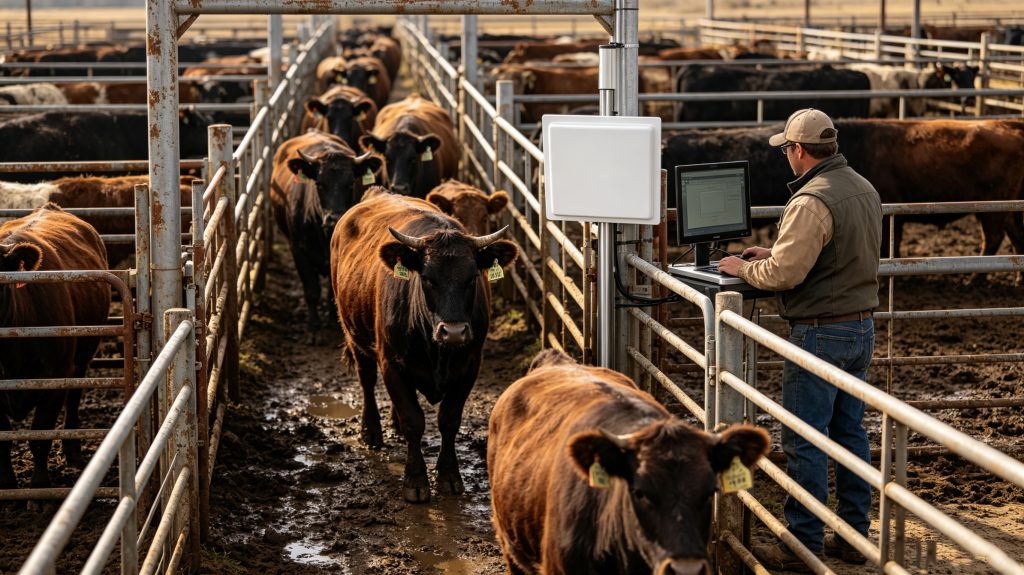
RFID checkpoint systems automatically record animal movement between livestock zones.
FAQ About RFID Ear Tags
Are RFID ear tags safe for animals?
Yes. Properly installed RFID ear tags are widely used in livestock industries worldwide and are designed to minimize stress and infection risks.
How long do RFID ear tags last?
High-quality RFID ear tags can last several years depending on environmental conditions, animal activity, and tag material durability.
Can RFID ear tags work in rain and mud?
Yes. Industrial livestock RFID tags are designed for outdoor environments including moisture, dust, and temperature fluctuations.
What frequency is best for livestock RFID?
LF RFID is common for government-regulated identification systems, while UHF RFID is often preferred for large farms requiring fast multi-tag reading.
Final Thoughts
RFID ear tags are no longer experimental tools reserved for large agricultural corporations. Mid-sized farms are adopting them because labor costs, traceability requirements, and inventory accuracy pressures continue increasing.
In real deployments, the farms achieving the best results are usually not the ones buying the most expensive hardware. They are the ones designing practical workflows around RFID data.
That distinction becomes obvious after the first rainy season.
RFID Industry Writer | IoT & Asset Tracking Analyst
James writes about RFID technology, asset tracking, and the practical challenges of digital transformation across warehousing, retail, manufacturing, and logistics.
His work focuses on how RFID is applied in real-world operations—improving inventory visibility, automating workflows, and helping businesses manage assets with greater accuracy and efficiency.
He regularly covers topics including UHF RFID, smart cabinets, RFID portals, tool tracking, warehouse automation, and industrial IoT trends..
RFID in hospitals improves medical asset visibility, inventory accuracy, and supply management. Discover how Cykeo RFID solutions enable real-time healthcare tracking and automation.
Discover if your iPhone can emulate RFID tags and how Cykeo's Bluetooth RFID Reader enables seamless integration. Explore capabilities, limitations, and practical uses.
Looking for a long range RFID scanner for warehouse, logistics, manufacturing, or asset tracking? Learn key factors including reading distance, antenna design, frequency, integration, and OEM options before bulk purchasing.
See how RFID improves hospital equipment tracking efficiency in real-world scenarios. Learn where it actually saves time and how smart cabinets streamline inventory.
 Cykeo RFID IoT Solution Products R&D Manufacturer