 Cykeo RFID IoT Solution Products R&D Manufacturer
How to Build RFID Tool Tracking System That Actually Works
113A practical, step-by-step guide to building an RFID tool tracking system using smart cabinets, antennas, and RFID modules. Designed for integrators and bulk buyers.
MoreAll RFID Product
An RFID reader module is the core component that enables RFID systems to identify, read, and process tag data. It provides the RF communication engine used in industrial automation, asset tracking, logistics visibility, smart manufacturing, and IoT deployments.
The reason RFID systems have become fundamental to modern automation is simple: the module performs the difficult part. Antennas may transmit signals and software may display data, but the RFID reader module is what actually converts radio frequency interactions into actionable business information.
By Michael Zhang, Senior RFID System Architect at Cykeo
For over 14 years, I have worked on RFID hardware development projects involving embedded UHF reader modules, industrial fixed readers, tunnel readers, warehouse portals, and manufacturing traceability systems. My work has included deploying RFID solutions in automotive factories, apparel distribution centers, electronics assembly facilities, and smart logistics hubs across Europe and Asia.
One lesson remains consistent: system performance depends heavily on the quality of the RFID reader module hidden inside the device.
An RFID reader module is a compact electronic unit designed to perform RFID tag communication and data processing.
Unlike complete RFID readers, modules are typically integrated into:
The module handles:
| Function | Description |
|---|---|
| Tag Reading | Detects RFID tags |
| Data Processing | Decodes EPC or UID information |
| RF Control | Manages transmission power |
| Communication | Connects with host systems |
| Multi-Tag Reading | Reads multiple tags simultaneously |
Without a capable module, even the most advanced RFID system struggles to achieve reliable performance.
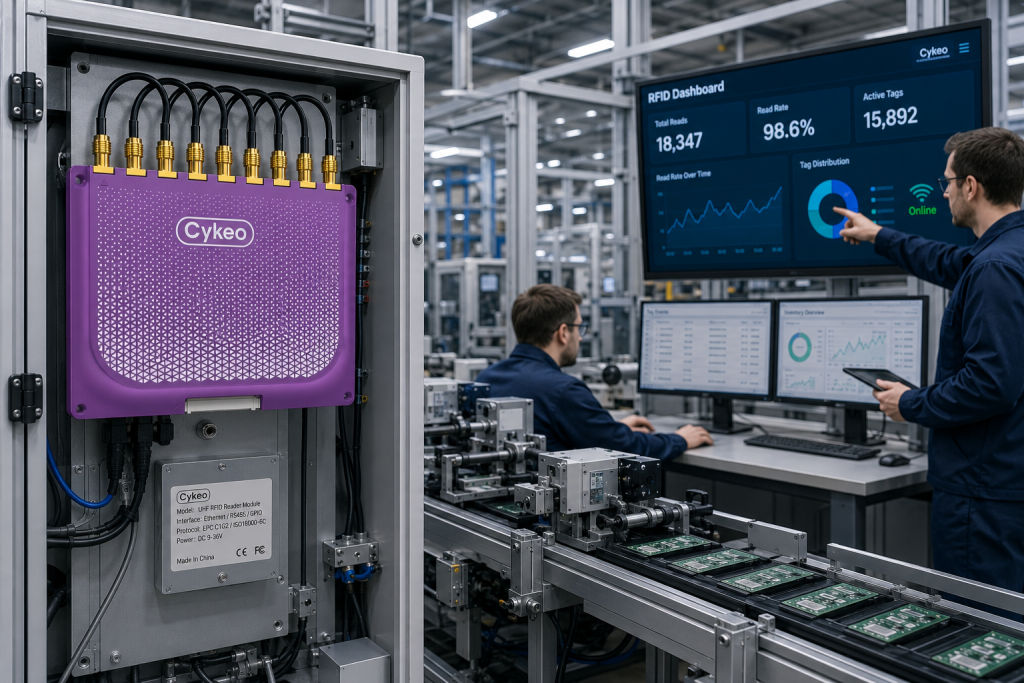
On a recent production-line deployment, RFID modules were installed directly inside automated test stations.
Instead of workers manually scanning components, the system identified each product automatically as it entered the workstation.
The difference was immediately visible.
Operators stopped handling scanners. Production records appeared automatically. Traceability improved without adding extra labor.
According to the Manufacturing Institute and Deloitte, manufacturers continue increasing investments in smart factory technologies to improve operational visibility and efficiency.
The market often focuses on antennas or software dashboards.
In practice, the module determines:
A poorly designed module may miss tags in dense environments.
A well-designed industrial module can reliably process hundreds of tags within seconds.
This distinction becomes critical in warehouses, manufacturing lines, and asset tracking applications.
Higher sensitivity improves tag detection in challenging environments.
Industrial modules often support adjustable transmission power for different deployment scenarios.
Modern UHF modules can simultaneously process dozens or hundreds of tags.
Common interfaces include:
Integration flexibility often determines project success more than raw reading distance.
Warehouse managers frequently ask where RFID generates the greatest value.
The answer is usually visibility.
RFID reader modules embedded inside fixed readers, conveyor systems, and portal stations continuously capture product movement.
According to GS1, real-time item visibility remains one of the primary drivers of RFID adoption within global supply chains.
Benefits include:
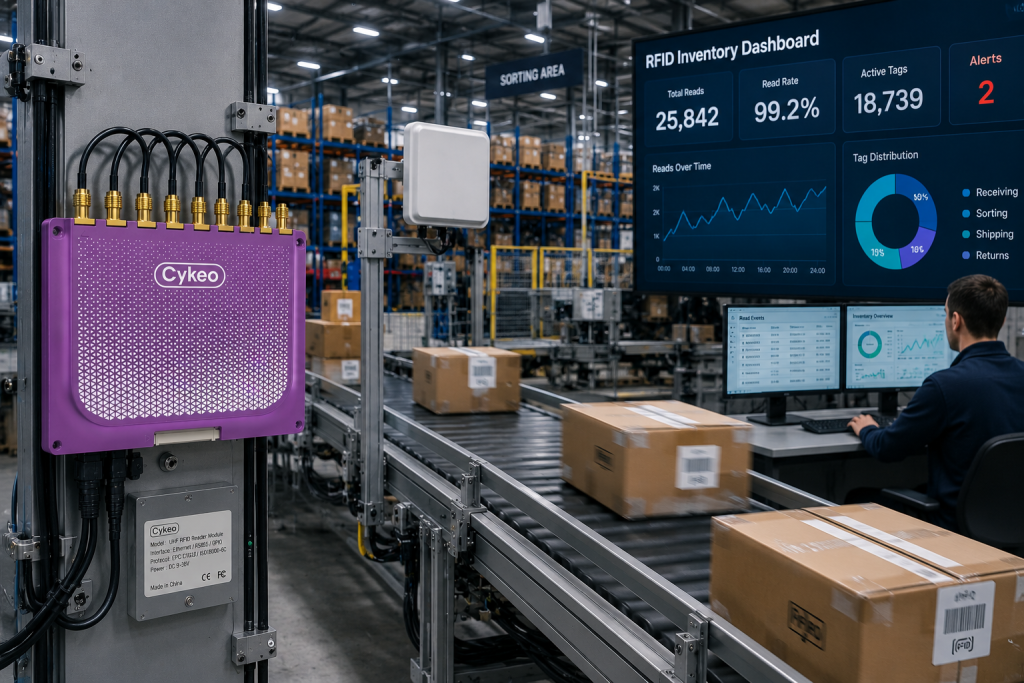
Cykeo develops industrial RFID reader modules designed for:
Key advantages include:
| Feature | Benefit |
| High Read Rate | Faster data collection |
| Multi-Tag Processing | Improved operational efficiency |
| Industrial Design | Reliable long-term operation |
| Flexible Interfaces | Easy integration |
| Compact Size | Suitable for embedded applications |
For OEM manufacturers and system integrators, module selection often determines the overall performance ceiling of the final RFID solution.
It generates RF signals, communicates with RFID tags, processes tag information, and transmits data to host systems.
A module is the internal RF engine. A reader is the complete device containing the module, antennas, enclosure, power system, and software.
UHF RFID (860–960 MHz) is widely used for logistics, inventory management, manufacturing, and asset tracking due to its longer read range.
Yes. Many industrial automation systems integrate RFID modules directly into machinery, kiosks, cabinets, and production equipment.
Absolutely. RFID modules are frequently used in Industrial IoT deployments to provide real-time identification and visibility.
RFID reader module technology serves as the foundation of modern RFID systems. Whether deployed in manufacturing, logistics, asset management, or Industrial IoT applications, a high-performance RFID reader module determines reading accuracy, operational efficiency, and long-term system reliability. As organizations continue pursuing automation and real-time visibility, RFID reader modules will remain a critical component of digital transformation strategies. The future of industrial identification starts with the right RFID reader module.
A practical, step-by-step guide to building an RFID tool tracking system using smart cabinets, antennas, and RFID modules. Designed for integrators and bulk buyers.
More
Need to know how to read RFID card in Android? We explain the two paths: using phone NFC for basic reads & connecting to professional UHF readers via CYKEO’s SDK.
More
Learn how many layers of aluminum foil are actually needed to block RFID signals, how it works, and whether this DIY method is truly reliable for protecting your cards.
More
Improve RFID read range by optimizing tags, antennas, reader settings, and installation conditions together, not by only increasing power.
More