 Cykeo RFID IoT Solution Products R&D Manufacturer
How to Scan RFID Tags into Google Sheets?
233Learn how to scan RFID tags into Google Sheets with RFID readers. Discover practical workflows, tools, and real applications from Cykeo for faster inventory tracking.
MoreAll RFID Product
Access RFID uses UHF RFID technology to automatically identify tagged assets or items passing through an entrance, enabling secure access control, real-time monitoring, and anti-theft protection without manual scanning. Modern RFID security gates simultaneously read multiple tags, detect unauthorized movement, and generate instant audio-visual alarms while maintaining smooth pedestrian traffic.
After deploying RFID access systems in libraries, enterprise campuses, archive centers, and industrial facilities, I’ve noticed that customers rarely ask how fast the gate reads tags after installation. Instead, they ask a different question: “Can we trust that nothing leaves unnoticed?” That shift perfectly explains why a well-designed access RFID solution is about reliability, not simply reading speed.
Traditional security checkpoints depend on manual inspections or barcode scanning.
Neither approach scales well when dozens of people move through an entrance simultaneously.
An intelligent access RFID gate automatically detects RFID-tagged assets while people walk naturally through the passage. There is no need to stop, align a barcode, or present every item individually.
Built on the ISO/IEC 18000-63 (EPC Class 1 Gen 2) air interface standard, modern UHF RFID access systems provide standardized communication between readers and passive RFID tags used worldwide.
According to GS1, EPC standards have become the foundation for global RFID identification across logistics, healthcare, manufacturing, retail, and enterprise asset management.
The RAIN Alliance also reports that billions of passive UHF RFID tags are deployed annually, reflecting widespread adoption of RFID-enabled identification systems.

Unlike conventional access systems that require individual scanning, an RFID gate continuously monitors the detection zone.
When tagged assets enter the reading field:
A typical intelligent access RFID solution includes:
| Component | Function |
|---|---|
| UHF RFID Reader | Reads EPC Gen2 RFID tags automatically |
| Multi-Antenna Array | Creates accurate detection coverage |
| Infrared Trigger | Activates reading only during passage |
| Audio & Visual Alarm | Warns of unauthorized movement |
| Management Software | Records events and analyzes traffic |
During commissioning, I usually spend more time adjusting antenna overlap than configuring software. Even small changes in antenna geometry can eliminate blind spots while preventing unwanted reads from nearby work areas.
Industrial-grade RFID gates identify multiple tagged items simultaneously with extremely low missed-read and false-read rates, even during continuous pedestrian traffic.
Specially designed rfid antenna arrays create a controlled reading zone that minimizes blind spots while reducing interference outside the gate.
Built-in warning lights and buzzers immediately notify operators when unauthorized tagged assets pass through the security gate.
Both online EAS and offline EAS alarm modes are supported, ensuring flexible deployment across different network environments.
Infrared sensors activate RFID reading only when someone enters the passage.
This improves reading efficiency while reducing unnecessary RF activity during idle periods.
The system supports external displays showing:
For libraries and archive centers, this feature gives administrators immediate visibility without opening management software.
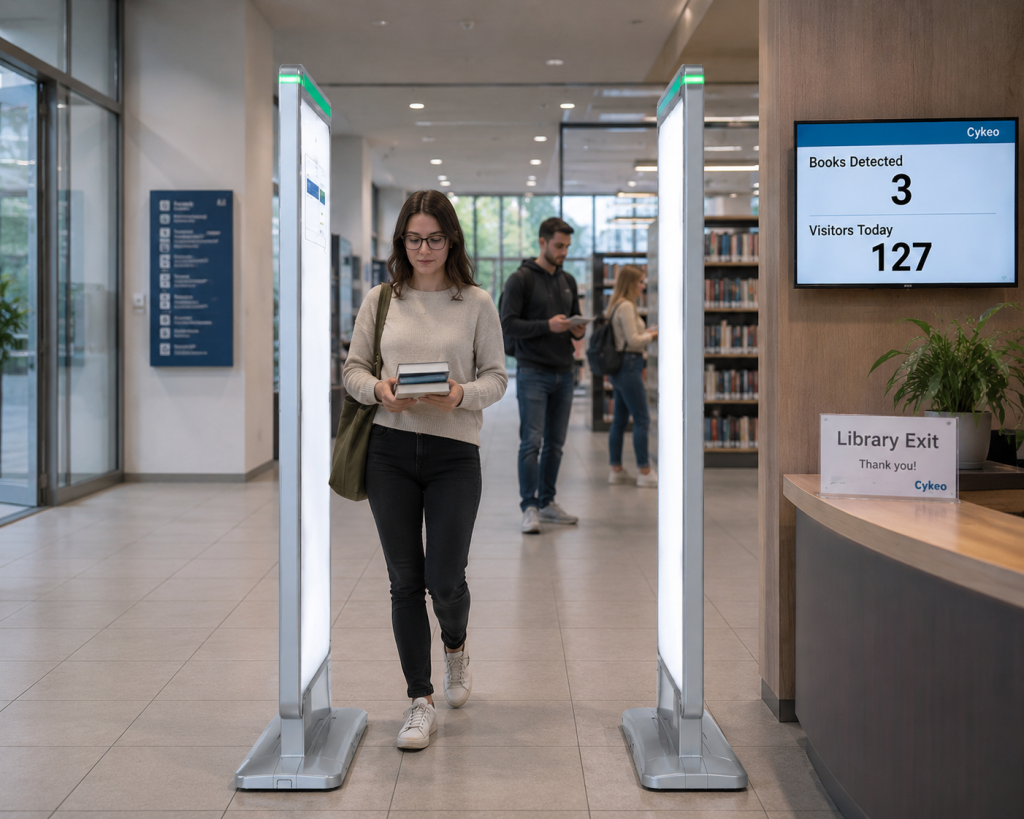
One assumption appears almost every time a new project begins.
Customers expect the biggest challenge to be reading more tags.
In reality, the more difficult task is reading only the tags that matter.
A properly engineered access RFID gate shouldn’t detect assets stored several meters away on adjacent shelving. Achieving precise coverage requires careful antenna tuning, infrared trigger timing, and site-specific calibration.
Those adjustments rarely appear in product specifications, yet they determine whether a security gate quietly performs for years or generates unnecessary alarms every day.
Modern Cykeo RFID access gates support multiple communication methods:
This flexibility allows organizations to integrate RFID security with existing asset management, library systems, warehouse software, or enterprise security platforms.
Access RFID is an automated identification system that uses RFID technology to monitor tagged assets or items entering and leaving controlled areas without manual scanning.
Yes. EPC Gen2 UHF RFID security gates are specifically designed to identify multiple RFID tags during a single passage event.
Libraries, enterprise offices, archive centers, healthcare facilities, universities, logistics centers, retail stores, and manufacturing plants all benefit from RFID access control technology.
Yes. Integrated infrared sensors allow the system to count people entering and exiting while simultaneously detecting RFID-tagged assets.
Cykeo designs intelligent access RFID systems for organizations where security, visibility, and operational efficiency are equally important. Built on ISO/IEC 18000-63 (EPC Gen2) technology, our RFID security gates combine high-performance multi-tag reading, precise antenna coverage, infrared-triggered detection, integrated audio-visual alarms, online/offline EAS modes, real-time people counting, and flexible Ethernet, Wi-Fi, or 4G connectivity.
Across deployments in libraries, enterprise campuses, archives, and industrial facilities, one lesson has remained consistent: the most effective access RFID solution is not the one that reads the farthest—it is the one that detects every authorized movement, ignores irrelevant signals, and provides managers with complete confidence in every entry and exit.

Learn how to scan RFID tags into Google Sheets with RFID readers. Discover practical workflows, tools, and real applications from Cykeo for faster inventory tracking.
More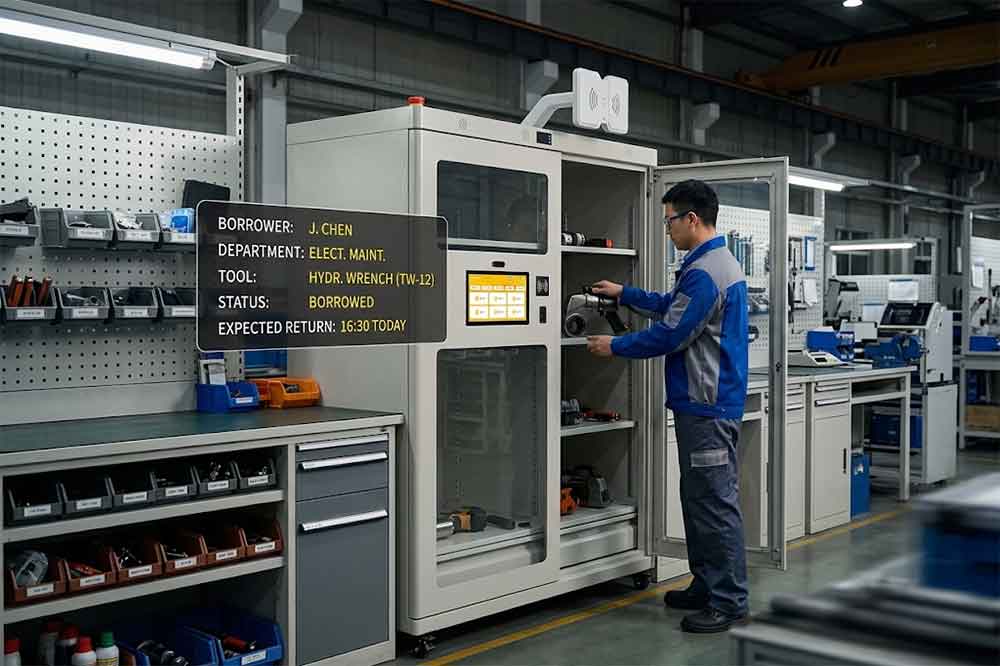
RFID tool cabinet can help factories manage tool borrowing, lending periods, responsible users, cross-department requests, and returns. It creates a clearer ...
More
Barcodes vs RFID: Discover which tracking tech cuts labor costs faster. See how businesses choose based on scanning headaches, metal interference, and hidden expenses.
More
RFID gate opener sticker systems improve automated access control, item tracking, and security management for libraries, retail, healthcare, and smart storage spaces.
More