13.56 MHz RFID is a high-frequency RFID technology that provides secure, fast, and reliable identification for document management, archive cabinets, libraries, healthcare, and access control applications. When combined with ISO 15693 tags, it enables contactless borrowing, returning, inventory, and real-time file tracking with exceptional accuracy.
After deploying HF RFID solutions for government archives, corporate record centers, and intelligent filing systems, I’ve found that the greatest improvement isn’t simply replacing barcode labels—it’s eliminating uncertainty. Staff stop wondering where a document is because the cabinet always knows.
Why 13.56 MHz RFID Is the Preferred Choice for Smart Archive Cabinets
Paper records still play an essential role in government agencies, financial institutions, legal offices, and enterprise headquarters. The challenge is not storing documents—it is locating the correct file immediately while maintaining complete borrowing records.
A 13.56 MHz RFID intelligent archive cabinet automates these tasks.
Instead of manually scanning every folder, users authenticate themselves, remove or return files, and the cabinet records every movement automatically. No manual input. No forgotten transactions.
According to ISO/IEC 15693, High Frequency RFID operates at 13.56 MHz and is specifically designed for vicinity identification, providing reliable short-range communication for document management and library systems.
The RFID Journal also notes that HF RFID remains the dominant technology for libraries, archives, pharmaceutical management, and document tracking because of its excellent anti-interference characteristics in dense indoor environments.
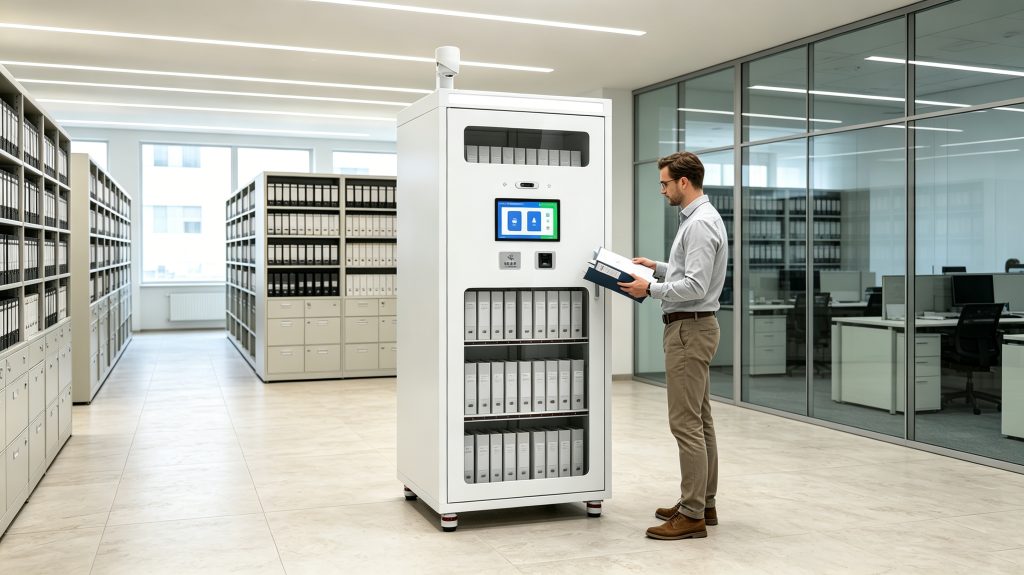
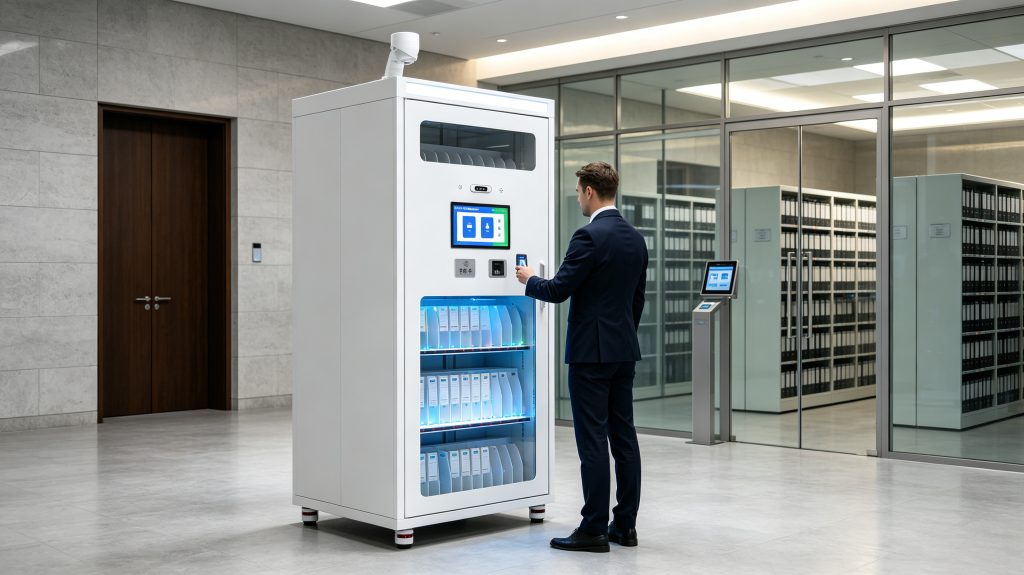
A Cykeo intelligent archive cabinet automatically manages document borrowing and returns using 13.56 MHz RFID technology.
How Does 13.56 MHz RFID Work?
Unlike UHF RFID, which is optimized for long-distance logistics, 13.56 MHz RFID uses magnetic coupling between the reader rfid antenna and the RFID tag.
This provides highly reliable communication at short distances while reducing accidental reads from neighboring cabinets or adjacent shelves.
In practical deployments, the LED guidance feature often receives the most praise from users. Rather than searching through dozens of folders, employees immediately locate the correct document through illuminated compartments, reducing retrieval time dramatically.
Real Benefits in Daily Archive Operations
During implementation, customers usually expect RFID to accelerate inventory.
They quickly discover that inventory is only one advantage.
Fully Automated Borrowing and Returning
Every borrowing event is recorded automatically, eliminating manual registration and reducing clerical errors.
Three-Second Inventory Verification
Routine daily and monthly inventory checks can be completed in approximately three seconds without removing files from storage.
Comprehensive Data Collection
Every movement is logged.
Administrators can analyze:
Borrowing frequency
Department usage
File circulation history
Long-term archive utilization
Identity-Based Security
By integrating employee cards, passwords, fingerprints, or facial recognition, every archive transaction is linked to a verified individual.
That level of accountability is difficult to achieve with paper logbooks.
LED Location Guidance
Each storage compartment features an indicator light, allowing operators to immediately identify the correct file position during borrowing or return.
In busy archive rooms, this seemingly simple function often saves more time than the RFID reading process itself.
LED guidance helps operators quickly locate and return archived files inside an intelligent RFID cabinet.
Expert Insight from Real Deployments
One misconception appears in nearly every project.
Customers believe RFID’s biggest advantage is faster identification.
After deployment, however, they consistently value something else more: confidence.
When every document movement is automatically recorded, managers no longer rely on handwritten logs or memory. Missing files become exceptions rather than daily frustrations.
The technology quietly shifts archive management from reactive searching to proactive visibility.
Frequently Asked Questions
What is 13.56 MHz RFID used for?
It is widely used for document management, intelligent archive cabinets, libraries, healthcare, pharmaceutical tracking, access control, and NFC-related applications.
Does 13.56 MHz RFID support ISO 15693?
Yes. ISO/IEC 15693 is one of the most widely adopted international standards for high-frequency RFID operating at 13.56 MHz.
Why is 13.56 MHz RFID better for archive management?
Its controlled reading range minimizes unintended tag detection while providing accurate identification of nearby tagged documents.
Can 13.56 MHz RFID improve document security?
Yes. Combined with identity authentication and management software, every borrowing and return transaction is recorded, creating a complete audit trail.
Why Choose Cykeo 13.56 MHz RFID Solutions?
Cykeo develops intelligent 13.56 MHz RFID solutions for organizations where document integrity, traceability, and operational efficiency are essential. Our smart archive cabinets support ISO 15693 protocol, providing automatic borrowing and return management, rapid inventory verification, comprehensive data collection, user authentication, and LED-guided file positioning.
Working with enterprise headquarters, government agencies, financial institutions, and archive centers has reinforced one lesson: the value of an archive system is measured not by how many files it stores, but by how confidently every file can be found, tracked, and returned. That is exactly what 13.56 MHz RFID technology delivers.
Choosing between circular and linear polarization RFID antennas can significantly impact system performance. This guide explains the differences, advantages, and real-world use cases to help RFID solution providers select the right antenna.
Many RFID asset tracking projects fail after deployment. This article explains the real reasons warehouses struggle with RFID systems and practical ways to fix them.
Learn how to obtain data from RFID tags via Bluetooth for seamless wireless workflows. Discover compatible devices, setup steps, and Cykeo’s Bluetooth-enabled RFID solutions.
Learn how does a rfid chip work through wireless identification technology, RFID communication principles, and Cykeo solutions for smart asset tracking.
 Cykeo RFID IoT Solution Products R&D Manufacturer