 Cykeo RFID IoT Solution Products R&D Manufacturer

how to scan rfid card
107RFID card scanning uses a compatible reader to communicate with card chips through radio signals and capture stored information without physical contact.
MoreAll RFID Product
High temperature RFID tracking tags are designed for industrial environments where ordinary RFID labels fail due to heat, pressure, chemicals, or repeated cleaning cycles. They provide stable identification and long-term asset visibility under extreme operating conditions.
That sounds straightforward. In practice, it rarely is.
Inside metal processing workshops, automotive coating lines, sterilization areas, and high-temperature manufacturing plants, RFID failure usually happens slowly first. Read distance becomes unstable. Adhesive layers weaken. Encapsulation cracks after thermal cycling.
Then inventory accuracy collapses all at once.
Over the last several years working around industrial RFID deployments, I have seen facilities spend more money replacing failed low-cost tags than investing in proper high temperature RFID tracking tags from the beginning.
The environment always wins eventually.
According to research published by the U.S. Department of Energy, industrial manufacturing environments frequently expose equipment and tracking systems to temperatures exceeding standard electronic operating ranges.
RFID Journal also documented growing industrial adoption of rugged RFID systems for manufacturing automation and tool traceability.
A standard paper RFID label might survive inside a warehouse.
It will not survive powder coating.
That difference matters more than many purchasing teams initially realize.
One automotive supplier we supported had tags peeling away after repeated exposure to curing ovens near 200°C. The original labels technically met specification sheets, but the adhesive degraded after multiple heating cycles.
That detail never appeared in the brochure.
After switching to industrial encapsulated RFID tags with heat-resistant mounting structures, the read consistency stabilized during production movement.
The lesson was simple: laboratory specifications are not the same as factory reality.
Industrial RFID tags are commonly manufactured using:
These materials protect the RFID chip and antenna from thermal deformation.
Cykeo industrial RFID systems use ultra high frequency RFID technology to support fast batch reading and automated asset visibility across manufacturing processes.
UHF RFID enables:
Even inside harsh industrial environments, stable data collection remains possible when tags are correctly engineered.
Manufacturing environments are messy in ways most office-based software teams underestimate.
Dust. Steam. Vibration. Oil mist. Forklift impacts.
RFID systems either tolerate that environment or quietly fail inside it.
| Feature | Industrial Benefit |
|---|---|
| Heat resistance | Survives ovens and sterilization |
| Rugged structure | Handles vibration and impacts |
| UHF identification | Fast bulk reading |
| Long lifecycle | Reduces replacement costs |
| Automated tracking | Improves production visibility |
According to Deloitte manufacturing trend reports, digital asset visibility continues becoming a critical operational priority across industrial facilities.

Not every “industrial RFID tag” is genuinely industrial.
Some products survive high temperature briefly but fail under repeated heating cycles.
Others survive heat but lose reading stability around metal surfaces.
That is why testing matters.
Always verify both:
Those are different measurements.
Metal surfaces dramatically affect RFID behavior.
Specialized anti-metal RFID structures are often required in industrial environments.
Cleaning agents, oils, solvents, and industrial detergents can gradually damage ordinary tag materials.
Long-term resistance matters more than short-term survival.
A surprising number of RFID failures have nothing to do with the chip itself.
The mounting method causes the issue.
I once visited a tooling workshop where expensive RFID tags kept disappearing from inventory records. The problem turned out to be mechanical vibration slowly loosening screws over several months.
The tags were functioning perfectly.
They simply were not physically staying attached.
After redesigning the mounting brackets and reducing vibration stress points, tag retention improved immediately.
RFID tracking depends on engineering discipline far beyond software dashboards.
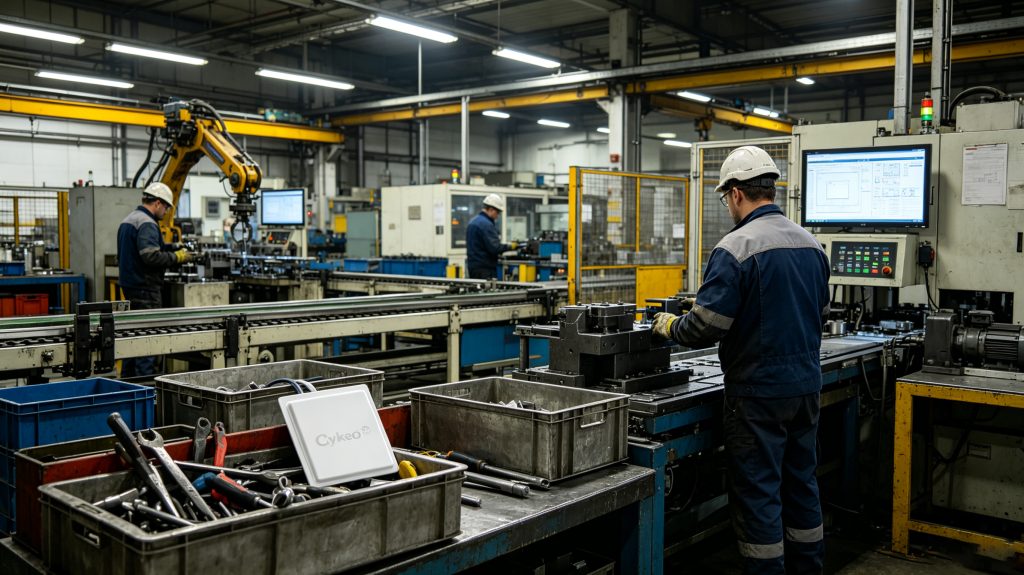
Industrial RFID tags can withstand temperatures ranging from 150°C to over 250°C depending on materials and design.
Yes. Many industrial RFID tags are specifically designed for metal mounting applications.
UHF RFID enables fast long-range reading and automated bulk identification across industrial production environments.
Specialized high temperature RFID tags can survive repeated cleaning, sterilization, and chemical exposure cycles.
High temperature RFID tracking tags are not just identification tools. In industrial operations, they become part of the production infrastructure itself.
When RFID systems fail inside harsh environments, operational visibility disappears quietly first — then productivity follows.
Cykeo industrial UHF RFID solutions are engineered for stable performance in manufacturing, metal processing, and high-temperature asset tracking environments where durability matters every single day.
RFID Industry Writer | IoT & Asset Tracking Analyst
James writes about RFID technology, asset tracking, and the practical challenges of digital transformation across warehousing, retail, manufacturing, and logistics.
His work focuses on how RFID is applied in real-world operations—improving inventory visibility, automating workflows, and helping businesses manage assets with greater accuracy and efficiency.
He regularly covers topics including UHF RFID, smart cabinets, RFID portals, tool tracking, warehouse automation, and industrial IoT trends..

RFID card scanning uses a compatible reader to communicate with card chips through radio signals and capture stored information without physical contact.
More
Improve inventory accuracy and speed with RFID stocktake solutions. The CK-DP13A RFID Inventory Tracking Station reads hundreds of items in seconds and integrates with ERP/WMS systems. Flexible setup with RFID readers and antennas makes it ideal f...
More
Confused about RFID and NFC? We answer "can a RFID reader read NFC" by explaining the technology relationship and which readers are compatible.
More
RFID in warehouses uses UHF radio communication to identify multiple tagged goods without line-of-sight scanning and connect physical inventory events with w...
More