 Cykeo RFID IoT Solution Products R&D Manufacturer
Can iPhone Read RFID Tags? Let’s Clear This Up.
366Can iPhone read RFID tags? We cut through the confusion. Get the honest truth about NFC compatibility and why iPhones aren't industrial RFID scanners.
MoreAll RFID Product
Inventory accuracy has always been one of the biggest challenges in textile management.
Hotels, hospitals, commercial laundries, and uniform rental companies all deal with the same issue: once textile volume becomes large enough, keeping inventory records accurate becomes much harder than expected.
Items move constantly between washing areas, storage rooms, transportation vehicles, and customer locations. During busy operations, even small counting mistakes quickly turn into inventory discrepancies.
Over time, those inaccuracies affect purchasing decisions, replacement planning, customer service, and operating costs.
That’s one reason RFID laundry tracking systems are becoming much more common across commercial textile industries.
Many textile businesses still rely heavily on manual inventory processes.
Staff count linens by hand, scan barcodes individually, or update inventory records manually during receiving and shipping.
Those workflows may function reasonably well at smaller scales, but once facilities begin processing thousands of items daily, errors become difficult to avoid.
Common problems include:
Even experienced teams struggle to maintain perfect accuracy during high-volume operations.
RFID helps reduce much of that manual dependency.
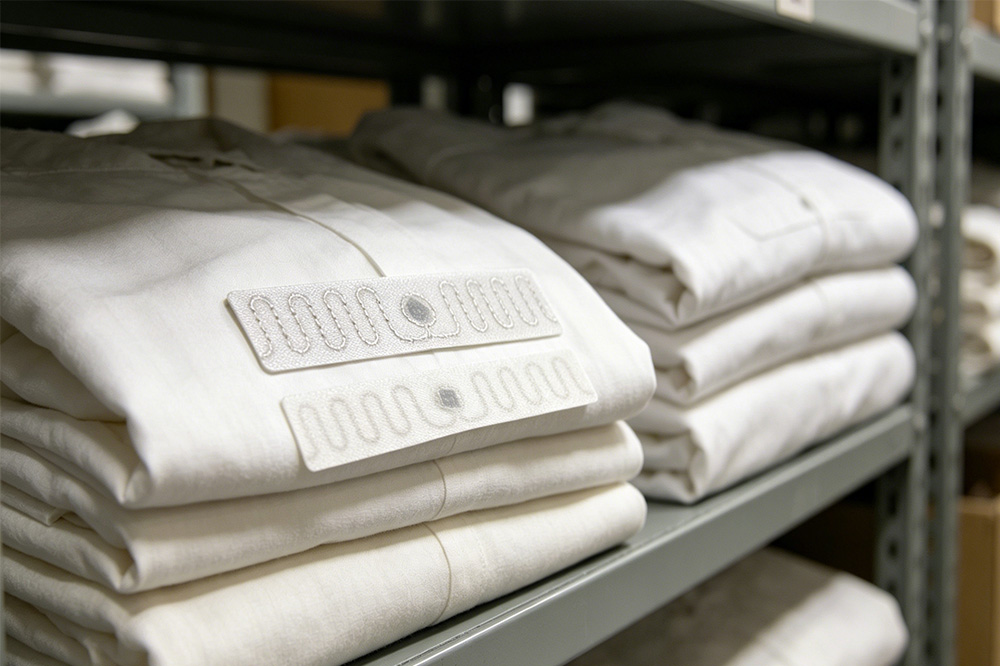
RFID laundry tags allow textile items to be identified automatically without direct scanning.
Each tag contains a unique ID connected to the textile management system.
The RFID tag is sewn directly into the linen or garment and remains readable during washing, drying, sorting, storage, and transportation.
As textiles move through RFID reading areas, inventory activity updates automatically.
A durable industrial RFID laundry tag is designed specifically for repeated industrial washing conditions and long-term textile circulation.
Because data collection becomes automated, inventory records stay much more consistent compared to manual systems.
Traditional barcode systems require items to be scanned individually.
That process becomes slow and error-prone when dealing with large textile volumes.
RFID systems work differently.
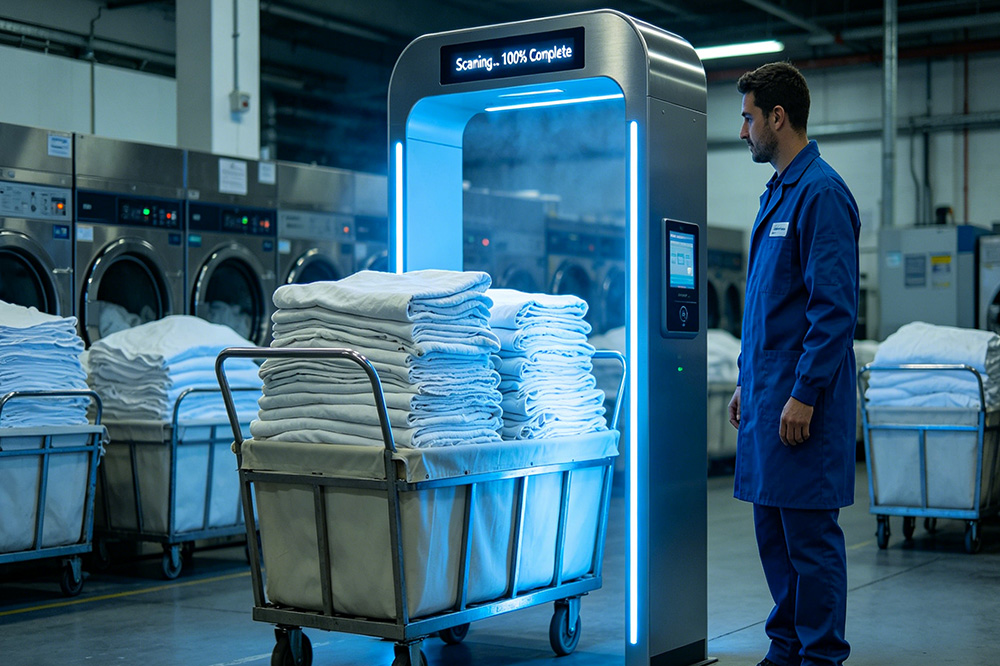
Entire carts or batches of linens can be identified automatically within seconds without opening bags or separating individual garments.
This greatly reduces missed scans and counting inconsistencies.
For commercial laundries processing thousands of textiles daily, bulk RFID scanning significantly improves operational visibility.
Many operators notice immediate improvements in:
The larger the operation becomes, the more valuable these improvements usually are.
One major problem with manual inventory systems is delayed updates.
By the time missing textiles are discovered, the actual issue may have happened hours or days earlier.
RFID systems improve visibility because inventory movement is recorded automatically throughout the workflow.
Operators can quickly see:
This makes it easier to identify discrepancies early before inventory problems become larger operational issues.
Healthcare and hospitality industries rely heavily on stable textile availability.
Hospitals cannot afford shortages of medical linens or staff garments. Hotels need accurate linen inventory to maintain room operations smoothly.
Inventory inaccuracies often lead to:
RFID tracking helps reduce these risks by giving operators more reliable inventory data.
Instead of relying on estimates, facilities can manage textile inventory based on actual movement records.
Many inventory problems are caused by simple manual mistakes.
Employees may scan the wrong barcode, skip counting steps during busy shifts, or place textiles into incorrect customer batches.
RFID automation reduces some of that risk because identification happens automatically as items move through the system.
This improves workflow consistency while reducing repetitive manual work.
In many commercial laundry environments, reducing human error is just as important as increasing processing speed.
Large textile businesses often operate across multiple facilities.
Inventory may move between:
Without centralized tracking, maintaining accurate inventory visibility across all locations becomes difficult.
RFID systems help businesses monitor textile movement across multiple operational points in real time.
This creates better control over inventory allocation and replacement planning.
For companies managing high textile circulation volume, centralized visibility becomes increasingly important as operations grow.
A few years ago, RFID textile tracking was mostly used by very large industrial operators.
Today, adoption is spreading rapidly across mid-sized commercial laundries, hospitality groups, healthcare systems, and textile rental companies.
The reason is simple: manual inventory management becomes harder to maintain as textile operations scale.
RFID helps businesses improve inventory accuracy while reducing operational pressure at the same time.
For many commercial textile operations today, RFID laundry tags are no longer considered optional upgrades. They are becoming part of the standard infrastructure used to manage textile inventory more efficiently.
User Guide
How to Remove RFID Tags from Clothing Safely (Without Ripping Your Shirt)
The Truth About RFID Signals: Aluminum Foil, Smartphones, and Reading Range Explained
How Security Tag Readers Work: RFID vs. Magnetic Systems – Which Is More Efficient?
How to Deactivate RFID Tags Without Guesswork or Myths?
How to Test RFID Tags with Phone
How to Test RFID Tags with Your Smartphone (No Scanner Needed)
How to Use Android Phone to Emulate RFID Tag: Full Tutorial and Application Guide
Can Your RFID Tags Reader iPhone ? Here’s How It Actually Works
Can You Use an NFC Phone as an RFID Tag?
How to Choose the Right RFID Tag for Clothing? Materials, Packaging & Attachment Explained
Industrial Essentials: 2025 Guide to the Most Durable Rugged RFID Tags
Active RFID Tag Range: The Real Difference Between Active and Passive Tags
Can iPhone read RFID tags? We cut through the confusion. Get the honest truth about NFC compatibility and why iPhones aren't industrial RFID scanners.
More
Discover the truth about battery-free RFID tags. Are they a sustainable, cost-saving solution for your business? Cykeo breaks down the facts, benefits, and real-world applications.
More
Learn how to choose RFID antennas for metal environments. Discover why metal affects RFID signals and how industrial RFID projects solve interference, missed reads, and performance issues.
More
Want to know how to read data from an RFID card? Cut through the hype. We cover card types, real tools, and what that hex dump actually means.
More