 Cykeo RFID IoT Solution Products R&D Manufacturer

RFID card Security and Industrial Applications Explained
113RFID card enables secure contactless access control and identification in offices, transport, and industry. Learn real deployments, standards, and insights with Cykeo.
MoreAll RFID Product
High frequency RFID is widely used for secure identification, asset tracking, and access management because it offers stable short-range communication with strong anti-interference performance in dense environments.
That is the short answer.
But after years of testing RFID systems inside libraries, medical storage rooms, production workshops, and office access points, I noticed something most marketing articles ignore: HF RFID is rarely chosen because it is “faster.” It is chosen because it behaves predictably.
That matters more.
At 13.56 MHz, high frequency RFID performs consistently around liquids, people, and compact indoor spaces where ultra long-range reading is unnecessary. In real deployments, stable identification often beats extreme distance.
According to the RFID Journal technical archive, HF RFID remains heavily adopted in ticketing, authentication, healthcare, and secure access applications due to its reliable near-field communication characteristics.
Research published by the National Institute of Standards and Technology (NIST) also highlighted RFID adoption for inventory accuracy and automated identification workflows in controlled environments.
A lot of industrial buyers immediately focus on UHF systems because they hear phrases like “long-range inventory.” That makes sense for warehouses.
But inside hospitals, office buildings, laboratories, and document archives, long reading distance can actually become a problem.
HF RFID provides tighter control.
One deployment we worked on involved pharmaceutical storage cabinets. The client originally tested UHF readers, but nearby metal shelving caused excessive reflections inside narrow compartments.
Switching to high frequency RFID stabilized the read zone almost immediately.
Sometimes shorter range creates cleaner data.
HF RFID systems typically operate at 13.56 MHz and rely on near-field electromagnetic coupling between the reader and the tag.
Unlike ultra high frequency RFID, HF systems are optimized for controlled-range communication.
| Component | Function |
|---|---|
| RFID Tag | Stores unique identification data |
| RFID Reader | Detects and exchanges information |
| Rfid Antenna | Generates communication field |
| Software Platform | Processes tracking and access data |
Cykeo RFID solutions integrate these components into centralized management platforms for identification, authorization, and tracking workflows.
HF RFID performs more consistently in environments where water absorption affects radio propagation.
This becomes important in:
One overlooked issue in RFID deployments is accidental reading.
In a dense office entrance, overly aggressive reading range can create duplicate scans or false triggers. HF RFID reduces that risk because the read field stays controlled and localized.
That improves operational reliability.
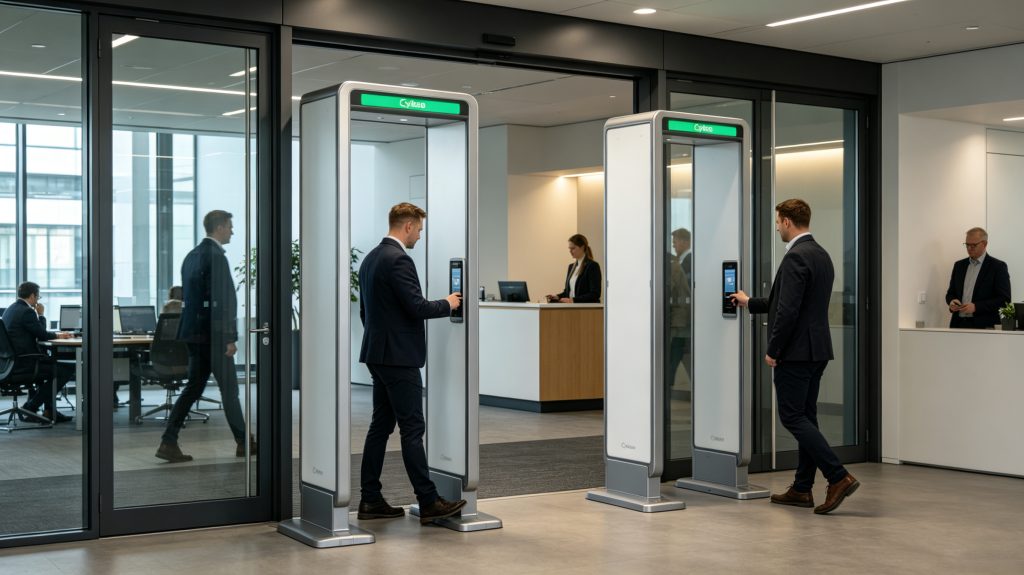
This comparison comes up constantly during projects.
The answer depends entirely on reading distance and environmental complexity.
| Feature | HF RFID | UHF RFID |
| Frequency | 13.56 MHz | 860–960 MHz |
| Reading Distance | Short | Long |
| Metal Sensitivity | Lower | Higher |
| Bulk Reading | Moderate | Excellent |
| Access Control | Excellent | Good |
| Warehouse Inventory | Limited | Excellent |
For large warehouse inventory, UHF dominates.
For secure authentication and localized reading, high frequency RFID still performs extremely well.
That distinction matters more than marketing trends.
One lesson I learned during a facility rollout: installation height changes everything.
A customer complained that employee badge detection was inconsistent near a loading entrance. The reader itself was functioning normally. The actual issue was forklift vibration affecting antenna orientation over time.
After adjusting mounting brackets and shielding nearby power cables, scan consistency improved dramatically.
RFID performance is often shaped by physical deployment details, not just chip specifications.
Another overlooked factor is user behavior.
People rarely tap cards perfectly. Systems designed around laboratory testing sometimes fail in real traffic conditions. Reliable RFID design requires tolerance for imperfect human movement.
That is where deployment experience becomes visible.
Organizations commonly improve:
According to Deloitte digital transformation reports, automated identification technologies continue reducing manual administrative overhead across enterprise environments.

High frequency RFID typically operates at 13.56 MHz and supports near-field communication.
Yes. HF RFID is widely used for secure access control because of its stable short-range performance.
Compared with UHF systems, HF RFID generally performs better around liquids and human bodies.
Healthcare, education, offices, laboratories, transportation, and authentication systems commonly use HF RFID technology.
High frequency RFID continues to remain relevant because reliability matters more than raw range in many real environments.
Inside secure buildings, laboratories, offices, and controlled storage areas, predictable reading behavior creates better operational confidence than aggressive scanning distance.
Cykeo high frequency RFID solutions are designed for stable indoor identification, secure authentication, and intelligent asset visibility where precision matters every day.
RFID Industry Writer | IoT & Asset Tracking Analyst
James writes about RFID technology, asset tracking, and the practical challenges of digital transformation across warehousing, retail, manufacturing, and logistics.
His work focuses on how RFID is applied in real-world operations—improving inventory visibility, automating workflows, and helping businesses manage assets with greater accuracy and efficiency.
He regularly covers topics including UHF RFID, smart cabinets, RFID portals, tool tracking, warehouse automation, and industrial IoT trends..

RFID card enables secure contactless access control and identification in offices, transport, and industry. Learn real deployments, standards, and insights with Cykeo.
More
Can RFID track location? The honest answer from real projects. Learn how RFID location works, where it fails, and what CYKEO recommends.
More
Get started the right way. Our ultimate guide on how to RFID reader walks you through hardware selection, physical setup, software configuration, and turning scans into actionable data.
More
in-depth look at how RFID transforms library management systems—from self-checkout and collection tracking to security and data analytics. Backed by real-world cases and hands-on experience, this article reveals how the technology is reshaping th...
More