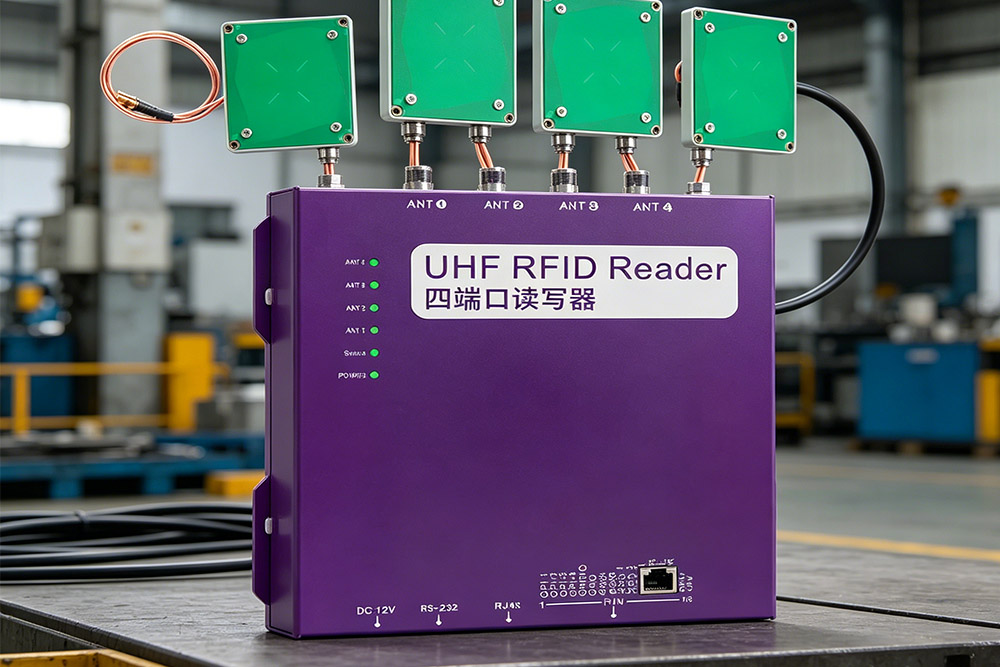
If you’ve ever seen a warehouse where items get recorded automatically as they pass through a gate—no scanning, no stopping—that’s usually a fixed RFID reader at work.
Most people first come across RFID through handheld scanners. But in real industrial projects, handheld is only the starting point.
When operations scale, companies move to fixed RFID readers—because manual scanning simply doesn’t keep up.
Let’s walk through what these devices actually are, and more importantly, when you need one.
What Is a UHF RFID Fixed Reader?
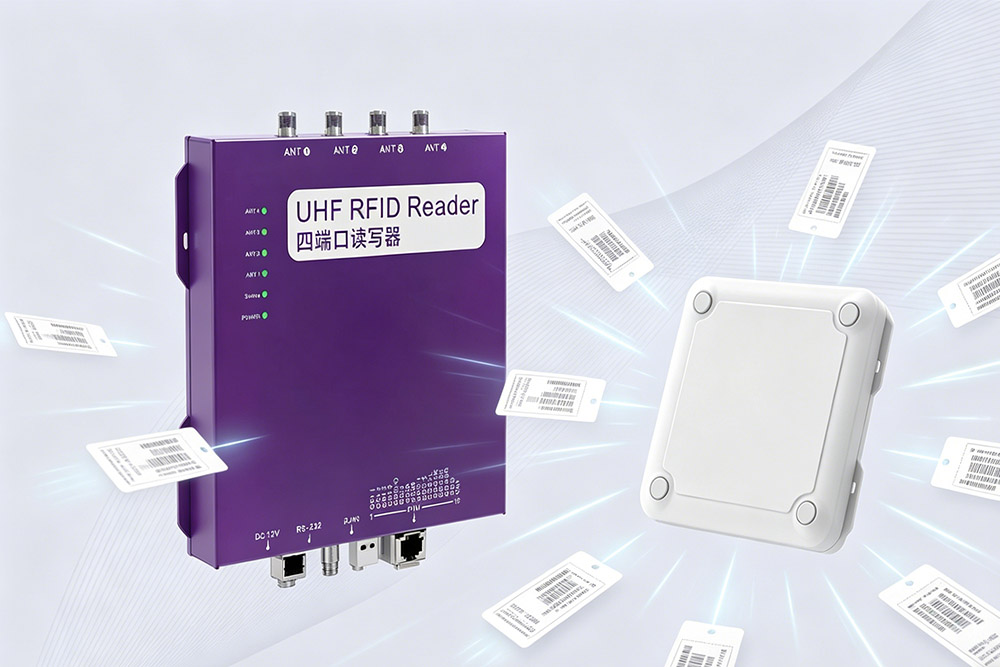
A UHF RFID fixed reader is a stationary device that automatically reads RFID tags within a defined area, without requiring human intervention.
Unlike handheld readers, it’s installed in a fixed position, such as:
Warehouse gates
Conveyor lines
Production lines
Access control checkpoints
Once installed, it continuously scans for tags and sends data directly to your system.
No trigger. No aiming. No manual process.
How It Works
At a basic level, the system has three parts:
RFID tags (attached to items)
Antennas (connected to the reader)
The fixed reader (data processor)
Here’s what happens on site:
The reader sends out radio signals through antennas
Tags entering the field respond with their ID
The reader captures multiple tags at once
Data is transmitted to WMS / ERP / software systems
In a well-configured setup, this all happens in milliseconds.
Why Fixed Readers Are Used Instead of Handheld Devices
Handheld readers are flexible—but they rely on people.
That becomes a problem when:
Volume increases
Speed matters
Accuracy is critical
Typical handheld limitations:
One operator = limited throughput
Manual scanning required
Easy to miss items
Fixed reader advantages:
Fully automated
Continuous operation
High-speed bulk reading (hundreds of tags per second)
Consistent accuracy
In short: Handheld helps you manage. Fixed readers help you scale.
Where Fixed RFID Readers Are Commonly Used
You’ll usually find them anywhere items move through defined points.
1. Warehouse Entry/Exit Points
Automatic recording of inbound/outbound goods
No need to stop forklifts
2. Conveyor Systems
Real-time tracking of items on belts
Used in sorting and logistics centers
3. Production Lines
Tracking parts through each stage
Monitoring work-in-progress (WIP)
4. Access Control & Asset Tracking
Monitoring tools, equipment, or personnel
Preventing loss or unauthorized movement
Understanding Antennas
A fixed reader doesn’t work alone—it relies on antennas.
Most industrial readers support:
4 ports
8 ports
16 ports
More ports = more antennas = wider coverage.
For example:
Small gate → 2–4 antennas
Large warehouse zone → 8+ antennas
Poor antenna setup is one of the main reasons RFID systems fail—not the reader itself.
What Kind of Read Range Can You Expect?
This is one of the most misunderstood topics.
You’ll often see claims like “up to 15 meters.” That’s under ideal conditions.
In real environments:
3–8 meters → typical stable range
Depends on tags, environment, and antenna placement
Metal, liquids, and interference can reduce performance significantly.
So the question isn’t “maximum range”—it’s reliable range.
When Do You Actually Need a Fixed RFID Reader?
You don’t always need one.
But you should seriously consider it if:
You are scanning large volumes of items daily
Manual processes are slowing operations
You need real-time tracking
Accuracy matters (inventory, compliance, audit)
If your team is still walking around scanning items one by one, that’s usually the tipping point.
A Simple Example
A warehouse initially used handheld RFID readers for inventory.
It worked—until volume increased.
Problems started:
Missed scans
Slow processing
Labor dependency
They installed fixed readers at entry/exit gates.
Result:
Automatic tracking
Faster throughput
Reduced labor
The system didn’t change much—just the way data was captured.
Common Misconception
Many buyers think:
“RFID system = reader”
In reality:
RFID success depends on:
Tag selection
Antenna layout
Environment setup
The reader is just one part—but it’s the core controller.
Final Thoughts
A UHF RFID fixed reader is not just a device—it’s a shift from manual tracking to automated data capture.
If your operation is still relying heavily on manual scanning, a fixed reader is usually the next logical step.
It doesn’t just make things faster—it makes them consistent.
If you’re planning to implement RFID in your warehouse or industrial system, it’s worth evaluating whether a fixed reader setup fits your workflow.
You can request:
System design suggestions
Antenna configuration advice
Compatibility details
Start with your use case, and build the system around it.
As technology advances rapidly, the concept of smart cities has garnered increasing attention. Among the key technologies enabling smart city development, Radio Frequency Identification (RFID) plays a pivotal role in boosting urban effici...
Discover the top long-range RFID readers optimized for vehicle access control. Learn how Cykeo’s secure, weatherproof solutions enhance security in parking lots, gated communities, and logistics hubs.
Wondering what does RFID card reader mean? We explain the definition, how it works, types from desktop to handheld, and everyday applications. Simple guidance from CYKEO engineers.
 Cykeo RFID IoT Solution Products R&D Manufacturer