 Cykeo RFID IoT Solution Products R&D Manufacturer
How to Choose the Correct RFID Antenna: Stop Gambling, Start Matching
290Unsure how to choose the correct RFID antenna? Our field-tested guide helps you match antenna specifications to your environment, range, and application needs.
MoreAll RFID Product
Most hospitals already have some form of storage system in place.
It might be:
For a long time, this setup has been “good enough”.
But as equipment and consumables increase, the gaps become more visible.
That’s when hospitals start looking at RFID medical cabinets—not as an upgrade, but as a way to fix ongoing issues.
In a typical setup:
This system depends heavily on people following the process.
And in a hospital environment, that’s not always realistic.
The problems don’t usually show up immediately.
They build over time.
Common situations:
During busy shifts, recording usage is often skipped.
Not because staff don’t care—but because patient care comes first.

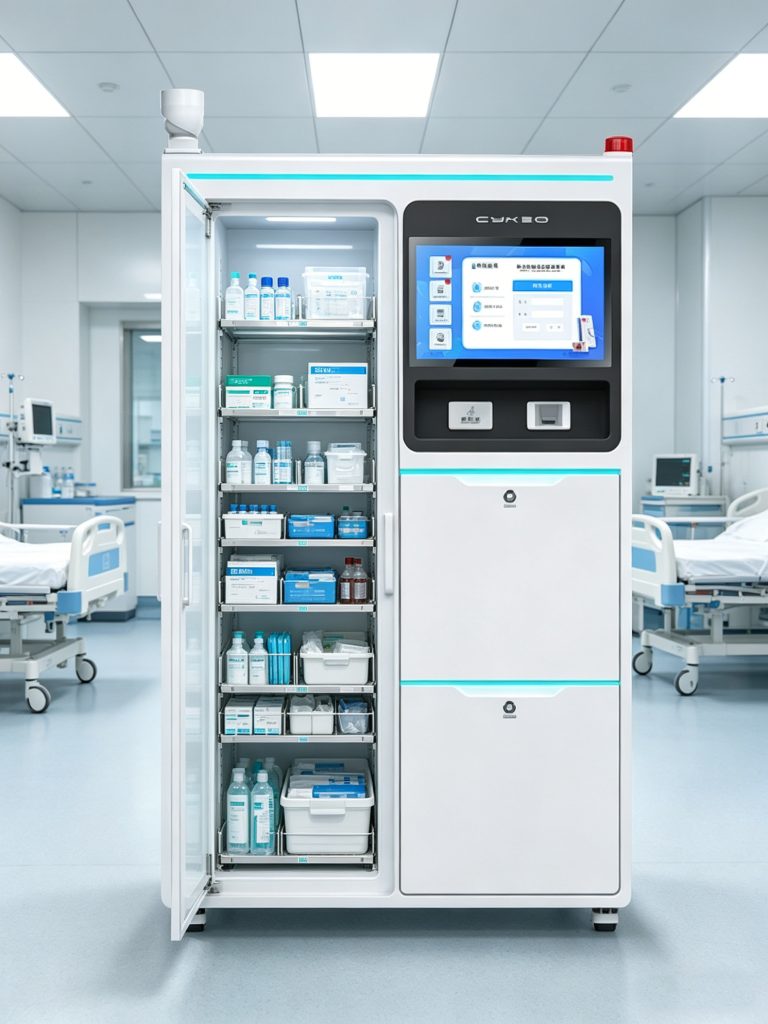
RFID medical cabinet doesn’t just store items—it controls and tracks them at the same time.
Instead of relying on manual logging:
From the staff’s point of view, the process is simple:
open → take → close
No scanning, no writing.
In a traditional setup:
A nurse needs a specific item.
It’s supposed to be in storage—but it’s not there.
Now time is spent:
With an RFID cabinet:
That difference becomes important during busy shifts.
This is really the core difference.
Relies on assumption
(“It should be there”)
Provides visibility
(“It is here / it was taken / it is missing”)
That shift alone removes a lot of uncertainty.
In practice, this means fewer surprises during audits or restocking.
Traditional systems can have rules—but enforcement is difficult.
RFID cabinets make accountability automatic:
Systems like an RFID medical cabinet are often used for:
Because these items require both control and traceability.
Not every hospital needs RFID everywhere.
Traditional storage can still work if:
In these cases, upgrading may not be necessary.
The shift usually happens when:
At that point, manual systems become harder to maintain.
Traditional storage looks cheaper at first.
But over time:
RFID systems require upfront investment,
but reduce these ongoing inefficiencies.
In real projects, most hospitals don’t replace everything.
A common approach is:
This keeps the system practical and cost-effective.

Traditional storage relies on people doing everything correctly.
RFID medical cabinets reduce that dependency.
They don’t replace staff—they reduce the number of things staff need to remember.
And in a hospital environment, that makes a difference.
If you’re currently using manual storage and running into issues with visibility or control,
it’s worth identifying where the gaps are:
From there, it becomes easier to decide whether an RFID-based setup makes sense—and where to start.
Related products
CYKEO-GY1B Medical RFID Cabinet
CYKEO-GY1A Smart Medical Cabinet RFID
CYKEO-GY2A UHF RFID Hospital Asset Cabinet
CYKEO-GY2B Medical RFID Storage Cabinet
CYKEO-GY1 Smart RFID Medical Cabinet
FTNG-L-CK-03 FENTANYL SMARTDRUG CABINET
FTNG-L-CK-02 RFID Fentanyl Secure Pharmacy Cabinet
FTNG-L-CK-01 Medical RFID Medicine Cabinet
CYKEO-MFX RFID Operating Room Cabinet
CYKEO-MFY Operating Room RFID Cabinet
CYKEO-MH RFID Scrub Return Cabinet
CYKEO-GY3 Low-Value Consumables Cabinet
Guide Recommendations
RFID Technology Reshapes Hospital Management: Driving Intelligent Transformation in Healthcare
RFID in Medical Equipment and Asset Management: A Smart Solution for Efficiency and Cost Reduction
RFID in Healthcare: Tracking Equipment, Improving Care
RFID in Healthcare: Is It Really Solving Hospital Problems or Just Adding Tech?
Unsure how to choose the correct RFID antenna? Our field-tested guide helps you match antenna specifications to your environment, range, and application needs.
More
Can a high frequency RFID scanner read UHF tags? No—and here’s why. Learn the real differences between 13.56 MHz HF and 860–960 MHz UHF RFID systems, including physics, protocols, read range, and dual-frequency reader options.
More
A long range RFID scanner helps power plants track maintenance tools, equipment, spare parts, and reusable assets at warehouses, workshops, substations, and ...
More
Learn how passive RFID tags work without batteries, how they get powered by RFID readers, and why they are widely used in libraries, retail, and inventory management.
More