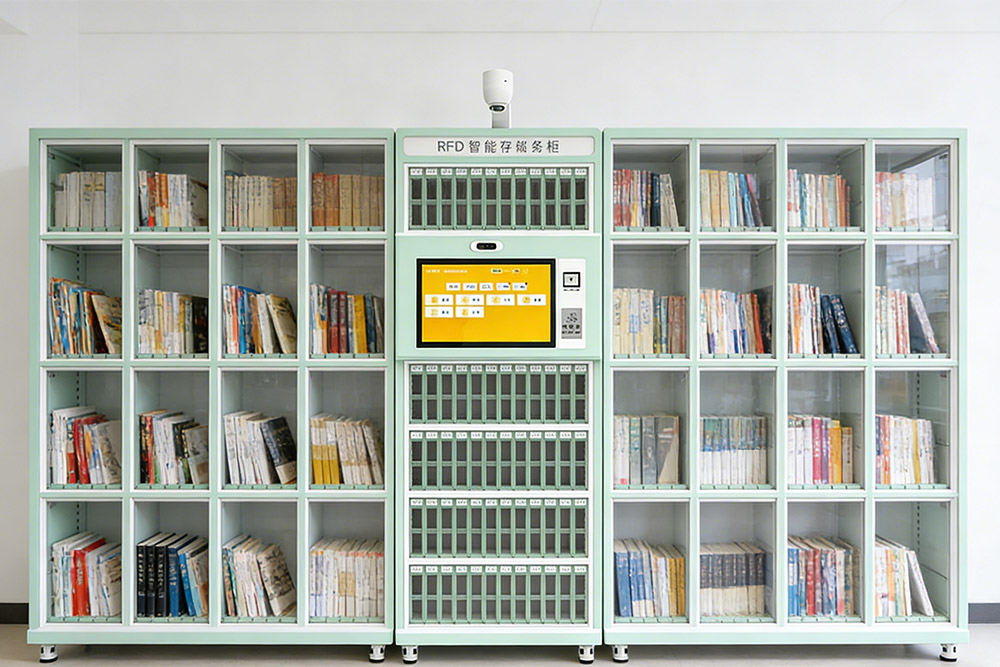
In many deployments, these cabinets act like 24/7 self-service library stations, especially in schools, offices, or public spaces.
This is similar to how some cities deploy unattended library kiosks where users can borrow and return books anytime.
Real Use Cases of RFID Library Solutions
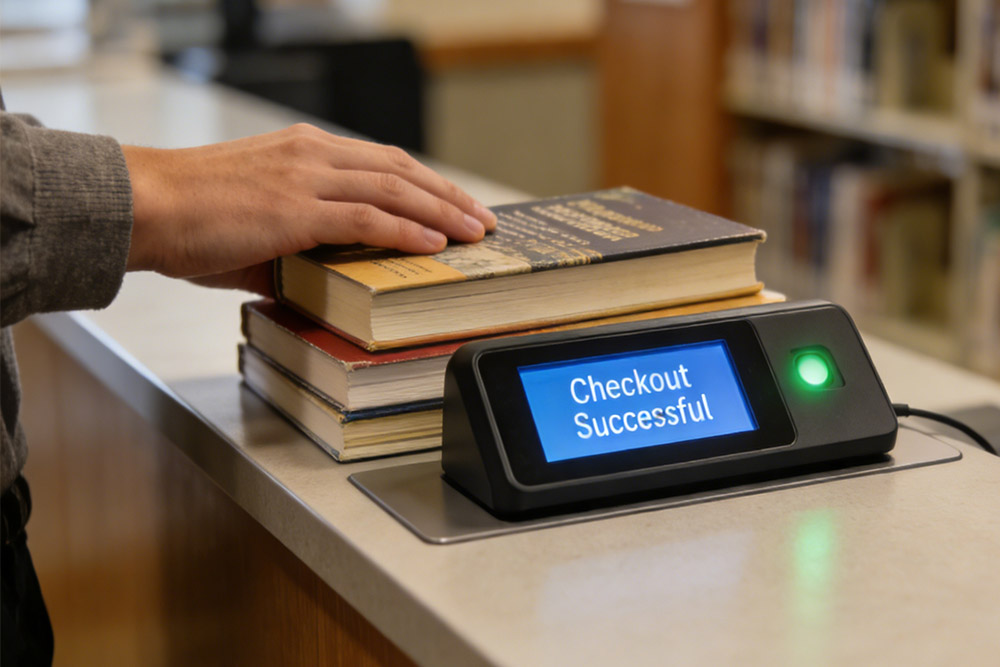
Self-Service Borrowing
Users place a stack of books on a reader → done in seconds.
No manual scanning. No waiting.
Automated Book Returns
Books pass through a return slot and are automatically:
Identified
Sorted
Routed to the correct category
Some systems even connect to conveyor belts for sorting.
Smart Shelves
Shelves equipped with RFID antennas can detect:
Which books are placed
If a book is misplaced
When items are removed
This reduces the time books stay “lost” inside the library.
Inventory Automation
Instead of scanning thousands of books manually, staff can:
Walk with a handheld reader
Or use automated systems
Some advanced systems even use robots to scan shelves with high accuracy.
How to Build an RFID Library System
If you’re planning a project, the process usually looks like this:
Step 1: Define the goal
Faster checkout?
Inventory accuracy?
Unmanned service?
Step 2: Choose the right frequency
HF (13.56 MHz) → common for libraries
NFC → short-range, mobile-friendly
UHF → longer range, more advanced use cases
Step 3: Select hardware
RFID tags for books
Readers and antennas
Smart cabinets or kiosks
Step 4: Integrate with library system
RFID needs to connect with your LMS (Library Management System).
Step 5: Start small, then scale
Many libraries begin with one station, then expand.
What Makes RFID Library Solutions “Smart”
It’s not just automation—it’s visibility.
With RFID, libraries can:
Know where every book is
Track movement in real time
Reduce human error
Improve user experience
In short, it turns a traditional library into a data-driven system.
Challenges to Consider
RFID isn’t perfect, and real projects do run into issues:
Initial tagging cost
System integration complexity
Staff training
Special handling for old or fragile books
Some libraries even run barcode + RFID systems together during transition.
Final Thoughts
RFID library solutions aren’t about replacing people—they’re about removing repetitive work.
Once implemented, the difference is obvious:
Faster service
Better organization
Less manual effort
And with tools like RFID library cabinets, libraries can extend their services beyond physical counters—into fully automated, self-service environments.
In the healthcare industry, patient safety is of paramount importance. However, due to the vast variety of medications and the complexity of their handling, the healthcare sector has long faced challenges in medication management and ensuring pati...
Discover what does the rfid chip do and how RFID chips enable automatic identification, tracking, and data management with Cykeo’s engineering experience and solutions.
Wondering "can RFID reader read NFC tag"? Discover the technical relationship between RFID and NFC, compatibility factors, and how CYKEO solutions bridge both technologies for seamless access control.
Use rfid tag android phones to read, write, and manage RFID tags fast. Learn real setup steps, compatibility limits, and field-tested tips from CYKEO engineers.
 Cykeo RFID IoT Solution Products R&D Manufacturer