Why RFID Emulation Boosts Efficiency but Also Poses Security Risks
In fields such as RFID access control, ticketing, and industrial testing, using Android RFID Emulator—based on Host-based Card Emulation (HCE)—has become key method for rapid deployment and debugging. However, this same technology has also been exploited by malicious actors to spoof UIDs, bypass access permissions, and even clone employee access cards. For system integrators and enterprise IT teams, understanding the security implications of Android RFID emulation and implementing effective protective measures has become critically important.
How Android RFID Emulator Works
Since Android 4.4, the system has supported Host-based Card Emulation (HCE), allowing smartphones to emulate RFID tag behavior. The emulation process works as follows:
The RFID reader sends an APDU (Application Protocol Data Unit) command to the phone.
The HCE-enabled app on the phone responds with emulated data.
Developers can define the emulated UID, AID, and card information.
The system remains compatible with readers based on the ISO 14443-4 standard.
As result, smartphones can simulate physical RFID cards and interact with systems without requiring hardware-level authorization under certain conditions.
Key Security Risks of Android RFID Emulators
Despite their convenience, Android RFID emulators introduce several security risks that enterprises must consider:
Risk Type
Description
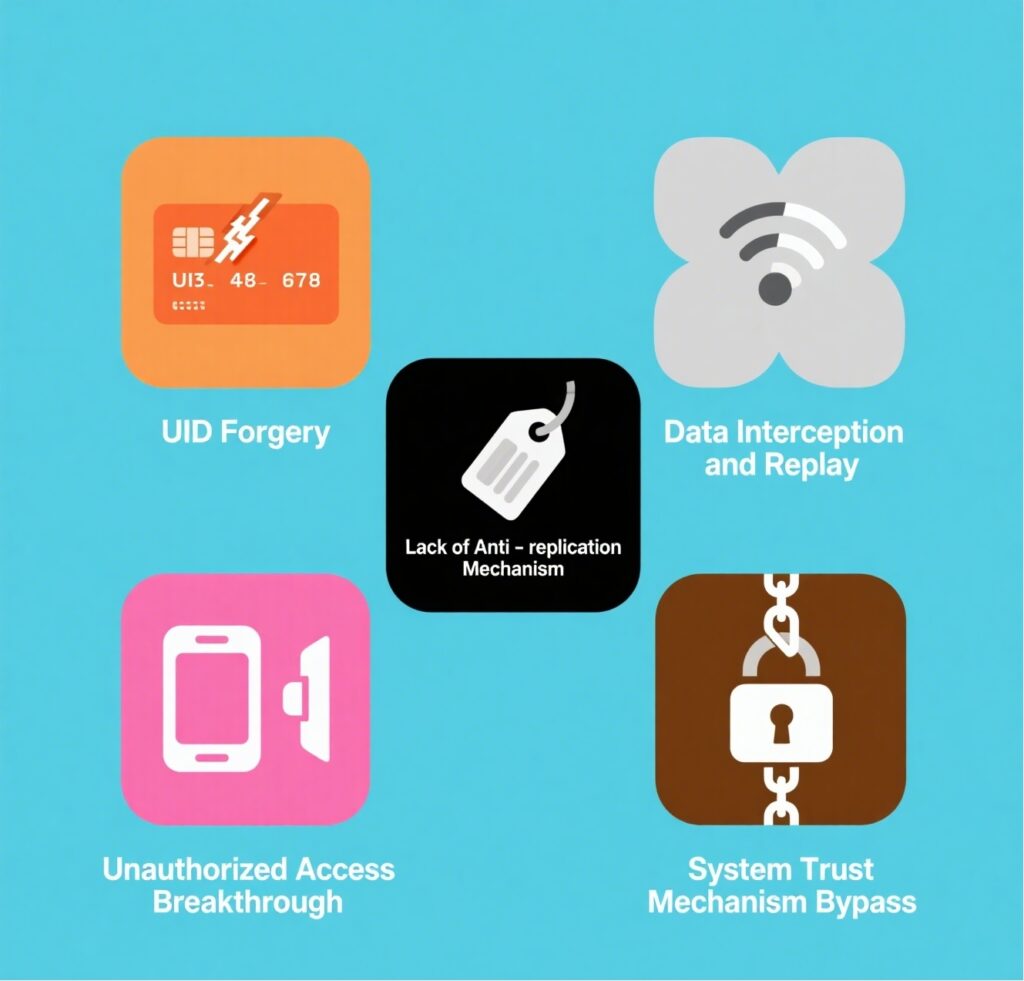
UID Spoofing
Attackers can forge specific UIDs to bypass authentication systems.
Data Interception & Replay
Hackers can intercept communication and replay responses from authorized cards.
Unauthorized Access
Emulators can simulate access cards to enter restricted areas.
Bypassing System Trust
Systems lacking secondary authentication are easily fooled by emulators.
Lack of Anti-Cloning Mechanisms
Tags without dynamic encryption or authentication protocols are easy to duplicate.
Real-World Attack Scenarios: How Emulation Threatens Physical Systems
▶ Case 1: Emulating an Employee Access Card An attacker used an Android phone with an NFC emulation app to clone a coworker’s access card UID. By doing so, they entered the company building at night without triggering access control alerts or logs.
▶ Case 2: Exploiting a Ticketing System Vulnerability In an NFC ticketing system without encryption or authentication, an attacker captured the communication between a legitimate ticket and the reader. They then emulated the ticket using a smartphone to gain unauthorized re-entry at a live event.
▶ Case 3: Industrial Control System Manipulation A factory used low-security RFID cards to operate critical machinery. An attacker used an Android RFID Emulator to replicate control commands, which led to unauthorized activation and disruption of automated systems.
How Can Enterprises Protect Themselves? Five Key Security Recommendations
Protection Strategy
Description
Use dynamic encrypted cards (e.g., MIFARE DESFire)
Prevent UID spoofing with dynamic challenge-response encryption.
Enable anti-emulation detection in readers
Restrict specific device types or detect abnormal antenna characteristics.
Implement two-factor authentication (2FA)
Combine card swiping with PIN codes, biometric checks, or facial recognition.
Deploy device whitelisting mechanisms
Only allow authorized cards or hardware to interact with the system.
Monitor unusual card activity and trigger alerts
Flag suspicious behavior like frequent UID changes or access attempts after hours.
Security Balance in Real-World Applications: Efficiency and Control Must Work Together
Using Android RFID Emulator can significantly speed up testing and development, especially during prototyping or access control system upgrades. However, once system moves into production, enterprises must take stricter control by:
Clearly separating emulated devices from authorized production hardware.
Restricting emulator usage by time, role, or network.
Building isolated testing environments to avoid cross-contamination with live systems.
Conclusion: Finding the Balance Between Flexibility and Security
Android RFID Emulator is powerful tool for modern RFID development and system validation, but it also opens potential attack vectors if misused. Enterprises and system integrators must understand its working principles and associated risks. By adopting multi-layer encryption, robust authentication, and access control strategies, they can maintain development agility while building a truly secure RFID infrastructure.
Explore the SSD-A07 UHF RFID antenna with 7 dBi gain, circular polarization, adjustable 840–960 MHz frequency, and 60°/75° beamwidth for stable RFID read/write performance.
SSD-A06 UHF RFID antenna with circular polarization, adjustable 840–960 MHz frequency, ≥4.5 dBi gain, and a compact directional design for RFID systems.
Learn how to select the best handheld RFID reader for warehouse inventory management. Compare UHF range, durability, software integration, and budget-friendly options.
Learn how to set up an RC522 RFID module with Raspberry Pi for DIY projects like access control, inventory tracking, and smart locks. Step-by-step instructions included.
A practical guide on how to read RFID with Android. Learn why your phone's NFC fails for most tags and the steps to connect an external UHF reader for real scanning apps.
Compare RFID laundry tags and barcode systems for textile management. Learn which solution works better for commercial laundries, hotels, hospitals, and uniform tracking operations.
 Cykeo RFID IoT Solution Products R&D Manufacturer