 Cykeo RFID IoT Solution Products R&D Manufacturer
How to Apply RFID Tag: Practical Placement and Application Guide
120RFID tags should be applied to clean, stable surfaces with validated orientation and placement. Metal, liquids, curvature, and nearby objects require testing...
MoreAll RFID Product
How to code rfid tags requires an RFID reader writer to communicate with the tag chip, send encoded data, verify the written information, and store identification details for tracking, inventory, and automation applications.
RFID tag coding is the process of writing digital information into an RFID chip through wireless communication.
Unlike printing a barcode, RFID coding does not modify the visible appearance of a product label. Instead, information is stored electronically inside the RFID tag memory.
In practical RFID deployments, the difference between a successful writing process and a failed one often comes down to hardware stability.
During RFID system testing, engineers usually discover that reading a tag is easier than writing one.
A reader only needs to receive a signal.
A writer must accurately transmit energy, communicate with the chip, complete the memory operation, and confirm the result.
This is why RFID encoding equipment requires precise RF control.
According to RAIN Alliance RFID Technology Overview, RAIN RFID systems use standardized UHF RFID technology based on EPC Gen2 specifications for identifying and managing physical items.
Cykeo RFID desktop writers are designed for applications requiring stable tag programming, including:
Before programming, users need:
The RFID tag must support the same protocol as the reader.
For UHF RFID applications, EPC Class 1 Gen 2 / ISO 18000-6C is commonly used.
Position control is important during RFID writing.
Unlike long-distance inventory reading, tag programming usually requires a controlled communication area.
Cykeo RFID desktop writers use near-field antenna technology to control the operation range:
| Operation | Controlled Range |
|---|---|
| RFID Reading | Within 30 cm |
| RFID Writing | Within 10 cm |
This design reduces accidental writing to nearby tags.
For issuing thousands of product tags, controlled writing distance improves operational reliability.
The RFID writer communicates with the chip and stores information.
Common writable data includes:
Different RFID tags have different memory structures.
Some tags only require EPC writing.
Others may require additional user memory configuration.
Professional RFID encoding systems should verify the writing result.
A typical workflow:
This prevents incorrect tag registration.
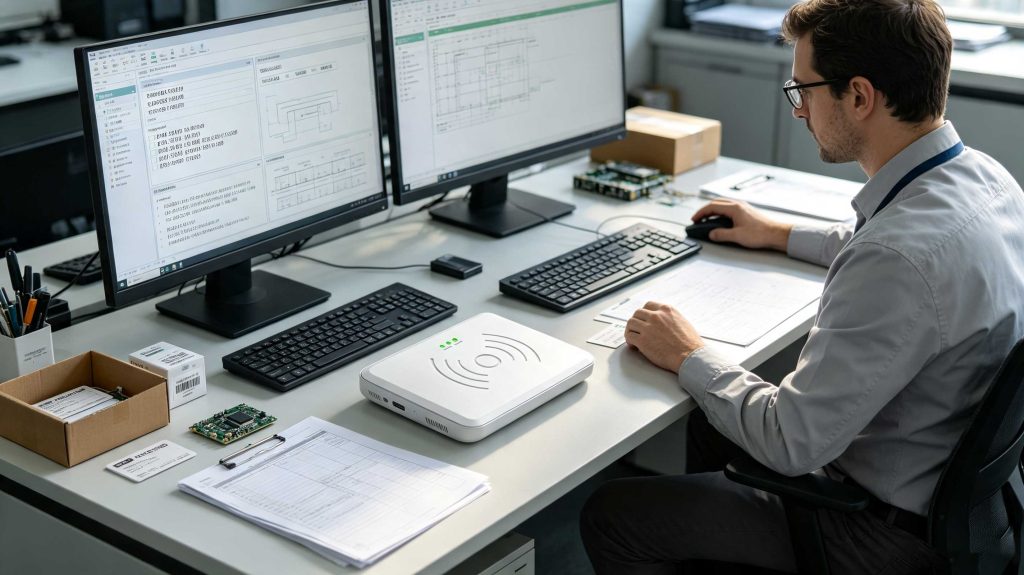
A desktop RFID writer is commonly used when companies need accurate and repeatable RFID programming.
Compared with handheld devices, desktop RFID writers provide:
Cykeo RFID desktop issuing equipment integrates:
Many RFID projects focus on reading distance.
However, RFID tag writing quality directly affects long-term system operation.
A failed write operation can create:
Cykeo desktop RFID writers provide stable writing performance through:
The device supports maximum output power up to 33 dBm.
This improves communication stability during RFID programming.
The near-field antenna design limits unnecessary tag activation.
Advantages:
Professional RFID issuing systems should support efficient batch operations.
Applications include:
Efficient RFID programming requires both hardware and software.
Cykeo provides:
For developers, the system supports:
This allows companies to create customized RFID applications.
Retailers encode RFID tags for:
The coded tag becomes the digital identity of each product.
RFID coding enables:
Libraries use RFID coding for:
Companies encode RFID tags for:
| Feature | RFID Coding | Barcode Printing |
|---|---|---|
| Data Storage | Electronic memory | Printed pattern |
| Contactless Writing | Yes | No |
| Multiple Item Processing | Yes | Usually one by one |
| Data Modification | Possible | Requires reprinting |
| Automation Level | High | Medium |
RFID provides greater flexibility because information can be digitally managed after the tag is created.
Consider:
Avoid:
A reliable process includes:
You need RFID tags, an RFID reader writer, coding software, and a computer system for managing tag data.
Many RFID tags support rewriting, depending on chip type and memory configuration.
Writing time depends on the RFID chip, data size, and equipment performance. Professional RFID writers support fast batch operations.
Yes. RFID desktop writers can support batch tag programming for large-scale applications.
Common causes include poor tag placement, interference, incompatible protocols, or insufficient RF communication quality.
RFID manufacturers often provide demo software and development tools. Cykeo provides RFID writing demos and C#/Java development support.
RFID coding is widely used in retail, logistics, healthcare, manufacturing, libraries, and asset management.
The quality of RFID tag coding depends heavily on the stability of the RFID reader writer.
For many applications, reading a tag is only the first step. The real challenge is writing information accurately and repeatedly.
Cykeo RFID desktop writer integrates the high-performance Impinj R500 RFID reader chip, providing strong RF processing capability for UHF RFID tag programming.
Technical advantages include:
| Technical Feature | Practical Benefit |
|---|---|
| Impinj R500 RFID chipset | Stable tag communication and writing performance |
| Maximum output power up to 33 dBm | Strong RF transmission capability |
| Near-field antenna design | Controlled writing area |
| Mini USB communication | Easy desktop deployment |
| C# and Java development resources | Faster software integration |
| Batch writing support | Improved issuing efficiency |
In actual RFID issuing environments, writing reliability matters more than simply increasing communication distance.
For example, a retail company preparing thousands of RFID product labels does not need a reader that activates tags several meters away.
It needs a controlled workstation where one operator can write the correct tag every time.
That is the design philosophy behind Cykeo RFID desktop writing solutions.
A professional RFID coding system consists of several connected components.
The complete workflow includes:
Data Preparation → RFID Software → Desktop RFID Writer → RFID Tag → Verification System
Before writing RFID tags, product or asset information needs to be prepared.
Typical data includes:
This information can come from:
The RFID writer performs wireless communication with the RFID chip.
Main operations include:
A stable RFID writer reduces repeated operations and improves production efficiency.
Professional RFID coding requires verification.
A complete verification process checks:
This step is especially important for:
Understanding RFID memory helps users understand how to code RFID tags correctly.
Most UHF RFID tags based on EPC Gen2 standards contain several memory areas.
| Memory Area | Function |
|---|---|
| Reserved Memory | Stores access and kill passwords |
| EPC Memory | Stores electronic product identification |
| TID Memory | Stores unique chip identification |
| User Memory | Stores additional application data |
EPC memory is the most commonly used area.
Businesses typically store:
For retail applications, EPC data becomes the digital identity of each product.
TID memory contains manufacturer-related chip information.
It is usually factory-programmed and provides unique chip identification.
Some RFID tags provide additional writable memory.
Possible applications:
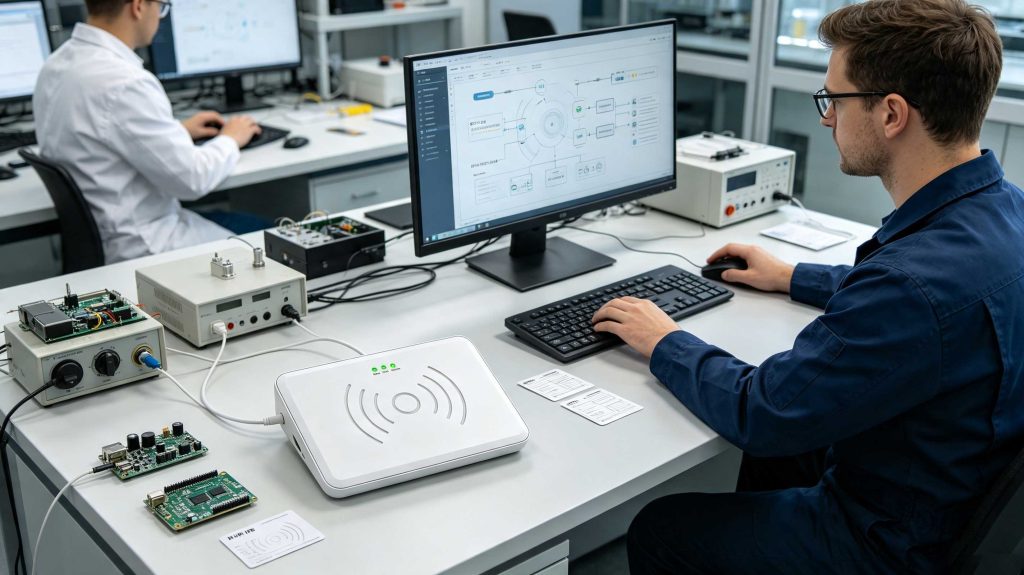
Retail companies often need to encode thousands of product tags before products enter stores.
Typical workflow:
Benefits:
Warehouses use RFID coding for:
Before products enter storage, RFID tags can be programmed with unique identification information.
Hospitals require accurate management of:
RFID coding helps create reliable digital records.
Industrial companies use RFID tags for:
The RFID tag becomes the long-term identity of the asset.
| Device Type | Best Application | Advantage |
|---|---|---|
| Desktop RFID Writer | Tag issuing and coding | Controlled writing environment |
| Handheld RFID Reader | Mobile inventory | Portable operation |
| Fixed RFID Reader | Gate and automation | Continuous monitoring |
| RFID Module | OEM integration | Custom product development |
Before deployment, determine:
Consider:
Cykeo provides demo software supporting:
RFID coding systems can connect with:
Example workflow:
ERP Data → RFID Software → Cykeo Writer → RFID Tag → Inventory System
You need compatible RFID tags, an RFID reader writer, coding software, and a data source containing information to be stored.
Yes. Professional RFID desktop writers support batch programming for large quantities of tags.
Near-field antennas provide better control over the writing area and reduce accidental programming of nearby tags.
Reading only retrieves stored information, while writing requires stable communication to modify RFID memory.
Yes. Cykeo provides C# and Java development resources for customized applications.
The device supports Mini USB communication for convenient desktop connection.
RFID coding is widely used in retail, logistics, healthcare, manufacturing, libraries, and industrial asset management.
Understanding how to code rfid tags means understanding the complete process behind digital identification.
A reliable RFID coding system requires more than writing information into a chip.
It requires:
Cykeo RFID desktop writers combine Impinj R500 performance, near-field antenna control, batch programming capability, and developer-friendly interfaces to support professional RFID issuing applications.
From retail products to industrial assets, RFID coding creates the foundation for smarter tracking and automated management.

RFID tags should be applied to clean, stable surfaces with validated orientation and placement. Metal, liquids, curvature, and nearby objects require testing...
More
High-memory RFID tags aren’t always necessary. Here’s a practical look at when they make sense—and when you’re just wasting money.
More
Wondering if you can use your smartphone as a scanner? We explain when a cell phone can read an RFID tag and the major limitations for business use.
More
Discover if your iPhone can emulate RFID tags and how Cykeo's Bluetooth RFID Reader enables seamless integration. Explore capabilities, limitations, and practical uses.
More