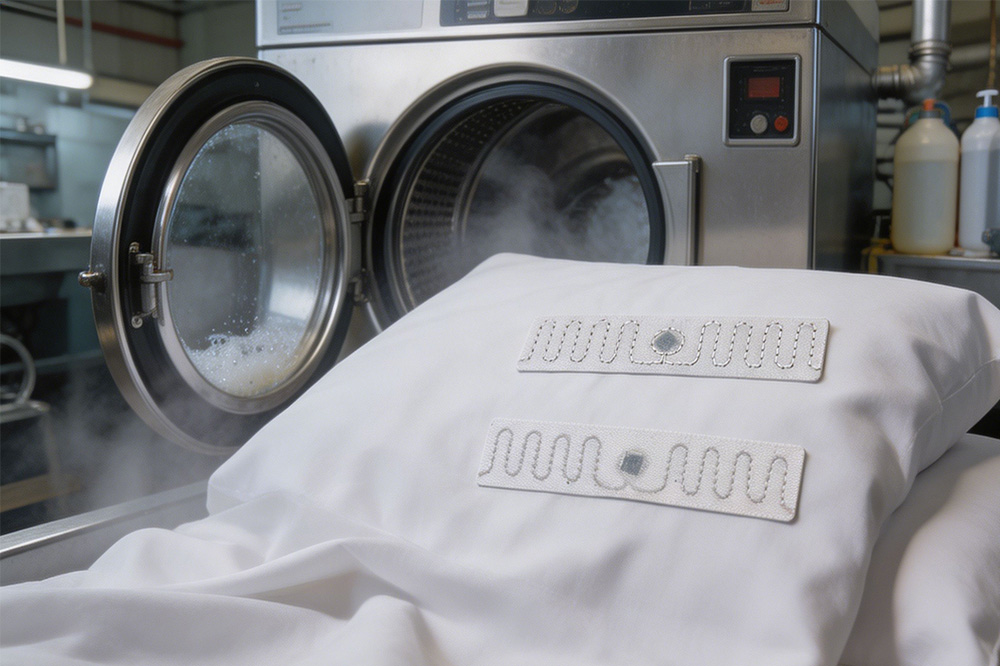
People outside the laundry industry are often surprised when they hear how harsh commercial washing environments actually are.
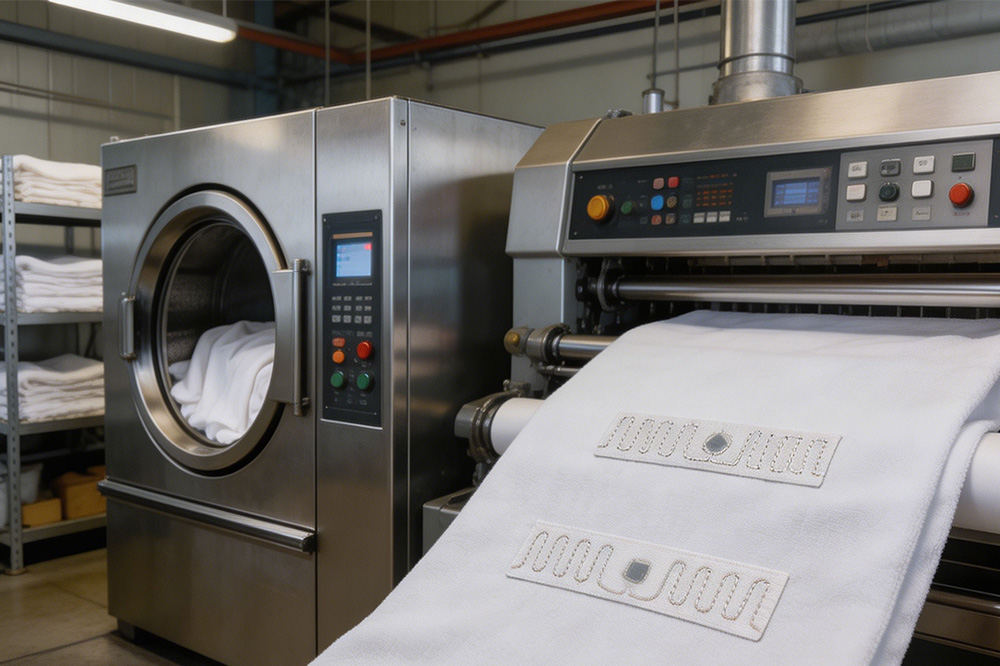
Industrial laundries are not the same as household washing machines. Textiles go through high-temperature washing, strong chemical detergents, pressing equipment, dehydration systems, and continuous tumble drying — sometimes hundreds of times during a product’s lifecycle.
For RFID solution providers, this creates one major challenge:
How do you keep a small electronic tag working reliably inside fabric after repeated industrial washing?
That question is exactly why industrial RFID laundry tags are built very differently from standard RFID labels used in retail or warehouse environments.
Normal RFID Labels Usually Fail Quickly
At first glance, many RFID tags look similar.
But tags designed for cartons, retail clothing, or warehouse pallets usually cannot survive commercial laundry conditions for very long.
The problems start appearing quickly:
Antennas crack from repeated bending
Adhesives weaken under heat
Moisture damages internal components
Chemical exposure affects sealing materials
High-pressure extraction deforms the tag structure
In some cases, standard RFID labels fail after only a small number of wash cycles.
That creates inaccurate tracking data and additional replacement costs.
For textile management systems, durability is not optional. If the tag fails, the tracking system fails with it.
Laundry RFID Tags Are Built for Extreme Conditions
Industrial RFID laundry tags are specifically designed to handle long-term textile washing environments.
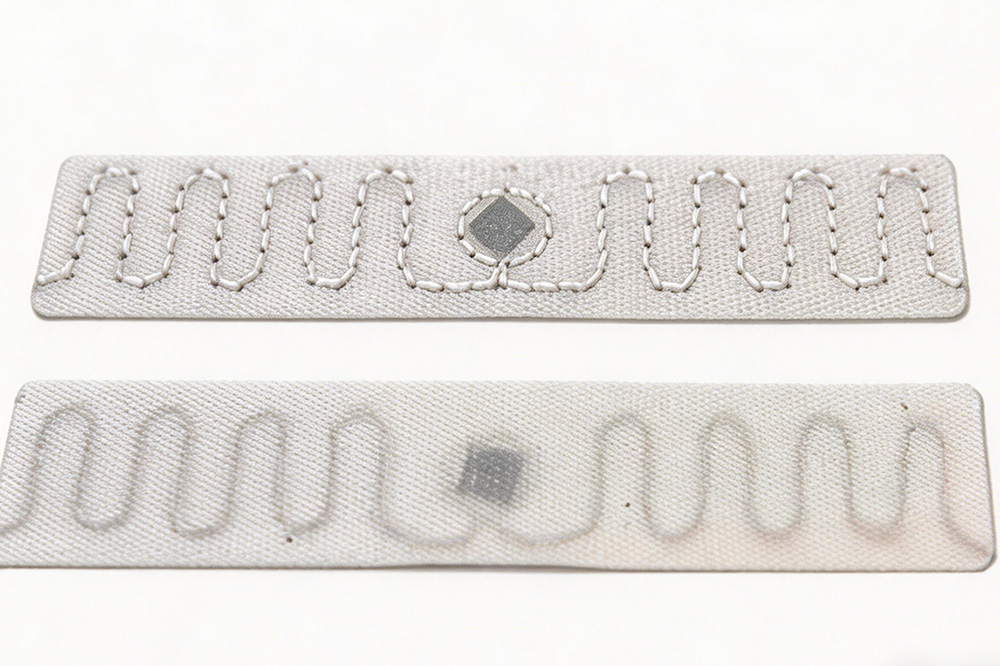
Instead of using ordinary label materials, manufacturers use specialized encapsulation structures that protect the RFID chip and antenna from moisture, heat, pressure, and chemicals.
Depending on the application, tags may use:
Heat-resistant textile materials
Flexible antenna designs
Waterproof encapsulation
High-strength stitching structures
Chemical-resistant protective layers
A properly designed industrial RFID laundry tag is typically made to survive repeated industrial washing, drying, ironing, and pressure extraction processes while maintaining stable reading performance.
That’s especially important for hotels, hospitals, and uniform rental companies where textiles remain in circulation for long periods.
High Temperature Is Only Part of the Problem
Many people assume heat is the biggest issue for laundry RFID tags.
Heat matters, but it’s really the combination of stress factors that creates the challenge.
A single textile item may experience:
Hot water washing
Alkaline detergents
Bleaching chemicals
Mechanical twisting
High-speed dehydration
Flatwork ironing pressure
Continuous folding and stretching
Over time, weak tag materials begin breaking down.
This is why industrial laundry RFID tags usually go through durability testing before large-scale deployment.
Commercial operators want to know whether the tags can maintain stable performance after hundreds of wash cycles — not just during initial installation.
Flexibility Matters More Than Most People Expect
Laundry tags are attached directly to flexible textiles.
That means the RFID tag itself also needs to tolerate constant movement.
Rigid tag structures often create problems because fabric naturally bends, folds, stretches, and compresses during washing and daily use.
Flexible RFID laundry tags tend to perform better because they move more naturally with the textile material itself.
This becomes especially important for:
Hotel bed sheets
Medical garments
Staff uniforms
Industrial workwear
Rental textiles
In many projects, overly rigid tags fail faster simply because the fabric motion creates stress on the internal antenna structure.
Hospitals and Hotels Need Long-Term Reliability
Healthcare and hospitality industries usually have strict textile replacement schedules.
Some items remain in circulation for years and complete hundreds of wash cycles during that time.
If RFID tags stop functioning halfway through the textile lifecycle, inventory tracking becomes inconsistent.
That’s why large operators typically focus on long-term stability instead of only looking at initial tag pricing.
A cheaper tag that fails early often costs more in the long run because replacing failed tags increases labor and operational disruption.
Reliable tracking matters much more once the system scales across thousands of textile items.
RFID Durability Directly Affects System Accuracy
In real laundry operations, tracking accuracy depends heavily on tag survival rates.
Even if the software and readers work perfectly, damaged RFID tags create missing data.
That can lead to:
Incorrect inventory counts
Lost textile visibility
Sorting mistakes
Delivery errors
Premature linen replacement
For RFID textile solution providers, choosing the right laundry tag is often one of the most important decisions in the entire system design.
Especially in commercial laundry environments, stable hardware usually determines whether the project succeeds long term.
The Industry Is Moving Toward Smarter Textile Tracking
As labor costs continue rising, more laundry operators are investing in automated textile tracking systems.
But automation only works when the RFID infrastructure remains reliable under real operating conditions.
That’s why industrial-grade RFID laundry tags have become a key part of modern textile management systems.
The focus is no longer simply “adding RFID.” The real goal is building a tracking system that can continue working reliably after years of washing, sorting, and daily industrial use.
Discover radio frequency identification rfid tags from Cykeo for asset tracking, inventory accuracy, and industrial automation. Improve visibility and efficiency with reliable RFID technology.
Discover the 5 critical tests to ensure your RFID readers survive harsh environments. Cykeo shares expert insights on durability, performance, and cost-effective rugged RFID technology.
CYKEO CK-B4L is a compact RFID Card Reader Android, designed for developers building Android systems and apps. RFID Reader for Android App Connect via Type-C to enable fast, stable RFID tag reading for anti-counterfeiting, inspection, picking, an...
 Cykeo RFID IoT Solution Products R&D Manufacturer