A card reader works by emitting radio frequency signals to power RFID tags and receive their data via backscatter communication, enabling fast, contactless identification and tracking within milliseconds.
That’s the clean answer. But in practice, especially when you’re standing in a warehouse at 6:30 AM watching pallets move past a gate antenna, the process feels less like theory and more like orchestration—signals, timing, interference, all happening invisibly.
RFID card reader principle in real environments
What actually happens during a read?
A card reader (especially UHF RFID) doesn’t “scan” like a barcode gun. It creates an RF field. When a tag enters that field:
The tag harvests energy from the reader signal
Its chip wakes up instantly (microseconds)
It reflects a modulated signal back (backscatter)
The reader decodes that signal into an ID
In controlled lab demos, this looks clean. In real deployments—metal racks, moving forklifts, overlapping signals—it becomes a timing game.
From field deployments, typical read cycles:
Stage
Time (approx.)
Signal emission
continuous
Tag activation
<1 ms
Data response
1–5 ms
Multi-tag anti-collision
dynamic
That’s how systems reach >400 reads per second, as seen in industrial readers.
UHF RFID reader performance and real data
Measured capabilities vs theoretical specs
From practical deployment with high-performance readers:
Read distance: up to 15 meters (open environment)
Write distance: up to 8 meters
Read rate: >400 tags/sec
Frequency coverage: 840–928 MHz global bands
These numbers align with industry references such as GS1 EPC Gen2 standards and deployment reports showing UHF RFID improving inventory accuracy from ~65% to over 95%.
But numbers alone don’t tell the full story.
In one warehouse test, moving cartons reduced effective read distance by nearly 30% due to orientation and material absorption. That’s why antenna placement matters more than raw power.
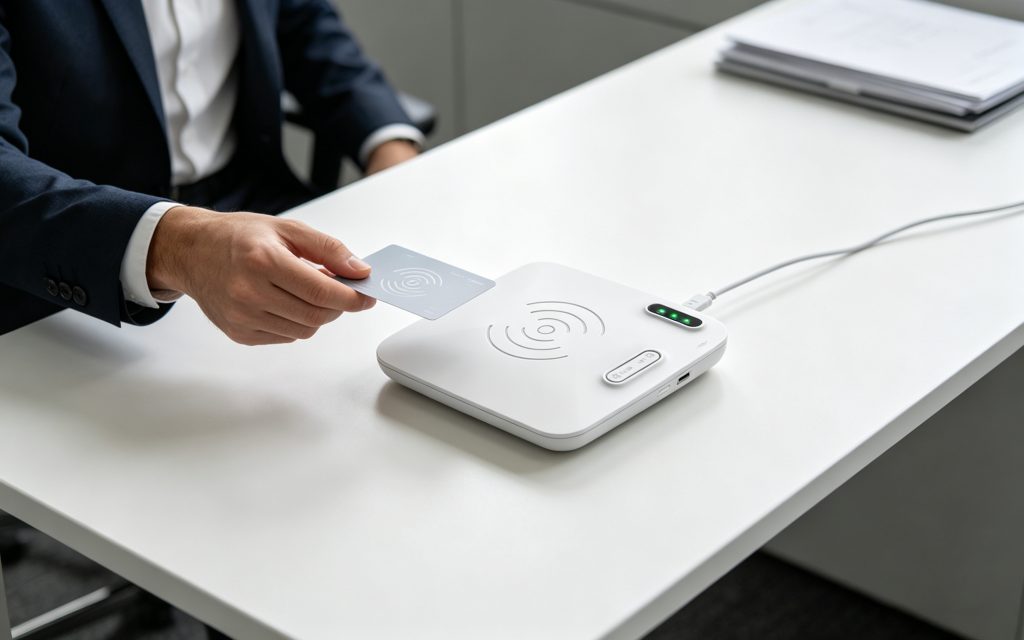
Unlike long-range gate readers, the CYKEO-D1L uses a near-field antenna. That changes everything.
Controlled read zone: within 30 cm
Write zone: within 10 cm
Output power: up to 33 dBm
Interface: Type-C for fast integration
This is not about distance—it’s about precision.
You don’t want accidental reads when issuing cards or encoding tags. The near-field design eliminates stray reads, something often overlooked in theory.
Controlled near-field RFID writing with CYKEO-D1L in a workstation
Signal control vs power: the overlooked factor
Why stronger isn’t always better
In many projects, teams initially increase power to fix read issues. It rarely works.
What actually improves performance:
Antenna polarization alignment
Tag orientation consistency
Reduced RF reflection (metal shielding)
Proper GPI/GPO trigger integration
Readers like Cykeo devices support GPI/GPO inputs/outputs, allowing integration with sensors (e.g., trigger reads only when objects pass a gate). This reduces noise and improves accuracy dramatically.
Typical RFID system structure
Core components
A complete system isn’t just the reader:
Component
Function
RFID Reader
Emits signal, processes data
Antenna
Shapes RF field
Tag
Stores and returns data
Middleware
Filters and processes reads
Backend system
Stores and analyzes data
In real deployments, middleware filtering can remove up to 80% redundant reads, improving system clarity.
Where card readers actually shine
Real-world applications
Based on deployments:
Asset entry/exit control
Warehouse inbound/outbound
Archive and document tracking
Jewelry inventory management
Personnel access monitoring
In a jewelry store pilot, RFID reduced manual counting time from 4 hours to under 20 minutes. That’s where the technology stops being “interesting” and becomes operationally necessary.
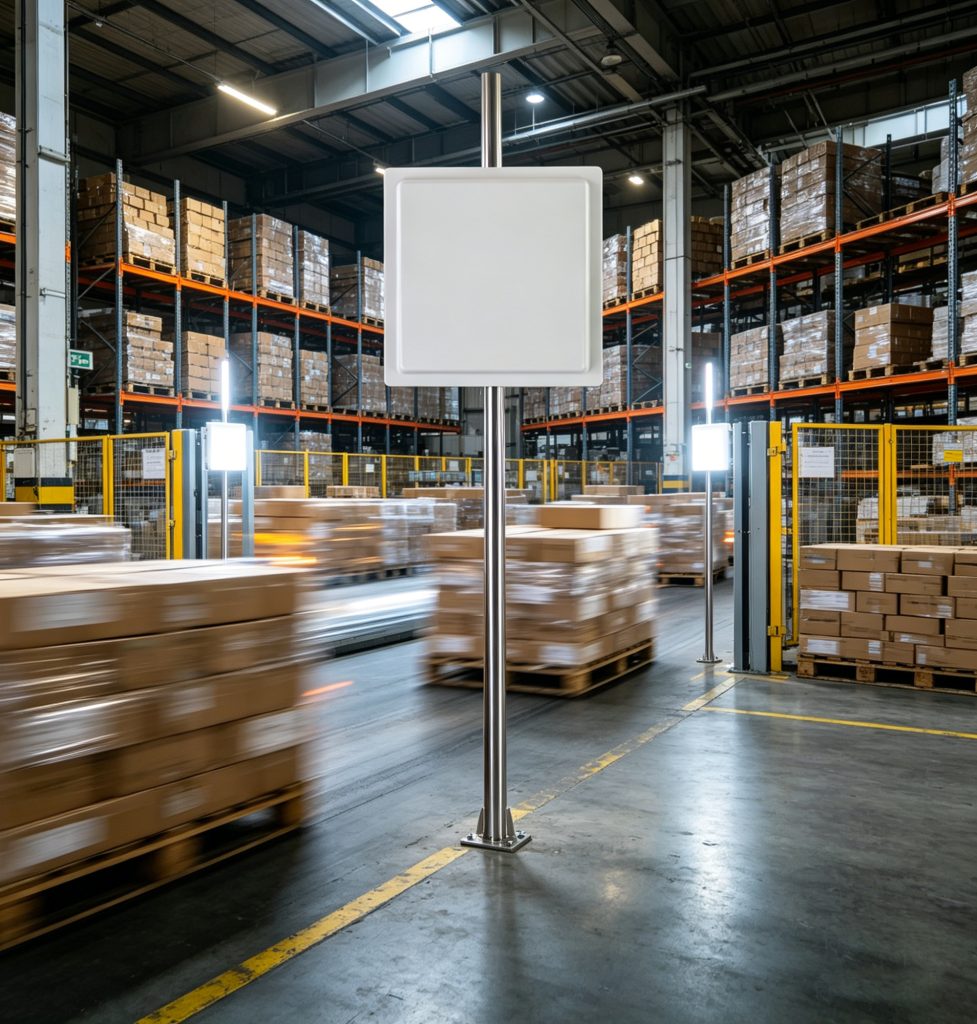
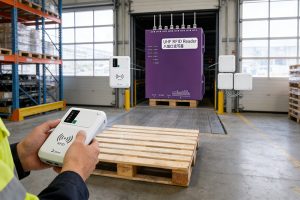
High-speed RFID reading in warehouse logistics using UHF system
Author experience & practical insight
Over the past years working with RFID deployments across warehousing and asset tracking, one pattern repeats:
Most failures are not hardware-related—they’re layout mistakes.
Reader installed too high
Antenna angle ignored
Tag placement inconsistent
Once corrected, systems often jump from 70% readability to 98%+ overnight.
That’s not marketing—it’s field reality.
FAQ
Do RFID card readers need line of sight?
No. RFID uses radio waves, so it can read through materials like plastic or cardboard, unlike barcode systems.
Can multiple cards be read at once?
Yes. Anti-collision algorithms allow hundreds of tags to be read per second simultaneously.
Why do some tags fail to read?
Common causes include metal interference, poor orientation, or incorrect frequency matching.
Is higher frequency always better?
Not necessarily. UHF offers longer range, but LF/HF can be more stable in certain environments.
Final thought on how a card reader works
Understanding how a card reader works is less about memorizing RF theory and more about seeing how signals behave in real environments—movement, materials, and timing all reshape the outcome.
That’s where systems like Cykeo readers stand out: not just strong specs, but predictable behavior when deployed correctly.
Need precise short-range reads? Discover how a meander line UHF RFID reader antenna for near-field applications solves dense environment tracking challenges.
Learn proven methods to achieve 30+ meter read ranges with UHF RFID readers. Discover Cykeo’s solutions for long-range tracking in logistics, mining, and large-scale facilities.
Discover how Cykeo tool tracker system improves industrial tool visibility, reduces loss, and enables real-time RFID tracking for smarter asset management.
Learn how an RFID inventory tracking system transforms warehouse operations. Discover components, benefits, real-world applications, and step-by-step implementation. Expert guidance from CYKEO engineers.
 Cykeo RFID IoT Solution Products R&D Manufacturer