An anti metal RFID tag is specifically engineered to maintain stable RF performance when attached directly to metal. By using an isolation layer between the antenna and the metal surface, it delivers reliable reading distance, higher identification accuracy, and long-term durability in demanding industrial environments.
In more than a decade of supporting RFID deployments across manufacturing plants, warehouses, energy facilities, and equipment maintenance centers, one lesson repeats itself: standard RFID labels fail surprisingly fast once metal enters the equation. Read ranges collapse. Tag sensitivity changes. Inventory accuracy drops. Anti-metal RFID tags were designed precisely to solve these problems—not as a marketing upgrade, but as an engineering necessity.
Why Does Metal Affect Ordinary RFID Tags?
Metal reflects and absorbs radio frequency energy. When a conventional RFID label is attached directly to steel or aluminum, its antenna becomes detuned, significantly reducing communication with the RFID reader.
An anti metal RFID tag incorporates a specially designed insulating structure—often foam, ferrite material, or engineered antenna geometry—to isolate the antenna from conductive surfaces.
The result is measurable.
According to GS1, RFID implementations commonly achieve inventory accuracy above 99%, compared with traditional manual inventory processes that frequently remain below 70–80%, depending on operating conditions.
Independent testing published by RAIN Alliance also explains why tags optimized for metallic environments dramatically improve RF performance compared with standard labels placed on conductive materials.
Where Is an Anti Metal RFID Tag Commonly Used?
From our project experience, anti-metal tags are rarely purchased for a single application. Most industrial customers gradually expand deployment after seeing measurable efficiency improvements.
Typical applications include:
Manufacturing equipment management
Tool tracking
IT asset management
Metal container identification
Warehouse pallet tracking
Medical equipment management
Oil & gas asset inspection
Power utility maintenance
Military logistics
Construction equipment management
One automotive supplier we supported initially tagged fewer than 800 welding fixtures. Six months later, after maintenance teams reported dramatically faster equipment verification, the deployment expanded to more than 12,000 production assets.
That growth was driven by operational results—not by replacing existing infrastructure.
Key Technical Advantages of an Anti Metal RFID Tag
Unlike ordinary adhesive RFID labels, industrial anti-metal tags are often designed for service lives measured in years rather than months.
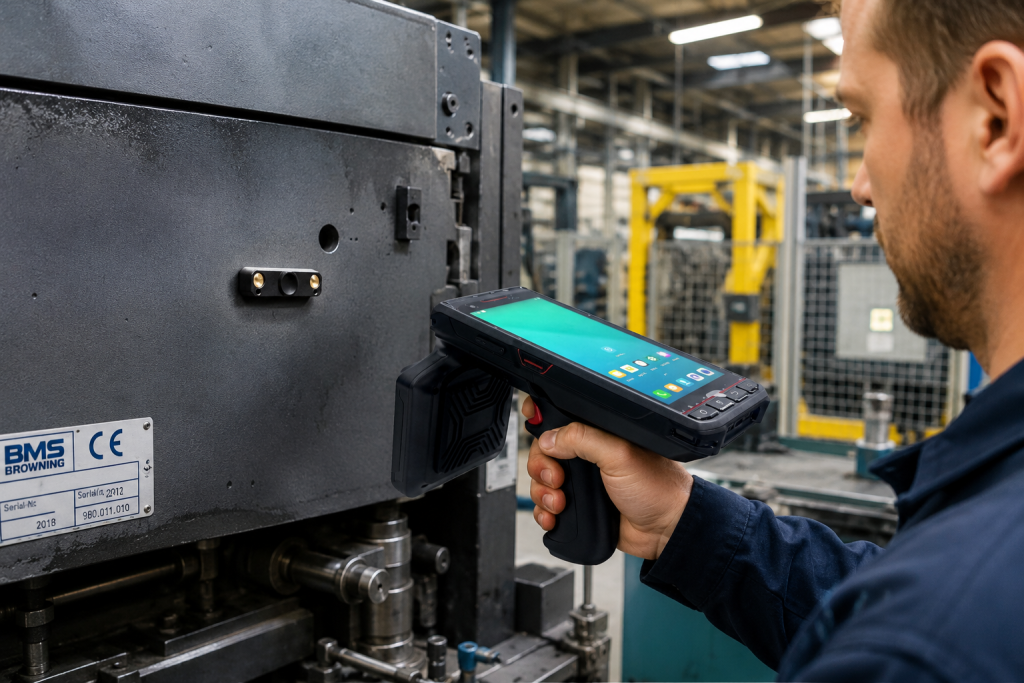
Cykeo anti metal RFID tag deployed on metal machinery inside a modern European factory.
How to Choose the Right Anti Metal RFID Tag
Selecting the correct tag requires more than comparing read distance specifications.
Experienced RFID engineers usually evaluate:
Metal Surface Type
Painted steel, stainless steel, aluminum, galvanized metal, and curved pipes all influence RF performance differently.
Reading Distance
Applications may require:
0.5–2 meters
3–5 meters
More than 10 meters with fixed readers
Matching the antenna polarization and reader power is equally important.
Installation Method
Options include:
Industrial adhesive
Rivets
Screws
Cable ties
Magnetic mounting
Permanent assets usually justify mechanical fixing for long-term reliability.
Environmental Conditions
Industrial environments often involve:
Oil
Dust
UV exposure
Outdoor weather
High humidity
Mechanical vibration
Choosing an IP67 or IP68 enclosure significantly improves operational life.
Field Experience from Cykeo Engineers
During one warehouse modernization project, forklift operators initially questioned whether RFID could reliably identify hundreds of metal cages stored only centimeters apart.
After several days of antenna tuning and tag positioning, read consistency improved dramatically.
The lesson was practical rather than theoretical.
The quality of the anti metal RFID tag mattered, but installation angle, reader configuration, and environmental testing mattered just as much. Successful RFID projects are rarely the result of a single hardware component—they come from system optimization.
At Cykeo, our engineering team routinely performs on-site RF testing before recommending tag models because laboratory specifications rarely capture every real production variable.
Routine maintenance inspection using Cykeo anti metal RFID tags.
FAQ About Anti Metal RFID Tag
Can an anti metal RFID tag be attached directly to steel?
Yes. It is specifically designed for direct installation on conductive metal surfaces without significant performance degradation.
Is an anti metal RFID tag waterproof?
Many industrial models are rated IP67 or IP68, making them suitable for outdoor environments, factories, and harsh industrial conditions.
What frequency is commonly used?
Most industrial solutions operate in the global UHF EPC Gen2 / ISO 18000-63 standard, enabling compatibility with mainstream RFID readers.
How long does an anti metal RFID tag last?
Industrial-grade tags commonly provide service lives exceeding 5–10 years depending on operating conditions, installation method, and environmental exposure.
Final Thoughts
Choosing the correct anti metal RFID tag is less about finding the longest advertised read range and more about ensuring stable performance throughout the asset’s lifecycle. When engineered correctly and deployed with proper RF testing, anti-metal RFID solutions deliver measurable improvements in inventory accuracy, maintenance efficiency, and industrial asset visibility. At Cykeo, our experience across manufacturing, logistics, utilities, and equipment management continues to show that carefully selected anti-metal RFID technology produces reliable long-term results where conventional RFID labels simply cannot.
Discover the maximum read range for industrial UHF RFID tags with handheld scanners. Learn how tag type, environment, and antenna design impact performance.
in-depth look at RFID bank card readers, from commercial applications to the controversy around RFID-blocking wallets. Drawing from real-world cases and industry experience, this article unpacks the tension between payment convenience and security...
RFID tag antennas play a vital role in read performance. This article explores how to choose the appropriate antenna structure and frequency for typical applications like warehouse logistics, medical tracking, and metallic environments—helping bus...
 Cykeo RFID IoT Solution Products R&D Manufacturer