 Cykeo RFID IoT Solution Products R&D Manufacturer
reader/writer High-Performance UHF RFID System for Industrial Automation
66reader/writer RFID UHF system enables fast bulk reading, secure writing, and automation for logistics, access control, and asset tracking with Cykeo performance.
MoreAll RFID Product
Yes. RFID in logistics and supply chain operations significantly improves inventory visibility, shipment verification, and warehouse productivity. Modern RFID systems can identify hundreds of tagged items within seconds while reducing manual counting errors and labor costs across the entire supply chain.
That answer sounds simple. The reality inside warehouses is more interesting.
Last year, while evaluating RFID verification systems for a distribution project, I watched operators spend nearly eight minutes checking a single outbound carton containing mixed apparel SKUs. After installing an RFID tunnel-based verification process, the same task was completed in seconds, with every tagged item automatically validated against shipping data before the carton left the dock.
That difference explains why RFID continues to expand throughout modern logistics networks.
Supply chains lose money whenever inventory visibility disappears.
A misplaced carton, incorrect shipment, or inventory discrepancy often triggers a chain reaction:
According to the National Retail Federation (NRF), inventory distortion caused by shrinkage, stock inaccuracies, and process failures costs retailers billions annually.
RFID addresses this problem by creating a real-time identification layer across products, cartons, pallets, and assets.
Instead of manually scanning items one by one, RFID allows multiple tagged products to be identified simultaneously.
| Benefit | Operational Impact |
|---|---|
| Real-time visibility | Faster inventory updates |
| Automated verification | Reduced shipping errors |
| Bulk reading capability | Higher throughput |
| Improved traceability | Better compliance |
| Labor reduction | Lower operating costs |
Inbound goods can be verified automatically as they arrive.
Rather than opening cartons and checking every SKU manually, RFID readers compare incoming products against expected shipment records.
Warehouse teams immediately identify:
The receiving dock becomes a validation point rather than a bottleneck.
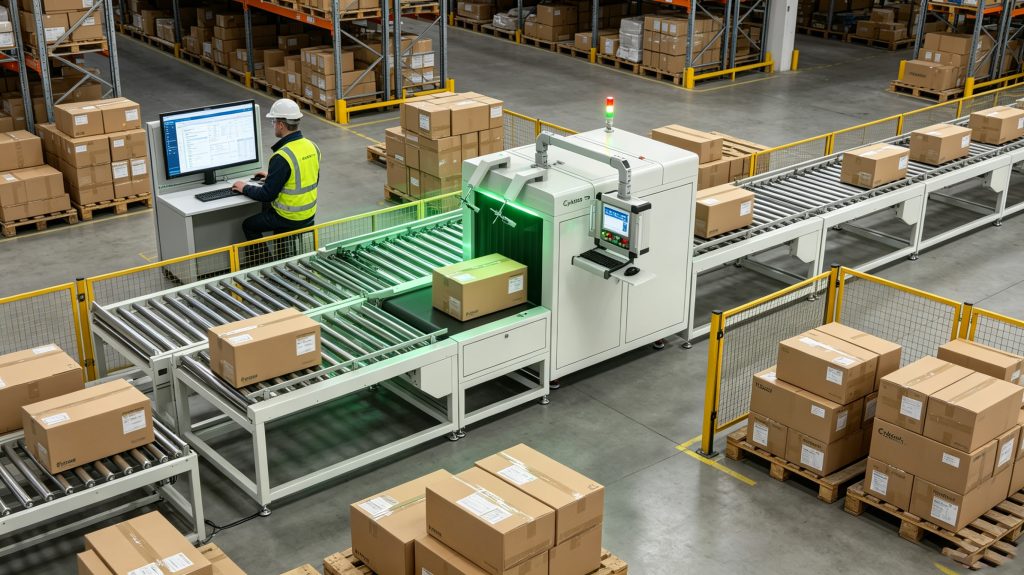
One challenge in logistics is balancing speed with accuracy.
Traditional counting methods force managers to choose one or the other.
RFID changes that equation.
The CYKEO-TP2A RFID Tunnel Inventory Channel Machine combines:
into a single verification platform.
| Function | Performance |
|---|---|
| RFID Reading Speed | 400+ tagged items |
| Verification Time | Under 3 seconds |
| Weight Range | 1g–50kg |
| Sorting Capability | Automatic exception handling |
| Inventory Efficiency | More than 100× improvement |
In practical deployments, inventory checks that previously required 5–10 minutes can often be completed in approximately 3–5 seconds.
Visibility is often discussed in presentations.
What matters is what happens on the warehouse floor.
The most effective RFID deployments create automated checkpoints throughout the movement process:
Every movement generates a digital event.
Managers no longer wait until the end of the shift to discover inventory discrepancies.
They see exceptions immediately.
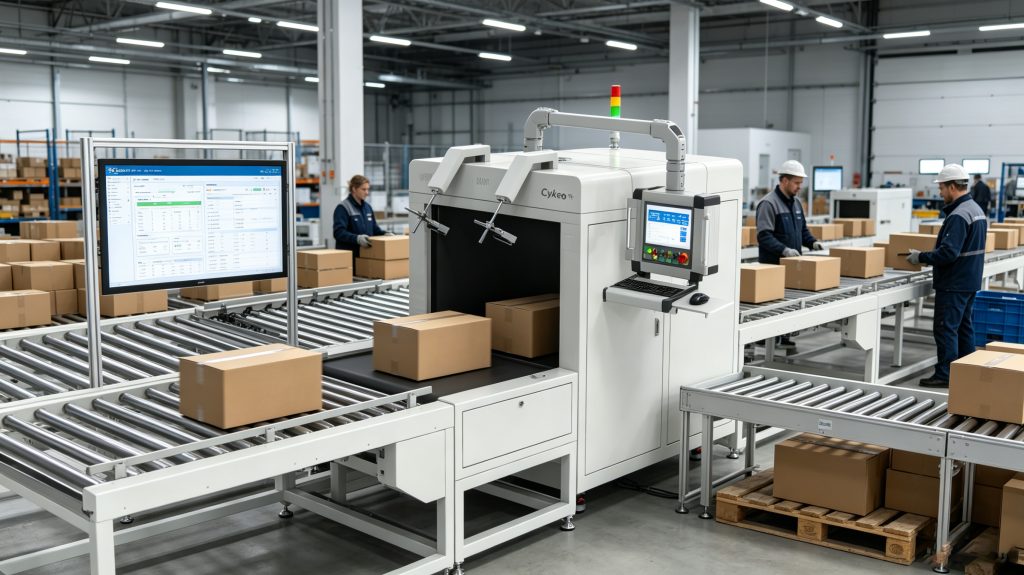
Standard RFID portals work well when products pass through controlled pathways.
Tunnel systems add another layer.
The CYKEO-TP2A uses:
to minimize missed reads.
This is especially important for industries handling dense packaging environments, including:
The system automatically generates verification lists in real time and alerts operators when data mismatches occur.
That immediate feedback prevents costly downstream errors.
RFID automatically records product movements throughout receiving, storage, picking, packing, and shipping processes, creating real-time visibility across operations.
Not entirely. Many advanced logistics systems combine RFID and barcode technologies to achieve higher verification accuracy and operational flexibility.
Modern UHF RFID systems can identify hundreds of tagged items at once. The Cykeo TP2A can verify more than 400 tagged products within approximately three seconds.
Yes. RFID dramatically reduces counting time while improving inventory accuracy and traceability.
Apparel, retail, luxury goods, healthcare, electrical equipment, logistics providers, and manufacturing companies typically achieve the highest ROI.
RFID in logistics and supply chain operations is no longer a future technology. It is a proven method for improving inventory accuracy, shipment verification, warehouse productivity, and operational visibility. When combined with advanced solutions such as the Cykeo TP2A RFID Tunnel Inventory Channel Machine, businesses can move from manual verification to intelligent, automated logistics workflows while dramatically increasing throughput and reducing costly errors.
reader/writer RFID UHF system enables fast bulk reading, secure writing, and automation for logistics, access control, and asset tracking with Cykeo performance.
More
Discover how to deploy RFID readers effectively for retail loss prevention. Learn about strategic placement, integration with EAS, and real-time inventory tracking.
More
Learning how to use handheld RFID reader writer? Step-by-step for inventory counting and tag programming. Power on, connect to Android, read EPCs, write user memory. Real field advice from CYKEO engineers.
More
Thinking of using an iPhone for RFID projects? We cut through the hype to show what "read and write" really means for iPhone NFC, and when you need pro gear.
More