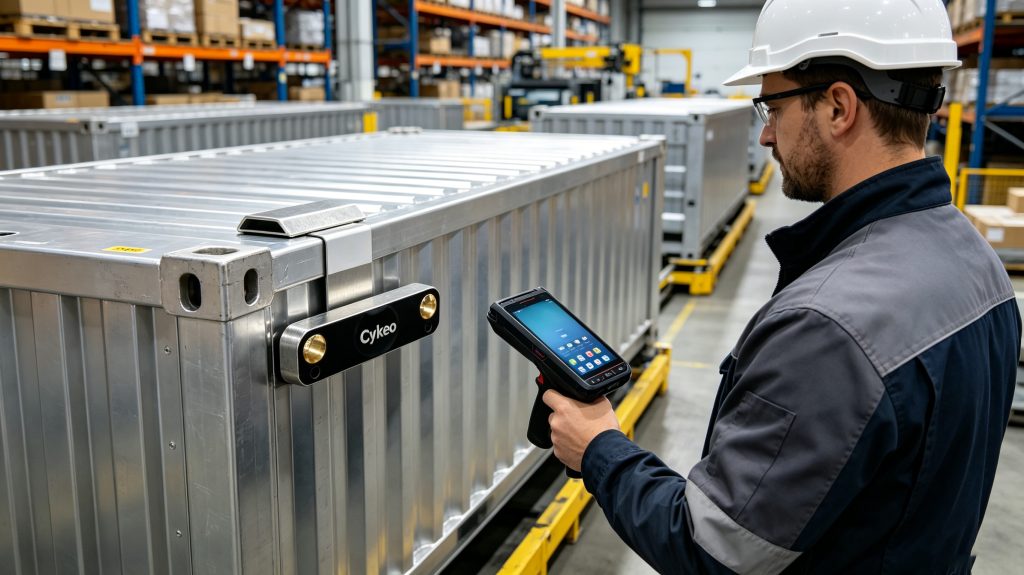
RFID metal tag is a specially designed RFID tag engineered to operate directly on metal surfaces without signal interference. It enables accurate asset identification, inventory management, maintenance tracking, and lifecycle monitoring in industrial, logistics, manufacturing, and energy environments.
Unlike standard RFID labels, which often fail when attached to metal, RFID metal tags incorporate shielding materials and antenna designs that maintain reliable read performance even when mounted on steel equipment, containers, machinery, and tools.
About the Author
This article was reviewed by the Cykeo RFID engineering team. Over the past decade, our specialists have deployed RFID asset tracking systems across manufacturing plants, utility companies, logistics hubs, automotive facilities, and heavy industrial environments. Our projects include RFID metal tag implementations for production assets, returnable transport items, maintenance equipment, and warehouse inventory management.
Why Standard RFID Tags Struggle on Metal
The first time I tested a conventional UHF RFID label on a stainless-steel machine frame, the result was predictable.
Read distance collapsed.
A tag capable of several meters in open air became almost unreadable once attached directly to metal.
The reason is simple. Metal reflects and absorbs radio frequency energy, detuning traditional RFID antennas and reducing signal efficiency.
That challenge led to the development of RFID metal tag technology.
Modern RFID metal tags use engineered antenna structures, insulating layers, and specialized substrates to maintain performance in environments where ordinary RFID labels fail.
How RFID Metal Tag Technology Works
An RFID metal tag combines:
RFID chip
Specialized antenna
Anti-metal shielding layer
Industrial-grade housing
The shielding layer creates a controlled separation between the antenna and the metal surface, allowing radio waves to function correctly.
Typical RFID Metal Tag Frequencies
RFID Type
Frequency
Typical Applications
LF RFID
125-134.2 kHz
Livestock, harsh environments
HF RFID
13.56 MHz
Tools, work-in-progress tracking
UHF RFID
860-960 MHz
Asset tracking, logistics, inventory
According to GS1 EPCglobal standards, UHF RFID remains the most widely adopted RFID technology for enterprise asset visibility and supply chain applications.
RFID metal tags provide reliable identification directly on metal assets.
Where RFID Metal Tags Deliver the Most Value
Manufacturing Facilities
Factories often manage thousands of tools, molds, fixtures, and production assets.
Manual audits consume labor and create data inaccuracies.
In one deployment, a maintenance team reduced equipment search time from several minutes to a few seconds simply by integrating RFID checkpoints throughout the facility.
Logistics and Returnable Transport Assets
Metal containers, roll cages, pallets, and shipping racks move continuously between facilities.
Without visibility, losses accumulate quietly.
RFID metal tags help organizations track:
Container movements
Loading operations
Yard management
Returnable asset utilization
According to research published by the U.S. Department of Energy, asset visibility improvements can significantly reduce unnecessary equipment purchases and improve utilization rates across industrial operations.
Industrial-grade RFID metal tags are commonly rated IP67 or IP68 and designed for long-term exposure.
These deployments often track:
Valves
Transformers
Utility equipment
Inspection assets
RFID metal tags automate inventory visibility across logistics operations.
Key Benefits of RFID Metal Tags
Operational Benefits
Faster inventory audits
Reduced manual labor
Real-time asset visibility
Improved asset utilization
Financial Benefits
Reduced equipment loss
Lower replacement costs
Better asset lifecycle management
Improved return on capital assets
Compliance Benefits
Maintenance documentation
Inspection traceability
Audit support
Regulatory reporting
RFID Metal Tag vs Standard RFID Label
Feature
RFID Metal Tag
Standard RFID Label
Works On Metal
Yes
Limited
Industrial Durability
High
Low
Outdoor Use
Yes
Limited
Read Stability
Excellent
Variable
Lifespan
Long-Term
Short-Term
For industrial asset management, the performance difference is substantial.
Original Insight from Real Deployments
One misconception I often hear is that RFID projects fail because of reader performance.
In reality, most failures begin with tag selection.
A poorly selected tag on metal can reduce read accuracy dramatically, regardless of how advanced the reader infrastructure may be.
The most successful projects usually spend more time evaluating tag placement, mounting methods, and environmental conditions than selecting readers.
That attention to detail often determines whether a deployment achieves 90% visibility or 99%+ visibility.
Frequently Asked Questions
What is an RFID metal tag?
An RFID metal tag is an RFID transponder specifically engineered to operate reliably on metal surfaces without signal degradation.
Can RFID metal tags be used outdoors?
Yes. Many industrial RFID metal tags are designed for harsh outdoor environments and include waterproof, dustproof, and impact-resistant protection.
What industries use RFID metal tags?
Manufacturing, logistics, energy, utilities, construction, aerospace, automotive, and defense sectors commonly use RFID metal tags.
How far can RFID metal tags be read?
Read distance depends on tag design, reader power, and environment. UHF RFID metal tags can often achieve several meters of read range under optimized conditions.
Are RFID metal tags reusable?
Yes. Most industrial RFID metal tags are designed for long-term reusable asset tracking applications.
Final Thoughts
RFID metal tag technology solves one of the biggest challenges in RFID deployment—reliable identification on metal surfaces. By combining specialized antenna engineering with rugged industrial construction, RFID metal tags deliver dependable performance where standard RFID labels fail.
For manufacturers, logistics operators, utility providers, and industrial enterprises, RFID metal tag solutions provide the visibility needed to reduce losses, improve maintenance processes, and create more efficient asset management systems.
As industrial digitalization accelerates, RFID metal tag deployments will continue to play a central role in intelligent asset tracking and operational excellence. RFID metal tag technology remains one of the most practical investments organizations can make when managing high-value metal assets.
RFID tags for garments must be washable, soft, and tamper-resistant. This article outlines common RFID label types—fabric, hang tag, embedded, and sew-in—and helps businesses select the right solution for different textile applications.
What is an RFID antenna? This hands-on guide explains the physics, types (HF vs UHF, loop, patch, dipole), key specs (gain, polarization, VSWR), and real commissioning tips I learned in Ningbo, Yiwu and Chicago — the stuff textbooks skip.
A real-world look at UHF RFID reader deployment issues in warehouses and industrial sites. Covers installation mistakes, integration gaps, and what wholesale buyers often miss before scaling RFID projects.
 Cykeo RFID IoT Solution Products R&D Manufacturer