 Cykeo RFID IoT Solution Products R&D Manufacturer
What is Antenna in RFID? (It’s Not What You Think)
476Stop getting lost in theory. Learn what is antenna in RFID systems practically, why its placement matters more than specs, and how it impacts your project's success.
MoreAll RFID Product
What is RFID? RFID is a wireless identification technology that uses radio waves to transfer data between RFID tags and readers, allowing businesses to automatically identify, track, and manage physical items without manual scanning.
At Cykeo, our RFID engineering team has worked with RFID identification systems across manufacturing facilities, logistics warehouses, libraries, medical environments, and industrial asset management projects. When customers first ask “what is RFID,” they often expect a simple replacement for barcodes. In reality, RFID is an entire identification ecosystem involving tags, readers, antennas, software, and data management processes.
The difference becomes obvious in real workplaces. A warehouse employee managing thousands of products does not need another scanning device; they need accurate information about what arrived, what moved, and what left. RFID creates that visibility automatically.
According to GS1, RFID is an automatic identification and data capture technology that enables objects to be uniquely identified and tracked through electronic communication. Today, RFID is widely used in retail, logistics, healthcare, manufacturing, transportation, and industrial automation.
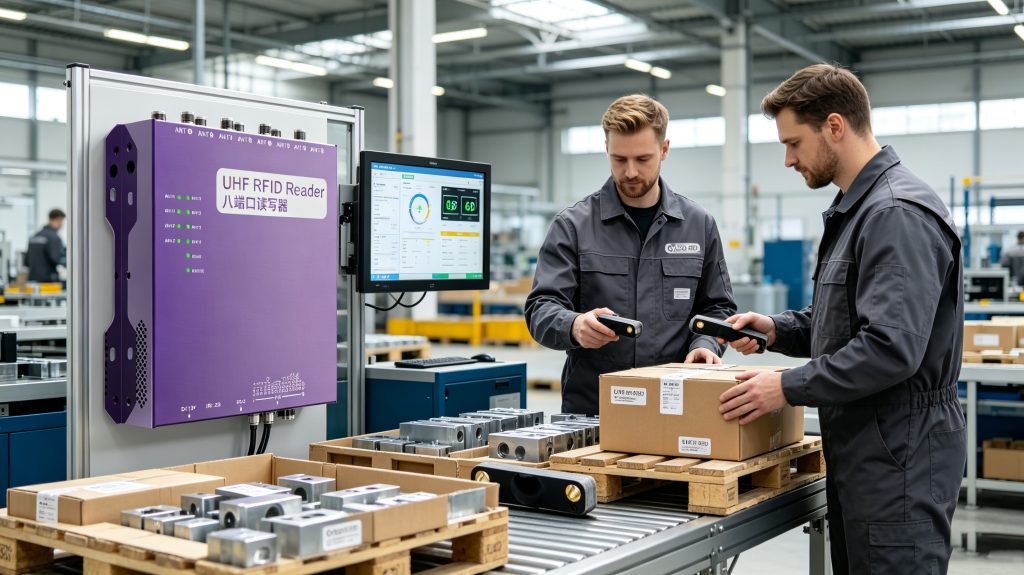
RFID stands for Radio Frequency Identification. It uses electromagnetic fields to automatically identify objects through small electronic tags.
A basic RFID system contains three primary components:
| Component | Function |
|---|---|
| RFID Tag | Stores identification information attached to an item |
| RFID Reader | Sends signals and receives tag data |
| Software Platform | Processes information and creates records |
The process works in a simple sequence:
Unlike traditional barcode systems, RFID does not require direct visual contact. Multiple items can often be identified at the same time.
For example, a clothing warehouse receiving hundreds of garments can use RFID readers to capture product information automatically instead of scanning every barcode individually.
RFID technology is generally divided into three frequency categories:
| RFID Type | Frequency | Typical Applications |
|---|---|---|
| LF RFID | 125–134 kHz | Animal identification, access systems |
| HF RFID | 13.56 MHz | Smart cards, libraries, NFC |
| UHF RFID | 860–960 MHz | Logistics, inventory, asset tracking |
Each frequency has different characteristics.
UHF RFID is widely used in industrial environments because it supports longer reading distances and faster multi-tag identification.
Cykeo commonly develops UHF RFID solutions for applications requiring:
Businesses adopt RFID because it solves several common operational problems.
Manual inventory counting can be slow and affected by human errors.
RFID allows companies to:
Research from Auburn University RFID Lab has demonstrated RFID’s ability to improve inventory visibility and operational efficiency, particularly in retail and supply chain environments.
In industrial facilities, finding equipment can consume valuable working hours.
RFID helps organizations monitor:
Instead of asking “where is this item?” employees can check digital records showing the latest identification event.
RFID does not eliminate employees. It removes repetitive identification tasks.
A warehouse worker can focus on moving products while the RFID system handles automatic data collection.
| Feature | RFID | Barcode |
|---|---|---|
| Reading Method | Radio waves | Optical scanning |
| Line of Sight Required | No | Yes |
| Multiple Item Reading | Yes | Usually one at a time |
| Data Capacity | Higher | Limited |
| Automation Level | High | Medium |
Barcodes remain useful for many applications, but RFID provides stronger automation when organizations manage large numbers of items.
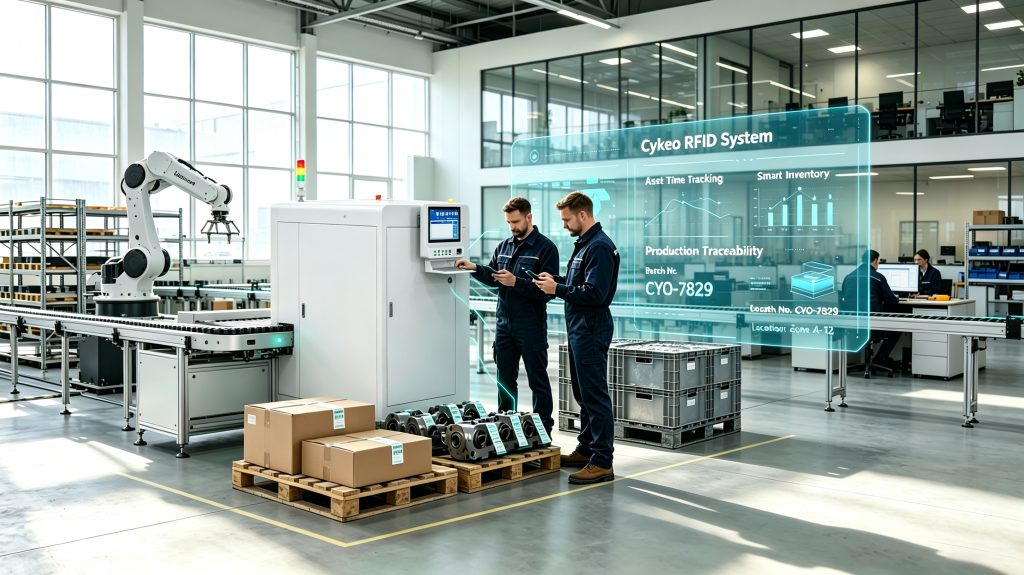
Retail companies use RFID for:
RFID improves:
Hospitals use RFID for:
After years of RFID implementation, one lesson is clear: RFID performance depends on the entire system, not only the tag.
During project testing, our engineers evaluate:
A metal container, a cardboard package, and a medical device may require completely different RFID solutions.
The best RFID system is not the one with the highest specification. It is the one that performs reliably in the customer’s actual workflow.
Many RFID tags are passive and do not require batteries. They receive energy from the RFID reader signal.
RFID can provide location information when tags are detected by readers installed in specific areas. It is different from GPS tracking.
RFID provides stronger automation for large-scale identification because it can read multiple items without direct scanning.
RFID is used in logistics, retail, manufacturing, healthcare, transportation, libraries, and asset management.
What is RFID? It is a powerful wireless identification technology that connects physical objects with digital information systems. From inventory control to industrial automation, RFID helps companies improve visibility, accuracy, and operational efficiency.
At Cykeo, we focus on practical RFID solutions designed around real business environments. Understanding RFID is the first step; selecting the right RFID system for the application is what creates long-term value.
Stop getting lost in theory. Learn what is antenna in RFID systems practically, why its placement matters more than specs, and how it impacts your project's success.
More
Cykeo reviews IOTE 2026 Shenzhen, showcasing AI + RFID solutions for warehouse logistics, retail, power, tool management, and system integration.
More
Keep your handheld RFID scanners in top shape! Learn step-by-step maintenance for battery care, cleaning, firmware updates, and troubleshooting.
More
Discover how tag UHF RFID technology enables fast multi-tag reading, real-time asset tracking, and industrial automation across manufacturing and logistics environments with Cykeo solutions.
More