 Cykeo RFID IoT Solution Products R&D Manufacturer
How Many RFID Tags Can Be Read at Once? From Dozens to Hundreds.
332Need bulk scanning? Learn how many RFID tags can be read at once with UHF technology and what factors affect real-world multi-tag reading performance.
MoreAll RFID Product
RFID in automation enables machines, conveyors, robots, and enterprise systems to identify and track assets automatically without manual scanning. By integrating RFID readers, tags, and software, Cykeo solutions improve production visibility, reduce human intervention, and support smarter industrial automation.
RFID in automation is no longer limited to identifying products. Today, it acts as a real-time communication layer between physical assets and digital manufacturing systems.
In one automotive components project our engineering team supported, operators previously stopped production several times each shift to verify pallet identities after different product variants entered the same assembly line. The interruption itself lasted only a few minutes, but the accumulated delays affected daily throughput.
After RFID readers were installed at each workstation, every production carrier identified itself automatically. Machines immediately received the correct processing instructions, and manual confirmation disappeared from the workflow.
That experience illustrates why RFID has become fundamental to industrial automation: machines no longer wait for people to tell them what is arriving next.
According to GS1, RFID provides automatic data capture that improves traceability, inventory accuracy, and process visibility across manufacturing and supply chain operations.
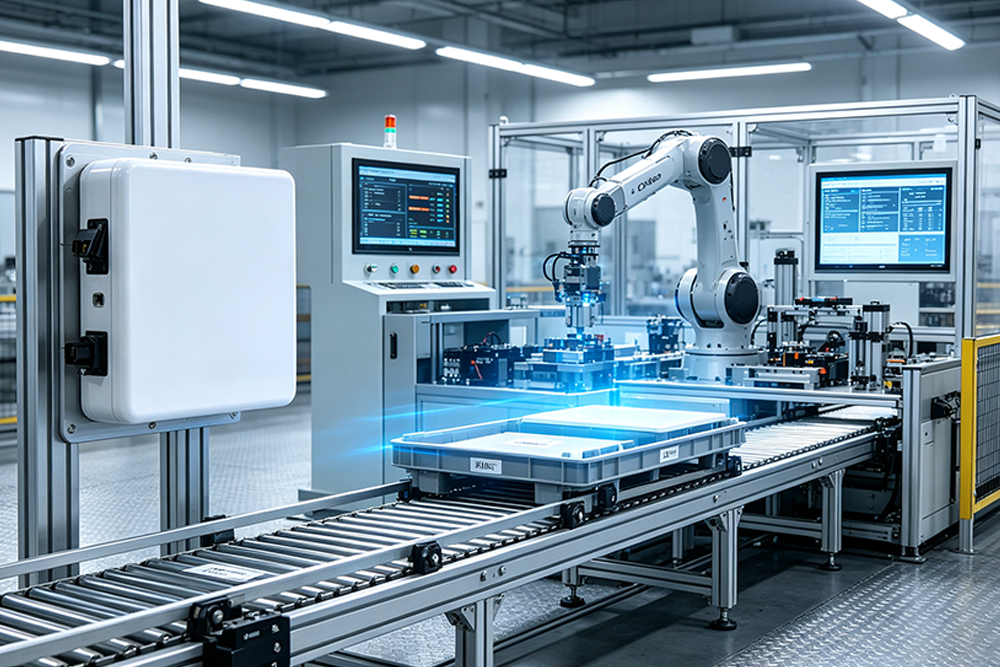
An industrial RFID automation system continuously exchanges information between physical assets and factory software.
| Component | Function |
|---|---|
| RFID Tags | Provide every product, pallet, fixture, or carrier with a unique identity |
| RFID Readers | Capture data automatically without operator involvement |
| RFID Antennas | Ensure reliable read zones across production equipment |
| Automation Software | Shares RFID data with PLC, MES, ERP, SCADA, and WMS platforms |
Unlike barcode systems, RFID reads multiple tagged objects simultaneously without requiring direct line-of-sight.
This allows conveyors, AGVs, robotic arms, and automated storage systems to operate continuously while receiving real-time identification data.
RFID influences more than inventory.
It changes machine behavior.
Instead of relying on fixed production recipes, manufacturing equipment can automatically adapt to the product that arrives at each station.
That flexibility becomes especially valuable during mixed-model manufacturing.
According to the RAIN Alliance, billions of passive RFID tags are deployed annually across manufacturing, logistics, retail, healthcare, and industrial automation, demonstrating rapid adoption of RFID-enabled digital transformation.
Meanwhile, Deloitte highlights that smart manufacturing technologies combining real-time data and automation improve operational visibility and production responsiveness.
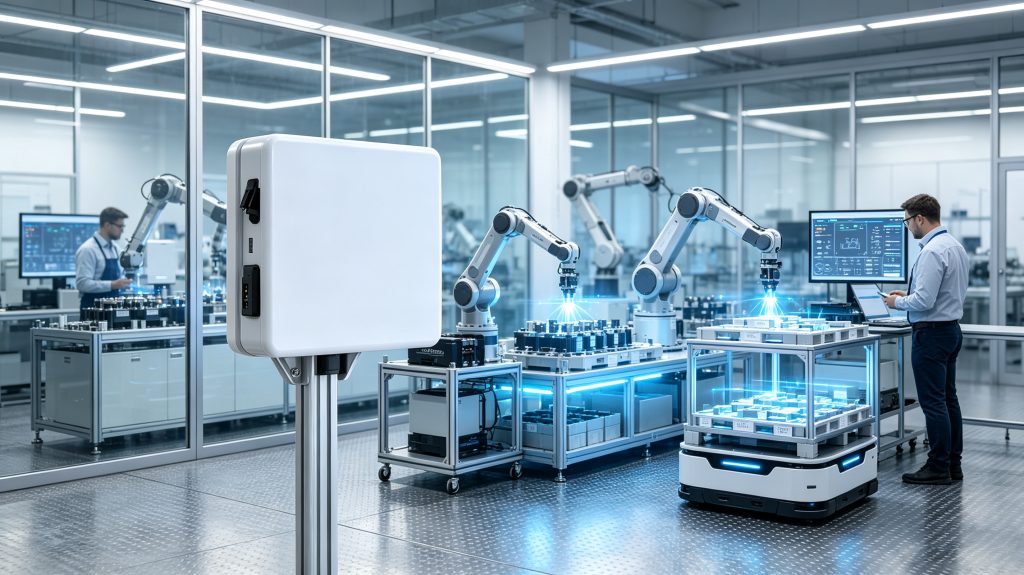
Successful RFID automation depends on engineering rather than hardware specifications alone.
Industrial environments introduce challenges that rarely appear in laboratory testing:
Cykeo engineers evaluate every installation based on actual operating conditions.
Before recommending reader placement, we analyze:
This deployment methodology consistently produces higher read reliability than simply increasing RF power.
Cykeo provides:
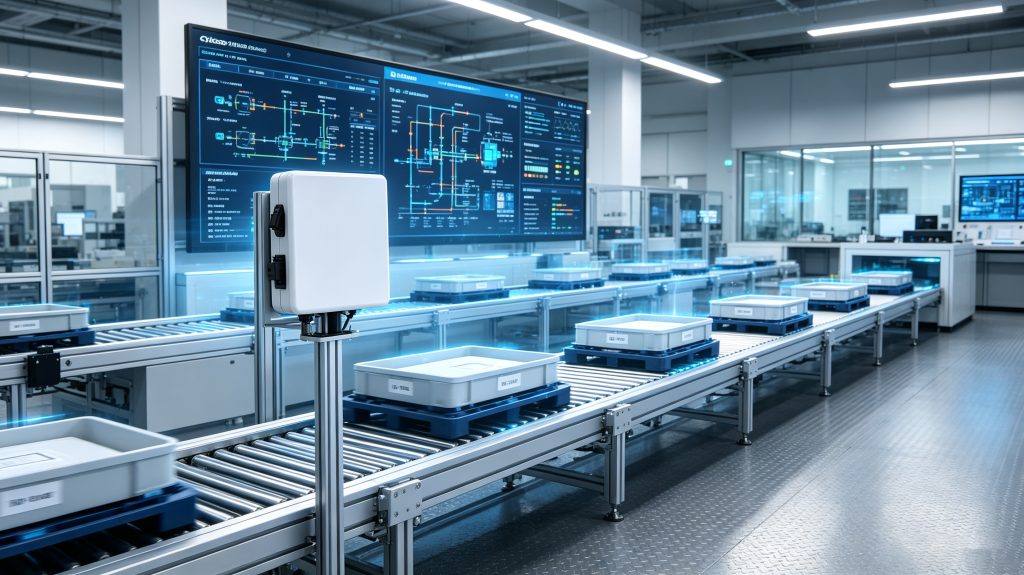
Yes. Cykeo RFID solutions support integration with PLCs, MES, ERP, SCADA, WMS, and other industrial control systems through SDKs, APIs, and standard communication interfaces.
Absolutely. Industrial RFID readers are designed to identify moving products and carriers at production speed, enabling automated decision-making without slowing manufacturing operations.
Yes. With proper antenna design, reader placement, and specialized RFID tags, reliable performance can be achieved even in metal-intensive industrial environments.
Automotive, electronics, aerospace, logistics, pharmaceuticals, food processing, warehousing, and general manufacturing all use RFID to improve automation, traceability, and operational efficiency.
As factories continue to adopt Industry 4.0 strategies, rfid in automation has evolved from a simple identification technology into a core element of intelligent manufacturing. By enabling machines to recognize products, exchange real-time data, and trigger automated decisions without human intervention, Cykeo RFID solutions help manufacturers improve traceability, reduce operational delays, and build more flexible production systems. Whether automating work-in-progress tracking, warehouse logistics, robotic assembly, or industrial material flow, rfid in automation provides the reliable digital foundation required for modern smart factories.
Need bulk scanning? Learn how many RFID tags can be read at once with UHF technology and what factors affect real-world multi-tag reading performance.
More
Explore how long do led tennis court lights last and how RFID UHF technology enables long-range, high-speed tracking for inventory and asset management.
More
Learn how to install RFID reader correctly. Our guide covers mounting, cabling, network setup, and testing for reliable UHF RFID system performance.
More
Tired of missing stock and slow counts? Discover how RFID inventory tags can speed up your inventory process, improve accuracy, and give you real-time visibility—without the headaches of manual tracking.
More