All RFID Product

how long do led tennis court lights last rfid uhf: Why Is It Used for Long-Range Tracking?

Cykeo News RFID FAQ 00

RFID UHF uses ultra-high frequency radio waves to enable long-range, high-speed identification of multiple tags, making it ideal for inventory, logistics, and asset tracking.

That’s the direct answer. But in practice, UHF RFID feels less like a “faster scanner” and more like removing the need to scan at all.

And yes—questions like “how long do led tennis court lights last” often surface alongside another concern: how long assets stay visible in your system, not just in theory.

Author & Field Experience

Cykeo UHF RFID Engineering Team

  • 10+ years deploying UHF RFID systems across logistics, warehousing, and industrial tracking
  • Experience with large-scale installations (10,000㎡–50,000㎡ facilities)
  • Integration with ERP, WMS, and real-time monitoring platforms

In a high-density warehouse deployment:

  • Read range extended up to 6–8 meters with passive UHF tags
  • Inventory scan time reduced by ~70%
  • Full aisle visibility achieved without manual handling

The shift wasn’t incremental—it changed how inventory checks were even scheduled.

What is rfid uhf?

RFID UHF (Ultra High Frequency) refers to RFID systems operating typically between 860–960 MHz, designed for long-range and high-speed tag reading.

Core components:

  • UHF RFID tags (usually passive)
  • UHF readers (handheld or fixed)
  • Antennas for signal transmission

According to RAIN RFID Alliance , UHF RFID enables simultaneous reading of hundreds of tags, supporting scalable industrial applications.

How rfid uhf works in real environments

From close-range scanning to distance-based visibility

Unlike HF or LF RFID, UHF:

  • Supports longer read distances (meters instead of centimeters)
  • Enables bulk reading without stopping
  • Works well in large, open environments

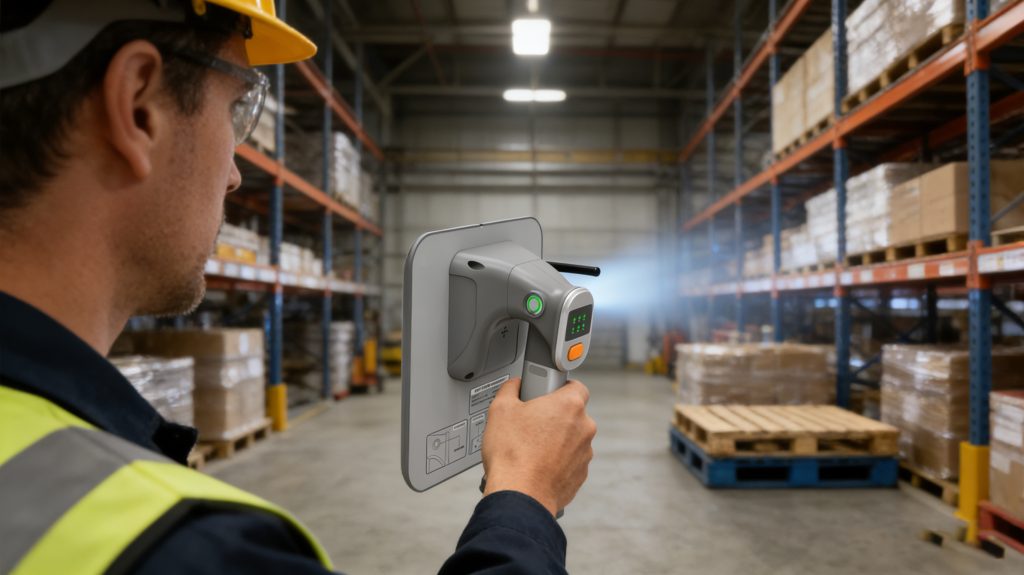
In one test, operators scanned an entire pallet zone simply by walking past it. No line-by-line checking. No interruption.

rfid uhf handheld reader scanning tagged inventory at distance
Long-range RFID UHF scanning in action

Key advantages of rfid uhf

1. Long read range

  • Typically 3–10 meters depending on setup
  • Enables non-contact bulk scanning
  • Reduces labor intensity

2. High-speed multi-tag reading

RFID systems can achieve inventory accuracy above 95%, largely due to rapid and automated data capture.

3. Scalability for large operations

  • Suitable for warehouses and logistics hubs
  • Handles high tag volumes efficiently
  • Supports automation workflows

RFID UHF vs other RFID frequencies

FeatureUHF RFIDHF RFIDLF RFID
Frequency860–960 MHz13.56 MHz125–134 kHz
Read rangeLong (meters)Medium (cm)Short (cm)
SpeedVery highModerateLow
Use caseLogistics, inventoryPayments, cardsAccess control

Practical deployment insights

UHF RFID performs well—but only when properly configured.

From field experience:

  • Metal surfaces can reflect signals unpredictably
  • Tag placement and orientation are critical
  • Reader power tuning impacts accuracy

In one facility, read accuracy increased from ~82% to 96% after repositioning tags on metal containers. No hardware changes—just adjustment.

How to choose an rfid uhf solution

Key considerations

  • Tag type: Standard vs on-metal UHF rfid tags
  • Environment: Indoor warehouse vs outdoor yard
  • Reader type: Handheld vs fixed
  • Read range requirements: Based on workflow
  • Compliance: Regional frequency regulations

FAQ about rfid uhf

Q1: What is the typical range of UHF RFID?

Usually between 3 to 10 meters, depending on environment and equipment.

Q2: Can UHF RFID read multiple tags at once?

Yes. It is designed for high-speed bulk reading.

Q3: Does UHF RFID work near metal?

Yes, but requires specialized tags and proper configuration.

Final insight from real deployments

RFID UHF doesn’t just extend range—it changes interaction.

Instead of scanning items individually, visibility becomes ambient. Data is captured as operations happen, not as a separate task.

And as with many deployments, even when the starting point is “how long do led tennis court lights last,” the real operational question becomes clearer:

How far—and how accurately—can we see our assets?

PgUp: PgDn:

Relevance

View more