What Is an RFID Card Reader Writer and Why Is It Important?
An RFID card reader writer is a specialized device that reads RFID card data and writes new information to RFID tags or cards with high accuracy. It is widely used for asset management, access control, card issuance, inventory systems, and RFID-based identification projects where reliable encoding is critical.
In real-world RFID deployments, reading tags is usually the easy part. Writing them correctly—especially hundreds or thousands in succession—is where system quality becomes obvious. After working on RFID implementation projects across warehouses, manufacturing facilities, libraries, and retail operations, I’ve found that write success rate often matters more than maximum read distance.
Why Businesses Still Depend on RFID Card Reader Writer Technology
RFID adoption continues to accelerate globally.
According to RFID Journal, RFID systems are increasingly deployed for inventory visibility, asset tracking, authentication, and supply chain automation because they reduce manual intervention and improve operational accuracy.
The challenge isn’t collecting data.
The challenge is creating accurate RFID data at the source.
That process starts with a dependable RFID card reader writer.
How an RFID Card Reader Writer Works
The process sounds simple but involves several technical steps.
The device communicates with RFID chips using radio frequency signals, retrieves existing data, and programs new information into designated memory locations.
Typical Encoding Workflow
Place RFID tag or card within the write zone.
Reader identifies chip type.
Encoding software generates required data.
Writer programs EPC, UID, or user memory.
Verification confirms successful writing.
For production environments, automatic verification is often more important than write speed.
One failed encoding operation can create downstream inventory errors that remain hidden for months.
Cykeo RFID Card Reader Writer Features
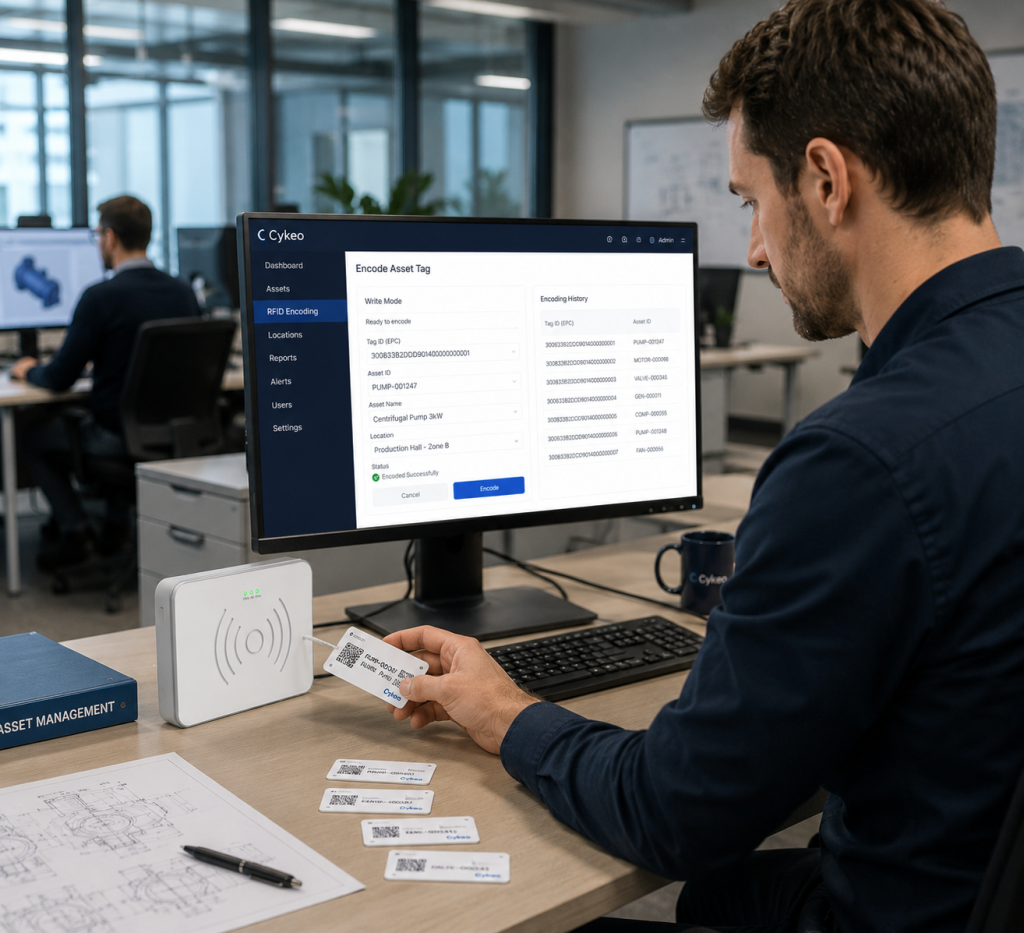
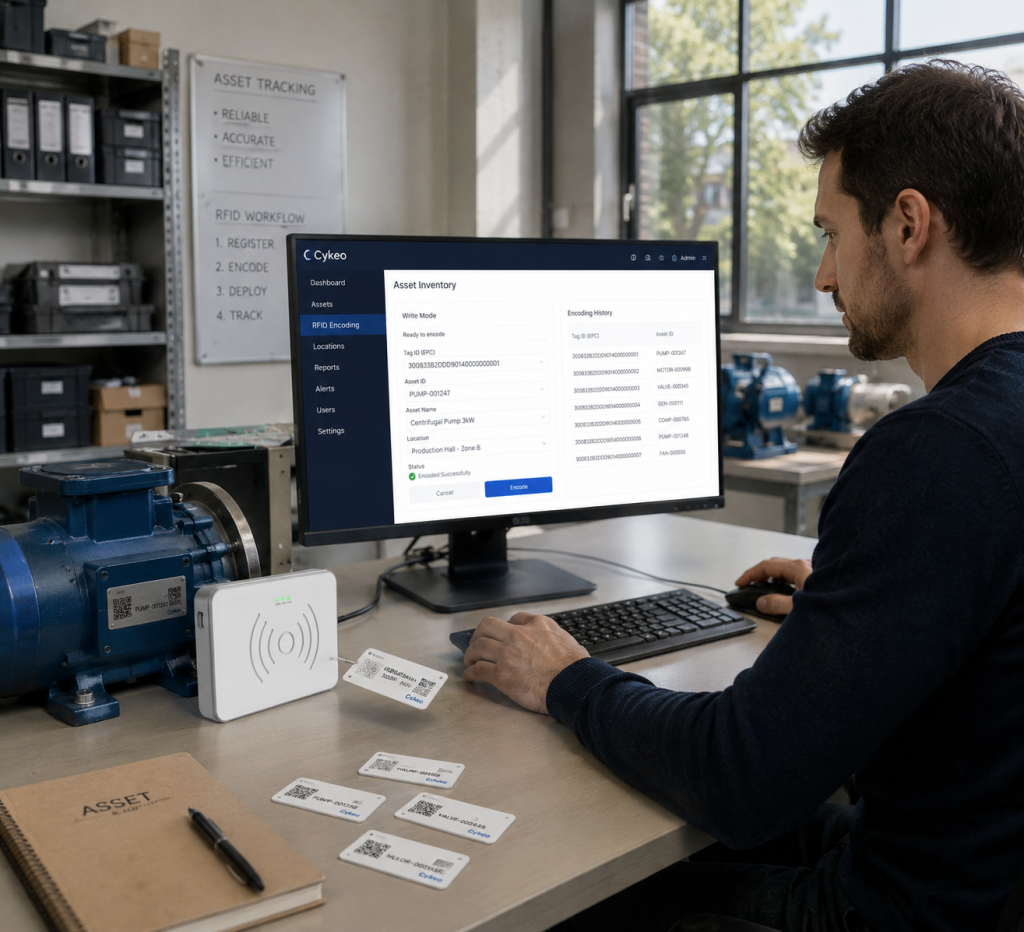
The Cykeo desktop RFID card reader writer was developed specifically for stable encoding applications.
Key Advantages
Compact desktop design
Near-field antenna technology
Controlled read range within 30 cm
Controlled write range within 10 cm
Up to 33 dBm RF output power
High write success rate
Mini USB communication
C# development kit available
Java development kit available
Batch card issuance support
Fast RFID tag filtering
The controlled operating range is particularly valuable.
Unlike long-range rfid readers, desktop encoding stations benefit from limiting the RF field to prevent accidental programming of nearby tags.
RFID asset labels are encoded before deployment.
What Makes Write Accuracy More Important Than Read Speed?
Many first-time RFID buyers focus on reading distance.
Experienced system integrators usually focus elsewhere.
A Lesson from a Warehouse Deployment
Several years ago, during an asset-tagging project involving more than 18,000 industrial tools, operators encoded approximately 2,000 RFID labels per day.
Reading performance was excellent.
The real bottleneck appeared when low-quality encoding equipment generated occasional write failures.
Even a 1% error rate created hundreds of verification issues.
After switching to a controlled near-field RFID card reader writer platform, encoding consistency improved significantly and verification time dropped.
That experience permanently changed how our team evaluates RFID hardware.
Desktop RFID Card Writer Applications
Asset Tracking
IT equipment management
Tool tracking
Medical asset identification
Industrial equipment registration
Access Control
Employee card issuance
Visitor credential creation
Temporary access cards
Retail Operations
Product RFID tagging
Inventory preparation
Item-level identification
Library Management
Book tagging
Archive management
Automated circulation systems
Performance Specifications Overview
Feature
Specification
RF Output Power
Up to 33 dBm
Read Range
≤ 30 cm
Write Range
≤ 10 cm
Communication
Mini USB
Development Support
C#, Java
Encoding Mode
Single & Batch
Tag Filtering
Supported
Batch RFID programming before warehouse deployment.
Industry Statistics Worth Knowing
According to research published by Auburn University’s RFID Lab, RFID deployments routinely improve inventory accuracy levels beyond 95%, substantially outperforming manual inventory methods.
GS1 also reports that item-level RFID adoption continues growing among retailers seeking inventory visibility and supply chain efficiency.
These gains begin with accurate RFID data creation.
Poor encoding quality compromises the entire system
Expert Perspective
One misconception persists across RFID projects.
People assume RFID readers are primarily identification devices.
In practice, many enterprise projects depend equally on writing capability.
A poorly encoded RFID tag can move through warehouses, factories, retail stores, and distribution centers carrying incorrect information the entire time.
That’s why professional RFID deployments place significant emphasis on encoding quality, verification procedures, and controlled RF environments.
The most successful RFID projects rarely have the fastest encoding stations.
They have the most reliable ones.
FAQ
What does an RFID card reader writer do?
It reads RFID card information and writes new data onto compatible RFID tags or cards for identification and tracking purposes.
Can RFID card reader writer devices support batch encoding?
Yes. Professional desktop RFID card reader writer systems support automated batch card issuance and high-volume tag programming.
Why is near-field encoding beneficial?
Near-field antennas prevent accidental detection of nearby tags and improve encoding accuracy during card issuance.
Does Cykeo provide software development support?
Yes. Cykeo provides development resources including C# and Java SDK support for system integration projects.
Learn how RFID reader modules are used in medical asset tracking, smart hospital cabinets, surgical instrument management, and healthcare inventory systems.
Need to know how to get data from RFID reader in Python? We cover socket scripts, SDK usage, and real-world tips for handling live tag streams in your application.
Active RFID tags are battery-powered devices that transmit identification signals to readers, supporting longer-range asset tracking, real-time monitoring, a...
 Cykeo RFID IoT Solution Products R&D Manufacturer