 Cykeo RFID IoT Solution Products R&D Manufacturer
How Does RFID Tag Look Like?
115Learn how does rfid tag look like in real applications, from adhesive labels and cards to on-metal tags, hard tags, key fobs, and industrial RFID formats.
MoreAll RFID Product
An RFID card reader and writer is a device that can both read data from RFID cards and write new information to compatible cards. It is widely used for access control, employee identification, membership management, campus systems, and smart building applications where secure contactless authentication is required.
After participating in RFID deployments for corporate offices, educational campuses, libraries, and industrial facilities over the last decade, I have learned that the real value of an RFID card reader and writer is not the reading function alone. The ability to securely issue, update, and manage credentials often determines whether a system remains scalable five years later.
Access credentials continue to evolve, but RFID cards remain one of the most widely deployed identification technologies worldwide.
From office badges and hotel keycards to university student IDs, RFID cards provide a balance of convenience, security, and low operating cost.
According to the RFID Journal, RFID-based identification systems continue expanding across enterprise access control, transportation, and institutional environments due to their ability to automate authentication while reducing manual verification requirements.
In practical deployments, organizations rarely replace RFID because it stops working. They usually upgrade because they need additional features or higher security levels.
The operating principle is straightforward.
The device communicates with RFID cards through radio frequency signals.
A reader retrieves information stored on the card, while the writer modifies or programs specific memory sectors based on user permissions.
Unlike magnetic stripe systems, RFID communication does not require physical contact.
Different projects require different standards.
| Standard | Typical Application |
|---|---|
| ISO14443A | Access control |
| ISO14443B | Secure identification |
| ISO15693 | Libraries and archives |
| NFC | Mobile interaction |
| MIFARE® | Employee and student cards |
Choosing the correct standard early in the project significantly reduces future integration costs.
Several years ago, during an office access deployment involving more than 2,000 employees, management initially focused on read speed.
What actually mattered was reliability during the first ten minutes of the day.
Between 8:20 AM and 8:30 AM, hundreds of staff members entered simultaneously.
The RFID card reader and writer infrastructure processed continuous authentication requests without requiring users to stop or reposition cards repeatedly.
Those ten minutes revealed more about system quality than weeks of laboratory testing.
Modern access systems use RFID credentials to:
According to the Security Industry Association (SIA), electronic access control continues to be one of the fastest-growing segments of physical security infrastructure.

Many organizations underestimate the importance of card writing capability.
Reading data is only part of the process.
Writing functions enable:
In large organizations, the ability to update card permissions remotely often eliminates the need to replace thousands of cards.
Universities represent one of the most demanding RFID environments.
A single card may simultaneously function as:
The flexibility of RFID card reader and writer systems makes this convergence possible.
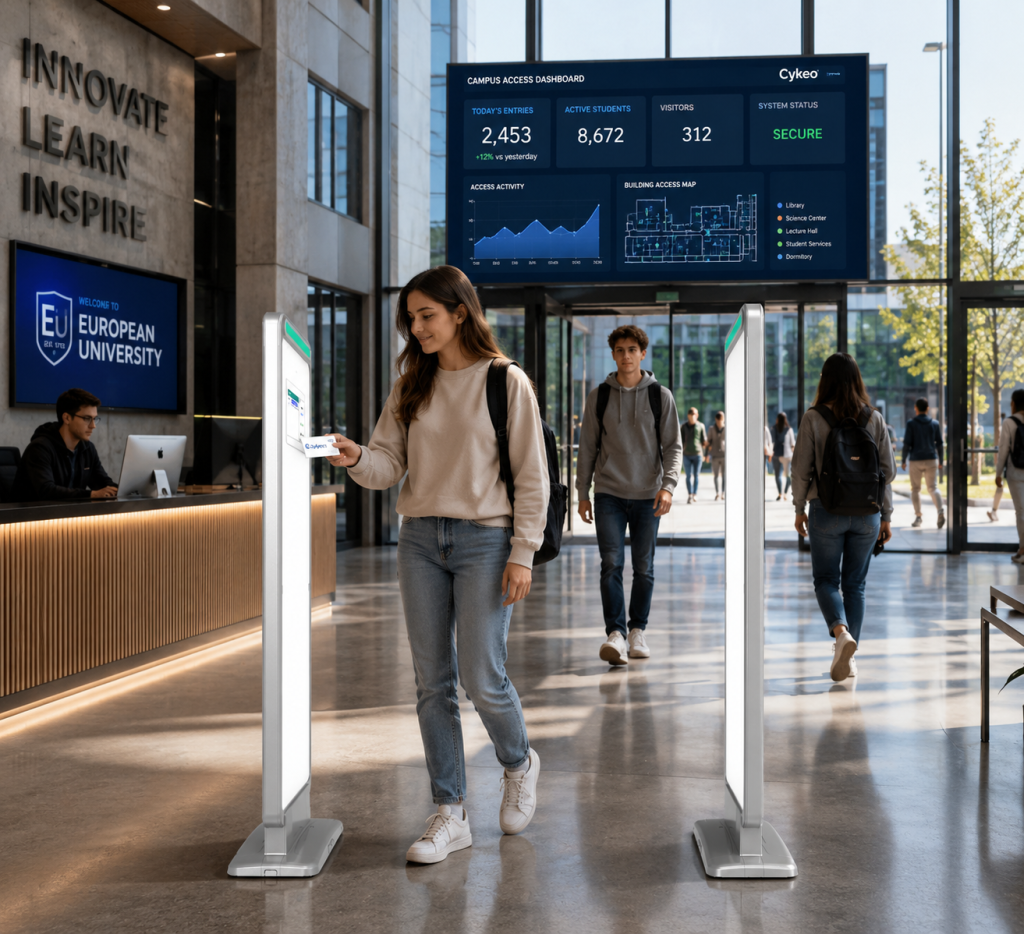
From actual deployments, the following factors have the greatest impact on system reliability:
Low-quality cards often cause inconsistent authentication.
Improper installation height can reduce user convenience and throughput.
Poor database administration creates more operational issues than hardware failures.
Metal structures and electromagnetic interference should always be considered during system design.
One recurring observation across RFID projects is that customers often compare devices based solely on read distance.
For access control systems, read distance is rarely the most important specification.
Consistency, authentication speed, credential security, and long-term management capability usually determine the success of a deployment.
The best RFID card reader and writer systems disappear into the workflow. Users stop noticing the technology because it simply works every day.
It reads RFID card information and writes new data to compatible cards for identification, authentication, and access management.
Yes. Reader-writer devices can encode, update, and manage card credentials depending on card type and security permissions.
Corporate offices, universities, hospitals, government facilities, hotels, libraries, and industrial sites commonly deploy them.
In most modern implementations, RFID cards offer stronger security features, encryption options, and better durability than magnetic stripe technologies.

Learn how does rfid tag look like in real applications, from adhesive labels and cards to on-metal tags, hard tags, key fobs, and industrial RFID formats.
More
Unsure how to RFID antennas work? We break down the two-step process of powering tags and receiving data that makes wireless identification possible.
More
Asset RFID tracking enables automated asset identification, inventory visibility, and real-time location management. Discover how Cykeo RFID solutions improve efficiency and reduce asset loss.
More
Find out if you can use your Android's NFC to read RFID tags. We explain the compatibility, major limitations, and why it's not a business solution.
More