Printable RFID tags combine visual labeling with RFID technology, allowing businesses to print text, barcodes, QR codes, and encode RFID data on a single label. They improve inventory accuracy, accelerate warehouse operations, and simplify asset tracking while remaining compatible with industrial RFID systems.
Several years ago, during an RFID deployment for a European electronics manufacturer, a warehouse supervisor pointed to two identical cartons and asked a simple question: “Which one contains the repaired units?” Both cartons carried RFID tags, yet operators still relied on handwritten notes because the tags had no visible information. We replaced them with printable RFID labels that combined EPC encoding, human-readable text, and barcodes. Within one shift, the confusion disappeared. That experience reminded me that RFID doesn’t replace visual identification—it works best when both technologies complement each other.
What Are Printable RFID Tags?
Printable RFID tags are RFID labels that integrate a passive RFID inlay beneath a printable surface, allowing both machine-readable and human-readable information to coexist on the same label.
Unlike traditional barcode labels, printable RFID tags store digital information inside the RFID chip while also displaying visible content such as:
Product names
Serial numbers
Asset IDs
QR codes
Barcodes
Company logos
Shipping information
This dual-identification capability significantly improves operational flexibility across manufacturing, warehousing, logistics, retail, healthcare, and asset management.
Why Are Printable RFID Tags Becoming the Industry Standard?
Many organizations initially adopt RFID to eliminate manual scanning.
In practice, however, warehouse staff, maintenance engineers, and logistics personnel still need visible information when handling products.
Printable RFID tags solve both requirements simultaneously.
The benefits include:
Feature
Business Advantage
RFID + printed label
Dual identification method
On-demand printing
Flexible label customization
Automatic RFID encoding
Reduced manual data entry
Barcode compatibility
Easy migration from barcode systems
High-speed identification
Improved warehouse productivity
Passive RFID technology
Maintenance-free operation
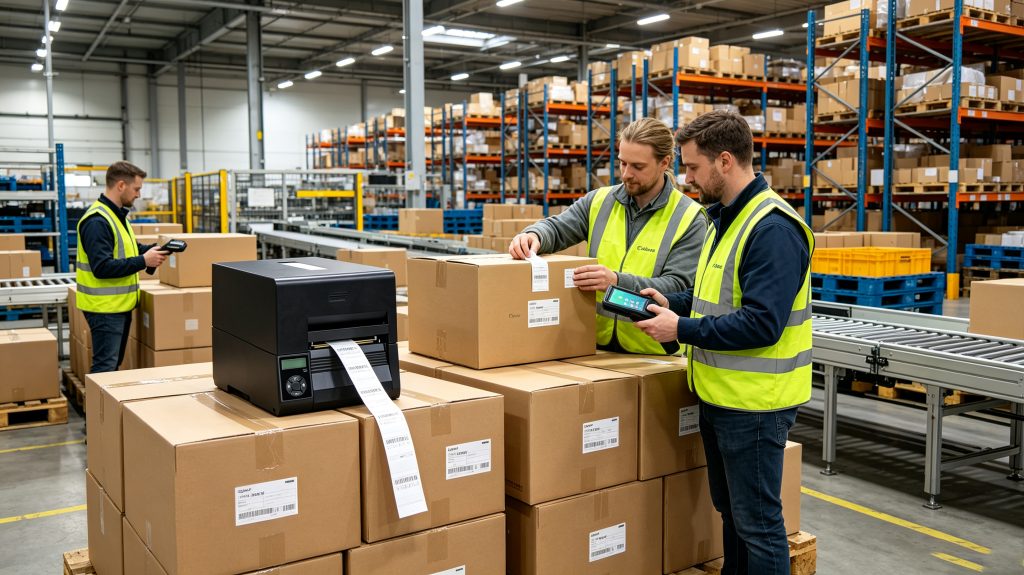
During one warehouse implementation, operators immediately noticed that locating products became easier—not because RFID suddenly read faster, but because they no longer needed separate barcode labels and handwritten stickers.
Cykeo printable RFID tags combine printed information with RFID identification for faster warehouse operations.
Where Are Printable RFID Tags Used?
Printable RFID technology has become standard across multiple industries where visual identification and automated data capture must work together.
Warehouse Inventory Management
Track pallets, cartons, bins, and storage locations while displaying product information for operators.
Asset Tracking
Label computers, tools, laboratory equipment, medical devices, and returnable assets.
Retail Inventory
Support inventory counting, anti-loss management, and omnichannel fulfillment.
Logistics & Distribution
Identify shipments with both RFID encoding and printed shipping information.
Healthcare
Manage medical assets, pharmaceutical inventory, and laboratory samples with greater traceability.
What Makes High-Quality Printable RFID Tags?
From our experience, successful RFID labeling depends on more than chip performance.
Several factors determine long-term reliability.
Excellent Print Surface
The label material should support thermal transfer or direct thermal printing with clear text and durable graphics.
Reliable RFID Performance
High reading sensitivity ensures fast identification even when multiple tags are present.
Strong Adhesive Performance
Industrial labels must remain securely attached despite temperature changes and daily handling.
Printer Compatibility
Cykeo printable RFID tags are designed for compatibility with leading RFID printers supporting EPC Gen2 encoding.
Flexible Customization
Available options typically include:
Different label sizes
Custom logo printing
EPC pre-encoding
Serialized numbering
QR code printing
Barcode printing
Industry Data Supporting RFID Label Adoption
Independent organizations continue documenting the rapid expansion of RFID labeling.
According to the RAIN Alliance, billions of passive UHF RFID tags are deployed globally each year across logistics, retail, healthcare, manufacturing, aviation, and industrial automation.
Meanwhile, GS1 reports that RFID implementations can improve inventory accuracy to over 99% when integrated with standardized identification processes, reducing inventory discrepancies and manual counting efforts.
These findings closely mirror what we observe during customer deployments, particularly in warehouses transitioning from barcode-only systems.
Field Experience from Cykeo Engineers
One electronics manufacturer initially requested RFID labels solely for automated inventory counting.
After installation, warehouse staff suggested adding printed serial numbers and product descriptions.
It seemed like a minor request.
Within weeks, picking accuracy improved because operators could visually confirm products without opening cartons or using handheld terminals.
That project reinforced an important principle:
The most effective RFID labels support both machines and people.
At Cykeo, we recommend printable RFID tags whenever visual verification remains part of the workflow, especially in mixed barcode-RFID environments.
Frequently Asked Questions
Can printable RFID tags be printed with ordinary barcode printers?
Only RFID-enabled printers can simultaneously print graphics and encode RFID chips. Standard thermal printers can print the surface but cannot program the RFID inlay.
Are printable RFID tags reusable?
Most printable RFID labels are designed for single-use applications, although reusable RFID hard tags are available for long-term asset management.
Can printable RFID tags include QR codes and barcodes?
Yes. Cykeo printable RFID tags support printing of text, QR codes, linear barcodes, serial numbers, and custom branding while storing RFID data internally.
Does Cykeo provide customized printable RFID labels?
Yes. Cykeo offers customized printable RFID tags with various chip options, dimensions, adhesives, EPC encoding, logo printing, and OEM manufacturing services.
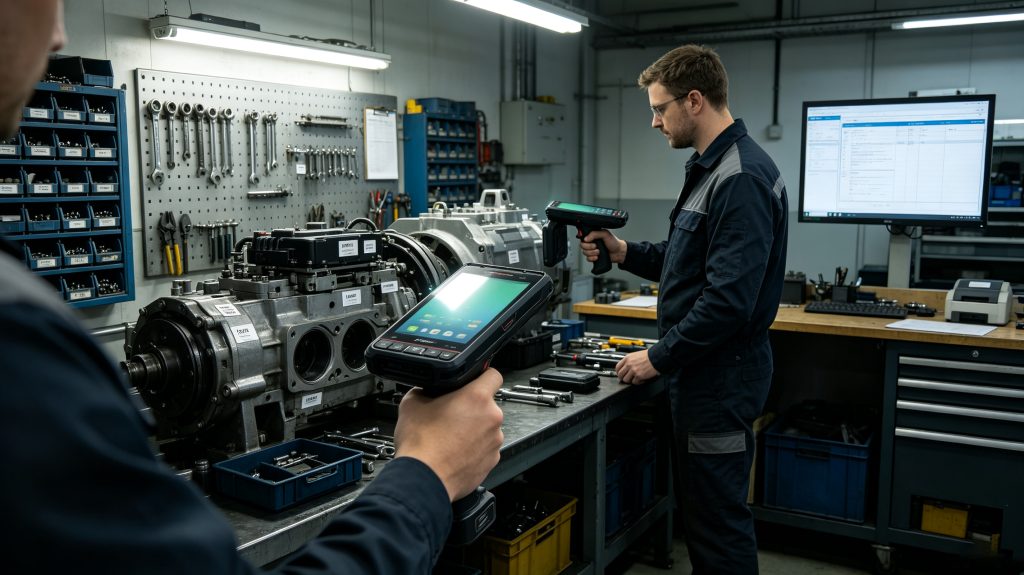
Printable RFID labels simplify equipment identification while enabling automatic RFID tracking.
Conclusion
Printable RFID tags bridge the gap between automatic identification and practical day-to-day operations. By combining RFID technology with visible printed information, they simplify warehouse management, asset tracking, logistics, retail inventory, and industrial identification. Supported by reliable RFID performance, flexible customization, and seamless compatibility with RFID printing systems, Cykeo printable RFID tags provide an efficient, scalable solution for organizations seeking smarter labeling and greater operational visibility.
Explore RFID project case studies across warehouses, hospitals, parking, factories, libraries, airports and logistics centers. Learn how fixed RFID readers solve real operational challenges.
Learn how RFID frequency range affects read distance, speed, and performance. Compare LF, HF, and UHF RFID systems with real-world insights from Cykeo RFID experts.
Discover how handheld RFID scanners reduce shipping mistakes, improve accuracy, and streamline logistics workflows. Learn best practices for implementation.
RFID reader can help warehouses identify products, pallets, containers and assets without requiring workers to scan every barcode individually. The most prac...
 Cykeo RFID IoT Solution Products R&D Manufacturer