A uhf rfid tag enables long-range, high-speed identification of items, and when paired with a handheld rfid writer, it delivers efficient, real-time data encoding and tracking.
That’s the direct answer. In practice, the value shows up when you stop counting items one by one—and start seeing them all at once.
Author & Field Experience
Author: Cykeo RFID Engineering Team
10+ years working with UHF RFID deployments in logistics, retail, and industrial sectors
Hands-on integration of handheld rfid writer devices with UHF tag systems
Experience with EPC Gen2 protocols, warehouse automation, and on-metal tagging challenges
In a regional distribution center project (~22,000㎡), we deployed uhf rfid tag systems for pallet and carton tracking:
Inventory counting speed improved by over 6× compared to barcode
Labor hours for cycle counts reduced by ~45%
Data latency dropped from hours to near real-time
These weren’t theoretical gains—they came from timestamp comparisons between WMS logs before and after deployment.
What is a uhf rfid tag?
A uhf rfid tag is a passive or active RFID tag operating in the UHF frequency band (860–960 MHz), designed for long-range and bulk identification.
Typical characteristics:
Read range: up to 3–10 meters (depending on environment)
No battery required (for passive tags)
Fast multi-tag reading capability
According to RAIN RFID Alliance , UHF RFID enables reading hundreds of tags per second, making it suitable for high-throughput environments.
How handheld rfid writer interacts with uhf rfid tag
Encoding and updating tag data in the field
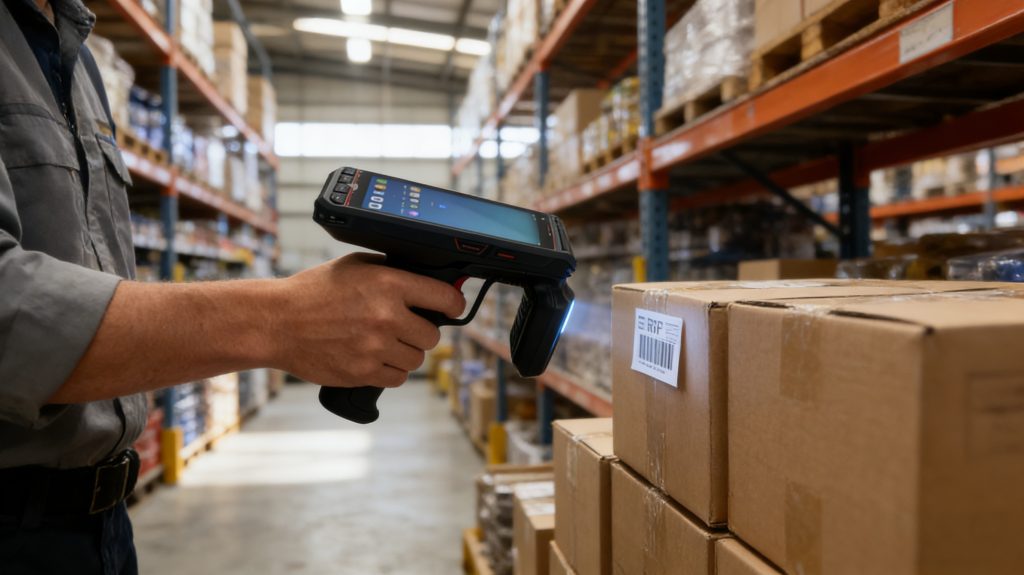
A handheld rfid writer writes EPC or user memory data into uhf rfid tag chips.
Typical workflow:
Attach uhf rfid tag to asset
Use handheld device to encode unique ID
Verify data instantly
Sync with backend system
The key shift here isn’t just speed—it’s control. Encoding no longer depends on a fixed station.
Real-time UHF RFID tag encoding on warehouse floor
Key advantages of uhf rfid tag in real operations
1. Long-range identification
Unlike HF or LF systems, uhf rfid tag supports extended read distances:
Scan items without direct line-of-sight
Identify goods on shelves or pallets
Reduce manual handling
2. Bulk reading capability
Multiple tags can be read simultaneously.
According to GS1 RFID systems significantly improve inventory visibility and can achieve over 95% accuracy in controlled environments.
3. Low cost at scale
Passive uhf rfid tag costs have decreased over the years, making large-scale deployment viable in retail and logistics.
Common types of uhf rfid tag
Tag Type
Application Scenario
Paper label
Retail, apparel
On-metal tag
Industrial tools, machinery
Hard tag
Reusable assets
Flexible tag
Curved surfaces
Real deployment observations
UHF RFID doesn’t behave perfectly in every environment.
From field experience:
Metal and liquid can affect signal performance
Tag orientation matters more than expected
Reader power settings require calibration
One warehouse team initially reported inconsistent reads. After adjusting tag placement angles and antenna power, read rates stabilized above 97%.
It wasn’t a hardware issue—it was a deployment detail.
How to choose the right uhf rfid tag
Key factors
Surface compatibility: Standard vs on-metal tags
Read range requirements: Based on use case
Durability: Heat, moisture, or chemical resistance
Memory size: EPC vs user memory needs
Compatibility: Must work seamlessly with handheld rfid writer
FAQ about uhf rfid tag
Q1: Do uhf rfid tags require a battery?
Most are passive and do not require a battery, making them cost-effective and low maintenance.
Q2: What is the typical read range?
Usually between 3–10 meters depending on environment and reader power.
Q3: Can handheld rfid writer rewrite tag data?
Yes. Tags can be re-encoded multiple times depending on chip type and memory configuration.
Final insight from field use
A uhf rfid tag doesn’t just store data—it changes how data is captured.
When paired with a handheld rfid writer, the system becomes mobile, immediate, and scalable. The biggest gains don’t come from the tag itself, but from how seamlessly it fits into daily operations.
That’s where efficiency stops being theoretical—and starts showing up in numbers.
Vehicle RFID tags are transforming modern transportation with fast, accurate identification and tracking. Discover how this technology improves traffic flow, toll collection, and logistics management.
Learn about RFID implant Sweden—how thousands of Swedes use microchip implants for access control, payments, and convenience. Discover the technology, benefits, and privacy considerations. Expert insights from CYKEO.
Tired of messy inventory and lost shipments? Try RFID! Real-time visibility, automated stocktaking, precise tracking—warehouse management just got a whole lot easier.
Discover budget-friendly RFID solutions tailored for small businesses. Learn how Cykeo’s scalable systems reduce inventory errors and boost productivity without breaking the bank.
 Cykeo RFID IoT Solution Products R&D Manufacturer