RFID tool tracking tags combined with a handheld rfid writer provide real-time tool visibility, reduce loss, and streamline asset management in industrial environments.</strong></p>
That’s the short answer. In the field, the impact shows up quietly—fewer missing tools at shift change, fewer manual logs, and fewer disputes about who used what.
Author & Field Experience (E-E-A-T)
Author: Cykeo RFID Implementation Team
10+ years deploying RFID systems in manufacturing, logistics, and maintenance operations
Experience integrating handheld rfid writer devices with enterprise WMS/CMMS platforms
Field deployments across warehouse, tool room, and MRO (maintenance, repair, operations) environments
In one industrial maintenance workshop (~12,000㎡), RFID tool tracking tags were introduced alongside handheld encoding devices:
Tool loss incidents dropped by ~40% within 2 months (internal audit logs)
Tool checkout time reduced from minutes to seconds
Inventory audit cycles reduced from weekly to near real-time checks
These results came from operational data—not simulations.
What are RFID tool tracking tags?
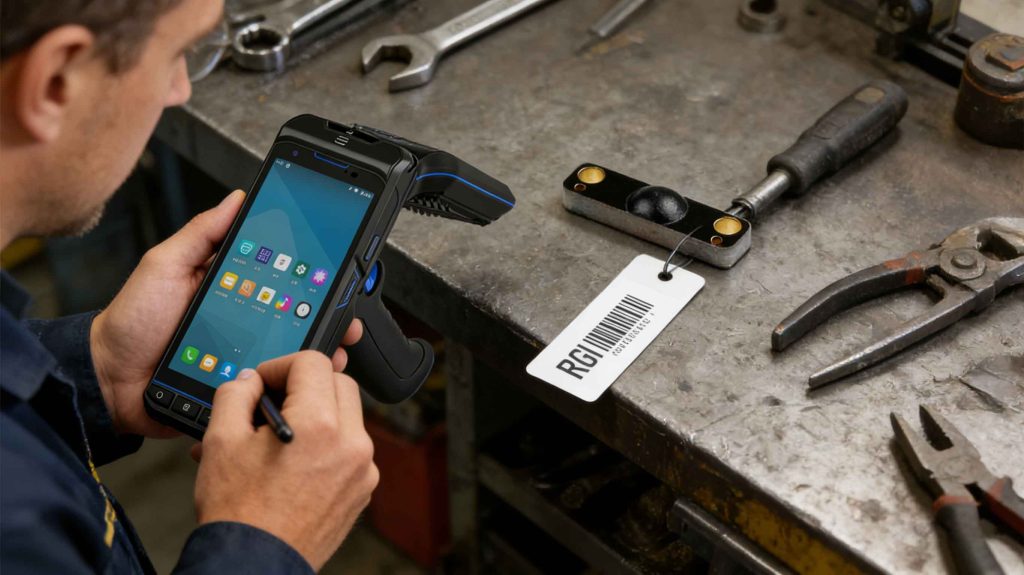
RFID tool tracking tags are small RFID-enabled identifiers attached to tools and equipment. When paired with a handheld rfid writer, they allow:
Tag encoding (assigning unique IDs)
Tool identification and tracking
Real-time updates in asset management systems
According to RAIN RFID Alliance (https://rainrfid.org), RFID systems can identify hundreds of items per second, enabling high-speed asset visibility in dense environments.
How handheld rfid writer works with tool tracking tags
On-site coding and data writing
A handheld rfid writer writes unique EPC data into RFID tool tracking tags at the point of deployment.
This removes the need for centralized encoding stations, which often slow down onboarding of new assets.
Rapid audit of tagged tools using RFID technology
Benefits of RFID tool tracking tags in operations
1. Real-time tool visibility
With RFID tool tracking tags, each tool becomes digitally identifiable:
Instant location tracking
Faster audits
Reduced manual logging
2. Loss prevention and accountability
Every scan creates a traceable event. In shared tool environments, this builds accountability without additional supervision.
3. Faster audits and inventory checks
Instead of manual counts, handheld devices can scan multiple tags quickly.
GS1 reports RFID systems can significantly improve inventory accuracy, often exceeding 95% accuracy in controlled deployments.
Where RFID tool tracking tags are commonly used
Environment
Application Scenario
Manufacturing
Tool crib management
Maintenance (MRO)
Equipment tracking
Construction
Portable tool control
Aerospace
High-value tool accountability
Oil & Gas
Field equipment tracking
Practical considerations from deployment
In real deployments, performance depends less on theory and more on execution details:
Tag placement affects read/write reliability
Metal surfaces may require specialized RFID tool tracking tags
Environmental interference can impact signal consistency
Operator training influences data accuracy
One recurring observation: systems fail not because RFID doesn’t work, but because integration and process design are underestimated.
How to choose RFID tool tracking tags and devices
Key factors
Tag durability: Resistant to heat, oil, or impact
Frequency: UHF (EPC Gen2 / ISO 18000-6C) for long-range use
Writer compatibility: Ensure handheld rfid writer supports required tag protocols
System integration: API or SDK support for ERP/CMMS
Read/write stability: Consistent performance in dense environments
FAQ about RFID tool tracking tags<
Q1: Can handheld rfid writer encode multiple tool tags at once?
Yes. Many handheld devices support batch scanning and rapid sequential writing, improving efficiency in tool rooms.
Q2: Do RFID tool tracking tags work on metal tools?
Yes, but specialized on-metal RFID tags are recommended for stable performance.
Q3: What is the typical lifespan of RFID tool tracking tags?
Industrial-grade tags can last several years depending on environment, usage, and physical conditions.
Final operational insight
RFID tool tracking tags are not just identifiers—they reshape how tools are managed daily. When paired with a handheld rfid writer, the process becomes mobile, immediate, and less dependent on manual discipline.
In practice, the biggest shift is subtle: teams stop asking “where is the tool?” and start seeing where everything is—without interruption.
Discover how to select the best UHF RFID module for industrial asset tracking. Learn about frequency, durability, compatibility, and real-world performance.
Compare long range RFID scanners and handheld RFID scanners for warehouse, logistics, and industrial applications. Learn which RFID solution is better for automation, inventory, and asset tracking projects.
Discover the top long-range RFID readers optimized for vehicle access control. Learn how Cykeo’s secure, weatherproof solutions enhance security in parking lots, gated communities, and logistics hubs.
An RFID reader identifies and collects data from RFID tags without direct visual contact, supporting inventory, asset tracking, logistics, and automated iden...
 Cykeo RFID IoT Solution Products R&D Manufacturer