 Cykeo RFID IoT Solution Products R&D Manufacturer
how passive rfid works
143Passive RFID works by harvesting RF energy from a reader to activate a battery-free tag, then returning data through modulated backscatter.
MoreAll RFID Product
An external RFID reader provides flexible antenna deployment, longer reading distances, and higher identification accuracy than integrated readers. It is widely used in asset tracking, warehouse management, manufacturing, logistics, and intelligent inventory systems where stable RFID performance is essential.
When customers ask why one RFID project consistently achieves over 99% read accuracy while another struggles with missed tags, the discussion almost always shifts from the reader itself to antenna placement. After participating in RFID deployments across factories, warehouses, laboratories, and equipment management centers, I’ve found that the ability to position antennas independently is often the deciding factor. That flexibility is exactly why industrial integrators continue choosing external RFID readers for complex environments.
An external RFID reader is an RFID device designed to connect with one or multiple external antennas instead of relying solely on an integrated antenna.
This architecture offers significantly greater installation flexibility.
Rather than placing the reader exactly where tags need to be identified, engineers install antennas at optimal reading positions while mounting the reader safely inside electrical cabinets, control boxes, or server rooms.
Typical communication interfaces include:
Because rfid antenna placement becomes independent of the reader location, the system adapts much more easily to changing production layouts.
During warehouse commissioning, one issue appears repeatedly.
Metal shelving, forklifts, conveyors, and moving personnel create constantly changing RF environments.
Instead of relocating the entire reader, engineers simply adjust antenna locations.
That seemingly small advantage saves hours of installation work.
Key benefits include:
| Feature | Practical Value |
|---|---|
| External antenna support | Flexible installation |
| Multiple antenna ports | Covers larger working areas |
| Long reading distance | Efficient bulk identification |
| Industrial interfaces | Easy PLC and MES integration |
| High transmit power | Stable RFID performance |
| Continuous operation | Suitable for 24/7 automation |
Unlike portable handheld devices designed for mobile inspection, external RFID readers are optimized for permanent infrastructure.

From our deployment experience, these readers perform particularly well where large numbers of RFID tags must be identified automatically.
Typical applications include:
One electronics manufacturer initially installed handheld readers for inventory verification. Six months later, fixed external RFID readers with overhead antennas automated the same workflow, eliminating manual scanning while improving inventory visibility across multiple production zones.
Many buyers focus exclusively on advertised reading range.
In practice, experienced RFID engineers evaluate additional performance indicators.
Industrial environments often require simultaneous identification of dozens or hundreds of RFID tags.
Advanced collision management algorithms greatly improve throughput.
Consistent transmit power is more valuable than occasional maximum distance.
Industrial readers typically support transmit power up to 33 dBm, providing stable communication across challenging environments.
Received Signal Strength Indicator (RSSI) helps software estimate tag proximity and verify reading quality.
Cykeo provides SDKs for:
This enables rapid integration with ERP, WMS, MES, and custom enterprise applications.
Independent industry organizations continue reporting rapid RFID adoption across industrial sectors.
According to RAIN Alliance, billions of passive UHF RFID tags are shipped annually, supporting applications in manufacturing, healthcare, logistics, aviation, retail, and industrial automation.
Meanwhile, GS1 states that RFID implementations can achieve inventory accuracy exceeding 99% when deployed using standardized identification practices and appropriate infrastructure.
These findings closely match what we observe during enterprise RFID deployments.
One installation remains particularly memorable.
A customer wanted to monitor metal tool carts moving through a narrow production corridor.
The first installation placed antennas directly opposite one another.
Read rates fluctuated.
Instead of replacing hardware, we repositioned the external antennas slightly above the doorway and adjusted their polarization.
Nothing else changed.
Read performance immediately stabilized.
Experiences like this reinforce a practical lesson: successful RFID systems depend not only on reader specifications but also on RF design, antenna placement, and environmental testing. That is why Cykeo engineers routinely perform on-site validation before recommending final antenna layouts.
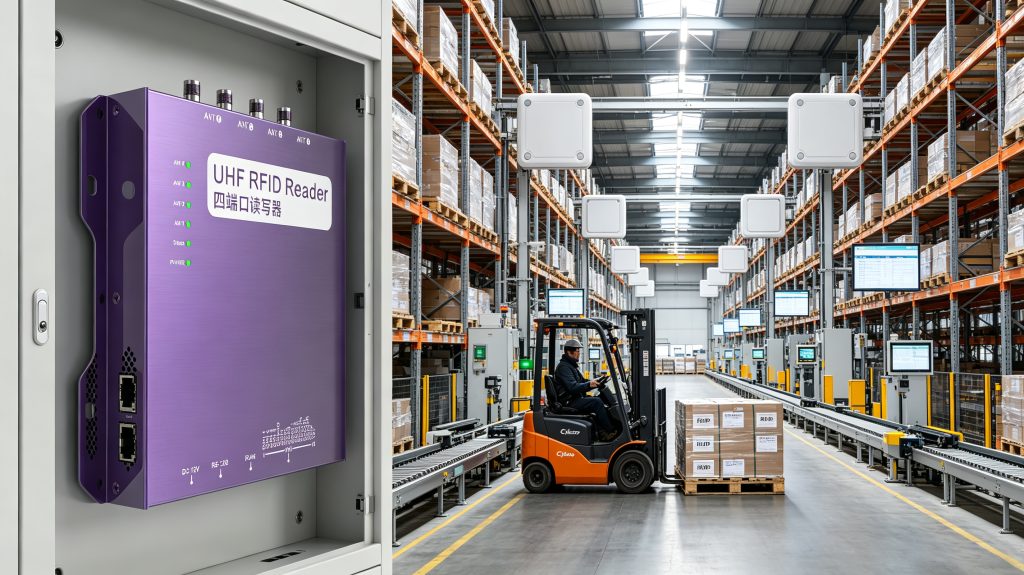
An external RFID reader supports separate antennas, allowing greater installation flexibility, wider coverage, and improved industrial performance.
Yes. Many industrial readers support multiple antenna ports, enabling one device to monitor several reading zones.
Manufacturing, logistics, healthcare, warehouses, transportation, libraries, laboratories, and industrial asset management all rely heavily on external RFID readers.
Yes. Cykeo provides C# and Java development kits, making integration with WMS, ERP, MES, and custom management platforms straightforward.
An external RFID reader offers the flexibility, scalability, and performance required for modern RFID infrastructure. By supporting external antennas, intelligent multi-tag reading, stable RF output, and industrial communication interfaces, Cykeo solutions help organizations automate identification workflows while improving operational visibility. Whether deployed in manufacturing, logistics, asset management, or warehouse automation, a properly engineered external RFID reader delivers dependable long-term performance.

Passive RFID works by harvesting RF energy from a reader to activate a battery-free tag, then returning data through modulated backscatter.
More
Explore what is rfid used for and discover how RFID technology improves asset tracking, inventory control, healthcare, libraries, and industrial automation with Cykeo solutions.
More
how IoT and RFID are transforming parking management. Find available parking spots in real-time, reserve spaces via mobile app, and reduce traffic congestion with smart parking systems.
More
how are rfid tags programmed? Learn how EPC and user memory are written, how RFID readers verify tags, and how desktop RFID encoders simplify fast, reliable tag programming.
More